WikiPathways: biological pathways across the species
I was not there. I only joined the WikiPathways project in late 2011, just as a contributor. And it was just before joining the BiGCaT research team of Prof. Chris Evelo in January 2012, where I started a project in the Open PHACTS project, not really about WikiPathways, but the open science WikiPathways was the main reason for me to join the group. Open PHACTS was close to my research and just created that opportunity.
WikiPathways was already around five years old when I created my account. It was created in January 2007 (doi:10.1038/npre.2010.5361.1). It was first formally published in 2008 (doi:10.1371/journal.pbio.0060184), so the project is about 20 years old (maybe a new WikiPathways conference next year?). The launch made it to Science (doi:10.1126/science.321.5889.623c):
The makers of GenMAPP [..] have launched a site for sharing findings on metabolic pathways. [..] WikiPathways (wikipathways.org) offers a way to integrate information on these complex networks [..] The site has more than 300 registered users and contains information on 500 metabolic pathways in seven species, including humans.
And Nature (doi:10.1038/455022A):
Alexander Pico remembers just when the idea hit him. In January 2007, he and his boss, Bruce Conklin, were discussing how to push their software tool for visualizing intracellular signalling pathways to the next level of interactivity — when Pico blurted out, “What we really need is a wiki!”
Just like review article curate and put primary literature in context, so that WikiPathways. They pitched it at the time as modelled after Wikipedia, but surely it is also just as well modelled after traditional knowledge dissemination approaches. One can easily argue that the wiki approach is essential: anyone can create an account. And this has been held against WikiPathways. But if you look at the who actually edits WikiPathways, these are only people working in an academic research environment.
WikiPathways is, of course, used as a reference knowledgebase, and the use in pathway enrichment and networking approaches are perhaps the best known. Another aspect of a wiki, however, is the community approach: a community can work out a collection of machine-readable (FAIR) pathway models, even when the discovery is in full swing. WikiPathways is also a platform to exchange knowledge, discuss literature, do research. The use to of this feature turned out really useful at the start of the COVID-19 pandemic.
Genomes, species, and pathways
The set of full genome assemblies was not that large; in 2021 there were 3278 genome assemblies for animal species (doi:10.1073/pnas.2109019118 and the Genomes on a Tree (doi:10.12688/wellcomeopenres.18658.1) reports 27883 assemblies for 664 complete genomes.
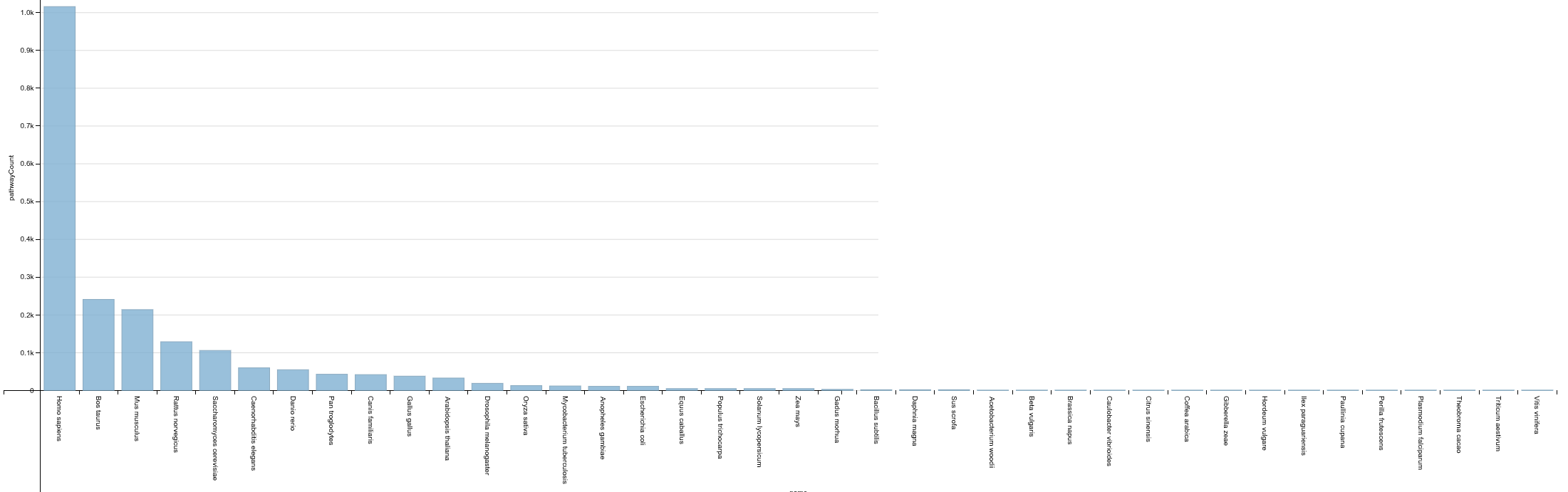
For WikiPathways, seven species in 2008 grew to 39 species today today, though many of them only have a few curated pathways. Indeed, human is still the predominent species, in number of pathways (visualized with this SPARQL query).
That said, several communities have worked in the past to create sets of pathways around specific species. In that post, I already mentioned Wormbase, but we also have a collection of pathways from YeastPathways (doi:10.1093/genetics/iyae185), for example wikipathways:WP137. Now, the yeast pathways are not in sync with the upstream SDG YeastPathways, I think, so there is some curation to do on our side (from the 2025 Genetics paper):
As the first major update since 2012, we updated 62 pathways with expert summaries on pathway genetics, biochemistry, regulation, and more. Thirty-three new pathways with specificity for yeast biochemistry were propagated from MetaCyc at SRI (Caspi et al. 2018), and 105 existing pathways were edited for proper enzymatic classification, reaction connectivity, and gene attribution. Compounds that were previously missing a chemical structure have also now been updated, along with the stoichiometry and scheme of many pathway reactions.
In similar style, WikiPathways has had similar project around setting up a pathway collection for a new species, like cow in a project by Zahra Roudbari (doi:10.3389/fgene.2019.01370). And more recently atlantic cod (ongoing research by Madhushri S. Varunjikar from the Norwegian Institute of Marine Research).
Homology converted pathways
But WikiPathays also has a feature to convert pathways from one species to another. With more and more whole genome assemblies becoming available, so are mappings of genes between one species and another. This is the basis of that cow project (from the article):
The online biological pathway repository, WikiPathways (Slenter et al., 2017), contains pathways of different species, however a B. taurus collection was missing.
And:
Second, the WikiPathways homology based the homology mapper which is available at GitHub (https://github.com/PathVisio/homology.mapper) was updated to improve homology coverage for gene products that were annotated with different data sources. The pathways were converted from human pathways, with a required minimum successful conversion of at least 50% of the original human genes.
The question is, of course, what is the best model species to use. That decision can be based on multiple aspect, including the use case. There is freedom.
So, when this week the book chapter Xenbase: A Guide to the Xenopus Genetics and Genomics Knowledgebase was published (doi:10.1007/978-1-0716-5360-9_3), and I was pinged WikiPathways was cited, I started reading.
WikiPathways are linked via gene symbol (Fig. 6A, black arrow) link redirects to a pre-set gene symbol search on this community-curated open science resource [20].
The linking via gene symbol made me write up this post. If they have the mappings, then with the GPML Homology Mapper we can create pathways for the two frog species (X. laevis and X. tropicalis).
Species specific curation
And there are reasons to do that. WikiPathways allows you to cite literature, at a pathway level, for a gene, protein, or metabolite, and even at the level of an interaction. That literature is species specific. The curation can also work out what to do with those parts of pathways for which no genes were mapped. Having this is machine-readable knowledge has shown to be of great usability, at the very least making the knowledge much, much easier to find.
And that brings us back to another role of review articles, of book chapters giving expert overviews, but also of wiki’s: put knowledge in perspective of the literature from which it is derived. I wish pathways database, generally, are used to communicate and get peer reviewed the fruits of the work studying the biological processes on all these species.
With more than 600 full genomes and 39 species in WikiPathays, we have an exciting and growing seed.
You can use your Mastodon or other ActivityPub-based Fediverse-account to comment on this article by leaving a publicly visible reply to this associated post. Content warnings are supported. You can also delete your comments at any time by deleting your post on the Fediverse.