-
Chem4Word goes Apache 2.0
Early March I reported about Konstantin’s JChemPaint-based chemistry plugin for OpenOffice, but there is (friendly) competition: Chem4Word. Being for Microsoft Word, the plugin only works on top of proprietary software, unfortunately; therefore, I cannot tell you if Chem4Word release is any good, but what Jim has showed me about a year ago, it is pretty cool. Another big difference is that Microsoft gave the Chem4Word a big grant, and Konstantin does not have such funding, AFAIK, and relies on community support. -
-bromo(chloro)iodomethane.png)
CIP rules for stereochemistry
Uniquely identifying stereochemical enantiomers is an important aspect of data exchange of chemical structures. The simplest, most neglected solution is to pass around 3D models, but a lot of people like to stick to things like SMILES, or IUPAC names. Now, given that we want to uniquely represent the stereochemistry, we can use special rules. One example for enantiomers are the Cahn-Ingold-Prelog (CIP) rules. -

ACS Liveblogging 1st Disclosures of Drug Candidates
Carmen liveblogged via her twitter account the disclosures of drug candidates at the past ACS meeting, and later aggregated the tweets in her blog. While many of her tweets made it into the FriendFeed room, the structure she drew up and shared did not make it. And until just know, I was not aware the had tweeted those too. The first twitpic she pushed was: -
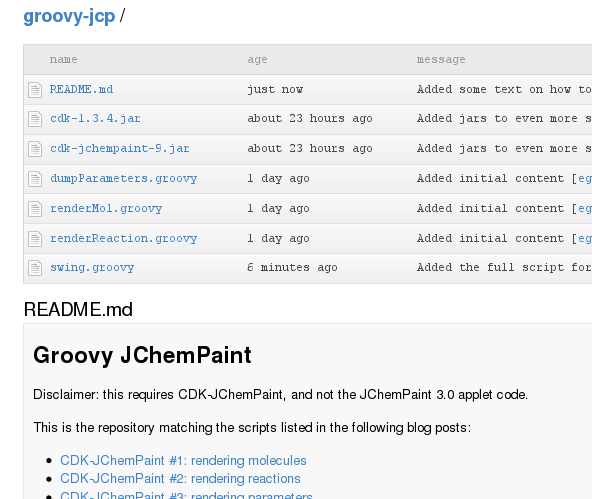
CDK-JChemPaint #4: embedding the renderer into a Swing panel
Now that we covered the utmost basics of using the CDK-JChemPaint patch (see #1, #2, #3), it is time to move on. I am happy to hear that so many people have started using the new rendering architecture, either via the EBI JChemPaint Swing applet/application branch, or via the CDK-JChemPaint patch. -
BitTorrents for Science
The idea has been lingering in the air for a long time now: sharing large science data sets using bittorrent. Over the past couple of years I have seen a lot of science related software being distributed over torrents, and the use in open source in general is abundant. Given a good network of so-called seeders, download times go down dramatically, and the overall energy consumption goes down too, as data has to follow a much shorter path.