Green Open Access: where is the index?
Gold Open Access is literature that has an explicit open license, like CC-BY. It optionally has an article processing charge (APC). It optionally charges APC to make profit or to fund other activities, like some societies do. Green Open Access is literature that has been made available by repositories. It optionally has an open license. It optionally has a standardized license, like CC-BY. But it can also be that no clear license is given or the “license” refers to some (local) law.
Many universities have green Open Access repositories, like Maastricht University and Radboud University. These repositories are scattered and contrary to FAIR principles, metadata is not shared widely. Of course, prominently, scholarly publishers could provide that information. Any paywalled journal article could have a link to a legal green open access version. It could. It would make total sense if spreading scientific knowledge is your goal. But we live in an alternate universe.
We are relying on third-party indexes. I here briefly describe two options, but love to read blog posts about other alternatives! I am not looking for routes like PubMed Central or Europe PMC that come with huge collections of open-licensed content, including in the FAIR JATS format
It’s really the non-OA-licensed green Open Access that we need to get indexed better.
Oh, and, of course, all Dutch literature must become green Open Access.
OpenAlex
Unpaywall (see also this post) has been collecting open access versions but is now including in OpenAlex. The annotation is quite rich and here the question is more, how can the open science community enrich this OpenAlex content.
Wikidata and WikiCite
Wikidata and WikiCite are projects aligned with Wikipedia, and [citation needed] is an essential part of that. We have used it in our research in multiple occassions. The curation process is transparent, providing the essential provenance needed for scientific research.
It provides the work available at URL property and it has been used to link to green Open Access versions. The extend, however, is less clear (to me). But another problem is that Wikidata does not have the ambition to be a generic solution. That said, all extra links help.
Schema.org and web search indexes?
That leaves me, for now, with the role of generic web searching. Doesn’t that help? I can just search for the article title, right? Well, yes. But the process of how to get your green open access article indexed is not clear. There are many metadata standards that your repository needs to support (e.g. OpenAlex lists 8 and that does not include schema.org) and that does not guarantee you get indexed. Worse, commercial companies are know to remove content in a opague process, like with this video about the Meta gluurbril. We cannot trust that green open access metadata gets preserved.
Maybe open web indexes will make a difference, but then we still need a simple API to integrate into our tools that just returns the information. I had a go at this last weekend. It would look something like this:
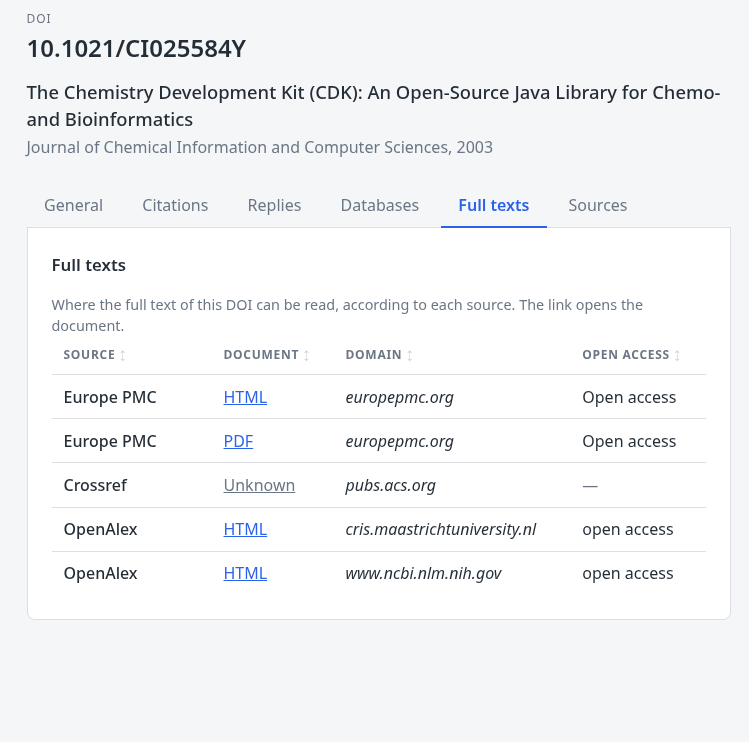
But things go slowly, and FAIR metadata most certainly. But if we consistently take steps, things do change. For example, after 20+ years, CrossRef now supports blog as research output type.
I like to stress, metadata is being shared by repositories, but we should support this a bit more. We should reuse that data, support that, curate that, etc. Let’s support our fellow open science community members! And that starts by sharing our knowledge on how all this works, does not work, could work, and what small steps we can take today and tomorrow. Looking foward to your ideas!
You can use your Mastodon or other ActivityPub-based Fediverse-account to comment on this article by leaving a publicly visible reply to this associated post. Content warnings are supported. You can also delete your comments at any time by deleting your post on the Fediverse.