Open Infrastructures #1: Research Software Directory
Research software is an integral part of scientific investigations.
This is what Struck wrote in 2018 in a contribution to the 2018 IEEE 14th International Conference on e-Science (e-Science) (doi:10.1109/eScience.2018.00016). I very much agree with this, and the notion is gaining ground in the academic community. Their paper “identifies challenges, risks and new opportunities in research software publication and discovery”.
At the same conference, Spaaks et al. presented a lightning talk about the Research Software Directory (RSD), “a content management system for research software, which promotes the visibility, reuse, and impact of research software” (doi:10.1109/eScience.2018.00013).
I wonder who spoke first at the meeting.
Anyway, I learned about RSD a while ago already and have been using it for some of our group’s research software. We don’t have a collection for our group, but you will find them under the Maastricht University organisation page.
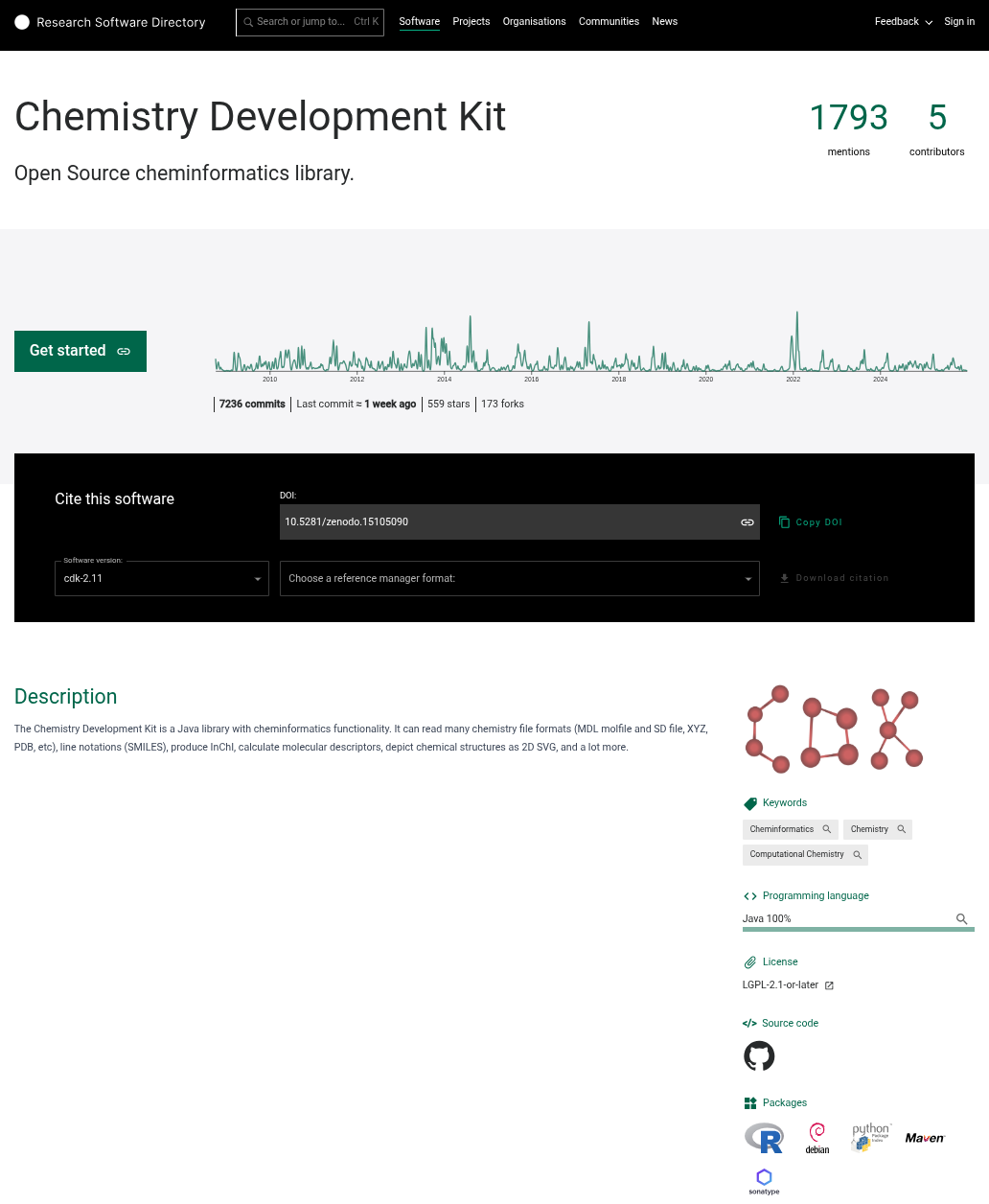
And as sketched by Struck and implemented by Spaaks et al., RSD gives rich context to the research software. It can track the activity on the project (for GitHub, GitLab, Codeberg etc), track citations to key literature, and can have links to distributions where the software is published (like Debian, CRAN, Bioconductor, etc).
This is what it looks like for the Chemistry Development Kit:
I like initiatives like this, as they help the community work out open standards to exchange metadata, and encourage other projects by reusing their APIs.
You can use your Mastodon or other ActivityPub-based Fediverse-account to comment on this article by leaving a publicly visible reply to this associated post. Content warnings are supported. You can also delete your comments at any time by deleting your post on the Fediverse.