-

Pharmaceutical Bioinformatics
The Wikberg group at Uppsala University where I did my first two years of post-docing in Sweden has a (free) course on pharmaceutical bioinformatics. We worked hard on a course book, which after a year got printed. It ended up with 400 pages, 15 chapters, and 3 appendices. It also includes examples on how to do discussed topics in Bioclipse: -
Java Performance...
Java virtual machines are weird things. They can optimize code on the fly, tuning how it runs the code, depending on the data it processes. That is why it can be faster than C and C++, or even faster then Fortran. Those are all pre-optimized based on the code, not based on the workload. But, at the same time, performance is tricky, and your best friend is a good profiler (like YourKit, which is free for Open Source use). -
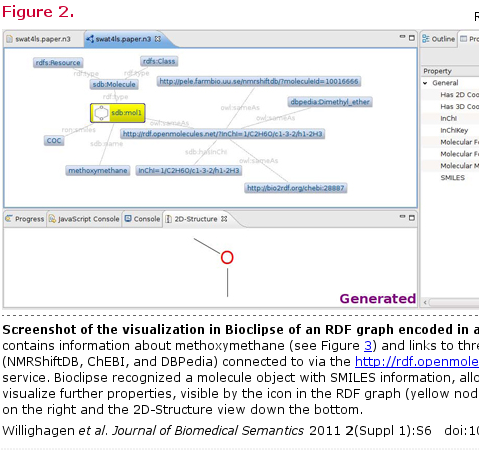
Bioclipse-CDK-ChEMBL-SPARQL-Chemometrics mashup paper published
Our (peer-reviewed) Bioclipse-CDK-SPARQL-Chemometrics mashup paper was just published online (doi:10.1186/2041-1480-2-S1-S6) as part of the SWAT4LS 2009 supplement, where we use the CC-SA-BY-licensed ChEMBL database as example data source, based on a presentation I gave in Amsterdam back then. -
Cleaner CDK Code #9: using the LoggingTool
A trick I used from Miguel Howard (of Jmol fame) is to not concatenate String until really needed. String concatenation will allocate new Strings, and thus burden the garbage collector (yeah, you lucky Fortran users who think twice before allocating memory :). Some time ago, he suggested this trick for the logger. I think in Jmol, but the CDK inherited that idea. -
Adding a CDK atom type
A very quick, short post on CDK atom types. These atom types are used by the CDK to decide how many missing hydrogens an atom has, or how many lone pairs, and if the atom can be part of an aromatic ring system. The CDK code basically consists of three parts: the atom type ontology, the atom type perception code, and the rest of the code that uses information from the ontology. -
CKAN and RDF: a nice example of why ontologies matter
For a while now I have been a so-called invited expert to the Linking Open Drug Data (LODD) task force of the W3C’s Health Care and Life Sciences Interest Group (HCLSIG). I also participate in the open-science group of the Open Knowledge Foundation (OKF). This is not really worth blogging about if the two are not being mashed up. Members from both sides are interested in learning how Open (think Is It Open Data?) the open data from the LODD network really is.
