-
Programming in the Life Sciences #4: communication from within HTML
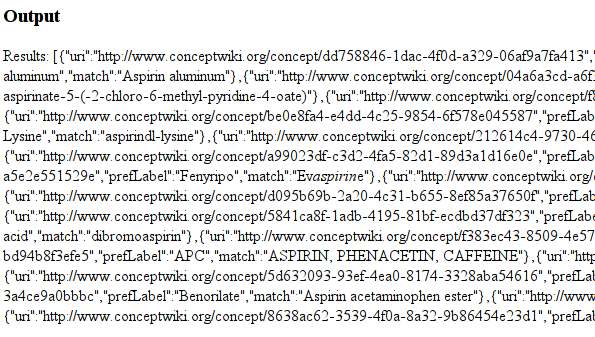
The purpose of a web service is that you give it a question or task, and that it returns an answer. For example, we can ask the Open PHACTS platform what compounds it knows with aspirin in the name. We pass the question (with the API key) and get a list of matching compounds. Now, this communication is complex: it happens at many levels, which are spelled out in the Internet Model. There are various variants of the stack of communication layers, but we are interested mostly in the top layers, at the application layer. In fact, for this course this model only serves as supporting information for those who want to learn more. -
Programming in the Life Sciences #3: the assessment
Now that I have wrote out the goals, what they students will practically do, and how to get started with the Open PHACTS platform, I will list how we will assess the students: -
Programming in the Life Sciences #2: accounts and API keys
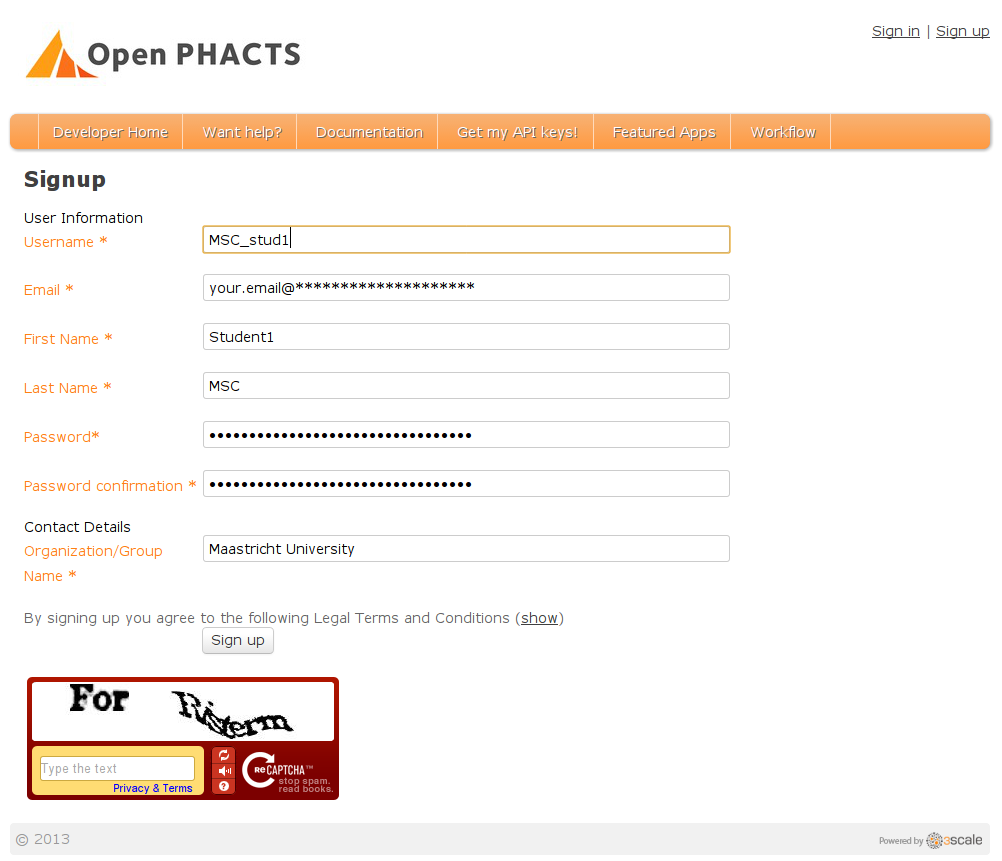
I have outlined the scope of the six-day course: the students will learn to program while hacking on the Open PHACTS’ Linked Data API (LDA). The first step is to get an account for the LDA. I have already done that to save time. But these are the steps to take. You go to https://dev.openphacts.org/signup: -
Programming in the Life Sciences #1: a six day course
Our department will soon start the course Programming in the Life Sciences for a group of some 10 students from the Maastricht Science Programme. This is the first time we give this course, and over the next weeks I will be blogging about this course. First, some information. These are the goals, to use programming to: -
CiteULike adds a HTML widget to embed citations
Spjuth, O.; Carlsson, L.; Alvarsson, J.; Georgiev, V.; Willighagen, E.; Eklund, M. Current Topics in Medicinal Chemistry 2012, 12, 1980-1986. -
Dereferencable InChIs: OpenMolecules RDF
About four and a half years ago, I started OpenMolecules RDF, a spin off from Chemical blogspace (Cb, which is still up and running thanks to Peter Maas!) where I started using InChIs in URIs . My interest came from the dereferencability, the ability to take an InChI and find information about the chemical structure representated by it. Because information about anything is scattered around the internet, and we need something decentralized . Moreover, at the time searching of InChIs with search engines like Google did not work well at all: InChIs were tokenized in inconvenient ways.