<?xml version="1.0" encoding="utf-8"?><feed xmlns="http://www.w3.org/2005/Atom" ><generator uri="https://jekyllrb.com/" version="4.3.4">Jekyll</generator><link href="https://chem-bla-ics.linkedchemistry.info/feed/by_tag/twitter.xml" rel="self" type="application/atom+xml" /><link href="https://chem-bla-ics.linkedchemistry.info/" rel="alternate" type="text/html" /><updated>2026-05-06T08:00:30+00:00</updated><id>https://chem-bla-ics.linkedchemistry.info/feed/by_tag/twitter.xml</id><title type="html">chem-bla-ics</title><subtitle>Chemblaics (pronounced chem-bla-ics) is the science that uses open science and computers to solve problems in chemistry, biochemistry and related fields.</subtitle><author><name>Egon Willighagen</name></author><entry><title type="html">Twitter exits FAIR and is no longer a dissemination solution</title><link href="https://chem-bla-ics.linkedchemistry.info/2023/07/01/twitter-exits-fair-and-is-no-longer.html" rel="alternate" type="text/html" title="Twitter exits FAIR and is no longer a dissemination solution" /><published>2023-07-01T00:00:00+00:00</published><updated>2023-07-01T00:00:00+00:00</updated><id>https://chem-bla-ics.linkedchemistry.info/2023/07/01/twitter-exits-fair-and-is-no-longer</id><content type="html" xml:base="https://chem-bla-ics.linkedchemistry.info/2023/07/01/twitter-exits-fair-and-is-no-longer.html"><![CDATA[<p>And just like that, without a warning, Twitter changed policies again, and you now need a Twitter account and be logged in to see public tweets:
<a href="https://www.theverge.com/2023/6/30/23779764/twitter-blocks-unregistered-users-account-tweets">Twitter has started blocking unregistered users</a>
(The Verge). Though I learned it first via Mastodon, of course.</p>

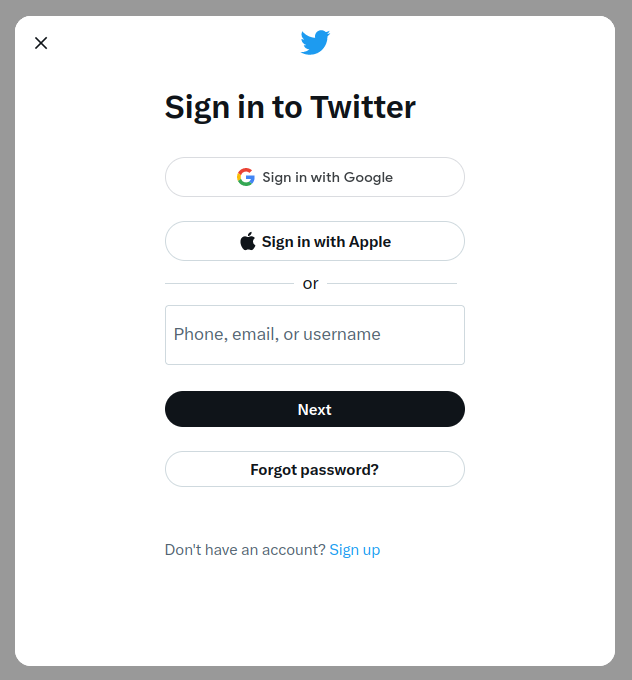
<p>For example, this is what happens when you go to <a href="http://twitter.com/wikipathways">twitter.com/wikipathways</a>:</p>

<p><img src="/assets/images/twitter_login.png" alt="Screenshot of the Twitter login page." /></p>

<p>Fortunately, <a href="https://wikipathways.org/">WikiPathways</a> does have a <a href="https://fosstodon.org/@wikipathways">Mastodon account</a>,
that anyone can see without having a Mastodon account. You can even follow WikiPathways’s account with
<a href="https://fosstodon.org/@wikipathways.rss">its RSS feed</a>. Dissemination should not be paywalled.</p>

<p>Maybe Musk has been talking to Elsevier and Springer Nature.</p>

<p>Tip: <a href="https://chem-bla-ics.linkedchemistry.info/2022/11/21/finding-mastodon-accounts-with-wikidata.html">Finding Mastodon accounts with Wikidata (a few SPARQL queries) <i class="fa-solid fa-recycle fa-xs"></i></a></p>

<p><strong>Update</strong>: <a href="https://tweakers.net/nieuws/211364/musk-blokkeren-van-niet-ingelogde-gebruikers-op-twitter-is-tijdelijke-maatregel.html">Musk</a> said this
was a temporary measure. The problem was scraping of content, you know, the content we openly share on Twitter. Maybe they could have done this
with APIs. Oh wait, they closed those behind a very expensive paywall.</p>

<p><strong>Update 2</strong>: Another rumor is that the forgot to make a deal with a cloud provider and suddenly were left with a fraction of the computing power.</p>

<p><strong>Update 3</strong>: The access has been restored, so you can start scraping/archiving all interesting tweets again.</p>]]></content><author><name>Egon Willighagen</name></author><category term="twitter" /><category term="mastodon" /><category term="wikipathways" /><summary type="html"><![CDATA[And just like that, without a warning, Twitter changed policies again, and you now need a Twitter account and be logged in to see public tweets: Twitter has started blocking unregistered users (The Verge). Though I learned it first via Mastodon, of course.]]></summary></entry><entry><title type="html">Scholia timeline</title><link href="https://chem-bla-ics.linkedchemistry.info/2023/01/27/scholia-timeline.html" rel="alternate" type="text/html" title="Scholia timeline" /><published>2023-01-27T00:00:00+00:00</published><updated>2023-01-27T00:00:00+00:00</updated><id>https://chem-bla-ics.linkedchemistry.info/2023/01/27/scholia-timeline</id><content type="html" xml:base="https://chem-bla-ics.linkedchemistry.info/2023/01/27/scholia-timeline.html"><![CDATA[<p><img style="float: right;" src="/assets/images/Scholia_work_profile_screenshot_as_of_2018-09-04.png" width="300" />
Sometimes I think back about how <a href="https://scholia.toolforge.org/">Scholia</a> started, and then I think I remember a
Twitter discussion. Twitter was a social platform that was unable to fight hate speech. I left it last year in favor
of <a href="https://scholar.social/@egonw">Mastodon</a>.</p>

<p>Anyway, I did some digging today and found <a href="https://web.archive.org/web/20230402075737/https://twitter.com/fnielsen/status/785008295505489920">this thread <i class="fa-solid fa-box-archive fa-xs"></i></a> from
October 8-9 2016. A few days earlier, Finn has created a profile based on data in Wikidata on his homepage,
<a href="https://twitter.com/egonwillighagen/status/783190125882777600">which I was very happy about <i class="fa-solid fa-link-slash fa-xs"></i></a>. You can see how
<a href="https://twitter.com/ReaderMeter/status/784810921029881856">Dario suggests <i class="fa-solid fa-link-slash fa-xs"></i></a> to put that webpage up on Toolforge.
For completeness, this is <a href="https://github.com/WDscholia/scholia/commit/484104fdf60e4d8384b9816500f2826dbfe064ce.patch">the first commit</a>,
October 9.</p>

<p>This chat was after <a href="https://fosstodon.org/@fnielsen">@fnielsen</a>’s <a href="https://finnaarupnielsen.wordpress.com/2016/09/30/the-wikidata-scholarly-profile-page/">blog post</a>
about the idea of the needed open infrastructure and a possible <a href="https://wikidata.org/">Wikidata</a> solution from
September 2016. Finally, it was also only half a year before Scholia got
<a href="https://www.nature.com/articles/nature.2017.21800">mentioned in Nature</a>.</p>

<p>BTW, at the time there still was a focus on bibliographic information. We learned since that the Wikidata platform
cannot technically meet the needs, at least not at this moment. Instead, the focus is now much more about the
literature that supports the knowledge in Wikidata and Wikipedia and make that as interoperable as possible.</p>]]></content><author><name>Egon Willighagen</name></author><category term="scholia" /><category term="twitter" /><category term="wikidata" /><category term="justdoi:10.1038/nature.2017.21800" /><summary type="html"><![CDATA[Sometimes I think back about how Scholia started, and then I think I remember a Twitter discussion. Twitter was a social platform that was unable to fight hate speech. I left it last year in favor of Mastodon.]]></summary></entry><entry><title type="html">s/Twitter/Mastodon/g</title><link href="https://chem-bla-ics.linkedchemistry.info/2022/11/12/stwittermastodong.html" rel="alternate" type="text/html" title="s/Twitter/Mastodon/g" /><published>2022-11-12T00:00:00+00:00</published><updated>2022-11-12T00:00:00+00:00</updated><id>https://chem-bla-ics.linkedchemistry.info/2022/11/12/stwittermastodong</id><content type="html" xml:base="https://chem-bla-ics.linkedchemistry.info/2022/11/12/stwittermastodong.html"><![CDATA[<p><img src="/assets/images/Mastodon_logotype_(simple)_new_hue.svg.png" style="width: 30%; display: block; margin-left: auto; margin-right: auto; float: right" alt="Mastodon logo. AGPL source: WikiCommons" />
Yeah, it has been hard to miss it (see e.g. <a href="https://www.nature.com/articles/d41586-022-03668-7">Should I join Mastodon? A scientists’ guide to Twitter’s rival</a>).
Twitter is experiencing some turbulence and <a href="https://joinmastodon.org/">Mastodon</a> has become a very attractive, open source,
community-driven, inclusive alternative. It’s been <a href="https://scholia.toolforge.org/topic/Q27986619">around since 2016</a> and there
is some <a href="https://scholia.toolforge.org/topic/Q27986619">research literature about it</a> already. I got
<a href="https://chem-bla-ics.blogspot.com/2018/09/mastodon-somewhere-between-twitter-and.html">my account in 2018</a>, but did
not start actively using it until earlier this year.</p>

<p>It’s a fascinating platform: federated, community driven, and open source. Oh, and it uses an open standard:
<a href="https://en.wikipedia.org/wiki/ActivityPub">ActivityPub</a>. I have still a lot to learn, but there are some reasons why Mastodon
is better and some reasons why it is worse than Twitter.</p>

<p>First, how can you follow me:</p>

<ul>
  <li>main scholarly account: <a href="https://social.edu.nl/@egonw">https://social.edu.nl/@egonw</a></li>
  <li>politics, foss, hobby account: <a href="https://mastodon.social/@egonw">https://mastodon.social/@egonw</a></li>
</ul>

<p><strong>Better</strong></p>

<p>Well, this is personal, of course, but the following points makes Mastodon for me a better platform:</p>

<ul>
  <li>distributed, open standard
    <ul>
      <li>e.g. no more tweeting of new Zotero entries (soon I hope), just follow my Zotero account</li>
    </ul>
  </li>
  <li>community standards
    <ul>
      <li>you can pick; if you don’t like the terms of your current server (read: service provider), just move to another server</li>
      <li>images must have alternate descriptions on many servers</li>
    </ul>
  </li>
  <li>edit button with version control</li>
  <li>content warnings</li>
  <li>ability to hide anything with #caturday (or any other word)</li>
  <li>detailed annotation of privacy (public, unlisted, etc; no encryption, tho)</li>
</ul>

<p><strong>Worse</strong></p>

<p>Maybe this category can better be called opportunities. After all, it’s the community that defines how it will evolve, just like Twitter did (which did not originally have hashtags, retweets). One big elephant in the scientific social media world wright now is the uncertainty about searching and indexing: will it be useful as (post-publication) platform? will we be able to use if for conference tweeting?</p>

<p>Another aspect is that in some countries mobile internet is deeply coupled with big companies. Think coupling of access with free whatsapp.</p>

<p>Finally: growing pains. The platform is growing fast, and right now it can be hard to find a server that accepts new accounts.</p>

<p><strong>Tips?</strong></p>

<p>Sure. Start with <a href="https://fedi.tips/">https://fedi.tips/</a>. Have fun! And I love to hear what your tips are :)</p>

<p>Image from <a href="https://commons.wikimedia.org/wiki/File:Mastodon_logotype_(simple)_new_hue.svg">WikiCommons</a>.</p>]]></content><author><name>Egon Willighagen</name></author><category term="mastodon" /><category term="twitter" /><category term="justdoi:10.1038/d41586-022-03668-7" /><summary type="html"><![CDATA[Yeah, it has been hard to miss it (see e.g. Should I join Mastodon? A scientists’ guide to Twitter’s rival). Twitter is experiencing some turbulence and Mastodon has become a very attractive, open source, community-driven, inclusive alternative. It’s been around since 2016 and there is some research literature about it already. I got my account in 2018, but did not start actively using it until earlier this year.]]></summary><media:thumbnail xmlns:media="http://search.yahoo.com/mrss/" url="https://chem-bla-ics.linkedchemistry.info/assets/images/Mastodon_logotype_(simple)_new_hue.svg.png" /><media:content medium="image" url="https://chem-bla-ics.linkedchemistry.info/assets/images/Mastodon_logotype_(simple)_new_hue.svg.png" xmlns:media="http://search.yahoo.com/mrss/" /></entry><entry><title type="html">Bioclipse enters the social web</title><link href="https://chem-bla-ics.linkedchemistry.info/2009/08/17/bioclipse-enters-social-web.html" rel="alternate" type="text/html" title="Bioclipse enters the social web" /><published>2009-08-17T00:00:00+00:00</published><updated>2009-08-17T00:00:00+00:00</updated><id>https://chem-bla-ics.linkedchemistry.info/2009/08/17/bioclipse-enters-social-web</id><content type="html" xml:base="https://chem-bla-ics.linkedchemistry.info/2009/08/17/bioclipse-enters-social-web.html"><![CDATA[<p>The <a href="https://en.wikipedia.org/wiki/Open_Notebook_Science">Open Notebook Science</a> <a href="http://spreadsheets.google.com/ccc?key=plwwufp30hfq0udnEmRD1aQ">Solubility project</a>
in particular is keen on sharing results using the <a href="https://en.wikipedia.org/wiki/Social_web">Social Web</a>. Last week I reported about the plugin I wrote to access
the data on <a href="https://www.friendfeed.com/">FriendFeed</a>.</p>

<p>When someone asked last week on the <a href="https://taverna.sf.net/">Taverna</a> mailing list about a Twitter <a href="http://twitter.com/">node</a>,
I was surely interested. Though this can hardly be called <em>core research</em>, I, <em>fortunately</em>, had to test
<a href="https://chem-bla-ics.linkedchemistry.info/2009/08/13/making-bioclipse-development-easier-new.html">the new Bioclipse SDK <i class="fa-solid fa-recycle fa-xs"></i></a> :)</p>

<p>So, I hacked up a Twitter plugin for <a href="https://www.bioclipse.net/">Bioclipse</a> in no time using <a href="https://www.winterwell.com/software/jtwitter.php">JTwitter</a>
(license:LGPL), to allow sending tweets to <a href="https://twitter.com/egonwillighagen">my Twitter account <i class="fa-solid fa-link-slash fa-xs"></i></a> (but not yet my
<a href="https://identi.ca/chemblaics">Identi.ca account</a>):</p>

<p><img src="/assets/images/bioclipseTweet1.png" alt="" /></p>

<p>Or, as copy/pastable script:</p>

<script src="https://gist.github.com/169156.js"></script>

<p>And you can see it really hit Twitter <a href="http://search.twitter.com/search?q=bioclipse+social+feature">here</a> and in this screenshot of my
<a href="http://choqok.gnufolks.org/">Choqok</a> client:</p>

<p><img src="/assets/images/bioclipseTweet.png" alt="" /></p>]]></content><author><name>Egon Willighagen</name></author><category term="bioclipse" /><category term="twitter" /><category term="friendfeed" /><summary type="html"><![CDATA[The Open Notebook Science Solubility project in particular is keen on sharing results using the Social Web. Last week I reported about the plugin I wrote to access the data on FriendFeed.]]></summary><media:thumbnail xmlns:media="http://search.yahoo.com/mrss/" url="https://chem-bla-ics.linkedchemistry.info/assets/images/bioclipseTweet.png" /><media:content medium="image" url="https://chem-bla-ics.linkedchemistry.info/assets/images/bioclipseTweet.png" xmlns:media="http://search.yahoo.com/mrss/" /></entry></feed>