<?xml version="1.0" encoding="utf-8"?><feed xmlns="http://www.w3.org/2005/Atom" ><generator uri="https://jekyllrb.com/" version="4.3.4">Jekyll</generator><link href="https://chem-bla-ics.linkedchemistry.info/feed/by_tag/swat4ls.xml" rel="self" type="application/atom+xml" /><link href="https://chem-bla-ics.linkedchemistry.info/" rel="alternate" type="text/html" /><updated>2026-11-01T15:22:34+00:00</updated><id>https://chem-bla-ics.linkedchemistry.info/feed/by_tag/swat4ls.xml</id><title type="html">chem-bla-ics</title><subtitle>Chemblaics (pronounced chem-bla-ics) is the science that uses open science and computers to solve problems in chemistry, biochemistry and related fields.</subtitle><author><name>Egon Willighagen</name></author><entry><title type="html">SWAT4HCLS 2026</title><link href="https://chem-bla-ics.linkedchemistry.info/2026/04/04/swat4hcls-2026.html" rel="alternate" type="text/html" title="SWAT4HCLS 2026" /><published>2026-04-04T16:54:00+00:00</published><updated>2026-04-04T16:54:00+00:00</updated><id>https://chem-bla-ics.linkedchemistry.info/2026/04/04/swat4hcls-2026</id><content type="html" xml:base="https://chem-bla-ics.linkedchemistry.info/2026/04/04/swat4hcls-2026.html"><![CDATA[<p>A bit over a week ago, <a href="https://www.swat4ls.org/workshops/amsterdam2026/">SWAT4HCLS 2026</a> took place, with the matching
<a href="https://www.swat4ls.org/workshops/amsterdam2026/swat4hcls-biohackathon-2026/">biohackathon</a> on Thursday (see
<a href="https://chem-bla-ics.linkedchemistry.info/2026/03/22/swat4hcls-2026-amsterdam-this-week.html">this post</a>.
I attempted a bit of live coverage on mastodon: <a href="https://social.edu.nl/@egonw/116285060969709401">day 1</a> and
<a href="https://social.edu.nl/@egonw/116289579219485790">day 2</a>. But it seems the semantic web community interested
in SWAT4HCLS has not found the fediverse yet. So, make sure to check
<a href="https://www.swat4ls.org/workshops/amsterdam2026/programme/accepted-submissions/">this full list of abstracts</a>.</p>

<p>The meeting consisted of <a href="https://www.swat4ls.org/workshops/amsterdam2026/programme/keynotes/">four keynotes</a>, each
one was quite interesting. Cornet gave a nice historic perspective of the venue and of the semantic web field,
which is a great way to welcome the participants to your institute. The talk also touches on the main theme
of the meeting: clinical data. It is a long standing (and important) research field, but progress is slow.
Cornet <a href="https://social.edu.nl/@egonw/116283216644714695">comments</a> along the lines that <em>we have been talking
about reasoning over patient data for more than twenty years, but we still have not solve it</em>.</p>

<p>The problem is really not only privacy, but simple also lack of a common language. As
<a href="https://qlever.scholia.wiki/orcid/0000-0003-3248-7899">Sabine Österle</a> explains
about sharing health/patient data in Switzerland, across 26 kantons and legislations and 4 national languages.
Another issue is more technical, running SPARQL across hospitals involves more than just aligning ontologies,
but also requires (too much) fiddling with SPARQL queries.</p>

<p>There was plenty of other content too, however. For example, I was pleasantly
<a href="https://social.edu.nl/@egonw/116284409447761902">surprised</a> by the
<a href="https://www.swat4ls.org/workshops/amsterdam2026/programme/accepted-submissions/#RDF4RiskAssessment_Toolkit_A_Toolkit_for_Converting_Tabular_Research_Data_to_FAIR_RDF_for_Risk_Assessment_and_Life_Sciences">RDF4RiskAssessment</a>
work, the <a href="https://www.swat4ls.org/workshops/amsterdam2026/programme/accepted-submissions/#RO-Crates_for_BioImaging">RO-Crates for BioImaging</a>,
and <a href="https://www.swat4ls.org/workshops/amsterdam2026/programme/accepted-submissions/#FDPcrawleR_A_Lightweight_R_Framework_for_Auditing_FAIR_Data_Points_and_FAIR_Virtual_Platforms">FDPcrawleR</a>.
All these projects have direct links to research ongoing in <a href="https://www.maastrichtuniversity.nl/research/translational-genomics">our TGX team</a>.</p>

<p><a href="https://qlever.scholia.wiki/orcid/0000-0003-1213-6776">Hanna Bast</a> gave the second keynote of the first day, about <a href="https://qlever.dev/">QLever</a>
(doi:<a href="https://doi.org/10.1145/3132847.3132921">10.1145/3132847.3132921</a>). She talked about some of the recent improvements,
something we really <a href="https://chem-bla-ics.linkedchemistry.info/2026/02/28/rescuing-scholia-3-we-did-it.html">needed for Scholia</a>.
She showed a technical approach to make federated queries faster, tho it currently only works between endpoints
that both run QLever. One thing I am looking forward to, is playing with the notion of
<a href="https://docs.qlever.dev/materialized-views/?h=materialize">materialized views</a>, but the biohackathon
was too short to get around to that during the Thursday.</p>

<p>The second day kicked off with a keynote by <a href="https://qlever.scholia.wiki/orcid/0000-0002-3469-4923">Janna Hastings</a>,
whose work I greatly admire. I was not disappointed today, and she showed the
<a href="https://www.bciontology.org/">Behaviour Change Intervention Ontology</a> and <a href="https://chebifier.hastingslab.org/">Chebifier</a>
(doi:<a href="https://doi.org/10.1039/D3DD00238A">10.1039/D3DD00238A</a>).</p>

<p>The last talk I want to mention in the blog is by two researcher working with Michel Dumontier. They
<a href="https://www.swat4ls.org/workshops/amsterdam2026/programme/accepted-submissions/#Embedding-based_Deduplication_of_Knowledge_Graphs_using_Graph_Neural_Networks">presented</a>
a study about deduplication in/of knowledge graphs. This is something I want to read in more detail.</p>]]></content><author><name>Egon Willighagen</name></author><category term="swat4ls" /><category term="mastodon" /><category term="justdoi:10.1039/D3DD00238A" /><category term="justdoi:10.1145/3132847.3132921" /><summary type="html"><![CDATA[A bit over a week ago, SWAT4HCLS 2026 took place, with the matching biohackathon on Thursday (see this post. I attempted a bit of live coverage on mastodon: day 1 and day 2. But it seems the semantic web community interested in SWAT4HCLS has not found the fediverse yet. So, make sure to check this full list of abstracts.]]></summary></entry><entry><title type="html">SWAT4HCLS 2026 Amsterdam this week</title><link href="https://chem-bla-ics.linkedchemistry.info/2026/03/22/swat4hcls-2026-amsterdam-this-week.html" rel="alternate" type="text/html" title="SWAT4HCLS 2026 Amsterdam this week" /><published>2026-03-22T00:00:00+00:00</published><updated>2026-03-22T00:00:00+00:00</updated><id>https://chem-bla-ics.linkedchemistry.info/2026/03/22/swat4hcls-2026-amsterdam-this-week</id><content type="html" xml:base="https://chem-bla-ics.linkedchemistry.info/2026/03/22/swat4hcls-2026-amsterdam-this-week.html"><![CDATA[<p>Tomorrow, <a href="https://www.swat4ls.org/workshops/amsterdam2026/">SWAT4HCLS 2026</a> will start, again in Amsterdam.
The first SWAT4LS I attended <a href="https://chem-bla-ics.linkedchemistry.info/2009/11/21/swat4ls-linking-open-drug-data-to.html">was also in Amsterdam</a>, and the second meeting in Amsterdam I was <a href="https://chem-bla-ics.linkedchemistry.info/2016/12/18/my-swat4ls-poster-about-enanomapper.html">also there</a>. And I was in <a href="https://www.swat4ls.org/workshops/cambridge2015/index.php">Cambridge</a> (see
<a href="https://chem-bla-ics.blogspot.com/2015/12/swat4ls-in-cambridge.html">this post</a>),
<a href="https://www.swat4ls.org/workshops/antwerp2018/">Antwerp</a>  (no post), and at least to one of the two
<a href="https://www.swat4ls.org/workshops/leiden2024/">Leiden</a> meetings (also no posts, it seems).</p>

<p>I am looking forward to meet old friends, new friends (some whom I never met in person), and
recent collaborators (that I never met in person).
For those who will not be in Amsterdam, you can follow the meeting on social media with
the <a href="https://hashtags-hub.toolforge.org/swat4hcls">hashtag #swat4hcls</a>. And there is also
<a href="https://fediwall.biohackrxiv.org/">this BioHackrXiv Fediwall</a>, for those in the
<a href="https://en.wikipedia.org/wiki/Fediverse">fediverse</a>.</p>

<h3 id="scholia-demo">Scholia demo</h3>

<p>I will give a demo to update people on the work in the <a href="https://github.com/wdscholia/scholia">Scholia</a> project with
Daniel Mietchen, Peter Patel-Schneider, Konrad Linden, Johannes Kalmbach,
Lars Willighagen, Wolfgang Fahl, and Hannah Bast (also keynote in Amsterdam)
to <a href="https://chem-bla-ics.linkedchemistry.info/2026/02/28/rescuing-scholia-3-we-did-it.html">update the SPARQL queries</a>
we use to visualize data in <a href="https://www.wikidata.org/">Wikidata</a> to SPARQL 1.1 so that it can run on
<a href="https://qlever.dev/">Qlever</a>.
The abstract can be <a href="https://commons.wikimedia.org/wiki/File:Scholia_2026_Compliance_with_SPARQL_1.1.pdf">found in Wikimedia Commons</a>.</p>

<p>This was the outcome of many years figuring how to ensure Scholia could remain working. The
<a href="https://en.wikipedia.org/wiki/Wikipedia:Wikipedia_Signpost/2026-02-17/Technology_report">Wikidata RDF graph split</a>
has given us many headaches, so many that just before christmas it became it could
be possible to survive the split, I was so happy, I realize I want to share this news. So, we teamed
up and wrote this demonstration contribution abstract. Thanks to everyone who made this happen!
Just to be clear, we are not done yet. The system is not running outside the Wikimedia Foundation
platforms.</p>

<p>One of the reviewer comments requested <a href="https://qlever.scholia.wiki/event/Q138033585">a Scholia page for the meeting</a>.
It has not been updated for the accepted speakers, but you can look at <a href="https://qlever.scholia.wiki/event-series/Q56846035">pages for past meetings</a>
to get an idea what you will find.</p>

<h3 id="swat4hcls-biohackathon-2026">SWAT4HCLS Biohackathon 2026</h3>

<p>There will also be <a href="https://www.swat4ls.org/workshops/amsterdam2026/swat4hcls-biohackathon-2026/">a biohackathon again</a>,
of course, with the <a href="https://index.biohackrxiv.org/tag/SWAT4HCLS26">option for BioHackRxiv reports</a>.
There are already <a href="https://www.swat4ls.org/workshops/amsterdam2026/swat4hcls-biohackathon-2026/">several pitches</a>,
including one that I submitted about Scholia.</p>]]></content><author><name>Egon Willighagen</name></author><category term="rdf" /><category term="sparql" /><category term="swat4ls" /><category term="wikidata" /><summary type="html"><![CDATA[Tomorrow, SWAT4HCLS 2026 will start, again in Amsterdam. The first SWAT4LS I attended was also in Amsterdam, and the second meeting in Amsterdam I was also there. And I was in Cambridge (see this post), Antwerp (no post), and at least to one of the two Leiden meetings (also no posts, it seems).]]></summary></entry><entry><title type="html">Rescuing Scholia #3: We did it!</title><link href="https://chem-bla-ics.linkedchemistry.info/2026/02/28/rescuing-scholia-3-we-did-it.html" rel="alternate" type="text/html" title="Rescuing Scholia #3: We did it!" /><published>2026-02-28T00:00:00+00:00</published><updated>2026-02-28T00:00:00+00:00</updated><id>https://chem-bla-ics.linkedchemistry.info/2026/02/28/rescuing-scholia-3-we-did-it</id><content type="html" xml:base="https://chem-bla-ics.linkedchemistry.info/2026/02/28/rescuing-scholia-3-we-did-it.html"><![CDATA[<p>It was not a set up, when I openly <a href="https://chem-bla-ics.linkedchemistry.info/2025/12/08/rescuing-scholia.html">wondered if we would be able to rescue Scholia in time</a>.
I honestly did not know. Three weeks and some serious hacking by an international team later <a href="https://chem-bla-ics.linkedchemistry.info/2025/12/31/rescuing-scholia-2-getting-close.html">I was more optimistic</a>.
Actually, just before christmas, we started writing a <a href="https://www.swat4ls.org/">SWAT4HCLS 2026</a> demonstration abstract. This was accepted and
you can read the <em>Scholia 2026: Compliance with SPARQL 1.1</em> preprint <a href="https://github.com/WolfgangFahl/ScholiaGraphSplitPaper">here</a> and
<a href="https://commons.wikimedia.org/wiki/File:Scholia_2026_Compliance_with_SPARQL_1.1.pdf">here</a>.
This paper describes the work that had to be done, and I am deeply grateful to everyone who contributed with smaller or
bigger contributions (Daniel, Peter, Konrad, Johannes, Lars, Wolfgang, Hannah).
I am merely first author for the demo, and just another contributor to the long series of patches, in a
<a href="https://github.com/WDscholia/scholia/pull/2715">branch started by Prof. Hannah Bast</a>.</p>

<p>The work actually started long before that, with the <em>Robustifying Scholia</em> grant (see doi:<a href="https://doi.org/10.3897/rio.5.e35820">10.3897/rio.5.e35820</a>),
where we explored alternatives. The Wikidata graph (RDF) split has been long coming, and I can recommend
<a href="https://en.wikipedia.org/wiki/Wikipedia:Wikipedia_Signpost/2026-02-17/Technology_report">this recent The Signpost article</a>
by <a href="https://disobey.net/@Bluerasberry">Lane</a> for a good overview. So, this would not have been possible with
<a href="https://github.com/WDscholia/scholia/graphs/contributors">the many people who contributed over the years</a>.
But this last sprint really made a difference.</p>

<p>The developments of the QLever software in the past year are very important, and the SPARQL endpoint we run now is live updated,
just like we knew from the Wikidata Query Service (WDQS). Recent improvement allowed us to replace all the Wikidata and Blazegraph
specific aspects of the SPARQL queries, and good discussions let to pragmatic approaches to keep localization features
Scholia had for displaying query results from Wikidata.</p>

<p>The work is not completed, however. All queries are SPARQL 1.1 now, but some can still be further optimized, and some still
need some fixing. For example, I still spot some QIDs here and there, instead of the localized labels that should be shown instead.
Also, we are actively looking in getting everything running again on WMF servers (see <a href="https://github.com/WDscholia/scholia/issues/2766">this overview issue</a>),
so that <em>scholia.toolforge.org</em> works again.</p>

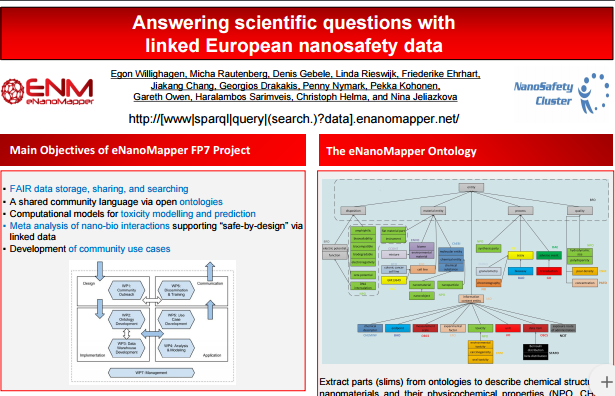
<p>For now, however, please use <a href="https://qlever.scholia.wiki/">qlever.scholia.wiki</a>.</p>]]></content><author><name>Egon Willighagen</name></author><category term="scholia" /><category term="sparql" /><category term="swat4ls" /><category term="doi:10.3897/RIO.5.E35820" /><summary type="html"><![CDATA[It was not a set up, when I openly wondered if we would be able to rescue Scholia in time. I honestly did not know. Three weeks and some serious hacking by an international team later I was more optimistic. Actually, just before christmas, we started writing a SWAT4HCLS 2026 demonstration abstract. This was accepted and you can read the Scholia 2026: Compliance with SPARQL 1.1 preprint here and here. This paper describes the work that had to be done, and I am deeply grateful to everyone who contributed with smaller or bigger contributions (Daniel, Peter, Konrad, Johannes, Lars, Wolfgang, Hannah). I am merely first author for the demo, and just another contributor to the long series of patches, in a branch started by Prof. Hannah Bast.]]></summary></entry><entry><title type="html">The SWAT4LS poster about eNanoMapper</title><link href="https://chem-bla-ics.linkedchemistry.info/2016/12/18/my-swat4ls-poster-about-enanomapper.html" rel="alternate" type="text/html" title="The SWAT4LS poster about eNanoMapper" /><published>2016-12-18T00:00:00+00:00</published><updated>2016-12-18T00:00:00+00:00</updated><id>https://chem-bla-ics.linkedchemistry.info/2016/12/18/my-swat4ls-poster-about-enanomapper</id><content type="html" xml:base="https://chem-bla-ics.linkedchemistry.info/2016/12/18/my-swat4ls-poster-about-enanomapper.html"><![CDATA[<p><a href="http://www.swat4ls.org/">SWAT4LS</a> was once again a great meeting. I doubt I will find time soon enough to
write up notes, but at least I can post the <a href="http://enanomapper.net/">eNanoMapper</a> poster I presented, which
is available from <a href="https://f1000research.com/">F1000Research</a>:</p>

<p><img src="/assets/images/enanomapper_poster.png" alt="" /></p>]]></content><author><name>Egon Willighagen</name></author><category term="swat4ls" /><category term="enanomapper" /><category term="sparql" /><category term="doi:10.7490/f1000RESEARCH.1113520.1" /><summary type="html"><![CDATA[SWAT4LS was once again a great meeting. I doubt I will find time soon enough to write up notes, but at least I can post the eNanoMapper poster I presented, which is available from F1000Research:]]></summary><media:thumbnail xmlns:media="http://search.yahoo.com/mrss/" url="https://chem-bla-ics.linkedchemistry.info/assets/images/enanomapper_poster.png" /><media:content medium="image" url="https://chem-bla-ics.linkedchemistry.info/assets/images/enanomapper_poster.png" xmlns:media="http://search.yahoo.com/mrss/" /></entry><entry><title type="html">SWAT4LS: wrapping up #1</title><link href="https://chem-bla-ics.linkedchemistry.info/2009/11/25/swat4ls-wrapping-up-1.html" rel="alternate" type="text/html" title="SWAT4LS: wrapping up #1" /><published>2009-11-25T00:00:00+00:00</published><updated>2009-11-25T00:00:00+00:00</updated><id>https://chem-bla-ics.linkedchemistry.info/2009/11/25/swat4ls-wrapping-up-1</id><content type="html" xml:base="https://chem-bla-ics.linkedchemistry.info/2009/11/25/swat4ls-wrapping-up-1.html"><![CDATA[<p>It’s already been five days since the <a href="http://www.swat4ls.org/2009/index.php">SWAT4LS</a> meeting (<a href="http://swat4ls.blogspot.com/">matching blog</a>),
and finally got around to writing up my personal summary. I very much enjoyed the <a href="http://blueobelisk.stackexchange.com/questions/16/who-will-go-to-swat4ls-and-wants-to-join-a-blue-obelisk-dinner">Blue Obelisk dinner</a>
on Thursday evening with <a href="http://semanticscience.wordpress.com/">Nico</a>, <a href="http://duncan.hull.name/">Duncan</a>, and
<a href="http://blog.chemdom.com/">Miguel</a> (the <a href="http://cdk.sf.net/">CDK</a> one).</p>

<p>The SWAT4LS was fun, interesting, perhaps to short, but very much appreciated! Thanx to all organizers! During the day various people tweeted the
meeting, using the <a href="http://search.twitter.com/search?q=%23swat4ls2009">#swat4ls2009</a> hashtag (forwarded to <a href="http://friendfeed.com/swat4ls2009">a FriendFeed room</a>),
while Nico covered things in various blog posts which I’ll link to below where appropriate. Summaries I have seen so far are from
<a href="http://semanticscience.wordpress.com/2009/11/24/semantic-web-tools-and-applications-for-life-sciences-2009-a-personal-summary/">Nico</a>
and <a href="http://duncan.hull.name/2009/11/24/swat4ls/">Duncan</a> (again :), and <a href="http://swat4ls.blogspot.com/2009/11/swat4ls-aftermath.html">the organizers</a>.</p>

<p>The day kicked off with a presentation by Alan Ruttenberg (<a href="http://semanticscience.wordpress.com/2009/11/20/swat4ls2009-keynote-alan-ruttenberg-semantic-web-technology-to-support-studying-the-relation-of-hla-structure-variation-to-disease/">Nico’s coverage</a>).
It nicely demonstrated where the semantic web for life sciences is going too. Particularly interesting was the integration of SPARQL with Jmol in
<a href="http://http//neurocommons.org/page/ImmPort/JmolViz">ImmPort/JmolViz</a>: it uses Jmol to visualize a PDB entry, while using SPARQL to retrieve atomic
and residue annotation, using Jmol script (we have to thank another Miguel (the <a href="http://www.jmol.org/">Jmol</a> one) for taking the scripting
and visualization capabilities <a href="http://sourceforge.net/mailarchive/forum.php?thread_name=64707.217.127.90.82.1035878883.squirrel@www.howards.org&amp;forum_name=jmol-developers">to the next level in 2002</a>).
It always makes me proud to see one of the projects I have worked on to hit a prominent place in keynote talks at conferences :)</p>

<p>Alan also clarified that <a href="http://creativecommons.org/choose/zero">CC0</a> is not a license, but a statement about the <em>public domain</em> nature
of data; there is nothing to accept, nothing to live up to. The important is, and I am sure most of my readers are well aware of that, is
that it formalized the public domain concept by wrapping it in a full CC0 statement. My recommendation to all who want to make (chemical data)
available as <em>public domain</em>, use the CC0; just because the CC0 works in any country, and it will make a lot of your users very happy.
<strong>If you cannot claim CC0 because you are not really owner (as I have seen done), do not claim the data to be public domain either
then (which was done)!</strong></p>

<p>There was also note of the <a href="http://www.co-ode.org/ontologies/amino-acid/2009/02/16/">Amino Acid Ontology</a>, which comes closer to our groups
proteochemometrics work, but I have yet to look if this can be used for or linked protein descriptors. Also interesting is the idea behind
<a href="https://github.com/alanruttenberg/rdfherd">RDFHerd <i class="fa-solid fa-recycle fa-xs"></i></a>, a project aiming to distribute RDF data sets as installable packages. If I understood
correctly, only <a href="http://virtuoso.openlinksw.com/dataspace/dav/wiki/Main/">Virtuoso</a> is yet supported, but this thing can fly, particularly,
if these packages are easily converted into <a href="http://www.debian.org/doc/FAQ/ch-pkg_basics.en.html">Debian packages</a>.</p>

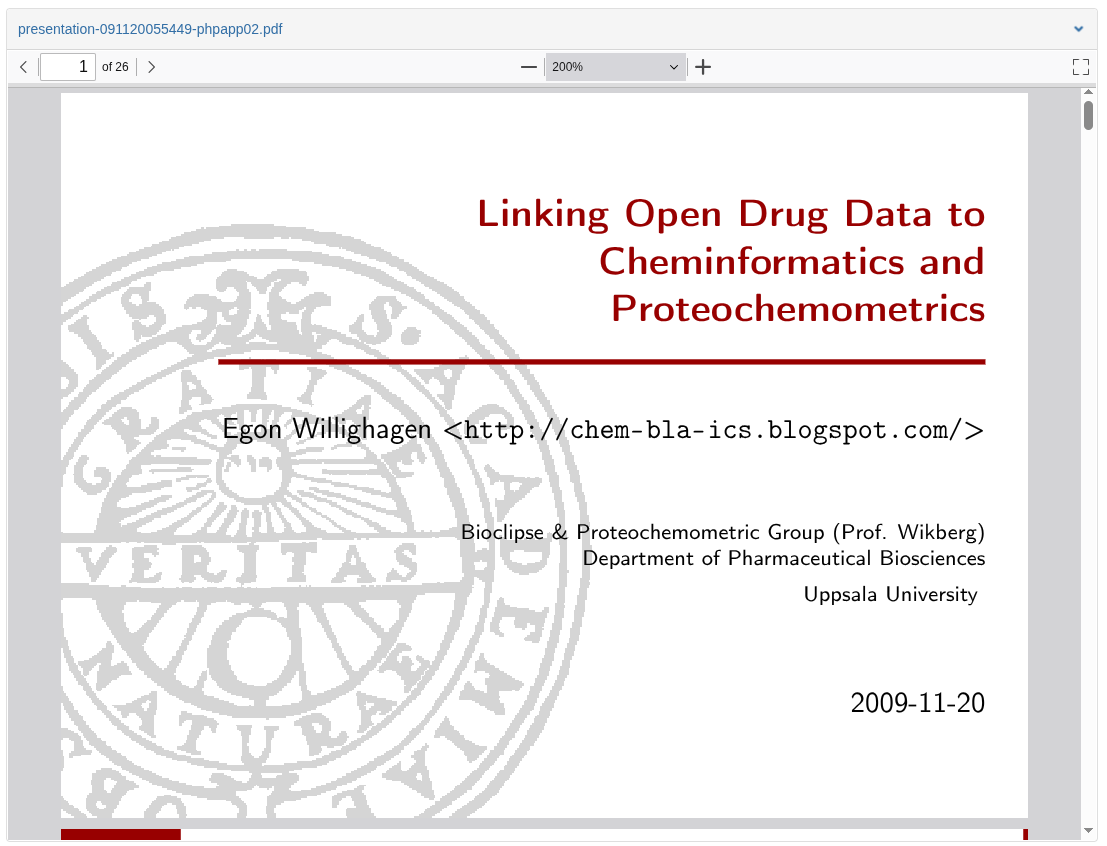
<p>More wrapping up will follow, but got other business to do first now.</p>]]></content><author><name>Egon Willighagen</name></author><category term="swat4ls" /><category term="blue-obelisk" /><category term="jmol" /><category term="sparql" /><summary type="html"><![CDATA[It’s already been five days since the SWAT4LS meeting (matching blog), and finally got around to writing up my personal summary. I very much enjoyed the Blue Obelisk dinner on Thursday evening with Nico, Duncan, and Miguel (the CDK one).]]></summary></entry><entry><title type="html">SWAT4LS: “Linking Open Drug Data to Cheminformatics and Proteochemometrics”</title><link href="https://chem-bla-ics.linkedchemistry.info/2009/11/21/swat4ls-linking-open-drug-data-to.html" rel="alternate" type="text/html" title="SWAT4LS: “Linking Open Drug Data to Cheminformatics and Proteochemometrics”" /><published>2009-11-21T00:00:00+00:00</published><updated>2009-11-21T00:00:00+00:00</updated><id>https://chem-bla-ics.linkedchemistry.info/2009/11/21/swat4ls-linking-open-drug-data-to</id><content type="html" xml:base="https://chem-bla-ics.linkedchemistry.info/2009/11/21/swat4ls-linking-open-drug-data-to.html"><![CDATA[<p>Please find below the presentation I gave today at <a href="https://www.swat4ls.org/workshops/amsterdam2009/">SWAT4LS <i class="fa-solid fa-recycle fa-xs"></i></a>:</p>

<p><a href="https://zenodo.org/records/3551852"><img src="/assets/images/zenodo_swat4ls_2009_lod.png" alt="" /></a></p>]]></content><author><name>Egon Willighagen</name></author><category term="swat4ls" /><category term="rdf" /><category term="semweb" /><category term="justdoi:10.5281/ZENODO.3551852" /><summary type="html"><![CDATA[Please find below the presentation I gave today at SWAT4LS :]]></summary><media:thumbnail xmlns:media="http://search.yahoo.com/mrss/" url="https://chem-bla-ics.linkedchemistry.info/assets/images/zenodo_swat4ls_2009_lod.png" /><media:content medium="image" url="https://chem-bla-ics.linkedchemistry.info/assets/images/zenodo_swat4ls_2009_lod.png" xmlns:media="http://search.yahoo.com/mrss/" /></entry></feed>