<?xml version="1.0" encoding="utf-8"?><feed xmlns="http://www.w3.org/2005/Atom" ><generator uri="https://jekyllrb.com/" version="4.3.4">Jekyll</generator><link href="https://chem-bla-ics.linkedchemistry.info/feed/by_tag/smiles.xml" rel="self" type="application/atom+xml" /><link href="https://chem-bla-ics.linkedchemistry.info/" rel="alternate" type="text/html" /><updated>2026-11-01T15:22:34+00:00</updated><id>https://chem-bla-ics.linkedchemistry.info/feed/by_tag/smiles.xml</id><title type="html">chem-bla-ics</title><subtitle>Chemblaics (pronounced chem-bla-ics) is the science that uses open science and computers to solve problems in chemistry, biochemistry and related fields.</subtitle><author><name>Egon Willighagen</name></author><entry><title type="html">Molecular Inorganics: SMILES, MDL molfile v3000, and InChIs</title><link href="https://chem-bla-ics.linkedchemistry.info/2026/07/26/inorganic-compounds-smiles-mdl-molfile-v3000-and-inchis.html" rel="alternate" type="text/html" title="Molecular Inorganics: SMILES, MDL molfile v3000, and InChIs" /><published>2026-07-26T00:00:00+00:00</published><updated>2026-07-26T00:00:00+00:00</updated><id>https://chem-bla-ics.linkedchemistry.info/2026/07/26/inorganic-compounds-smiles-mdl-molfile-v3000-and-inchis</id><content type="html" xml:base="https://chem-bla-ics.linkedchemistry.info/2026/07/26/inorganic-compounds-smiles-mdl-molfile-v3000-and-inchis.html"><![CDATA[<p>Making chemistry more FAIR requires unique identifiers for chemical structures. For organic compounds plenty of solutions exist that
do a great job. Last year and last week, I attended two technical <a href="https://www.inchi-trust.org/">InChI</a> meetings, both with
<a href="https://en.wikipedia.org/wiki/Organometallic_chemistry">organometallic compounds</a> and other molecular inorganics as one of the key topics. Thanks to
<a href="https://bsky.app/profile/herreslab.bsky.social">Sonja</a> (<a href="https://fed.brid.gy/bsky/herreslab.bsky.social">Mastodon bridge</a>)
and <a href="https://www.linkedin.com/in/gerd-blanke-b13115/">Gerd</a> for the invitations. My role includes thinking about what all the
work on the InChI means for the <a href="http://cdk.github.io/">Chemistry Development Kit</a>.</p>

<p>Many things came up. One was testing of new InChI functionality for these organometallic compounds, particularly the stereochemistry.
<a href="https://chem-bla-ics.linkedchemistry.info/2007/08/02/molecules-in-wikipedia.html">Wikipedia has many chemical compounds</a> and could
be a source, but <a href="https://chem-bla-ics.linkedchemistry.info/2022/11/12/wikidata-script-for-smiles-smarts-and.html">so does Wikidata</a>.
Both use the SMILES, but not all SMILES captures all the chemistry we need. And the InChI software needs
<a href="https://en.wikipedia.org/wiki/Chemical_table_file#V3000">an V3000 MDL Molfile</a>. Thanks to John and other CDK developers, there
is good support for recent cheminformatics software, but I was not sure it had what I would need.</p>

<p>This post is the first of a few related posts. This post is about converting SMILES from <a href="https://wikidata.org/">Wikidata</a>
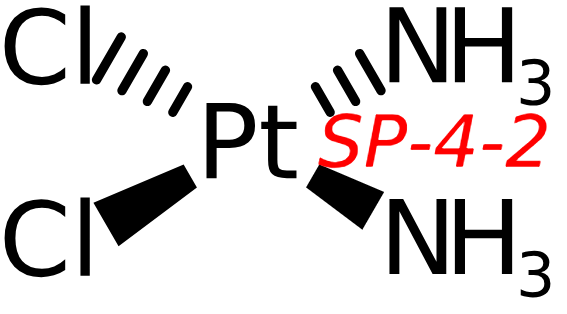
to V3000 files. Take <a href="https://qlever.scholia.wiki/chemical/Q412415">cisplatin</a>: it has four ligands around a platinum atom,
all in a single plane:</p>

<p><img src="/assets/images/cisplatin.png" alt="" /></p>

<p>In this image, in red, is actually an annotation of how the ligands are oriented around the platinum. This is also reflected
in the <em>isomeric SMILES</em> in Wikidata: <code class="language-plaintext highlighter-rouge">Cl[Pt@SP1]([NH3])([NH3])Cl</code>.</p>

<p>The following source code is written in <a href="https://chem-bla-ics.linkedchemistry.info/tag/groovy">Groovy</a> which I have used for many
years because it is less verbose than Java. First, we set up our helper classes:</p>

<div class="language-groovy highlighter-rouge"><div class="highlight"><pre class="highlight"><code><span class="nd">@Grab</span><span class="o">(</span><span class="n">group</span><span class="o">=</span><span class="s1">'org.openscience.cdk'</span><span class="o">,</span> <span class="n">module</span><span class="o">=</span><span class="s1">'cdk-smiles'</span><span class="o">,</span> <span class="n">version</span><span class="o">=</span><span class="s1">'2.12'</span><span class="o">)</span>
<span class="nd">@Grab</span><span class="o">(</span><span class="n">group</span><span class="o">=</span><span class="s1">'org.openscience.cdk'</span><span class="o">,</span> <span class="n">module</span><span class="o">=</span><span class="s1">'cdk-silent'</span><span class="o">,</span> <span class="n">version</span><span class="o">=</span><span class="s1">'2.12'</span><span class="o">)</span>
<span class="nd">@Grab</span><span class="o">(</span><span class="n">group</span><span class="o">=</span><span class="s1">'org.openscience.cdk'</span><span class="o">,</span> <span class="n">module</span><span class="o">=</span><span class="s1">'cdk-ctab'</span><span class="o">,</span> <span class="n">version</span><span class="o">=</span><span class="s1">'2.12'</span><span class="o">)</span>
<span class="nd">@Grab</span><span class="o">(</span><span class="n">group</span><span class="o">=</span><span class="s1">'org.openscience.cdk'</span><span class="o">,</span> <span class="n">module</span><span class="o">=</span><span class="s1">'cdk-sdg'</span><span class="o">,</span> <span class="n">version</span><span class="o">=</span><span class="s1">'2.12'</span><span class="o">)</span>

<span class="kn">import</span> <span class="nn">org.openscience.cdk.smiles.SmilesParser</span><span class="o">;</span>
<span class="kn">import</span> <span class="nn">org.openscience.cdk.silent.SilentChemObjectBuilder</span><span class="o">;</span>
<span class="kn">import</span> <span class="nn">org.openscience.cdk.io.SDFWriter</span><span class="o">;</span>
<span class="kn">import</span> <span class="nn">org.openscience.cdk.layout.StructureDiagramGenerator</span><span class="o">;</span>
<span class="kn">import</span> <span class="nn">javax.vecmath.Vector2d</span>

<span class="n">builder</span> <span class="o">=</span> <span class="n">SilentChemObjectBuilder</span><span class="o">.</span><span class="na">getInstance</span><span class="o">()</span>
<span class="n">sp</span> <span class="o">=</span> <span class="k">new</span> <span class="n">SmilesParser</span><span class="o">(</span><span class="n">builder</span><span class="o">)</span>
<span class="n">sdg</span> <span class="o">=</span> <span class="k">new</span> <span class="n">StructureDiagramGenerator</span><span class="o">();</span>
</code></pre></div></div>

<p>With some extra code, I can actually get many compounds from Wikidata to convert to v3000 with a SAPRQL (as I have done
last year with CXSMILES and polymers, unpublished), but let’s go with a single example:</p>

<div class="language-groovy highlighter-rouge"><div class="highlight"><pre class="highlight"><code><span class="n">smiles</span> <span class="o">=</span> <span class="s2">"Cl[Pt@SP1]([NH3])([NH3])Cl"</span>
<span class="n">label</span> <span class="o">=</span> <span class="s2">"cisplatin"</span>
<span class="n">wdItem</span> <span class="o">=</span> <span class="s2">"Q412415"</span>
</code></pre></div></div>

<p>I can parse the SMILES and generated 2D coordinates with (which is also the approach by <a href="https://www.simolecule.com/cdkdepict/depict/bow/svg?smi=Cl%5BPt%40SP1%5D(%5BNH3%5D)(%5BNH3%5D)Cl&amp;zoom=2.0&amp;annotate=cip">CDK Depict</a>
which I used for the above 2D diagram of cisplatin):</p>

<div class="language-groovy highlighter-rouge"><div class="highlight"><pre class="highlight"><code><span class="n">mol</span> <span class="o">=</span> <span class="n">sp</span><span class="o">.</span><span class="na">parseSmiles</span><span class="o">(</span><span class="n">smiles</span><span class="o">)</span>
<span class="n">sdg</span><span class="o">.</span><span class="na">setMolecule</span><span class="o">(</span><span class="n">mol</span><span class="o">);</span>
<span class="n">sdg</span><span class="o">.</span><span class="na">generateCoordinates</span><span class="o">(</span><span class="k">new</span> <span class="n">Vector2d</span><span class="o">(</span><span class="mi">0</span><span class="o">,</span> <span class="mi">1</span><span class="o">));</span>
<span class="n">mol</span> <span class="o">=</span> <span class="n">sdg</span><span class="o">.</span><span class="na">getMolecule</span><span class="o">();</span>
</code></pre></div></div>

<p>If you have more than one molfile, they can be combined into a <a href="https://en.wikipedia.org/wiki/Chemical_table_file#SDF">SD file</a>,
to which additional properties can be added:</p>

<div class="language-groovy highlighter-rouge"><div class="highlight"><pre class="highlight"><code><span class="n">mol</span><span class="o">.</span><span class="na">setTitle</span><span class="o">(</span><span class="n">label</span><span class="o">)</span>
<span class="n">mol</span><span class="o">.</span><span class="na">setProperty</span><span class="o">(</span><span class="s2">"PUBCHEM_SUBSTANCE_SYNONYM"</span><span class="o">,</span> <span class="n">label</span><span class="o">)</span>
<span class="n">mol</span><span class="o">.</span><span class="na">setProperty</span><span class="o">(</span><span class="s2">"PUBCHEM_SUBSTANCE_COMMENT"</span><span class="o">,</span> <span class="n">smiles</span><span class="o">)</span>
<span class="n">mol</span><span class="o">.</span><span class="na">setProperty</span><span class="o">(</span><span class="s2">"PUBCHEM_EXT_DATASOURCE_REGID"</span><span class="o">,</span> <span class="n">wdItem</span><span class="o">)</span>
<span class="n">mol</span><span class="o">.</span><span class="na">setProperty</span><span class="o">(</span><span class="s2">"PUBCHEM_EXT_SUBSTANCE_URL"</span><span class="o">,</span> <span class="s2">"https://qlever.scholia.wiki/"</span> <span class="o">+</span> <span class="n">wdItem</span><span class="o">)</span>
</code></pre></div></div>

<p>And then generate the actual SD file with:</p>

<div class="language-groovy highlighter-rouge"><div class="highlight"><pre class="highlight"><code><span class="n">writer</span> <span class="o">=</span> <span class="k">new</span> <span class="n">FileWriter</span><span class="o">(</span><span class="k">new</span> <span class="n">File</span><span class="o">(</span><span class="s2">"demo.sdf"</span><span class="o">))</span>
<span class="n">SDFWriter</span> <span class="n">sdfWriter</span> <span class="o">=</span> <span class="k">new</span> <span class="n">SDFWriter</span><span class="o">(</span><span class="n">writer</span><span class="o">);</span>
<span class="n">sdfWriter</span><span class="o">.</span><span class="na">getSetting</span><span class="o">(</span><span class="n">SDFWriter</span><span class="o">.</span><span class="na">OptAlwaysV3000</span><span class="o">).</span><span class="na">setSetting</span><span class="o">(</span><span class="s2">"true"</span><span class="o">);</span>
<span class="n">sdfWriter</span><span class="o">.</span><span class="na">write</span><span class="o">(</span><span class="n">mol</span><span class="o">);</span>
<span class="n">sdfWriter</span><span class="o">.</span><span class="na">close</span><span class="o">();</span>
<span class="n">writer</span><span class="o">.</span><span class="na">close</span><span class="o">();</span>
</code></pre></div></div>

<p>We then get this v3000 file:</p>

<div class="language-plaintext highlighter-rouge"><div class="highlight"><pre class="highlight"><code>cisplatin
  CDK     07262618042D

  0  0  0     0  0            999 V3000
M  V30 BEGIN CTAB
M  V30 COUNTS 5 4 0 0 0
M  V30 BEGIN ATOM
M  V30 1 Cl -1.29904 2.25 0 0
M  V30 2 Pt 0 1.5 0 0
M  V30 3 N 1.29904 2.25 0 0 VAL=4
M  V30 4 N 1.29904 0.75 0 0 VAL=4
M  V30 5 Cl -1.29904 0.75 0 0
M  V30 END ATOM
M  V30 BEGIN BOND
M  V30 1 1 2 1 CFG=3
M  V30 2 1 2 3 CFG=3
M  V30 3 1 2 4 CFG=1
M  V30 4 1 2 5 CFG=1
M  V30 END BOND
M  V30 END CTAB
M  END
&gt; &lt;PUBCHEM_SUBSTANCE_COMMENT&gt;
Cl[Pt@SP1]([NH3])([NH3])Cl

&gt; &lt;PUBCHEM_EXT_DATASOURCE_REGID&gt;
Q412415

&gt; &lt;PUBCHEM_SUBSTANCE_SYNONYM&gt;
cisplatin

&gt; &lt;PUBCHEM_EXT_SUBSTANCE_URL&gt;
https://qlever.scholia.wiki/Q412415

$$$$
</code></pre></div></div>

<p>I can copy/paste the resulting v3000 content to the <a href="https://iupac-inchi.github.io/InChI-Web-Demo/">InChI Web Demo</a> to calculate the
Standard InChI:</p>

<div class="language-plaintext highlighter-rouge"><div class="highlight"><pre class="highlight"><code>InChI=1S/2ClH.2H3N.Pt/h2*1H;2*1H3;/q;;;;+2/p-2
</code></pre></div></div>

<p>And this is what the two technical meetings I attended were about: <em>molecular inorganics</em>. The above InChI does not feel right,
and certainly lost the connectivity of the ligands with the platinum. However, if we add the beta option <code class="language-plaintext highlighter-rouge">-MolecularInorganics</code>,
then we get this InChI (where the <code class="language-plaintext highlighter-rouge">B</code> in <code class="language-plaintext highlighter-rouge">InChI=1B</code> reflects the beta state of this feature):</p>

<div class="language-plaintext highlighter-rouge"><div class="highlight"><pre class="highlight"><code>InChI=1B/Cl2H6N2Pt/c1-5(2,3)4/h3-4H3
</code></pre></div></div>

<p>However, this beta version does not distinguish cisplatin from <a href="https://qlever.scholia.wiki/chemical/Q25403157">transplatin</a>. For that,
we need to dive into how to represent the stereochemistry of these inorganics first.</p>]]></content><author><name>Egon Willighagen</name></author><category term="chemistry" /><category term="inchi" /><category term="wikidata" /><category term="smiles" /><category term="pubchem" /><summary type="html"><![CDATA[Making chemistry more FAIR requires unique identifiers for chemical structures. For organic compounds plenty of solutions exist that do a great job. Last year and last week, I attended two technical InChI meetings, both with organometallic compounds and other molecular inorganics as one of the key topics. Thanks to Sonja (Mastodon bridge) and Gerd for the invitations. My role includes thinking about what all the work on the InChI means for the Chemistry Development Kit.]]></summary><media:thumbnail xmlns:media="http://search.yahoo.com/mrss/" url="https://chem-bla-ics.linkedchemistry.info/assets/images/cisplatin.png" /><media:content medium="image" url="https://chem-bla-ics.linkedchemistry.info/assets/images/cisplatin.png" xmlns:media="http://search.yahoo.com/mrss/" /></entry><entry><title type="html">Wikidata script for SMILES, SMARTS, and CXSMILES depiction</title><link href="https://chem-bla-ics.linkedchemistry.info/2022/11/12/wikidata-script-for-smiles-smarts-and.html" rel="alternate" type="text/html" title="Wikidata script for SMILES, SMARTS, and CXSMILES depiction" /><published>2022-11-12T00:00:00+00:00</published><updated>2022-11-12T00:00:00+00:00</updated><id>https://chem-bla-ics.linkedchemistry.info/2022/11/12/wikidata-script-for-smiles-smarts-and</id><content type="html" xml:base="https://chem-bla-ics.linkedchemistry.info/2022/11/12/wikidata-script-for-smiles-smarts-and.html"><![CDATA[<p>In August I reported about <a href="https://chem-bla-ics.linkedchemistry.info/2022/08/02/wikidata-now-escapes-smiles-and-cxsmiles.html">2D depiction of (CX)SMILES in Wikidata via linkouts <i class="fa-solid fa-recycle fa-xs"></i></a>
(<a href="https://chem-bla-ics.blogspot.com/2017/07/wikidata-visualizes-smiles-strings-with.html">going back to 2017</a>). Based on a script by
<a href="https://orcid.org/0000-0001-5916-0947">Magnus Manske</a>, I wrote a <a href="https://www.wikidata.org/wiki/User:Egon_Willighagen/cdkdepict_gadget.js">Wikidata gadget</a>
that uses the same <a href="https://www.simolecule.com/cdkdepict/depict.html">CDK Depict</a>
(<a href="https://cdkdepict.cloud.vhp4safety.nl/">VHP4Safety mirror</a>) to depict the 2D structure in <a href="https://wikidata.org/">Wikidata</a> itself:</p>

<p><img src="/assets/images/Screenshot_20221112_130346.png" alt="Depicting of part of a Wikidata page with 2D structures of a canonical SMILES and matching CXSMILES." /></p>

<p>Note the depiction of the undefined (CIP) stereochemistry on two atoms. Thanks to
<a href="https://orcid.org/0000-0003-0443-9902">Adriano</a> and <a href="https://nextmovesoftware.com/blog/author/john/">John</a> for working that out.</p>

<p>More about CXSMILES in Wikidata in <a href="https://egonw.github.io/cdk-cxsmiles/">this Dagstuhl meeting results write up</a>.</p>]]></content><author><name>Egon Willighagen</name></author><category term="wikidata" /><category term="cdk" /><category term="cxsmiles" /><category term="dagstuhl" /><category term="smiles" /><category term="vhp4safety" /><summary type="html"><![CDATA[In August I reported about 2D depiction of (CX)SMILES in Wikidata via linkouts (going back to 2017). Based on a script by Magnus Manske, I wrote a Wikidata gadget that uses the same CDK Depict (VHP4Safety mirror) to depict the 2D structure in Wikidata itself:]]></summary></entry><entry><title type="html">Biology, ACPs, lipids, cheminformatics, and Dagstuhl</title><link href="https://chem-bla-ics.linkedchemistry.info/2022/08/01/biology-acps-lipids-cheminformatics-and.html" rel="alternate" type="text/html" title="Biology, ACPs, lipids, cheminformatics, and Dagstuhl" /><published>2022-08-01T00:00:00+00:00</published><updated>2022-08-01T00:00:00+00:00</updated><id>https://chem-bla-ics.linkedchemistry.info/2022/08/01/biology-acps-lipids-cheminformatics-and</id><content type="html" xml:base="https://chem-bla-ics.linkedchemistry.info/2022/08/01/biology-acps-lipids-cheminformatics-and.html"><![CDATA[<p>Already 3 months ago I visited <a href="https://www.dagstuhl.de/">Dagstuhl</a> for the second time. The weather was much better than in the January right before
the start of the pandemic. The first I attended the Computational Metabolomics meeting, with the focus From Cheminformatics to Machine Learning, one
of the things we concerned ourselves with was how to do computation with compound classes (see
<a href="https://drops.dagstuhl.de/opus/volltexte/2020/12403/pdf/dagrep_v010_i001_p144_20051.pdf">Section 3.6</a> and
<a href="https://egonw.github.io/cdk-cxsmiles/">this online book</a>). We know how to handle
SMILES and we know how to the substructure searching with SMARTS, but what if you have compound classes or lipid classes? Biology is a greasy business.</p>

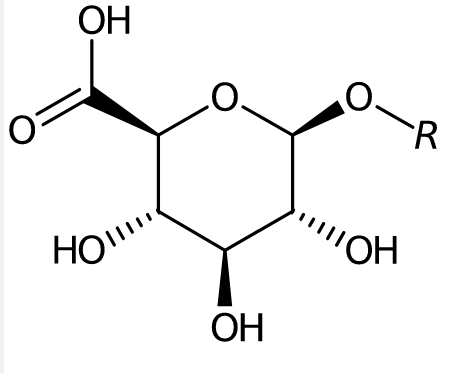
<p>From a <a href="https://wikipathways.org/">WikiPathways</a> there is additional complexity, with modified proteins involved in lipid metabolism, the acyl-carrier
proteins. They look like this, and the R group is a protein:</p>

<p><img src="/assets/images/Screenshot_20220801_180944.png" alt="" /></p>

<p>We have quite a few of them in WikiPathway and they also show up in <a href="https://www.ebi.ac.uk/chebi/searchId.do?chebiId=CHEBI:5697">ChEBI</a> (and likely
Reactome), <a href="https://www.lipidmaps.org/databases/lmsd/LMFA07060040?LMID=LMFA07060040">LIPID MAPS</a>, and
<a href="https://www.kegg.jp/entry/C05764">KEGG</a>.</p>

<p>During this years Dagstuhl we used up one session to continue working on it (report pending). Part of the results is that
<a href="https://www.wikidata.org/">Wikidata</a> (see doi:<a href="https://doi.org/10.7554/eLife.52614">10.7554/eLife.52614</a> and
doi:<a href="https://doi.org/10.7554/eLife.70780">10.7554/eLife.70780</a>) now has <a href="https://www.wikidata.org/wiki/Property:P10718">a property for CXSMILES</a>.
CDK 2.0 (doi:<a href="https://doi.org/10.1186/s13321-017-0220-4">10.1186/s13321-017-0220-4</a>) already supported CXSMILES and the above image is actually created with
<a href="https://github.com/cdk/depict">CDK Depict</a> (thx to John!).</p>

<p>So, that means I can now start adding all those ACPs to Wikidata :) Here’s <a href="https://www.wikidata.org/wiki/Q113377202">hexadecanoyl-[acp]</a>
(or this <a href="https://scholia.toolforge.org/chemical-class/Q113377202">Scholia page</a>):</p>

<p><img src="/assets/images/Screenshot_20220801_182345.png" alt="" /></p>]]></content><author><name>Egon Willighagen</name></author><category term="cdk" /><category term="chebi" /><category term="dagstuhl" /><category term="epilipidnet" /><category term="kegg" /><category term="wikipathways" /><category term="lipidmaps" /><category term="metabolomics" /><category term="smiles" /><category term="wikidata" /><category term="doi:10.7554/ELIFE.52614" /><category term="doi:10.7554/ELIFE.70780" /><category term="doi:10.1186/S13321-017-0220-4" /><category term="cxsmiles" /><summary type="html"><![CDATA[Already 3 months ago I visited Dagstuhl for the second time. The weather was much better than in the January right before the start of the pandemic. The first I attended the Computational Metabolomics meeting, with the focus From Cheminformatics to Machine Learning, one of the things we concerned ourselves with was how to do computation with compound classes (see Section 3.6 and this online book). We know how to handle SMILES and we know how to the substructure searching with SMARTS, but what if you have compound classes or lipid classes? Biology is a greasy business.]]></summary></entry><entry><title type="html">ChemCuration: a small trick to fix the SMILES of glucuronides</title><link href="https://chem-bla-ics.linkedchemistry.info/2019/10/09/chemcuration-small-trick-to-fix-smiles.html" rel="alternate" type="text/html" title="ChemCuration: a small trick to fix the SMILES of glucuronides" /><published>2019-10-09T00:00:00+00:00</published><updated>2019-10-09T00:00:00+00:00</updated><id>https://chem-bla-ics.linkedchemistry.info/2019/10/09/chemcuration-small-trick-to-fix-smiles</id><content type="html" xml:base="https://chem-bla-ics.linkedchemistry.info/2019/10/09/chemcuration-small-trick-to-fix-smiles.html"><![CDATA[<p><span style="width: 40%; display: block; margin-left: auto; margin-right: auto; float: right">
<img src="/assets/images/Screenshot_20191008_144049.png" /> <br />
Glucuronide functional group.
</span></p>

<p>Now that the <a href="https://chemcuration.github.io/chemcuration2019/">ChemCuration 2019</a> online poster conference is nearing, and
my upcoming talks about chemistry in <a href="https://wikidata.org/">Wikidata</a> (also needing curation), and the much longer process
of curation of metabolite (-like) structures in <a href="https://wikipathways.org/">WikiPathways</a>, I decided that something I
tweeted earlier this week is actually quite useful, and therefore something I should really write up in my lab notebook.</p>

<p><a href="https://en.wikipedia.org/wiki/Glucuronide">Glucuronide</a> is an example (biological) functional group. And there are several
databases that represent the stereochemistry now always correct. That is an interoperability (and thus FAIR) problem.
Correcting this is not trivial, particularly if you have to redraw the same glucuronide group again and again.</p>

<p>So, not looking forward to that, I invested a bit of time to find a <a href="http://opensmiles.org/">SMILES</a> trick. What if I had
a SMILES snippet that I could easily copy/paste and attach to the SMILES of the chemical structure it is attached to? Here
goes.</p>

<div class="language-plaintext highlighter-rouge"><div class="highlight"><pre class="highlight"><code>O1[C@H](C(O)=O)[C@H]([C@H](O)[C@@H](O)[C@@H]1O9)O.
</code></pre></div></div>

<p>I just realized that <a href="https://twitter.com/egonwillighagen/status/1181573810543321088">the original 3 I used</a> can better be
a <code class="language-plaintext highlighter-rouge">9</code>, which is less likely to occur in the SMILES of the rest of the molecule. The period at the end is also deliberate.
That way, I can just copy past the SMILES of the rest directly after that period. Then I get a disconnected structure, but
I only have to put a 9 next to the atom that is binding to the glucuronide. So, let’s see the R group is methane, I get:</p>

<div class="language-plaintext highlighter-rouge"><div class="highlight"><pre class="highlight"><code>O1[C@H](C(O)=O)[C@H]([C@H](O)[C@@H](O)[C@@H]1O9)O.C9
</code></pre></div></div>

<p>Now, next stop: <code class="language-plaintext highlighter-rouge">CoA</code> and other common biological tags.</p>]]></content><author><name>Egon Willighagen</name></author><category term="chemistry" /><category term="curation" /><category term="wikidata" /><category term="wikipathways" /><category term="smiles" /><summary type="html"><![CDATA[Glucuronide functional group.]]></summary><media:thumbnail xmlns:media="http://search.yahoo.com/mrss/" url="https://chem-bla-ics.linkedchemistry.info/assets/images/Screenshot_20191008_144049.png" /><media:content medium="image" url="https://chem-bla-ics.linkedchemistry.info/assets/images/Screenshot_20191008_144049.png" xmlns:media="http://search.yahoo.com/mrss/" /></entry><entry><title type="html">Slow publishing innovation: SMILES in ACS journals</title><link href="https://chem-bla-ics.linkedchemistry.info/2014/02/21/slow-publishing-innovation.html" rel="alternate" type="text/html" title="Slow publishing innovation: SMILES in ACS journals" /><published>2014-02-21T00:00:00+00:00</published><updated>2014-02-21T00:00:00+00:00</updated><id>https://chem-bla-ics.linkedchemistry.info/2014/02/21/slow-publishing-innovation</id><content type="html" xml:base="https://chem-bla-ics.linkedchemistry.info/2014/02/21/slow-publishing-innovation.html"><![CDATA[<p>Elsevier is not the only publisher with a <a href="https://chem-bla-ics.linkedchemistry.info/2014/02/15/elseviers-new-text-mining-initiative-is.html">large innovation inertia</a>.
In fact, I think many large organizations do, particularly if there are too many interdependencies, causing too long lines. Greg Laundrum
<a href="https://plus.google.com/u/0/+GregLandrum/posts/JsgLruHQ6go">made me aware</a> that one <a href="http://acs.org/">American Chemical Society</a>
journal is now <a href="http://pubs.acs.org/doi/full/10.1021/jm5002056">going to encourage</a> (not require) machine readable forms of chemical
structures to be included in their flagship. The reasoning by Gilson <em>et al.</em> is balanced. It is also 15 years too late. This
question was relevant at the end of the last century. The technologies were already more advanced than what will now be adopted.
15 years!!! Seriously, that’s close to the time it takes to bring a new drug on the market!</p>

<p>Look at what they suggest and think about it. Include SMILES strings for structures in the paper. I very much welcome this, of course,
despite I am not a big fan of SMILES at all. They could have said something about <a href="http://opensmiles.org/spec/open-smiles.html">OpenSMILES</a>
too, which is more precise. They do say something about the InChI and InChIKey, but not that the SMILES string can more precisely reflect
the drawing. I wonder why they don’t go for a format that can actually capture the image, like CML or a MDL molfile. Then again, a SMILES
copy/pastes so nicely. Talking about slow innovation. There is zero technical reason you could not copy/paste a MDL molfile into a
spreadsheet (and you can with many tools, in fact…)</p>

<p>Now, I still have tons of questions. What tool will be used to validate the correctness and absence of ambiguity before the publication?
Will the SMILES strings be validated at all? And at what level? Will it have to be compatible with particular tools? Does it have to be
compatible with OpenSMILES? Under what license will these SMILES be available (can we data mine <a href="https://en.wikipedia.org/wiki/Digital_object_identifier">DOI</a>-SMILES
links and openly share them)? What was the reasoning for finally adopting this? Will the journal also accept submission where both SMILES
and other formats are provided? Will they accept or deny SMARTS strings (e.g. for Markush structures)?</p>

<p>All in all, I second the others, and am happy to see this step. I do hope they do not stop here and wait again 15 years for another step.
In fact, they ask for input on <a href="mailto:jmc@jmedchem.acs.org">jmc@jmedchem.acs.org</a>. That is double promising!</p>]]></content><author><name>Egon Willighagen</name></author><category term="publishing" /><category term="smiles" /><category term="acs" /><category term="cito:discusses:10.1021/jm5002056" /><summary type="html"><![CDATA[Elsevier is not the only publisher with a large innovation inertia. In fact, I think many large organizations do, particularly if there are too many interdependencies, causing too long lines. Greg Laundrum made me aware that one American Chemical Society journal is now going to encourage (not require) machine readable forms of chemical structures to be included in their flagship. The reasoning by Gilson et al. is balanced. It is also 15 years too late. This question was relevant at the end of the last century. The technologies were already more advanced than what will now be adopted. 15 years!!! Seriously, that’s close to the time it takes to bring a new drug on the market!]]></summary></entry><entry><title type="html">ChemSpider fail #1: SMILES</title><link href="https://chem-bla-ics.linkedchemistry.info/2009/08/06/chemspider-fail-1-smiles.html" rel="alternate" type="text/html" title="ChemSpider fail #1: SMILES" /><published>2009-08-06T00:00:00+00:00</published><updated>2009-08-06T00:00:00+00:00</updated><id>https://chem-bla-ics.linkedchemistry.info/2009/08/06/chemspider-fail-1-smiles</id><content type="html" xml:base="https://chem-bla-ics.linkedchemistry.info/2009/08/06/chemspider-fail-1-smiles.html"><![CDATA[<p>Cheminformatics is difficult, I know. But I thought I used a simple SMILES when I typed <em>C1CNCC1</em>, but <a href="http://www.chemspider.com/">ChemSpider</a>
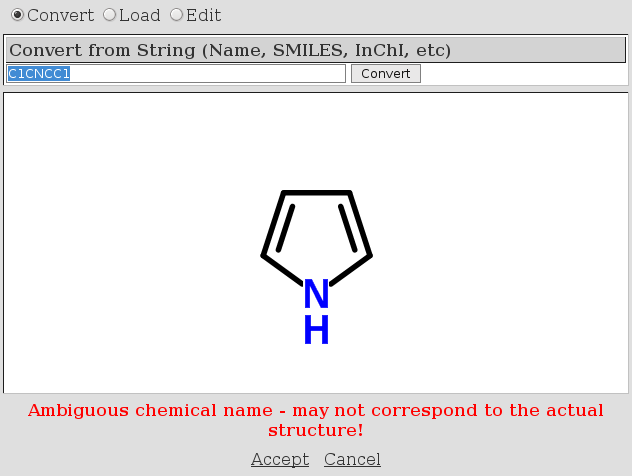
got it wrong :) The correct structure should be <a href="http://en.wikipedia.org/wiki/Pyrrolidine">pyrrolidine</a>, not
<a href="http://en.wikipedia.org/wiki/Pyrrole">pyrrole</a>. I always mix up those names, so defaulted to ChemSpider to give me the correct name, which
<a href="http://www.chemspider.com/RecordView.aspx?rid=3fdc7226-0f87-44c5-b367-f3fdbda4bbde">ChemSpider knows</a> and where it also has the
SMILES correct… there just seems something wrong with there search dialog:</p>

<p><img src="/assets/images/chemSpiderFail.png" alt="" /></p>

<p>There has been <a href="http://www.chemspider.com/blog/?p=55">some talk about a ChemSpider Bugzilla</a>, but I don’t think this has
materialized yet, and I’ll have the default to <em>info-at-chemspider-dot-com</em> …</p>]]></content><author><name>Egon Willighagen</name></author><category term="chemspider" /><category term="smiles" /><category term="inchikey:RWRDLPDLKQPQOW-UHFFFAOYSA-N" /><summary type="html"><![CDATA[Cheminformatics is difficult, I know. But I thought I used a simple SMILES when I typed C1CNCC1, but ChemSpider got it wrong :) The correct structure should be pyrrolidine, not pyrrole. I always mix up those names, so defaulted to ChemSpider to give me the correct name, which ChemSpider knows and where it also has the SMILES correct… there just seems something wrong with there search dialog:]]></summary><media:thumbnail xmlns:media="http://search.yahoo.com/mrss/" url="https://chem-bla-ics.linkedchemistry.info/assets/images/chemSpiderFail.png" /><media:content medium="image" url="https://chem-bla-ics.linkedchemistry.info/assets/images/chemSpiderFail.png" xmlns:media="http://search.yahoo.com/mrss/" /></entry><entry><title type="html">DBPedia enters rdf.openmolecules.net</title><link href="https://chem-bla-ics.linkedchemistry.info/2009/02/17/dbpedia-enters-rdfopenmoleculesnet.html" rel="alternate" type="text/html" title="DBPedia enters rdf.openmolecules.net" /><published>2009-02-17T00:00:00+00:00</published><updated>2009-02-17T00:00:00+00:00</updated><id>https://chem-bla-ics.linkedchemistry.info/2009/02/17/dbpedia-enters-rdfopenmoleculesnet</id><content type="html" xml:base="https://chem-bla-ics.linkedchemistry.info/2009/02/17/dbpedia-enters-rdfopenmoleculesnet.html"><![CDATA[<p>As of tonight, <a href="http://rdf.openmolecules.net/">rdf.openmolecules.net</a> links to the chemistry <a href="http://www.dbpedia.org/">DBPedia</a> (1816 chemical compounds),
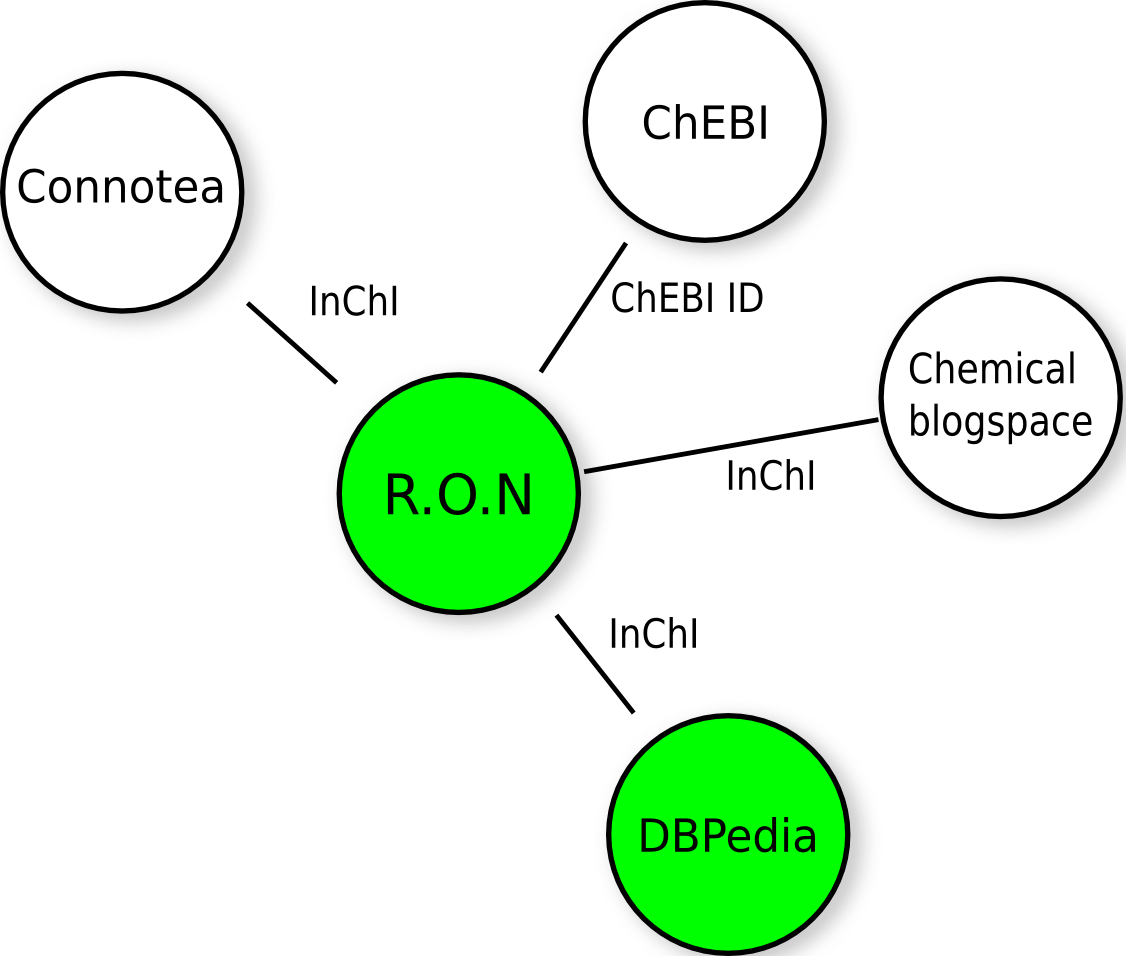
for which I used the SPARQL given in <a href="https://chem-bla-ics.linkedchemistry.info/2009/02/11/dbpedia-lookup-and-autocomplete-of.html">DBPedia: lookup and autocomplete of chemistry <i class="fa-solid fa-recycle fa-xs"></i></a>.
It’s first of several steps to extend rdf.openmolecules.net to link up various chemistry database. The below figure shows the current state, where the green nodes are fully RDF-ied:</p>

<p><img src="/assets/images/ons.png" alt="" /></p>

<p>Drugs are still missing, but will add those too, and since not all entries had InChIs, SMILES were converted using
<a href="https://chem-bla-ics.linkedchemistry.info/2009/02/10/cdk-12-release-candidate.html">CDK 1.1.5 <i class="fa-solid fa-recycle fa-xs"></i></a>.</p>]]></content><author><name>Egon Willighagen</name></author><category term="rdf" /><category term="dbpedia" /><category term="sparql" /><category term="inchi" /><category term="smiles" /><category term="chebi" /><category term="cb" /><summary type="html"><![CDATA[As of tonight, rdf.openmolecules.net links to the chemistry DBPedia (1816 chemical compounds), for which I used the SPARQL given in DBPedia: lookup and autocomplete of chemistry . It’s first of several steps to extend rdf.openmolecules.net to link up various chemistry database. The below figure shows the current state, where the green nodes are fully RDF-ied:]]></summary><media:thumbnail xmlns:media="http://search.yahoo.com/mrss/" url="https://chem-bla-ics.linkedchemistry.info/assets/images/ons.png" /><media:content medium="image" url="https://chem-bla-ics.linkedchemistry.info/assets/images/ons.png" xmlns:media="http://search.yahoo.com/mrss/" /></entry><entry><title type="html">DBPedia: lookup and autocomplete of chemistry</title><link href="https://chem-bla-ics.linkedchemistry.info/2009/02/11/dbpedia-lookup-and-autocomplete-of.html" rel="alternate" type="text/html" title="DBPedia: lookup and autocomplete of chemistry" /><published>2009-02-11T00:00:00+00:00</published><updated>2009-02-11T00:00:00+00:00</updated><id>https://chem-bla-ics.linkedchemistry.info/2009/02/11/dbpedia-lookup-and-autocomplete-of</id><content type="html" xml:base="https://chem-bla-ics.linkedchemistry.info/2009/02/11/dbpedia-lookup-and-autocomplete-of.html"><![CDATA[<p>On the <a href="http://dbpedia.org/">DBPedia</a> <a href="https://lists.sourceforge.net/lists/listinfo/dbpedia-discussion">discussion mailing list</a> there was a post on a
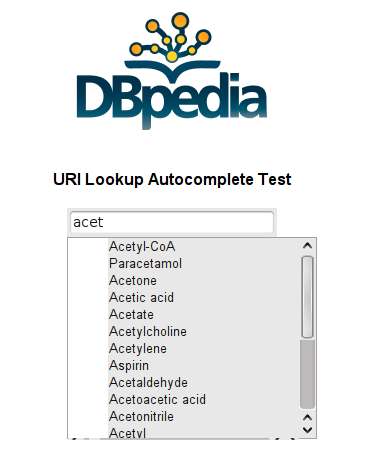
nice web page which allows you to look up things, and which features a autocomplete edit field. The below screenshot show lookup of molecular structures:</p>

<p><img src="/assets/images/dbpediaAutocomplete.png" alt="" /></p>

<p>If you are not ware of this, adding content to DBPedia is as easy as adding something to <a href="http://www.wikipedia.org/">WikiPedia</a>. Literally: DBPedia is
the <a href="http://en.wikipedia.org/wiki/Resource_Description_Framework">RDF</a> flavour of WikiPedia. It extracts the information from the info boxes, as I
discussed before (see <a href="https://chem-bla-ics.linkedchemistry.info/2007/08/02/molecules-in-wikipedia.html">Molecules in Wikipedia <i class="fa-solid fa-recycle fa-xs"></i></a>).</p>

<p>BTW, one can take advantage of DBPedia to see what WikiPedia has to offer in terms of chemistry. For example, to list all molecules which have a SMILES, one can use this simple SPARQL query:</p>

<script src="http://gist.github.com/57559.js"></script>

<p>Or, to list those which have an InChI:</p>

<script src="https://gist.github.com/57571.js"></script>

<p>And this is actually quite useful, e.g. it can be used in quality control. Running the above queries will show up several broken SMILES and InChIs. I have not had time to fix those yet, so please go ahead and beat me to those fixes, and get some WikiPedia Fame :) Alternatively, invert the queries and add missing InChIs, PubChem CID or SMILES. When I have a bit more free time again, after the new stable CDK and Bioclipse releases, I’ll runs these analyses again, and summarize them in a web page.</p>]]></content><author><name>Egon Willighagen</name></author><category term="rdf" /><category term="dbpedia" /><category term="wikipedia" /><category term="smiles" /><category term="inchi" /><summary type="html"><![CDATA[On the DBPedia discussion mailing list there was a post on a nice web page which allows you to look up things, and which features a autocomplete edit field. The below screenshot show lookup of molecular structures:]]></summary><media:thumbnail xmlns:media="http://search.yahoo.com/mrss/" url="https://chem-bla-ics.linkedchemistry.info/assets/images/dbpediaAutocomplete.png" /><media:content medium="image" url="https://chem-bla-ics.linkedchemistry.info/assets/images/dbpediaAutocomplete.png" xmlns:media="http://search.yahoo.com/mrss/" /></entry><entry><title type="html">SMILES to become an Open Standard</title><link href="https://chem-bla-ics.linkedchemistry.info/2007/09/28/smiles-to-become-open-standard.html" rel="alternate" type="text/html" title="SMILES to become an Open Standard" /><published>2007-09-28T00:00:00+00:00</published><updated>2007-09-28T00:00:00+00:00</updated><id>https://chem-bla-ics.linkedchemistry.info/2007/09/28/smiles-to-become-open-standard</id><content type="html" xml:base="https://chem-bla-ics.linkedchemistry.info/2007/09/28/smiles-to-become-open-standard.html"><![CDATA[<p>Craig James wants <a href="http://sourceforge.net/mailarchive/forum.php?thread_name=46FA7584.9080902%40emolecules.com&amp;forum_name=blueobelisk-discuss">to make SMILES an open standard</a>,
and this has been received with much enthusiasm. SMILES (<a href="http://en.wikipedia.org/wiki/SMILES">Simplified molecular input line entry specification</a>)
is a de facto standard in chemoinformatics, but the specification is not overly clear, which Craig wants to address. The
<a href="http://blueobelisk.svn.sf.net/svnroot/blueobelisk/smiles-spec/trunk/smiles_spec.html">draft</a> is CC-licensed and will be discussed on the new
<a href="http://www.blueobelisk.org/">Blue Obelisk</a> <a href="http://sourceforge.net/mailarchive/forum.php?forum_name=blueobelisk-smiles">blueobelisk-smiles</a>
mailing list.</p>

<p>Illustrative is my confusion about the sp2 hybridized atoms, which use lower case element symbols in SMILES. Very often this is seen as
indicating aromaticity. I have written up <a href="http://wiki.cubic.uni-koeln.de/cdkwiki/doku.php?id=smiles_aromaticity">the arguments supporting both views</a>
in the <a href="http://wiki.cubic.uni-koeln.de/cdkwiki/doku.php?id=start">CDK wiki</a>. I held the position that lower case elements indicated
sp2 hybridization, and the CDK SMILES parser was converted accordingly some years ago. A recent discussion, however, stirred up the
discussion once more (which led to the aforementioned wiki page).</p>

<p>You can imagine my excitement when I looked up the meaning in the new draft. It states: <em>The formal meaning of a lowercase “aromatic”
element in a SMILES string is that the atom is in the sp2 electronic state. When generating a normalized SMILES, all sp2 atoms are
written using a lowercase first character of the atomic symbol. When parsing a SMILES, a parser must note the sp2 designation of each
atom on input, then when the parsing is complete, the SMILES software must verify that electrons can be assigned without violating the
valence rules, consistent with the sp2 markings, the specified or implied hydrogens, external bonds, and charges on the atoms.</em></p>]]></content><author><name>Egon Willighagen</name></author><category term="smiles" /><category term="blue-obelisk" /><summary type="html"><![CDATA[Craig James wants to make SMILES an open standard, and this has been received with much enthusiasm. SMILES (Simplified molecular input line entry specification) is a de facto standard in chemoinformatics, but the specification is not overly clear, which Craig wants to address. The draft is CC-licensed and will be discussed on the new Blue Obelisk blueobelisk-smiles mailing list.]]></summary></entry><entry><title type="html">CDK Workshop - Days #3 and #4</title><link href="https://chem-bla-ics.linkedchemistry.info/2007/02/03/cdk-workshop-days-3-and-4.html" rel="alternate" type="text/html" title="CDK Workshop - Days #3 and #4" /><published>2007-02-03T00:00:00+00:00</published><updated>2007-02-03T00:00:00+00:00</updated><id>https://chem-bla-ics.linkedchemistry.info/2007/02/03/cdk-workshop-days-3-and-4</id><content type="html" xml:base="https://chem-bla-ics.linkedchemistry.info/2007/02/03/cdk-workshop-days-3-and-4.html"><![CDATA[<p>Days #3 and #4 of the <a href="http://wiki.cubic.uni-koeln.de/cdkwiki/doku.php?id=spring2007workshop">CDK Workshop</a> have been
quite busy indeed, and I have not been able to summarize them so far. After <a href="https://chem-bla-ics.linkedchemistry.info/2007/01/30/cdk-workshop-day-2.html">a rather interesting day #2 <i class="fa-solid fa-recycle fa-xs"></i></a>,
the third day was the last one with scheduled presentations. Kai Hartmann showed how he used the CDK in his systems
biology research, and contributed the code he wrote to predict Gibbs energies based on fragment contributions.
Miguel Rojas showed his MS prediction work, which is based on the CDK too.</p>

<p>Much of the rest of day and Thursday continued on the work started yesterday: making the 3D structure builder a
singleton class, and applying and testing an optimization for the AllRingsFinder to address
<a href="https://chem-bla-ics.linkedchemistry.info/2007/01/30/cdk-workshop-day-2.html">molecules like Choloyl-CoA <i class="fa-solid fa-recycle fa-xs"></i></a>. The trick
basically consists of applying the all rings finding algorithm to isolated systems only. The effect is
considerable: the total computation time for Choloyl-CoA decreases by a 93 fold! We found that the
fingerprints used in the template library for the 3D structure builder are outdated, and Christoph worked
on updating that, which required searching into old archives to find the tool to do just this.</p>

<p>Because the above performance fix did not fix the current slow SMILES parsing, Kai looked at the
<code class="language-plaintext highlighter-rouge">DeduceBondOrderTool</code> which is the slow component, and optimized the used algorithm by reusing determined
molecular ring systems. Nevertheless, on users requests, a time out mechanism is now available for SMILES
parsing. Additionally, several of the bugs found on the second workshop day have been fixed. Meanwhile,
I was distracted by other things. For example, fixing <a href="http://www.bioclipse.net/">Bioclipse</a> bugs for
<a href="http://bioclipse.blogspot.com/2007/02/bioclipse-101-released.html">the version 1.0.1 released yesterday</a>.
The SENECA tool is not forgotten too, and last weekend I made some good progress with it,
<a href="http://wiki.cubic.uni-koeln.de/blog/pivot/entry.php?id=15">which Christoph blogged about</a>.</p>]]></content><author><name>Egon Willighagen</name></author><category term="cdk" /><category term="smiles" /><summary type="html"><![CDATA[Days #3 and #4 of the CDK Workshop have been quite busy indeed, and I have not been able to summarize them so far. After a rather interesting day #2 , the third day was the last one with scheduled presentations. Kai Hartmann showed how he used the CDK in his systems biology research, and contributed the code he wrote to predict Gibbs energies based on fragment contributions. Miguel Rojas showed his MS prediction work, which is based on the CDK too.]]></summary></entry></feed>