<?xml version="1.0" encoding="utf-8"?><feed xmlns="http://www.w3.org/2005/Atom" ><generator uri="https://jekyllrb.com/" version="4.3.4">Jekyll</generator><link href="https://chem-bla-ics.linkedchemistry.info/feed/by_tag/semweb.xml" rel="self" type="application/atom+xml" /><link href="https://chem-bla-ics.linkedchemistry.info/" rel="alternate" type="text/html" /><updated>2026-10-07T12:46:55+00:00</updated><id>https://chem-bla-ics.linkedchemistry.info/feed/by_tag/semweb.xml</id><title type="html">chem-bla-ics</title><subtitle>Chemblaics (pronounced chem-bla-ics) is the science that uses open science and computers to solve problems in chemistry, biochemistry and related fields.</subtitle><author><name>Egon Willighagen</name></author><entry><title type="html">Using compact identifiers in project reports</title><link href="https://chem-bla-ics.linkedchemistry.info/2026/03/29/using-compact-identifiers-in-project-reports.html" rel="alternate" type="text/html" title="Using compact identifiers in project reports" /><published>2026-03-29T00:00:00+00:00</published><updated>2026-03-29T00:00:00+00:00</updated><id>https://chem-bla-ics.linkedchemistry.info/2026/03/29/using-compact-identifiers-in-project-reports</id><content type="html" xml:base="https://chem-bla-ics.linkedchemistry.info/2026/03/29/using-compact-identifiers-in-project-reports.html"><![CDATA[<p>This document describes how you can improve the FAIR-ness of your project report by using
compact identifiers. Of course, it can be applied to any other document too, and has been used
in, for example, journal articles and online documentation already.</p>

<p>Compact identifiers find a balance between compactness in writing and being a persistent, unique,
and global identifier. It “is a string constructed by concatenating a namespace prefix, a separating colon,
and a locally unique identifier (LUI)” (doi:<a href="https://doi.org/10.1038/sdata.2018.29">10.1038/sdata.2018.29</a>).
For example, for proteins it can represent the PDB structure <a href="https://bioregistry.io/pdb:2gc4">2gc4</a> as
<em>pdb:2gc4</em>. There is a clear similarity with the SciCrunch <a href="https://rrid.site/">Research Resource Identifiers</a>
(RRIDs) as used by several journals, like
<a href="https://elifesciences.org/inside-elife/ff683ecc/rrids-how-did-we-get-here-and-where-are-we-going">eLife</a>
(doi:<a href="https://doi.org/10.1007/s12021-015-9284-3">10.1007/s12021-015-9284-3</a>).</p>

<p>When the prefixes are defined by community standards, then a compact identifier can be resolved.
There currently are multiple providers of prefix files (doi:<a href="https://doi.org/10.1038/sdata.2018.29">10.1038/sdata.2018.29</a>),
including Identifiers.org (doi:<a href="https://doi.org/10.1093/bioinformatics/btaa864">10.1093/bioinformatics/btaa864</a>)
and Bioregistry (doi:<a href="https://doi.org/10.1038/s41597-022-01807-3">10.1038/s41597-022-01807-3</a>).
The Bioregistry has an overview of more than twenty registries of prefixes and their metadata
(doi:<a href="https://doi.org/10.1038/s41597-022-01807-3">10.1038/s41597-022-01807-3</a>). The metadata commonly
includes information on the URL pattern for each identifier. Often this is more than one pattern, as
there may more several databases with information for the same identifier.</p>

<p>It is the URL pattern in the database that allows services to <em>resolve</em> the compact identifier
into a link to a database. The above registries correspond to three existing <em>resolvers</em> that will take a compact
identifier as part of a resolver URL and redirect to the database with the record matching
that identifier:</p>

<ul>
  <li>Name-to-Thing (N2T): <a href="https://n2t.net/">https://n2t.net/</a></li>
  <li>Identifiers.org: <a href="https://identifiers.org/">https://identifiers.org/</a></li>
  <li>The Bioregistry: <a href="https://bioregistry.io/">https://bioregistry.io/</a></li>
</ul>

<p>Each of these URLs can be extended with a compact identifier. For example, a taxon record
from the NCBI databases or the PDB entry mentioned earlier:</p>

<ul>
  <li><a href="https://bioregistry.io/pdb:2gc4">https://bioregistry.io/pdb:2gc4</a></li>
  <li><a href="https://identifiers.org/col:6MB3T">https://identifiers.org/col:6MB3T</a> (<code class="language-plaintext highlighter-rouge">col</code> is the prefix for the Catalogue of Life)</li>
</ul>

<h2 id="why-use-in-reports">Why use in reports?</h2>

<p>Using persistent identifiers is generally accepted as a good practice that benefits science
and has been part of the ideas of FAIR data (doi:<a href="https://doi.org/10.1038/sdata.2016.18">10.1038/sdata.2016.18</a>)
and of Open Science. Compact
identifiers make it easy to be precise in reports about what things the reports talk about: they
are relatively short but very precise at the same time. also, that has the benefit that they
are much easier to reuse than labels of things and concepts that intrinsically have a certain
level of uncertainty; a database entry has commonly a very specific meaning.</p>

<h2 id="examples-uses">Examples uses</h2>

<p>The use of compact identifiers can be used in two ways. The simplest is to just put the
compact identifier as plain text in the document, possibly in parentheses
(with the compact identifier highlighted here in bold):</p>

<ul>
  <i>This report is only about the experimental data of the human (<b>NCBITaxon:9606</b>) cell lines.</i>
</ul>

<p>Or:</p>

<ul>
  <i>We found that BRCA1 (<b>ensembl:ENSG00000012048</b>) played an important role.</i>
</ul>

<p>Alternatively, you can add a hyperlink with one of the resolvers, for example, Identifiers.org:</p>

<ul>
  <i>We found that BRCA1 (<b><a href="https://identifiers.org/ensembl:ENSG00000012048">ensembl:ENSG00000012048</a></b>) played an important role.</i>
</ul>

<h3 id="compact-identifiers-for-material-identifiers">Compact identifiers for material identifiers</h3>

<p>The European Registry of Materials proposes to use the compact identifier for their
ERM identifiers (doi:<a href="https://doi.org/10.1186/s13321-022-00614-7">10.1186/s13321-022-00614-7</a>):</p>

<ul>
  <i>
    For example, the NanoSolveIT project registered a material with the ERM00000001 identifier.
    The full Uniform Resource Identifier (URI) for this compound is
    https://nanocommons.github.io/identifiers/registry#ERM00000001 which is too long to be used
    in documentation. The corresponding compact identifier <b>erm:ERM00000001</b> is easy to use in written
    material, analogous to the use of Protein Data Bank (PDB) identifiers for proteins in journals.
  </i>
</ul>

<h3 id="compact-identifiers-for-citation-intent-annotations">Compact identifiers for citation intent annotations</h3>

<p>The compact identifier has also been used as the method to include citation intentions in journal
articles (doi:<a href="https://doi.org/10.1186/s13321-020-00448-1">10.1186/s13321-020-00448-1</a>,
compact identifier here highlighted in bold):</p>

<ul>
  <i>
    We take advantage here of the ability to add notes to full form [..] references in bibliographies.
    These are referred to as bibnotes. The content of the note will be strictly formatted: it will use
    the syntax [<b>cito:usesMethodIn</b>] and formatted in bold. That is, the bibnote starts with the
    [ character, followed by one of the CiTO types, and ends with the ] character. If you wish to
    provide more than one annotation, you can repeat this syntax, separated by one or more spaces,
    for example: [<b>cito:usesMethodIn</b>] [<b>cito:citeAsAuthority</b>].
  </i>
</ul>

<p>Note that in this use, the square brackets and bold typeface are used to make them easier to
be recognized. Also, note that this document uses this approach to indicate the intention of
why the cited articles are cited.</p>

<h2 id="conclusion">Conclusion</h2>

<p>This document described what the compact identifier is, how it helps linking to online
databases, and how they can be used in written reports as plain text, optionally
hyperlinked with one of the compact identifier resolvers.</p>

<h3 id="acknowledgments">Acknowledgments</h3>

<p>I thank <a href="https://n2t.net/github:tabbassidaloii">github:tabbassidaloii</a>,
<a href="https://n2t.net/github:cthoyt">github:cthoyt</a>, and
<a href="https://n2t.net/github:larsgw">github:larsgw</a> for their comment on
<a href="https://github.com/egonw/compact-ids-in-reports">this GitHub repo</a>.</p>]]></content><author><name>Egon Willighagen</name></author><category term="identifier" /><category term="semweb" /><category term="cito" /><category term="cito:usesMethodIn,includesQuotationFrom:10.1038/sdata.2018.29" /><category term="cito:obtainsBackgroundFrom:10.1007/s12021-015-9284-3" /><category term="cito:usesMethodIn:10.1093/bioinformatics/btaa864" /><category term="mycito:usesMethodIn:10.1038/S41597-022-01807-3" /><category term="cito:obtainsBackgroundFrom:10.1038/sdata.2016.18" /><category term="mycito:includesQuotationFrom:10.1186/S13321-022-00614-7" /><category term="mycito:includesQuotationFrom:10.1186/S13321-020-00448-1" /><summary type="html"><![CDATA[This document describes how you can improve the FAIR-ness of your project report by using compact identifiers. Of course, it can be applied to any other document too, and has been used in, for example, journal articles and online documentation already.]]></summary></entry><entry><title type="html">Kasabi archive at the Internet Archive</title><link href="https://chem-bla-ics.linkedchemistry.info/2024/08/15/kasabi-archives.html" rel="alternate" type="text/html" title="Kasabi archive at the Internet Archive" /><published>2024-08-15T00:00:00+00:00</published><updated>2024-08-15T00:00:00+00:00</updated><id>https://chem-bla-ics.linkedchemistry.info/2024/08/15/kasabi-archives</id><content type="html" xml:base="https://chem-bla-ics.linkedchemistry.info/2024/08/15/kasabi-archives.html"><![CDATA[<p><a href="https://www.wikidata.org/wiki/Q128214915">Kasabi</a> was an innovative RDF publishing platform from around 2011.
<a href="https://web.archive.org/web/20130907095112/http://blog.kasabi.com/about/">Shortlived</a>, and maybe just too early.
I published two open datasets there. One was ChEMBL-RDF (see these <a href="https://chem-bla-ics.linkedchemistry.info/tag/chembl">posts</a>).
The second was a small data sets called <a href="https://chem-bla-ics.linkedchemistry.info/2011/07/06/chempedia-rdf-2-kasabi.html">ChemPedia</a>,
a open science effort to crowdsource chemical names. This is still very much needed, and possibly Wikidata could fill that gap,
but it would first need to be able to handle all labels as statements itself.</p>

<p>Anyway, just before they shutdown because of, I understood, lack of commercial interest, they
<a href="https://archive.org/details/kasabi">archived all data</a>, including the ChemPedia datasets. I was happy to be reminded about that,
because I am not sure I had archived that data.</p>]]></content><author><name>Egon Willighagen</name></author><category term="semweb" /><category term="chembl" /><category term="kasabi" /><category term="ia" /><category term="chempedia" /><summary type="html"><![CDATA[Kasabi was an innovative RDF publishing platform from around 2011. Shortlived, and maybe just too early. I published two open datasets there. One was ChEMBL-RDF (see these posts). The second was a small data sets called ChemPedia, a open science effort to crowdsource chemical names. This is still very much needed, and possibly Wikidata could fill that gap, but it would first need to be able to handle all labels as statements itself.]]></summary></entry><entry><title type="html">“Emerging practices for mapping and linking life sciences data using RDF”</title><link href="https://chem-bla-ics.linkedchemistry.info/2012/04/10/emerging-practices-for-mapping-and.html" rel="alternate" type="text/html" title="“Emerging practices for mapping and linking life sciences data using RDF”" /><published>2012-04-10T00:00:00+00:00</published><updated>2012-04-10T00:00:00+00:00</updated><id>https://chem-bla-ics.linkedchemistry.info/2012/04/10/emerging-practices-for-mapping-and</id><content type="html" xml:base="https://chem-bla-ics.linkedchemistry.info/2012/04/10/emerging-practices-for-mapping-and.html"><![CDATA[<p>The “Emerging practices for mapping and linking life sciences data using RDF” (doi:<a href="https://doi.org/10.1016/j.websem.2012.02.003">10.1016/j.websem.2012.02.003</a>)
is now available online, where I contributed a section on the original workflow for creating <a href="https://www.ebi.ac.uk/chembldb/">ChEMBL</a> triples,
and contributed to the section about open licensing, referring to <a href="http://creativecommons.org/publicdomain/zero/1.0/">CCZero</a> and the
<a href="http://pantonprinciples.org/">Panton Principles</a>. Happy reading!</p>

<p>(Yes, it is indeed an Elsevier journal…)</p>]]></content><author><name>Egon Willighagen</name></author><category term="semweb" /><category term="chembl" /><category term="doi:10.1016/J.WEBSEM.2012.02.003" /><summary type="html"><![CDATA[The “Emerging practices for mapping and linking life sciences data using RDF” (doi:10.1016/j.websem.2012.02.003) is now available online, where I contributed a section on the original workflow for creating ChEMBL triples, and contributed to the section about open licensing, referring to CCZero and the Panton Principles. Happy reading!]]></summary></entry><entry><title type="html">ChEMBL 13 as RDF</title><link href="https://chem-bla-ics.linkedchemistry.info/2012/03/04/chembl-13-as-rdf.html" rel="alternate" type="text/html" title="ChEMBL 13 as RDF" /><published>2012-03-04T00:00:00+00:00</published><updated>2012-03-04T00:00:00+00:00</updated><id>https://chem-bla-ics.linkedchemistry.info/2012/03/04/chembl-13-as-rdf</id><content type="html" xml:base="https://chem-bla-ics.linkedchemistry.info/2012/03/04/chembl-13-as-rdf.html"><![CDATA[<p><strong>Update</strong>: this work is now described in <a href="https://chem-bla-ics.linkedchemistry.info/2013/05/09/new-paper-chembl-database-as-linked.html">this paper <i class="fa-solid fa-recycle fa-xs"></i></a>.</p>

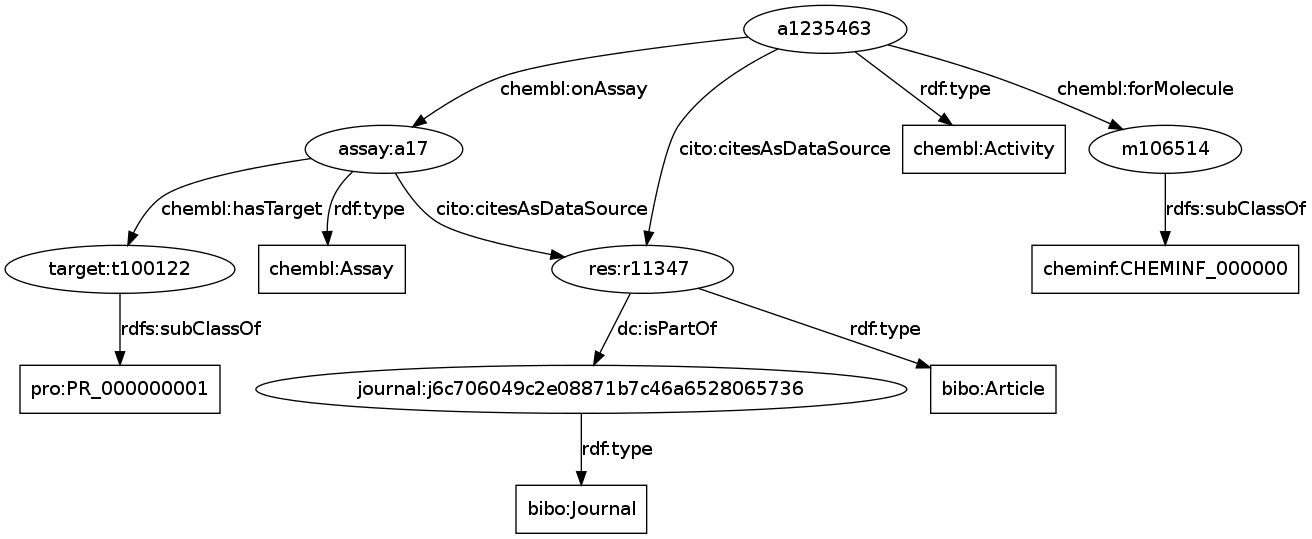
<p>Last week, ChEMBL 13 was <a href="http://chembl.blogspot.com/2012/02/chembl-13-released.html">released</a>, with even more data, data fixes,
<a href="ftp://ftp.ebi.ac.uk/pub/databases/chembl/ChEMBLdb/releases/chembl_13/chembl_13_release_notes.txt">etc</a>. Since my RDF for
<a href="https://chem-bla-ics.linkedchemistry.info/2011/04/21/chembl-09-as-rdf.html">ChEMBL 09 <i class="fa-solid fa-recycle fa-xs"></i></a> my workflow has become
<a href="https://github.com/egonw/chembl.rdf/commits/master">more solid</a> and uses more common ontologies, started using more common ontologies
and ontologies I just like, such as <a href="http://www.plosone.org/article/info:doi/10.1371/journal.pone.0025513">CHEMINF</a> and
<a href="http://www.jbiomedsem.com/content/1/S1/S6">CiTO</a>. Below is an overview of the resource types present in the RDF:
activities (almost 7M now), chemical entities, assays, targets, and documents.</p>

<p><img src="/assets/images/relations.png" alt="" /></p>

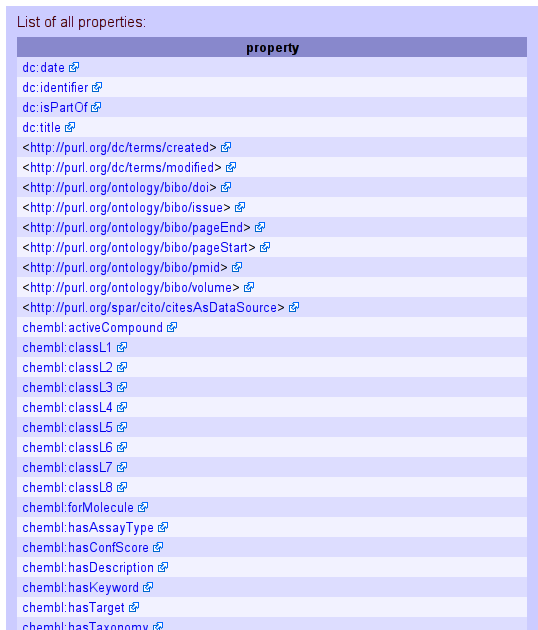
<p>The <a href="https://chem-bla-ics.linkedchemistry.info/2011/10/22/chembl-rdf-uploading-data-to-kasabi.html">data on Kasabi <i class="fa-solid fa-recycle fa-xs"></i></a> will be updated soon,
and the <a href="http://rdf.farmbio.uu.se/chembl/sparql">SPARQL end point</a> hosted by Uppsala University was updated yesterday, including the
<a href="http://rdf.farmbio.uu.se/chembl/snorql/">SNORQL frontend</a>:</p>

<p><img src="/assets/images/chemblRDF13.png" alt="" /></p>

<p>The new data is not fully backwards compatible. The changes to the RDF include the use of <code class="language-plaintext highlighter-rouge">cito:citesAsDataSource</code>, more typing
using existing ontologies, e.g. with <code class="language-plaintext highlighter-rouge">cheminf:CHEMINF_000000</code> and <code class="language-plaintext highlighter-rouge">pro:PR_000000001</code> from the
<a href="http://pir.georgetown.edu/pro/">PRotein Ontology</a>.</p>

<p>A paper dedicated to the ChEMBL-RDF is in preparation. Existing use cases can be found
<a href="http://www.jbiomedsem.com/content/2/S1/S6">here</a>.</p>]]></content><author><name>Egon Willighagen</name></author><category term="chembl" /><category term="rdf" /><category term="semweb" /><category term="ontology" /><category term="cheminf" /><category term="doi:10.1371/JOURNAL.PONE.0025513" /><category term="cito" /><category term="justdoi:10.1186/2041-1480-1-S1-S6" /><category term="doi:10.1186/2041-1480-2-S1-S6" /><summary type="html"><![CDATA[Update: this work is now described in this paper .]]></summary><media:thumbnail xmlns:media="http://search.yahoo.com/mrss/" url="https://chem-bla-ics.linkedchemistry.info/assets/images/relations.png" /><media:content medium="image" url="https://chem-bla-ics.linkedchemistry.info/assets/images/relations.png" xmlns:media="http://search.yahoo.com/mrss/" /></entry><entry><title type="html">ChEMBL-RDF: Uploading data to Kasabi with pytassium</title><link href="https://chem-bla-ics.linkedchemistry.info/2011/10/22/chembl-rdf-uploading-data-to-kasabi.html" rel="alternate" type="text/html" title="ChEMBL-RDF: Uploading data to Kasabi with pytassium" /><published>2011-10-22T00:00:00+00:00</published><updated>2011-10-22T00:00:00+00:00</updated><id>https://chem-bla-ics.linkedchemistry.info/2011/10/22/chembl-rdf-uploading-data-to-kasabi</id><content type="html" xml:base="https://chem-bla-ics.linkedchemistry.info/2011/10/22/chembl-rdf-uploading-data-to-kasabi.html"><![CDATA[<p>I reported earlier how to I <a href="http://chem-bla-ics.blogspot.com/2011/07/chempedia-rdf-3-uploading-data-to.html">uploaded the ChemPedia (RIP) data onto Kasabi</a>.
But for ChEMBL-RDF I have used the <a href="https://github.com/iand/pytassium">pytassium</a> tool, not just because it has a cool name :) I discovered yesterday,
however, that I did not write down in this lab notebook, what steps I needed to take to reproduce it. And I just wanted to uploaded new triples to the
<a href="http://kasabi.com/dataset/chembl-rdf">ChEMBL-RDF data set on Kasabi</a>.</p>

<p>The new triples I wanted to upload, link the <a href="http://chembl.blogspot.com/2011/08/chembl-11-released.html">new public CHEMBL identifiers</a>
(like <a href="https://www.ebi.ac.uk/chembldb/index.php/compound/inspect/CHEMBL25">CHEMBL25 for aspirin</a>) to the internal ChEMBL database identifier I used for
ChEMBL 09 for the URIs. So, I am adding a lot of triples like:</p>

<div class="language-turtle highlighter-rouge"><div class="highlight"><pre class="highlight"><code><span class="nl">&lt;http://data.kasabi.com/dataset/chembl-rdf/09/molecule/m517180&gt;</span><span class="w"> </span><span class="nl">&lt;http://www.w3.org/2002/07/owl#sameAs&gt;</span><span class="w">
</span><span class="nl">&lt;http://data.kasabi.com/dataset/chembl-rdf/09/chemblid/CHEMBL1&gt;</span><span class="w">
</span></code></pre></div></div>

<p>And the pytassium code I use to upload this to Kasabi looks like:</p>

<div class="language-python highlighter-rouge"><div class="highlight"><pre class="highlight"><code><span class="kn">import</span> <span class="n">pytassium</span>
<span class="kn">import</span> <span class="n">time</span>

<span class="n">dataset</span> <span class="o">=</span> <span class="n">pytassium</span><span class="p">.</span><span class="nc">Dataset</span><span class="p">(</span><span class="sh">'</span><span class="s">chembl-rdf</span><span class="sh">'</span><span class="p">,</span><span class="sh">'</span><span class="s">XXX</span><span class="sh">'</span><span class="p">)</span>

<span class="c1"># Store the contents of a turtle file
</span><span class="n">dataset</span><span class="p">.</span><span class="nf">store_file</span><span class="p">(</span><span class="sh">'</span><span class="s">chemblids.nt</span><span class="sh">'</span><span class="p">,</span> <span class="n">media_type</span><span class="o">=</span><span class="sh">'</span><span class="s">text/plain</span><span class="sh">'</span><span class="p">)</span>
</code></pre></div></div>

<p>So, that omission in my log book has been corrected now.</p>]]></content><author><name>Egon Willighagen</name></author><category term="kasabi" /><category term="chembl" /><category term="semweb" /><summary type="html"><![CDATA[I reported earlier how to I uploaded the ChemPedia (RIP) data onto Kasabi. But for ChEMBL-RDF I have used the pytassium tool, not just because it has a cool name :) I discovered yesterday, however, that I did not write down in this lab notebook, what steps I needed to take to reproduce it. And I just wanted to uploaded new triples to the ChEMBL-RDF data set on Kasabi.]]></summary></entry><entry><title type="html">ChemPedia-RDF #2: Kasabi</title><link href="https://chem-bla-ics.linkedchemistry.info/2011/07/06/chempedia-rdf-2-kasabi.html" rel="alternate" type="text/html" title="ChemPedia-RDF #2: Kasabi" /><published>2011-07-06T00:00:00+00:00</published><updated>2011-07-06T00:00:00+00:00</updated><id>https://chem-bla-ics.linkedchemistry.info/2011/07/06/chempedia-rdf-2-kasabi</id><content type="html" xml:base="https://chem-bla-ics.linkedchemistry.info/2011/07/06/chempedia-rdf-2-kasabi.html"><![CDATA[<p><img style="float: right;" src="/assets/images/kasabi.png" width="200" />
<a href="http://beta.kasabi.com/">Kasabi</a> is a new, RDF hosting service by <a href="http://www.talis.com/">Talis</a>. It’s still in beta, and I have been testing
their beta service with the <a href="https://chem-bla-ics.linkedchemistry.info/2009/11/19/chempedia-rdf-1-sparql-end-point.html">RDF version <i class="fa-solid fa-recycle fa-xs"></i></a> I created of
<a href="http://metamolecular.com/chempedia/">ChemPedia Substances</a> (the now no longer existing cool web service from
<a href="http://metamolecular.com/">MetaMolecular</a> to draw and name organic molecules).</p>

<p>Kasabi makes the RDF data available via a few APIs, depending on the APIs selected by the uploader. I picked all five of them, just to see how
things work. Of direct interest are the SPARQL end point, but also the option to host the data as dereferencable resources. Cool! That was just
what was missing for me.</p>

<p>Now, using the API requires you to get an account. This will allow Kasabi to control the traffic, and as such creates a business model around
providing services around Open Data. I think this approach will work. But just to make clear, this does mean you need to get an account first,
if you like to play with this data. Once you got an account, you get an API key, and you can append that to any URI with <code class="language-plaintext highlighter-rouge">?apikey=XXXX</code> to
authenticate yourself. I think this does mean Kasabi will have to go to a https connection, which is not yet the case. Moreover, you will need
to subscribe to the data set too. That, in fact, with #altmetrics in mind, sounds really interesting :)</p>

<p>The ChemPedia RDF data is available at: <a href="http://beta.kasabi.com/dataset/chempedia-rdf">http://beta.kasabi.com/dataset/chempedia-rdf</a></p>

<p>This web page will give the five APIs, of which the augmentation one is really interesting, but I have not played with that yet to say much
about it. The idea of that API is to augment RDF you post with data from the data set. Like in a <a href="http://en.wikipedia.org/wiki/Augmented_reality">augmented reality</a>.
That should be cool for mashups.</p>

<p>Now, the APIs I do understand include this SPARQL end point (remember to add your API key!):</p>

<p><a href="http://labs.kasabi.com/explorer/sparql/sparql-endpoint-chempedia-rdf">http://labs.kasabi.com/explorer/sparql/sparql-endpoint-chempedia-rdf</a></p>

<p>And the Linked Data feature. In the <a href="http://chem-bla-ics.blogspot.com/2011/07/chempedia-rdf-3-uploading-data-to.html">next post</a>, I will
explain how I tweaked the original data, how I uploaded it, and how this resulted in the dereferencable resources, like:</p>

<p><a href="http://data.kasabi.com/dataset/chempedia-rdf/substances/2-2595-7562-8125.html">http://data.kasabi.com/dataset/chempedia-rdf/substances/2-2595-7562-8125.html</a></p>

<p>Note the links for RDF/XML, RDF/JSON, and Turtle, directly accessible by replacing the .html extension with .rdf, .json, and .ttl respectively.
An API key does not seem required for this, which makes perfect sense.</p>

<p>It took me some chatting with the people from Talis, who have been very helpful, as the whole platform was a bit overwhelming. But, for the first
time ever, I actually got Linked Open Data online, in a Linked Data manner.</p>]]></content><author><name>Egon Willighagen</name></author><category term="semweb" /><category term="kasabi" /><category term="chemistry" /><summary type="html"><![CDATA[Kasabi is a new, RDF hosting service by Talis. It’s still in beta, and I have been testing their beta service with the RDF version I created of ChemPedia Substances (the now no longer existing cool web service from MetaMolecular to draw and name organic molecules).]]></summary><media:thumbnail xmlns:media="http://search.yahoo.com/mrss/" url="https://chem-bla-ics.linkedchemistry.info/assets/images/kasabi.png" /><media:content medium="image" url="https://chem-bla-ics.linkedchemistry.info/assets/images/kasabi.png" xmlns:media="http://search.yahoo.com/mrss/" /></entry><entry><title type="html">Presentation at AstraZeneca</title><link href="https://chem-bla-ics.linkedchemistry.info/2010/09/22/presentation-at-astrazeneca.html" rel="alternate" type="text/html" title="Presentation at AstraZeneca" /><published>2010-09-22T00:00:00+00:00</published><updated>2010-09-22T00:00:00+00:00</updated><id>https://chem-bla-ics.linkedchemistry.info/2010/09/22/presentation-at-astrazeneca</id><content type="html" xml:base="https://chem-bla-ics.linkedchemistry.info/2010/09/22/presentation-at-astrazeneca.html"><![CDATA[<p>Today and tomorrow I am guest at AstraZeneca in Mölndal. This is the presentation
I gave today about the work on Bioclipse-RDF:</p>

<p><a href="https://doi.org/10.5281/zenodo.3597662"><img src="/assets/images/az_presentation_semwebLS.png" alt="" /></a></p>]]></content><author><name>Egon Willighagen</name></author><category term="chemistry" /><category term="rdf" /><category term="semweb" /><category term="mcprinciples" /><category term="justdoi:10.5281/zenodo.3597662" /><summary type="html"><![CDATA[Today and tomorrow I am guest at AstraZeneca in Mölndal. This is the presentation I gave today about the work on Bioclipse-RDF:]]></summary><media:thumbnail xmlns:media="http://search.yahoo.com/mrss/" url="https://chem-bla-ics.linkedchemistry.info/assets/images/az_presentation_semwebLS.png" /><media:content medium="image" url="https://chem-bla-ics.linkedchemistry.info/assets/images/az_presentation_semwebLS.png" xmlns:media="http://search.yahoo.com/mrss/" /></entry><entry><title type="html">The Molecular Chemometrics Principles #2: be clear in what you mean</title><link href="https://chem-bla-ics.linkedchemistry.info/2010/08/12/molecular-chemometrics-principles-2-be.html" rel="alternate" type="text/html" title="The Molecular Chemometrics Principles #2: be clear in what you mean" /><published>2010-08-12T00:00:00+00:00</published><updated>2010-08-12T00:00:00+00:00</updated><id>https://chem-bla-ics.linkedchemistry.info/2010/08/12/molecular-chemometrics-principles-2-be</id><content type="html" xml:base="https://chem-bla-ics.linkedchemistry.info/2010/08/12/molecular-chemometrics-principles-2-be.html"><![CDATA[<p>I noted <a href="https://chem-bla-ics.linkedchemistry.info/2010/08/09/molecular-chemometrics-principles-1.html">earlier this week</a>
that <em>[d]uring the week [in <a href="/2010/08/06/oxford-2.html">Oxford <i class="fa-solid fa-recycle fa-xs"></i></a>], someone (name and address is know at the
editorial office) commented on the fact that my blog posts are somewhat difficult to follow; that is, it’s
often not clear why I am posting what I am posting</em>. This triggered the start of a series of principles in
the field I coined <a href="https://doi.org/10.1080/10408340600969601">Molecular Chemometrics</a>, and the promise
that I will try to indicate in each blog post to which of these principles it relates. Just to put things in a bit more
perspective; to make a bit more clear why I am blogging about that bit; just to be clear in what I mean.</p>

<p>Now, the first principle was about the need for access to data (<a href="https://chem-bla-ics.linkedchemistry.info/2010/08/09/molecular-chemometrics-principles-1.html">McPrinciple #1</a>).
This principle goes without saying, one would think, but is not widely accepted yet. This is why Open Data promotion is still needed. For example, data in papers
still is not freely redistributable, as <a href="https://chem-bla-ics.linkedchemistry.info/2010/08/09/molecular-chemometrics-principles-1.html">Peter points out once again</a>.</p>

<p>Anyway, this post is not about McPrinciple #1, but about the second principle.</p>

<p><strong>Molecular Chemometrics Principles #2</strong>: In order to reproduce cheminformatics studies you need to be able to understand the input data.</p>

<p>Readers of my blog will surely recognize this theme. Clearly this theme explains my past fetish for the
<a href="http://chem-bla-ics.blogspot.com/search?q=CML">Chemical Markup Language</a>, and my more recent work on the
<a href="http://chem-bla-ics.blogspot.com/search?q=RDF">Resource Description Framework</a>.</p>

<p>And it is so easy to jump to conclusions. Easy to make mistakes. And this is not just at the received side; the sending
person may have accidentally made a mistake, or left something accidentally unclear, causing incorrect assumptions, and
therefore errors in the cheminformatics computation. Now, if the data was semantically (clearly) annotated, and the
meaning was clear, it was also trivial to see when a mistake had sneaked in. Think of it as a check bit.</p>

<p>“Well, isn’t this a bit exaggerated,” you might say. Perhaps, perhaps not. An simple, recent example. We all know
<a href="http://www.opensmiles.org/">SMILES</a>, right? And we all know that lower case element symbols indicate aromaticity, right?
That is, c1ccccc1 is aromatic, right? So, what’s the problem then?</p>

<p>Now, consider the SMILES string c1ccc1. Lower case carbon element symbols, so aromatic, right? Oh, wait…</p>

<p>Therefore, be clear in what you mean. It saves us from a lot of trouble.</p>

<p>Further reading:</p>

<ul>
  <li><a href="https://chem-bla-ics.linkedchemistry.info/2010/08/09/molecular-chemometrics-principles-1.html">The Molecular Chemometrics Principles #1: access to data</a></li>
  <li>Molecular Chemometrics, 2006 (doi:<a href="https://doi.org/10.1080/10408340600969601">10.1080/10408340600969601</a>)</li>
</ul>]]></content><author><name>Egon Willighagen</name></author><category term="mcprinciples" /><category term="chemometrics" /><category term="rdf" /><category term="cml" /><category term="semweb" /><category term="doi:10.1080/10408340600969601" /><summary type="html"><![CDATA[I noted earlier this week that [d]uring the week [in Oxford ], someone (name and address is know at the editorial office) commented on the fact that my blog posts are somewhat difficult to follow; that is, it’s often not clear why I am posting what I am posting. This triggered the start of a series of principles in the field I coined Molecular Chemometrics, and the promise that I will try to indicate in each blog post to which of these principles it relates. Just to put things in a bit more perspective; to make a bit more clear why I am blogging about that bit; just to be clear in what I mean.]]></summary></entry><entry><title type="html">My OpenTox Workshop contribution: Linking explicit and implicit knowledge</title><link href="https://chem-bla-ics.linkedchemistry.info/2010/05/30/my-opentox-workshop-contribution.html" rel="alternate" type="text/html" title="My OpenTox Workshop contribution: Linking explicit and implicit knowledge" /><published>2010-05-30T00:00:00+00:00</published><updated>2010-05-30T00:00:00+00:00</updated><id>https://chem-bla-ics.linkedchemistry.info/2010/05/30/my-opentox-workshop-contribution</id><content type="html" xml:base="https://chem-bla-ics.linkedchemistry.info/2010/05/30/my-opentox-workshop-contribution.html"><![CDATA[<p>Please find below the views I have expressed at the <a href="http://www.opentox.org/data/blogentries/public/opentoxworkshoppotsdam2010">OpenTox Workshop</a>
in the nice Potsdam area near Berlin:</p>

<p><a href="https://doi.org/10.5281/zenodo.3551856"><img src="/assets/images/linkingExplictImplicit2010.png" alt="" /></a></p>

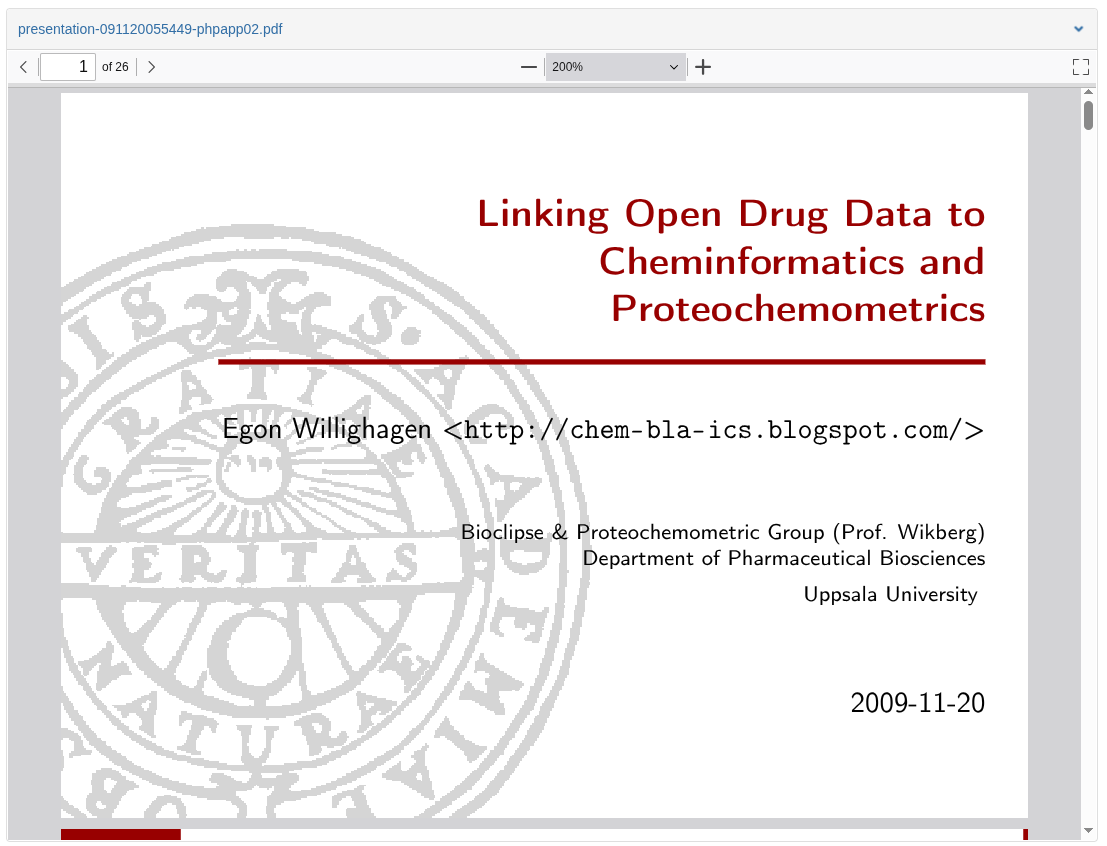
<p>More on the meeting later.</p>]]></content><author><name>Egon Willighagen</name></author><category term="opentox" /><category term="semweb" /><category term="chemistry" /><category term="rdf" /><category term="cdk" /><category term="bioclipse" /><category term="justdoi:10.5281/zenodo.3551856" /><summary type="html"><![CDATA[Please find below the views I have expressed at the OpenTox Workshop in the nice Potsdam area near Berlin:]]></summary><media:thumbnail xmlns:media="http://search.yahoo.com/mrss/" url="https://chem-bla-ics.linkedchemistry.info/assets/images/linkingExplictImplicit2010.png" /><media:content medium="image" url="https://chem-bla-ics.linkedchemistry.info/assets/images/linkingExplictImplicit2010.png" xmlns:media="http://search.yahoo.com/mrss/" /></entry><entry><title type="html">SWAT4LS: “Linking Open Drug Data to Cheminformatics and Proteochemometrics”</title><link href="https://chem-bla-ics.linkedchemistry.info/2009/11/21/swat4ls-linking-open-drug-data-to.html" rel="alternate" type="text/html" title="SWAT4LS: “Linking Open Drug Data to Cheminformatics and Proteochemometrics”" /><published>2009-11-21T00:00:00+00:00</published><updated>2009-11-21T00:00:00+00:00</updated><id>https://chem-bla-ics.linkedchemistry.info/2009/11/21/swat4ls-linking-open-drug-data-to</id><content type="html" xml:base="https://chem-bla-ics.linkedchemistry.info/2009/11/21/swat4ls-linking-open-drug-data-to.html"><![CDATA[<p>Please find below the presentation I gave today at <a href="https://www.swat4ls.org/workshops/amsterdam2009/">SWAT4LS <i class="fa-solid fa-recycle fa-xs"></i></a>:</p>

<p><a href="https://zenodo.org/records/3551852"><img src="/assets/images/zenodo_swat4ls_2009_lod.png" alt="" /></a></p>]]></content><author><name>Egon Willighagen</name></author><category term="swat4ls" /><category term="rdf" /><category term="semweb" /><category term="justdoi:10.5281/ZENODO.3551852" /><summary type="html"><![CDATA[Please find below the presentation I gave today at SWAT4LS :]]></summary><media:thumbnail xmlns:media="http://search.yahoo.com/mrss/" url="https://chem-bla-ics.linkedchemistry.info/assets/images/zenodo_swat4ls_2009_lod.png" /><media:content medium="image" url="https://chem-bla-ics.linkedchemistry.info/assets/images/zenodo_swat4ls_2009_lod.png" xmlns:media="http://search.yahoo.com/mrss/" /></entry></feed>