<?xml version="1.0" encoding="utf-8"?><feed xmlns="http://www.w3.org/2005/Atom" ><generator uri="https://jekyllrb.com/" version="4.3.4">Jekyll</generator><link href="https://chem-bla-ics.linkedchemistry.info/feed/by_tag/rss.xml" rel="self" type="application/atom+xml" /><link href="https://chem-bla-ics.linkedchemistry.info/" rel="alternate" type="text/html" /><updated>2026-02-28T20:19:43+00:00</updated><id>https://chem-bla-ics.linkedchemistry.info/feed/by_tag/rss.xml</id><title type="html">chem-bla-ics</title><subtitle>Chemblaics (pronounced chem-bla-ics) is the science that uses open science and computers to solve problems in chemistry, biochemistry and related fields.</subtitle><author><name>Egon Willighagen</name></author><entry><title type="html">Blog planets: blogging about Debian, GNOME, Wikimedia, FSFE, and many more</title><link href="https://chem-bla-ics.linkedchemistry.info/2023/08/04/blog-planets-blogging-about-debian.html" rel="alternate" type="text/html" title="Blog planets: blogging about Debian, GNOME, Wikimedia, FSFE, and many more" /><published>2023-08-04T00:00:00+00:00</published><updated>2023-08-04T00:00:00+00:00</updated><id>https://chem-bla-ics.linkedchemistry.info/2023/08/04/blog-planets-blogging-about-debian</id><content type="html" xml:base="https://chem-bla-ics.linkedchemistry.info/2023/08/04/blog-planets-blogging-about-debian.html"><![CDATA[<p>I am still an avid user of <a href="https://en.wikipedia.org/wiki/Category:Web_syndication_formats">RSS/Atom feeds</a>. I use
<a href="https://feedly.com/">Feedly</a> daily, partly because of their easy to use app. My blog is part of
<a href="https://planetrdf.com/">Planet RDF</a>, a <em>blog planet</em>. Blog planets aggregate blogs from many people around a certain topic.
It’s like a forum, but open, free, community driven. It’s exactly what the web should be.</p>

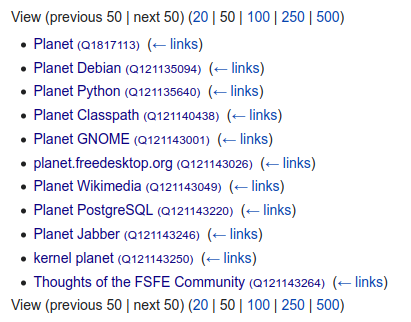
<p>It turned out that planets do still exist, so I started a small corner on Wikidata: <a href="https://www.wikidata.org/wiki/Q121134938">Q121134938</a>,
and a number of <a href="https://www.wikidata.org/wiki/Special:WhatLinksHere/Q121134938">existing blog planets</a>:</p>

<p><img src="/assets/images/blog_planets.png" alt="Screenshot of the 'What links here' page for the Wikidata item 'blog planet'." /></p>

<p>The software used to run these planets is ancient, though. We need a new generation of software, replacing things like
<a href="https://en.wikipedia.org/wiki/Planet_(software)">Planet</a>. And I want something people can easily host on GitHub or GitLab Pages or the likes.</p>

<p>I created a minimal shape expression but the Wikidata items for the planets still lack a lot of information that can be added. First,
we can think of them as venues, perhaps, where people “publish” their work. Second, we can annotate the blog planets with ‘main subject’
for the topics the cover. Or we can list the people that are “author” on the planet; most planets are very transparent about which
blogs they aggregate.</p>

<p>Love to see where this is going. Who knows? Maybe we will see Postgenomic (see doi:<a href="https://doi.org/10.1186/1471-2105-8-487">10.1186/1471-2105-8-487</a>) and
<a href="https://chem-bla-ics.blogspot.com/search?q=%22chemical+blogspace%22">Chemical blogspace</a> resurface :)</p>]]></content><author><name>Egon Willighagen</name></author><category term="rss" /><category term="wikidata" /><category term="cb" /><category term="doi:10.1186/1471-2105-8-487" /><summary type="html"><![CDATA[I am still an avid user of RSS/Atom feeds. I use Feedly daily, partly because of their easy to use app. My blog is part of Planet RDF, a blog planet. Blog planets aggregate blogs from many people around a certain topic. It’s like a forum, but open, free, community driven. It’s exactly what the web should be.]]></summary><media:thumbnail xmlns:media="http://search.yahoo.com/mrss/" url="https://chem-bla-ics.linkedchemistry.info/assets/images/blog_planets.png" /><media:content medium="image" url="https://chem-bla-ics.linkedchemistry.info/assets/images/blog_planets.png" xmlns:media="http://search.yahoo.com/mrss/" /></entry><entry><title type="html">SVN commit hooks down for CDK and Bioclipse</title><link href="https://chem-bla-ics.linkedchemistry.info/2008/07/05/svn-commit-hooks-down-for-cdk-and.html" rel="alternate" type="text/html" title="SVN commit hooks down for CDK and Bioclipse" /><published>2008-07-05T00:00:00+00:00</published><updated>2008-07-05T00:00:00+00:00</updated><id>https://chem-bla-ics.linkedchemistry.info/2008/07/05/svn-commit-hooks-down-for-cdk-and</id><content type="html" xml:base="https://chem-bla-ics.linkedchemistry.info/2008/07/05/svn-commit-hooks-down-for-cdk-and.html"><![CDATA[<p>SourceForge has been playing with system upgrades again, and in an attempt to debug the failing CIA
commits on IRC, I reinstalled the hooks for <a href="http://cdk.sf.net/">CDK</a> and <a href="http://www.bioclipse.net/">Bioclipse</a>,
so that now all hooks seem to fail, including the email hook… Apparently, it is a known bug, e.g. see
<a href="https://sourceforge.net/tracker/index.php?func=detail&amp;aid=2011306&amp;group_id=1&amp;atid=200001">this bug report</a>.
I assume SF will fix this soon.</p>

<p>On the bright side, I also noted an updated webpage for <a href="http://sourceforge.net/community/forum/forum.php?id=11&amp;page">SF uptime/problem tracker</a>,
where it is also reported that stats are currently down for upgrade. There also has an
<a href="http://sourceforge.net/community/forum/rss.php?forum=11">RSS feed</a>, which I recommend as a good monitoring
tool for SF site problems.</p>]]></content><author><name>Egon Willighagen</name></author><category term="cdk" /><category term="bioclipse" /><category term="rss" /><summary type="html"><![CDATA[SourceForge has been playing with system upgrades again, and in an attempt to debug the failing CIA commits on IRC, I reinstalled the hooks for CDK and Bioclipse, so that now all hooks seem to fail, including the email hook… Apparently, it is a known bug, e.g. see this bug report. I assume SF will fix this soon.]]></summary></entry><entry><title type="html">Quality Publishing: EndNote versus InChIs</title><link href="https://chem-bla-ics.linkedchemistry.info/2008/04/22/quality-publishing-endnote-versus.html" rel="alternate" type="text/html" title="Quality Publishing: EndNote versus InChIs" /><published>2008-04-22T00:00:00+00:00</published><updated>2008-04-22T00:00:00+00:00</updated><id>https://chem-bla-ics.linkedchemistry.info/2008/04/22/quality-publishing-endnote-versus</id><content type="html" xml:base="https://chem-bla-ics.linkedchemistry.info/2008/04/22/quality-publishing-endnote-versus.html"><![CDATA[<p>Some publishers hesitate a bit, but others go full speed ahead into the electronic publishing era.
<a href="http://baoilleach.blogspot.com/">Noel</a> commented on my <a href="https://chem-bla-ics.linkedchemistry.info/2008/04/21/open-access-open-data-leads-to-added.html">post about OA/OD inviting added value <i class="fa-solid fa-recycle fa-xs"></i></a>:</p>

<blockquote>
  <p>I heard a talk by the <a href="http://www.rsc.org/">RSC</a> at the ACS, saying that their RSS feeds contain
<a href="http://www.iupac.org/inchi/">InChI</a>s now! Just thought I’d throw that out there :-)</p>
</blockquote>

<p>The RSC <a href="http://www.rsc.org/Publishing/Journals/ProjectProspect/">Project Prospect</a> is ahead of other
publishers, for <a href="https://chem-bla-ics.linkedchemistry.info/2007/02/01/rsc-first-publisher-to-go-semantic.html">over a year already <i class="fa-solid fa-recycle fa-xs"></i></a>.
Adding InChIs to RSS feeds are a cheap way of adding machine-readable chemistry to ones publishing
pipeline; adding CML would allow much more detail (see
<a href="http://chem-bla-ics.blogspot.com/search?q=CMLRSS">this overview of CMLRSS information in my blog</a>). <!-- keep link --></p>

<p>But, importantly, it allows third-parties to efficiently set up DOI-InChI tables. Cheap (Asian?) workers become
rather expensive, when compared to machine mining to create such databases. Sure, the authoring becomes
somewhat more expensive, but who will argue that scientists might be a bit more precise in what they
publish. I, for sure, would love to see authors focus on adding InChIs to experimental sections, then
that they focus on getting EndNote to put the comma, bold and upper casing in the right place, to meet
journal standards.</p>

<p>Another publisher who takes its job seriously is <a href="http://www.beilstein-journals.org/">Beilstein</a>.
Stephan recently showed me some of the things they are up too, like information rich figures (yes,
you’ll have access to the source, and identify the molecular structures in reaction schema). He
also showed me to the RDF now by default available for all their articles. For example, for
DOI:<a href="http://dx.doi.org/10.1186/1860-5397-3-50">10.1186/1860-5397-3-50</a>,
<a href="http://www.beilstein-journals.org/bjoc/content/rdf/1860-5397-3-50.rdf">the RDF is available here</a>.
It’s indicated in the HTML with:</p>

<div class="language-html highlighter-rouge"><div class="highlight"><pre class="highlight"><code><span class="nt">&lt;link</span> <span class="na">rel=</span><span class="s">'alternate'</span> <span class="na">type=</span><span class="s">'text/rdf'</span> <span class="na">title=</span><span class="s">'RDF'</span> <span class="na">href=</span><span class="s">'http://www.beilstein-journals.org/bjoc/content/rdf/1860-5397-3-50.rdf'</span><span class="nt">/&gt;</span>
</code></pre></div></div>

<p>There is, actually, also a lot of citation information available in the <code class="language-plaintext highlighter-rouge">&lt;meta&gt;</code> tags in the HTML,
but apparently not the right stuff yet to have <a href="http://www.zotero.org/">Zotero</a> pick it up nicely
(not sure what this Firefox plugin is actually looking for). No chemistry in the RDF it seems,
but there is <a href="https://chem-bla-ics.linkedchemistry.info/2008/03/10/my-foaf-network-3-my-publications.html">BIBO <i class="fa-solid fa-recycle fa-xs"></i></a>,
<a href="https://chem-bla-ics.linkedchemistry.info/tag/foaf">FOAF <i class="fa-solid fa-recycle fa-xs"></i></a> and Dublin Core.</p>

<p>Main suggestion to Stephan, right now, would be to include InChIs in the RDF and RSS feed.</p>

<p>Disclaimer: <a href="http://chem-bla-ics.blogspot.com/search?q=project+prospect+CUBIC">Colin</a>, behind <!-- keep link -->
Project Prospect, visit our group when I was still in Cologne; Stephan contributed code bits
to the CDK project, e.g. this <a href="http://cheminfo.informatics.indiana.edu/~rguha/code/java/nightly/api/org/openscience/cdk/math/Matrix.html">this Matrix class</a>.</p>

<p>Oh, <a href="https://chem-bla-ics.linkedchemistry.info/2007/10/16/lunch-at-nature-hq-with-euan-joanna-ian.html">Nature <i class="fa-solid fa-recycle fa-xs"></i></a> is,
of course, also a publisher who actively gets into electronic publishing age.</p>]]></content><author><name>Egon Willighagen</name></author><category term="publishing" /><category term="inchi" /><category term="justdoi:10.1186/1860-5397-3-50" /><category term="cml" /><category term="rss" /><category term="foaf" /><summary type="html"><![CDATA[Some publishers hesitate a bit, but others go full speed ahead into the electronic publishing era. Noel commented on my post about OA/OD inviting added value :]]></summary></entry><entry><title type="html">Why chemistry-rich RSS feeds matter…</title><link href="https://chem-bla-ics.linkedchemistry.info/2008/01/30/why-chemistry-rich-rss-feeds-matter.html" rel="alternate" type="text/html" title="Why chemistry-rich RSS feeds matter…" /><published>2008-01-30T00:00:00+00:00</published><updated>2008-01-30T00:00:00+00:00</updated><id>https://chem-bla-ics.linkedchemistry.info/2008/01/30/why-chemistry-rich-rss-feeds-matter</id><content type="html" xml:base="https://chem-bla-ics.linkedchemistry.info/2008/01/30/why-chemistry-rich-rss-feeds-matter.html"><![CDATA[<p>Peter <a href="http://wwmm.ch.cam.ac.uk/blogs/murrayrust/?p=943">wrote up an item</a> on Nick’s
<a href="http://wwmm.ch.cam.ac.uk/crystaleye/">CrystalEye’s RSS feed</a>, and I have been enthusiastic about
chemistry-enriched RSS feeds for some time. CMLRSS has the chemical data inline in the RSS; see
DOI:<a href="http://dx.doi.org/10.1021/ci034244p">10.1021/ci034244p</a>, the use of CMLRSS in Chemical blogspace
described <a href="http://chemicalblogspace.blogspot.com/2007/01/cb-gets-cmlrss-feed.html">here</a> and
<a href="https://chem-bla-ics.linkedchemistry.info/2007/04/30/improved-cmlrss-feed-for-chemical.html">here <i class="fa-solid fa-recycle fa-xs"></i></a>,
and the <a href="https://chem-bla-ics.linkedchemistry.info/2006/03/06/progress-with-cmlrss-plugin-for.html">CMLRSS support in Bioclipse <i class="fa-solid fa-recycle fa-xs"></i></a>.</p>

<p>Nick’s RSS feed does not put the chemistry inline, but does link to the raw CML file:</p>

<div class="language-xml highlighter-rouge"><div class="highlight"><pre class="highlight"><code><span class="nt">&lt;entry&gt;</span>
  <span class="nt">&lt;title&gt;</span>No title supplied<span class="nt">&lt;/title&gt;</span>
  <span class="nt">&lt;link</span> <span class="na">rel=</span><span class="s">"enclosure"</span> <span class="na">href=</span><span class="s">"http://wwmm.ch.cam.ac.uk/crystaleye/summary//acs/inocaj/2008/3/data/ic702497x/ic702497xsup1_THP4-SINC-publ/ic702497xsup1_THP4-SINC-publ.complete.cml.xml"</span> <span class="na">hreflang=</span><span class="s">"en"</span> <span class="nt">/&gt;</span>
  <span class="c">&lt;!-- much more, that I skipped for brevity --&gt;</span>
<span class="nt">&lt;/entry&gt;</span>
</code></pre></div></div>

<p>The example shown by Peter was nicely chosen: something is wrong with that example. It uncovers a
bug in the pipeline, that could have been uncovered by a simple agent monitoring the RSS feed.
That is why this technology is important! It allows pipelining of information between services.</p>

<p>Anyway, before you read on, check the <a href="http://wwmm.ch.cam.ac.uk/crystaleye/summary/acta/e/2008/01-00/data/xu2383/xu2383sup1_I/xu2383sup1_I.cif.summary.html">structure in the example</a>
yourself <em>(Bis(pyrimidine-2-carboxylato-K2N,O)copper(II))</em>.</p>

<p>Done? Checked it? You saw the problem, right? Good.</p>

<p>I have scanned the CIF source, but that does not seem to contain the problem. It nicely shows a
general limitation of commonly used chemoinformatics tools: the lack of proper atom typing (a
problem I have been looking into for the <a href="http://cdk.sf.net/">Chemistry Development Kit</a>;
see <a href="https://chem-bla-ics.linkedchemistry.info/2007/07/01/atom-typing-in-cdk.html">Atom Typing in the CDK <i class="fa-solid fa-recycle fa-xs"></i></a> and
<a href="https://chem-bla-ics.linkedchemistry.info/2007/11/06/evidence-of-aromaticity.html">Evidence of Aromaticity <i class="fa-solid fa-recycle fa-xs"></i></a>.).</p>

<p>You will have noted that the 2D diagram in Peter’s blog is charged. I checked the
<a href="http://wwmm.ch.cam.ac.uk/crystaleye/summary/acta/e/2008/01-00/data/xu2383/xu2383sup1_I/xu2383sup1_I.complete.cml.xml"><em>complete</em> CML source code</a>
for the CrystelEye entry, and that contains the charges on the two oxygens bound to the cupper
too. However, the copper is not charged. That leads to a rather unlike situation; that is,
that crystal structures will about attract the whole laboratory to itself in a blink of an
eye: there is nothing to balance the double-negative charge! It is conveniently summarized in this bit of the CML:</p>

<div class="language-xml highlighter-rouge"><div class="highlight"><pre class="highlight"><code><span class="nt">&lt;formula</span> <span class="na">formalCharge=</span><span class="s">"-2"</span> <span class="na">concise=</span><span class="s">"C 10 H 6 Cu 1 N 4 O 4 -2"</span><span class="nt">&gt;</span>
  <span class="nt">&lt;atomArray</span> <span class="na">elementType=</span><span class="s">"C H Cu N O"</span> <span class="na">count=</span><span class="s">"10.0 6.0 1.0 4.0 4.0"</span><span class="nt">/&gt;</span>
<span class="nt">&lt;/formula&gt;</span>
</code></pre></div></div>

<p>Now, I also checked the <a href="http://wwmm.ch.cam.ac.uk/crystaleye/summary/acta/e/2008/01-00/data/xu2383/xu2383sup1_I/xu2383sup1_I.raw.cml.xml"><em>raw</em> CML</a>;
that seems to be unaffected too. So, the bug must be somewhere in the software that converts
the raw CML into complete CML. And, before the InChI calculation, because that one is wrong
too. A agent scanning the RSS feed, would have detected this. Someone interested in writing
up a grant proposal on this?</p>

<p>BTW, the system is not awfully wrong: the negative charge on the acidic carboxyl groups is
to be expected. But if the bond between the oxygen and the carbon would have been coordinating,
not covalent, and the copper would have been +2, then it was fine. Because many chemoinformatics
tools do not have really support for dative bonds, a covalent bond could be drawn, but then
the oxygens should be uncharged… right, not? :)</p>

<p>Oh, and surely, one can do much, much more with those feeds. I blogged about that earlier in
<a href="https://chem-bla-ics.linkedchemistry.info/2007/08/24/automatic-classification-of-thousands.html">Automatic Classification of thousands of Crystal Structures <i class="fa-solid fa-recycle fa-xs"></i></a>.</p>]]></content><author><name>Egon Willighagen</name></author><category term="rss" /><category term="chemistry" /><category term="doi:10.1021/CI034244P" /><summary type="html"><![CDATA[Peter wrote up an item on Nick’s CrystalEye’s RSS feed, and I have been enthusiastic about chemistry-enriched RSS feeds for some time. CMLRSS has the chemical data inline in the RSS; see DOI:10.1021/ci034244p, the use of CMLRSS in Chemical blogspace described here and here , and the CMLRSS support in Bioclipse .]]></summary></entry><entry><title type="html">re: ACS RSS feeds are messed up</title><link href="https://chem-bla-ics.linkedchemistry.info/2007/09/21/re-acs-rss-feeds-are-messed-up.html" rel="alternate" type="text/html" title="re: ACS RSS feeds are messed up" /><published>2007-09-21T00:10:00+00:00</published><updated>2007-09-21T00:10:00+00:00</updated><id>https://chem-bla-ics.linkedchemistry.info/2007/09/21/re-acs-rss-feeds-are-messed-up</id><content type="html" xml:base="https://chem-bla-ics.linkedchemistry.info/2007/09/21/re-acs-rss-feeds-are-messed-up.html"><![CDATA[<p>A couple of people now confirmed the <a href="https://chem-bla-ics.linkedchemistry.info/2007/09/16/acs-rss-feeds-are-messed-up.html">problem with the ACS journal RSS feeds <i class="fa-solid fa-recycle fa-xs"></i></a>.
Being back behind my desktop machine, I can post the obligatory screenshot:</p>

<p><img src="/assets/images/acsRSSproblem.png" alt="" /></p>

<p>The feed for Chemical Biology shows 79 feed items and the first one was a <em>Environ. Sci. Technol.</em> paper. The first of the
108 papers listed in the feed for Molecular Pharmaceutics is a perp from <em>J.Phys.Chem.C.</em></p>]]></content><author><name>Egon Willighagen</name></author><category term="acs" /><category term="rss" /><category term="cito:repliesTo:10.59350/xtm6b-5gf91" /><summary type="html"><![CDATA[A couple of people now confirmed the problem with the ACS journal RSS feeds . Being back behind my desktop machine, I can post the obligatory screenshot:]]></summary><media:thumbnail xmlns:media="http://search.yahoo.com/mrss/" url="https://chem-bla-ics.linkedchemistry.info/assets/images/acsRSSproblem.png" /><media:content medium="image" url="https://chem-bla-ics.linkedchemistry.info/assets/images/acsRSSproblem.png" xmlns:media="http://search.yahoo.com/mrss/" /></entry><entry><title type="html">ACS RSS feeds are messed up</title><link href="https://chem-bla-ics.linkedchemistry.info/2007/09/16/acs-rss-feeds-are-messed-up.html" rel="alternate" type="text/html" title="ACS RSS feeds are messed up" /><published>2007-09-16T00:10:00+00:00</published><updated>2007-09-16T00:10:00+00:00</updated><id>https://chem-bla-ics.linkedchemistry.info/2007/09/16/acs-rss-feeds-are-messed-up</id><content type="html" xml:base="https://chem-bla-ics.linkedchemistry.info/2007/09/16/acs-rss-feeds-are-messed-up.html"><![CDATA[<p>All start is difficult. The ACS must know that, but <a href="http://blog.everydayscientist.com/?p=661">they still blame Google</a>.
In this blog, <a href="http://blog.everydayscientist.com/">Everyday Scientist</a> mentions that the ACS RSS journal TOC feeds are
sometimes messed up. I noted that too, but lived with it. The ACS generally is a very professional organization, but
when I read they told ES that his Google RSS client was the problem, I just had to confirm his problems, hoping that
some ACS representative can relay the message to their IT department.</p>

<p><a href="http://akregator.kde.org/">Akregator</a> is the RSS client that I use, and I noticed the exact same problem ES noted:
every now and then, twice, three times a month, the RSS feeds for one journal give the content of another journal.
For example, I get the TOC of Chemical Reviews in the RSS feed of the <a href="http://pubs.acs.org/journals/jcisd8/index.html">JCIM</a>.
Things like that.</p>

<p>Now, because Akregator has absolute nothing to do with Google, it cannot be Google who is messing up the RSS feeds.
Because ES is having the same issues I have, it cannot be Akregator either. Ergo, it is the RSS feed system of the
ACS itself that is messed up.</p>]]></content><author><name>Egon Willighagen</name></author><category term="acs" /><category term="rss" /><summary type="html"><![CDATA[All start is difficult. The ACS must know that, but they still blame Google. In this blog, Everyday Scientist mentions that the ACS RSS journal TOC feeds are sometimes messed up. I noted that too, but lived with it. The ACS generally is a very professional organization, but when I read they told ES that his Google RSS client was the problem, I just had to confirm his problems, hoping that some ACS representative can relay the message to their IT department.]]></summary></entry><entry><title type="html">Improved CMLRSS feed for Chemical blogspace</title><link href="https://chem-bla-ics.linkedchemistry.info/2007/04/30/improved-cmlrss-feed-for-chemical.html" rel="alternate" type="text/html" title="Improved CMLRSS feed for Chemical blogspace" /><published>2007-04-30T00:00:00+00:00</published><updated>2007-04-30T00:00:00+00:00</updated><id>https://chem-bla-ics.linkedchemistry.info/2007/04/30/improved-cmlrss-feed-for-chemical</id><content type="html" xml:base="https://chem-bla-ics.linkedchemistry.info/2007/04/30/improved-cmlrss-feed-for-chemical.html"><![CDATA[<p>While adding the <a href="http://wiki.cubic.uni-koeln.de/cb/blog_search.php?blog_id=116">116th blog (David Bradley’s Chemistry News)</a>
to <a href="http://wiki.cubic.uni-koeln.de/cb/">Chemical blogspace</a> (see also <a href="http://chemicalblogspace.blogspot.com/2007/04/new-blogs-5.html">New Blogs #5</a>,
I noticed that <a href="http://www.sciencebase.com/science-blog/">David</a> is using
<a href="https://chem-bla-ics.linkedchemistry.info/2006/12/10/including-smiles-cml-and-inchi-in.html">semantic markup for InChI’s <i class="fa-solid fa-recycle fa-xs"></i></a> (thanx!).</p>

<p>That urged me to finally clean up <a href="https://chem-bla-ics.linkedchemistry.info/2006/02/25/hacking-inchi-support-into.html">my InChI extension<i class="fa-solid fa-recycle fa-xs"></i></a> for the
<a href="http://www.postgenomic.com/">Postgenomic.com</a> software. One important step was to create a PHP page with only one InChI, such as
<a href="http://wiki.cubic.uni-koeln.de/cb/inchi.php?id=61">this one</a>. That would solve the something broken links in the CMLRSS feed,
because of characters in InChIs that Apache cannot handle as the PHP page expects. Once that was done, I also pimped up the
CMLRSS feed itself: I added a human-friendly name, the title of the blog item discussing the molecule, and the picture Cb
downloads from <a href="http://pubchem.ncbi.nlm.nih.gov/">PubChem</a>:</p>

<p><img src="/assets/images/cmlrss_Cb2.png" alt="" /></p>

<p>Of course the feed is still <a href="http://chem-bla-ics.blogspot.com/search?q=CMLRSS">CML enabled</a>.</p>]]></content><author><name>Egon Willighagen</name></author><category term="cb" /><category term="rss" /><category term="cml" /><category term="inchi" /><category term="semweb" /><category term="pubchem" /><summary type="html"><![CDATA[While adding the 116th blog (David Bradley’s Chemistry News) to Chemical blogspace (see also New Blogs #5, I noticed that David is using semantic markup for InChI’s (thanx!).]]></summary><media:thumbnail xmlns:media="http://search.yahoo.com/mrss/" url="https://chem-bla-ics.linkedchemistry.info/assets/images/cmlrss_Cb2.png" /><media:content medium="image" url="https://chem-bla-ics.linkedchemistry.info/assets/images/cmlrss_Cb2.png" xmlns:media="http://search.yahoo.com/mrss/" /></entry><entry><title type="html">Pipelining chemical information with Yahoo Pipes</title><link href="https://chem-bla-ics.linkedchemistry.info/2007/03/16/pipelining-chemical-information-with.html" rel="alternate" type="text/html" title="Pipelining chemical information with Yahoo Pipes" /><published>2007-03-16T00:00:00+00:00</published><updated>2007-03-16T00:00:00+00:00</updated><id>https://chem-bla-ics.linkedchemistry.info/2007/03/16/pipelining-chemical-information-with</id><content type="html" xml:base="https://chem-bla-ics.linkedchemistry.info/2007/03/16/pipelining-chemical-information-with.html"><![CDATA[<p>Chemists are picking up <a href="http://pipes.yahoo.com/">Yahoo Pipes</a>, or, as Noel calls them,
<a href="http://www.mail-archive.com/blue-obelisk@hardly.cubic.uni-koeln.de/msg00120.html">Pipeline Pilot for RSS feeds</a>.
I tend to agree, as the source of the workflows are closed, that is, at least require registering to the Yahoo webpage.</p>

<p>Several chemical applications have been developed since. One was developed by <a href="http://msblog.kermitmurray.com/">Kermit</a>
who wrote an <a href="http://msblog.kermitmurray.com/2007/02/yahoo-pipes-mass-spectrometry.html">aggregator for mass spectrometry journal articles</a>.
And <a href="http://www.chemicalforums.com/index.php?action=profile;u=2">Mitch</a> has set up a
<a href="http://www.chemicalforums.com/index.php?topic=13458.msg62253#msg62253">similar feature for ACS journals</a>.</p>

<p>Now, what I am really waiting for, are the first applications that deal with molecular structures, and a
pipe that alerts me about publications in which molecules are discussed matching a certain
<a href="https://doi.org/10.1021/ci600305h">MQL molecular query for an interesting substructure</a>.</p>]]></content><author><name>Egon Willighagen</name></author><category term="rss" /><category term="chemistry" /><category term="publishing" /><category term="justdoi:10.1021/ci600305h" /><summary type="html"><![CDATA[Chemists are picking up Yahoo Pipes, or, as Noel calls them, Pipeline Pilot for RSS feeds. I tend to agree, as the source of the workflows are closed, that is, at least require registering to the Yahoo webpage.]]></summary></entry><entry><title type="html">AVI movies of CMLRSS howto in Bioclipse</title><link href="https://chem-bla-ics.linkedchemistry.info/2006/07/03/avi-movies-of-cmlrss-howto-in.html" rel="alternate" type="text/html" title="AVI movies of CMLRSS howto in Bioclipse" /><published>2006-07-03T00:00:00+00:00</published><updated>2006-07-03T00:00:00+00:00</updated><id>https://chem-bla-ics.linkedchemistry.info/2006/07/03/avi-movies-of-cmlrss-howto-in</id><content type="html" xml:base="https://chem-bla-ics.linkedchemistry.info/2006/07/03/avi-movies-of-cmlrss-howto-in.html"><![CDATA[<p>David Strumfels posted news <a href="https://web.archive.org/web/20061011100407/http://usefulchem.blogspot.com/2006/07/cml-in-rss-feeds.html">about the Useful Chemistry CMLRSS feed <i class="fa-solid fa-box-archive fa-xs"></i></a>.
He explains how this feed can be accessed using <a href="http://www.jmol.org/">Jmol</a> and <a href="http://www.bioclipse.net/">Bioclipse</a>. The latter are accompanied by two AVI
movies: <a href="http://showme.physics.drexel.edu/usefulchem/Software/bioclipse/CreatingAnOPML.avi">one about creating a new OPML file</a>, and
<a href="http://showme.physics.drexel.edu/usefulchem/Software/bioclipse/UsingAnOPML.avi">one about accessing the CMLRSS file from the OPML</a>.</p>]]></content><author><name>Egon Willighagen</name></author><category term="cml" /><category term="rss" /><category term="bioclipse" /><category term="jmol" /><summary type="html"><![CDATA[David Strumfels posted news about the Useful Chemistry CMLRSS feed . He explains how this feed can be accessed using Jmol and Bioclipse. The latter are accompanied by two AVI movies: one about creating a new OPML file, and one about accessing the CMLRSS file from the OPML.]]></summary></entry><entry><title type="html">Open Text Mining Interface and Bioclipse</title><link href="https://chem-bla-ics.linkedchemistry.info/2006/05/07/open-text-mining-interface-and.html" rel="alternate" type="text/html" title="Open Text Mining Interface and Bioclipse" /><published>2006-05-07T00:00:00+00:00</published><updated>2006-05-07T00:00:00+00:00</updated><id>https://chem-bla-ics.linkedchemistry.info/2006/05/07/open-text-mining-interface-and</id><content type="html" xml:base="https://chem-bla-ics.linkedchemistry.info/2006/05/07/open-text-mining-interface-and.html"><![CDATA[<p>Timo Hannay <a href="https://web.archive.org/web/20060620194249/http://blogs.nature.com/wp/nascent/2006/04/open_text_mining_interface.html">blogged <i class="fa-solid fa-box-archive fa-xs"></i></a>
in <a href="http://www.nature.com/">Nature</a>’s <a href="https://web.archive.org/web/20060504035155/http://blogs.nature.com/wp/nascent/">Nascent blog <i class="fa-solid fa-box-archive fa-xs"></i></a>
about the Open Text Mining Interface (OTMI), which is “a suggestion from Nature about how we might achieve text-mining
and indexing purposes”. The idea is that each article has a link pointing to a machine readable file
containing raw data about (and from?) the article. The standing example uses
<a href="http://atompub.org/2005/07/11/draft-ietf-atompub-format-10.html">Atom 1.0</a> as a container, allowing raw
data to be included using foreign namespaces, such as <a href="http://prismstandard.org/">Dublic Core</a>
(for metadata) and <a href="http://prismstandard.org/">Prism</a> (for bibliographic data), and the OTMI text
mining statistics uses a namespace too.</p>

<p>In a comment, <a href="http://www.ch.ic.ac.uk/rzepa/">Henry Rzepa</a> proposed inclusion of CML, and refers to earlier
work on CMLRSS where <a href="http://www.xml-cml.org/">Chemical Markup Language</a> is embedded in RSS news feeds
for which I wrote readers for <a href="http://www.jmol.org/">Jmol</a> and
<a href="http://jchempaint.sf.net/">JChemPaint</a> (DOI:<a href="https://doi.org/10.1021/ci034244p">10.1021/ci034244p</a>).</p>

<p>As readers of my blog know, the <a href="http://www.bioclipse.net/">Bioclipse</a> project has been working hard
on an integrated (bio)chemistry workbench, and the <a href="http://bioclipse.blogspot.com/2006/05/bioclipse-090-released.html">latest release</a>
includes a <a href="http://wiki.bioclipse.net/index.php?title=CMLRSS_plugin">CMLRSS reader plugin</a> too, which
supports CML embedded in Atom 0.3/1.0 and RSS 1.0/2.0 feeds. Now, adding support for other embedded
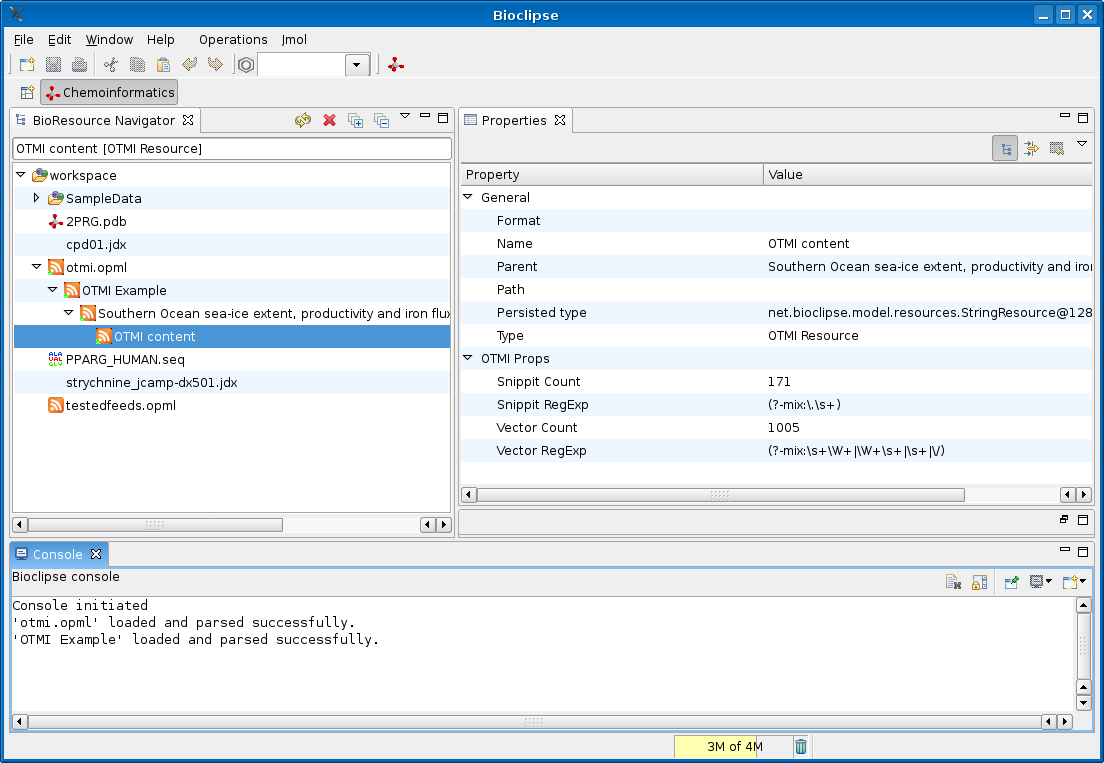
namespaces is trivial, and this morning I hacked in support for OTMI:</p>

<p><img src="/assets/images/otmiSupport.png" alt="" /></p>

<p>This screenshot show the original OTMI example
with the Atom 1.0 entry now wrapped in an Atom 1.0 <code class="language-plaintext highlighter-rouge">&lt;feed&gt;</code> element. There is no nice OTMI icon for the OTMI content in the
Atom 1.0 entry, neither did I make a ‘view’ yet showing the actual vector’s or the snippet’s, but that’s a piece of cake too.</p>

<p>Now, the nice thing about this is that the Bioclipse code for the Atom and RSS feeds, just greps through the feed entry
and show whatever CML or OTMI content is present. When Nature decides to include CML in these OTMI files too,
I will not have to update the current code.</p>]]></content><author><name>Egon Willighagen</name></author><category term="cml" /><category term="bioclipse" /><category term="xml" /><category term="textmining" /><category term="rss" /><category term="doi:10.1021/CI034244P" /><summary type="html"><![CDATA[Timo Hannay blogged in Nature’s Nascent blog about the Open Text Mining Interface (OTMI), which is “a suggestion from Nature about how we might achieve text-mining and indexing purposes”. The idea is that each article has a link pointing to a machine readable file containing raw data about (and from?) the article. The standing example uses Atom 1.0 as a container, allowing raw data to be included using foreign namespaces, such as Dublic Core (for metadata) and Prism (for bibliographic data), and the OTMI text mining statistics uses a namespace too.]]></summary><media:thumbnail xmlns:media="http://search.yahoo.com/mrss/" url="https://chem-bla-ics.linkedchemistry.info/assets/images/otmiSupport.png" /><media:content medium="image" url="https://chem-bla-ics.linkedchemistry.info/assets/images/otmiSupport.png" xmlns:media="http://search.yahoo.com/mrss/" /></entry></feed>