<?xml version="1.0" encoding="utf-8"?><feed xmlns="http://www.w3.org/2005/Atom" ><generator uri="https://jekyllrb.com/" version="4.3.4">Jekyll</generator><link href="https://chem-bla-ics.linkedchemistry.info/feed/by_tag/publishing.xml" rel="self" type="application/atom+xml" /><link href="https://chem-bla-ics.linkedchemistry.info/" rel="alternate" type="text/html" /><updated>2026-04-19T09:50:36+00:00</updated><id>https://chem-bla-ics.linkedchemistry.info/feed/by_tag/publishing.xml</id><title type="html">chem-bla-ics</title><subtitle>Chemblaics (pronounced chem-bla-ics) is the science that uses open science and computers to solve problems in chemistry, biochemistry and related fields.</subtitle><author><name>Egon Willighagen</name></author><entry><title type="html">The Internet Journal of Chemistry</title><link href="https://chem-bla-ics.linkedchemistry.info/2025/08/11/the-internet-journal-of-chemistry.html" rel="alternate" type="text/html" title="The Internet Journal of Chemistry" /><published>2025-08-11T00:00:00+00:00</published><updated>2025-08-11T00:00:00+00:00</updated><id>https://chem-bla-ics.linkedchemistry.info/2025/08/11/the-internet-journal-of-chemistry</id><content type="html" xml:base="https://chem-bla-ics.linkedchemistry.info/2025/08/11/the-internet-journal-of-chemistry.html"><![CDATA[<p>The <a href="https://scholia.toolforge.org/topic/Q27211732">Internet Journal of Chemistry</a> (IJC, issn:1099-8292) was one of the first scientific journals to get
published on the world wide web (part of <em>the Internet</em>), see doi:<a href="https://doi.org/10.1080/00987913.2000.10764578">10.1080/00987913.2000.10764578</a>.
Issues were published from 1998 to 2004. But because it predates
systematic archiving of webpages by libraries, a lot is lost. The nature of the journal, however, makes it unique, and quite
a number of articles are cited a lot, and should be part of the <em>scientific record</em>.
But I soon realized it actually is quite hard to track down content of the journal. I knew some articles have been
<em>author accepted manuscripts</em> online. One of that was my own first (and single) author-article, self-archived on
Zenodo (doi:<a href="https://doi.org/10.5281/zenodo.1495470">10.5281/zenodo.1495470</a>), green open access style.</p>

<p>I wanted to see what I could recover, and here I describe what I did and what could be done next.</p>

<h2 id="a-list-of-all-articles">A list of all articles</h2>

<p>The first step is actually to create a list of all articles published in the IJC and collect as much metadata about
them as possible. With just over 100 articles, I decided to use Wikidata, as a machine-readable database, supporting the curation and reporting. I wanted at least
two independent sources, and for Wikidata, use public resources. That means, while Web of Science does have a list of
all articles, I only used this for validation, and <strong>not</strong> as information source. Instead, I used citations to IJC
articles and, of course, the Internet Archive (IA). It turns out <a href="https://web.archive.org/web/*/http://www.ijc.com/abstracts/*">a query like this</a>
does wonders (well, for the abstracts; I did not find full-texts archived on IA):</p>

<div class="language-plaintext highlighter-rouge"><div class="highlight"><pre class="highlight"><code>https://web.archive.org/web/*/http://www.ijc.com/abstracts/*
</code></pre></div></div>

<p>I found that all but one article had the abstract archived in the IA. Here’s <a href="https://web.archive.org/web/20000925050415/http://www.ijc.com/abstracts/abstract2n8.html">an example</a>:</p>

<p><img src="/assets/images/ia_ijc_abstract.png" alt="" /></p>

<p>This gave my a lot of information to add to Wikidata. Title, publication date, volume, article number, keywords, an absstract,
and, of course, the list of authors. Some authors I know personally, many I did not. But it did allow me to enter all
articles to Wikidata along with the authors and “author” (<a href="https://www.wikidata.org/wiki/Property:P50">P50</a>) or
“author name string” (<a href="https://www.wikidata.org/wiki/Property:P2093">P2093</a>).</p>

<h2 id="the-article-authors">The article authors</h2>

<p>It also turned out that multiple authors listed their IJC article on their public ORCID profile.
That greatly helped identification. I managed to <a href="https://w.wiki/Ezda">link many authors</a> to mostly existing Wikidata items:</p>

<p><img src="/assets/images/ijc_authors.png" alt="" /></p>

<p>I already mentioned that I used Wikidata to collect this information. Besides the <a href="https://scholia.toolforge.org/venue/Q27211732">interactive visualization with Scholia</a>,
it also gave me the option to track my progress with SPARQL queries. For example, <a href="https://w.wiki/Ezdf">this query</a> helped
me do that author FAIR-ification:</p>

<p><img src="/assets/images/ijc_sparql1.png" alt="" /></p>

<p>You can see here two columns with author information, one for P50 and the other for P2093. There is quite some
identification left to be done, and additional information is welcome:</p>

<p><img src="/assets/images/ijc_sparql2.png" alt="" /></p>

<h2 id="sources">Sources</h2>

<p>So, that brings us to this list of sources:</p>

<ul>
  <li>Internet Archive: abstracts and metadata</li>
  <li>ORCID profiles: ORCIDs of (some) authors</li>
  <li>Google Scholar: metadata and citations</li>
  <li>Web of Science: independent list for external validation</li>
</ul>

<p>Because there is plenty of work left to be done and I hope the collected information will further spread
in library collections, I added sources as much as possible. <a href="https://w.wiki/Em9i">This query</a> lists for all
articles the Web of Science identifier (recorded so that everyone can check the consistency), the link
to the Internet Archive-d abstract page, and a link to a known full text (five).</p>

<p>If you wonder, neither <a href="https://openalex.org/works?page=1&amp;filter=primary_location.source.id:s32147083">OpenAlex</a>
or <a href="https://europepmc.org/search?query=JOURNAL%3A%28%22Internet%20Journal%20of%20Chemistry%22%29">Europe PMC</a> have a full list.</p>

<h2 id="whats-next">What’s next?</h2>

<p>I do not have a formal training in archiving, but I am happy with the minimal viable metadata collection.
I know more can be done (and love to hear your pointers and suggestions): more author identies,
better coverage of keyword annotation, etc. But I think an important addition is adding citations
to and from the IJC articles are important. The journal predates efforts like the <a href="https://i4oc.org/">I4OC</a> and
<a href="https://opencitations.net/">Open Citations</a>, so I may have to manually recover citations from Google Scholar.
I will have to report on that later. But you can enjoy the citations that are
<a href="https://scholia.toolforge.org/venue/Q27211732#Citations">already there</a>. And now that we have sufficient metadata,
I can use this to find more full texts.</p>

<p>Btw, I have made contact with Prof. <a href="https://scholia.toolforge.org/author/Q28420106">Steven Bachrach</a>,
who founded the journal and was the Editor-in-Chief.</p>]]></content><author><name>Egon Willighagen</name></author><category term="publishing" /><category term="wikidata" /><category term="scholia" /><category term="doi:10.5281/ZENODO.1495470" /><category term="cito:citesAsEvidence:10.1080/00987913.2000.10764578" /><category term="europepmc" /><summary type="html"><![CDATA[The Internet Journal of Chemistry (IJC, issn:1099-8292) was one of the first scientific journals to get published on the world wide web (part of the Internet), see doi:10.1080/00987913.2000.10764578. Issues were published from 1998 to 2004. But because it predates systematic archiving of webpages by libraries, a lot is lost. The nature of the journal, however, makes it unique, and quite a number of articles are cited a lot, and should be part of the scientific record. But I soon realized it actually is quite hard to track down content of the journal. I knew some articles have been author accepted manuscripts online. One of that was my own first (and single) author-article, self-archived on Zenodo (doi:10.5281/zenodo.1495470), green open access style.]]></summary><media:thumbnail xmlns:media="http://search.yahoo.com/mrss/" url="https://chem-bla-ics.linkedchemistry.info/assets/images/ia_ijc.png" /><media:content medium="image" url="https://chem-bla-ics.linkedchemistry.info/assets/images/ia_ijc.png" xmlns:media="http://search.yahoo.com/mrss/" /></entry><entry><title type="html">Archiving, but not really</title><link href="https://chem-bla-ics.linkedchemistry.info/2025/08/06/archiving-but-not-really.html" rel="alternate" type="text/html" title="Archiving, but not really" /><published>2025-08-06T00:00:00+00:00</published><updated>2025-08-06T00:00:00+00:00</updated><id>https://chem-bla-ics.linkedchemistry.info/2025/08/06/archiving-but-not-really</id><content type="html" xml:base="https://chem-bla-ics.linkedchemistry.info/2025/08/06/archiving-but-not-really.html"><![CDATA[<p><a href="https://sauropods.win/@mike">Mike Taylor</a> wrote up <a href="https://doi.org/10.59350/svpow.24000">a post</a> about the various things a journal article is doing,
the first being <em>a scientific report</em>. We put a lot of money in establishing a scientific track record. In the past 30 years
how we publish our research and how we archive it has changed significantly. If you read my blog more often, you know I have
been critical of the performance of many publishers. Springer Nature was so disappointing that after 5 years I
<a href="https://chem-bla-ics.linkedchemistry.info/2021/06/11/conflict-of-interest-or-why-i-am.html">stepped down</a>
as Editor-in-Chief (of two) of the <a href="https://en.wikipedia.org/wiki/Journal_of_Cheminformatics">Journal of Cheminformatics</a>.
There is so much that must be <a href="https://chem-bla-ics.linkedchemistry.info/2024/09/16/publishing.html">done better</a>.</p>

<p>But in the most recent iteration, triggered by some work for <a href="https://www.wikipathways.org/">WikiPathways</a>, I was using
<a href="https://europepmc.org/">Europe PMC</a> to find articles that
mention <em>WikiPathways</em> and then search in the full text for the string <code class="language-plaintext highlighter-rouge">WP</code>, as a trigger for the possible mention of
WikiPathways pathway identifiers, which look like <code class="language-plaintext highlighter-rouge">WP4846</code>. The use of <em>compact (resource) identifiers</em>
(see doi:<a href="https://doi.org/10.1038/sdata.2018.29">10.1038/sdata.2018.29</a>) is minimal, but at least some articles use identifiers.</p>

<p>That allows me to extend our WikiPathways knowledge graph of <a href="https://www.wikipathways.org/browse/citedin">articles citing specific pathways</a>.
At the time of writing, we collected 2509 citations from 440 different articles to 883 different pathways. Now,
I want to blog about that more, but it’s related to an observation.</p>

<h2 id="information-loss">Information loss</h2>
<p>Now, back in the late ninities I learned about GNU/Linux and after playing with Red Hat and Suse, I settled for Debian.
One of the things I learned is that, generally, information corruption (like data loss) is an absolute red flag, a no-go,
a total showstopper.</p>

<p>And then we have this in publishing, the one area where data corruption must also be a no-go:</p>

<p><img src="/assets/images/imageResolutionLoss.png" alt="" /></p>

<p>In this image, the left side shows a screenshot of the publisher version of the article and on the right side
the version in <a href="https://pmc.ncbi.nlm.nih.gov/">Pubmed Central</a> (PMC). PMC has been an important project to archive full text versions of articles:</p>

<blockquote>
  <p>11.2 million articles are archived in PMC.</p>
</blockquote>

<p>So, this is <strong>really bad</strong>! The archived version is not really useful. As a human I already struggle to read the
degraded image, let alone an algorithm.</p>

<p>Does that matter? Yes, projects like the awesome
<a href="https://pfocr.wikipathways.org/">Pathway Figure OCR</a> (see doi:<a href="https://doi.org/10.1186/s13059-020-02181-2">10.1186/s13059-020-02181-2</a>)
depend on images to be FAIR enough to extract information. (Side note: yes, these images should be vector
graphics, but commercial publishers decided about twenty years ago that they could not care enough.)</p>

<p>At this moment, I do not know where the information is lost. Maybe PubMed Central is storing the images in a low
resolution. Maybe the publisher provides PMC with a low resolution image. But to me, this must be solved as soon
as possible. This is utterly unacceptable.</p>

<p>I wonder what the authors of the article (doi:<a href="https://doi.org/10.1186/s13287-025-04166-z">10.1186/s13287-025-04166-z</a>)
I took as example think of this.</p>]]></content><author><name>Egon Willighagen</name></author><category term="publishing" /><category term="cito:citesAsRecommendedReading:10.59350/svpow.24000" /><category term="cito:citesAsRecommendedReading:10.1186/s13059-020-02181-2" /><category term="cito:describes:10.1186/s13287-025-04166-z" /><category term="cito:obtainsBackgroundFrom:10.1038/sdata.2018.29" /><category term="europepmc" /><summary type="html"><![CDATA[Mike Taylor wrote up a post about the various things a journal article is doing, the first being a scientific report. We put a lot of money in establishing a scientific track record. In the past 30 years how we publish our research and how we archive it has changed significantly. If you read my blog more often, you know I have been critical of the performance of many publishers. Springer Nature was so disappointing that after 5 years I stepped down as Editor-in-Chief (of two) of the Journal of Cheminformatics. There is so much that must be done better.]]></summary><media:thumbnail xmlns:media="http://search.yahoo.com/mrss/" url="https://chem-bla-ics.linkedchemistry.info/assets/images/imageResolutionLoss.png" /><media:content medium="image" url="https://chem-bla-ics.linkedchemistry.info/assets/images/imageResolutionLoss.png" xmlns:media="http://search.yahoo.com/mrss/" /></entry><entry><title type="html">Niche papers and citation intentions</title><link href="https://chem-bla-ics.linkedchemistry.info/2025/01/26/niche-papers.html" rel="alternate" type="text/html" title="Niche papers and citation intentions" /><published>2025-01-26T00:00:00+00:00</published><updated>2025-01-26T00:00:00+00:00</updated><id>https://chem-bla-ics.linkedchemistry.info/2025/01/26/niche-papers</id><content type="html" xml:base="https://chem-bla-ics.linkedchemistry.info/2025/01/26/niche-papers.html"><![CDATA[<p>I wish I could say I remember the first citation to one of my research articles. I do not. But I do remember
the excitement to see why someone was citing my research. What I do remember is that I got a comment around
the same time along the lines of this: <em>“why would anyone cite your article if they can download the results
for free?”</em> (about open science cheminformatics research). Other times. Indeed, I found out there are many reasons why people are citing and not citing
articles. The above is one of them (still happens too often). But that’s also an intrinsic property of the
current publishing model: some papers get cited too much, others get cited too little.</p>

<p><a href="https://scholar.social/@dingemansemark">Mark Dingemanse</a> wrote up a post <em><a href="https://doi.org/10.59350/m6erd-7px95">[i]n praise of niche papers</a></em>,
suggesting people to highlight papers that are not cited enough (as proxy for not getting enough attention).
They write:</p>

<blockquote>
  <p>Let’s define niche papers informally as work to be proud of even if it managed to remain a bit obscure;
good work that would deserve more readers. Niche papers may not contain the most flashy results. They
may not appear in the most glamourous venues. They may be book chapters. They don’t easily gather
drive-by citations.</p>
</blockquote>

<h2 id="why-i-found-this-post-interesting">Why I found this post interesting</h2>

<p>Before I move on to highlighting niche papers (from our group and from others), I want to ponder
a bit more about the rest. The first I learned is that the citation count to articles is a bad measure
for the impact (<a href="https://chem-bla-ics.linkedchemistry.info/2006/11/07/when-is-open-source-chemoinformatics.html">2006 pondering</a>):
articles using your work may get more citations than your own article. For example, the first paper
(doi:<a href="https://doi.org/10.1021/CI025584Y">10.1021/CI025584Y</a>) about the open science cheminformatics
about the <a href="https://cdk.github.io">Chemistry Development Kit</a> (CDK) was originally cited less than
the paper about the BRENDA enzyme database (doi:<a href="https://doi.org/10.1093/NAR/GKH081">10.1093/NAR/GKH081</a>)
using the CDK for fingerprint calculations (to compare and search enzyme substrates), and later much
less than MZmine (doi:<a href="https://doi.org/10.1186/1471-2105-11-395">10.1186/1471-2105-11-395</a>)
(see <a href="https://scholia.toolforge.org/works/Q27061829,Q27136473,Q24599948">this Scholia page</a>):</p>

<p><img src="/assets/images/cdk_citations.png" alt="" /></p>

<p>I think we should with limiting ourselves to papers and book chapters. We must extend out notion of research output,
anyway, starting with data and software. This is part of defining what niche is, imo.</p>

<p>Second reason why I liked Mark’s post is the <em>drive-by citations</em>, which he references to
<a href="https://scatter.wordpress.com/2009/04/30/drive-by-citations/">a 2009 post by andrewperrin</a> which defined
such a citations as</p>

<blockquote>
  <p>references to a work that make a very quick appearance, extract a very small, specific point from the work,
and move on without really considering the existence or depth of connection between the student’s work and
the cited work.</p>
</blockquote>

<p>This is someone I noted too when analyzing citations to the aforementioned CDK paper. Particularly in the
early days, it was cited a lot in a similar way: it was not using the CDK, but ascribed some authority
to the paper in a <em>very quick appearance, without really considering the cited work</em>. The
<a href="https://purl.org/spar/cito">Citation Typing Ontology</a> (CiTO, doi:<a href="https://doi.org/10.1186/2041-1480-1-s1-s6">10.1186/2041-1480-1-s1-s6</a>)
has <em>cito:citesAsAuthority</em> for that (not exactly the same thing,
and maybe CiTO should have <em>cito:driveByCitation</em> too). And they happen a lot, and in the past I have
guestimated them to make up 20-35% of the citations to an article, and I postulate that
high-journal-impact-factor journals amass a higher ratio than specialistic (niche?) journals.</p>

<p>With FAIR citations (see <a href="https://chem-bla-ics.linkedchemistry.info/2024/12/30/fair-blog-to-blog-citations.html">this post</a>)
we can visualize that ratio, here in <a href="https://scholia.toolforge.org/work/Q27061829#cito-incoming">this Scholia page</a>:</p>

<p><img src="/assets/images/cdk_citations_why.png" alt="" /></p>

<p>It is also obvious that the first CDK paper introduced a new method. But the pattern is not
limited to this paper, and with <a href="https://scholia.toolforge.org/cito/#article-counts">just over 2000 citation intentions</a>,
we start of get some idea of this pattern:</p>

<p><img src="/assets/images/citations_why.png" alt="" /></p>

<h2 id="my-contributed-niche-papers">My contributed Niche Papers</h2>

<p>That brings me to a first neglected paper, David Shotton’s original conference proceedings <em>CiTO, the Citation Typing Ontology</em>
(doi:<a href="https://doi.org/10.1186/2041-1480-1-S1-S6">10.1186/2041-1480-1-S1-S6</a>), another paper where citing articles
are more cited than the original:</p>

<p><img src="/assets/images/cito_openalex.png" alt="" /></p>

<p>A second example is cited even less (only <a href="https://openalex.org/works?page=1&amp;filter=cites%3Aw2103581950">36 times</a>
according to OpenAlex), but a wonderful early example of machine learning of a massive amount of data:
<em>Genome‐Scale Classification of Metabolic Reactions: A Chemoinformatics Approach</em> (doi:<a href="https://doi.org/10.1002/anie.200503833">10.1002/anie.200503833</a>) by
Diogo Latino and João Aires‐de‐Sousa. My <a href="https://chem-bla-ics.linkedchemistry.info/2006/04/04/mining-kegg-pathway-database-with-self.html">2006 blog post</a>
about their article did not make a difference. And this is remarkable if you look at home many articles
are <a href="https://scholar.google.com/scholar?hl=en&amp;as_sdt=0,5&amp;as_ylo=2021&amp;q=enzyme+reaction+classification+with+machine+learning">published now yearly in similar efforts</a>.</p>

<p>From our group, I think the impact of <a href="https://scholar.google.com/citations?view_op=list_works&amp;hl=en&amp;hl=en&amp;user=bJYJJVMAAAAJ">Ryan Miller</a>’s
<em>Understanding signaling and metabolic paths using semantified and harmonized information about biological interactions</em>
(doi:<a href="https://doi.org/10.1371/journal.pone.0263057">10.1371/journal.pone.0263057</a> is not fully appreciated yet. This
paper describes and validates work by Ryan, Martina Kutmon, Answesha Bohler, and Andra Waagmeester on modelling biological
interaction in a FAIR way. It builds on earlier work, like the <a href="https://rdf.wikipathways.org/">WikiPathways RDF</a>
work by Andra (doi:<a href="https://doi.org/10.1371/JOURNAL.PCBI.1004989">10.1371/journal.pcbi.1004989</a>),
but zooms in on the interactions and develops method to assess the quality of the FAIR modelling
of them. This provides us with a method to evaluate later analyses where these interactions are used.</p>

<p>A second paper from our group which I expected to get more attention is a paper by <a href="https://scholar.google.com/citations?hl=en&amp;user=8ZmXyZcAAAAJ">Ammar</a>
(doi:<a href="https://doi.org/10.1186/s13321-023-00701-3">10.1186/s13321-023-00701-3</a>) where he looked
into personalized binding affinities. That is, drugs may bind better to their targets for some
people than for other (and therefore work better for some people than for other), and his analysis
suggests they impact can be significant. We will learn in time.</p>]]></content><author><name>Egon Willighagen</name></author><category term="publishing" /><category term="justdoi:10.59350/m6erd-7px95" /><category term="doi:10.1021/CI025584Y" /><category term="justdoi:10.1186/1471-2105-11-395" /><category term="justdoi:10.1093/NAR/GKH081" /><category term="justdoi:10.1002/anie.200503833" /><category term="justdoi:10.1186/2041-1480-1-S1-S6" /><category term="doi:10.1371/JOURNAL.PONE.0263057" /><category term="doi:10.1371/JOURNAL.PCBI.1004989" /><category term="doi:10.1186/S13321-023-00701-3" /><summary type="html"><![CDATA[I wish I could say I remember the first citation to one of my research articles. I do not. But I do remember the excitement to see why someone was citing my research. What I do remember is that I got a comment around the same time along the lines of this: “why would anyone cite your article if they can download the results for free?” (about open science cheminformatics research). Other times. Indeed, I found out there are many reasons why people are citing and not citing articles. The above is one of them (still happens too often). But that’s also an intrinsic property of the current publishing model: some papers get cited too much, others get cited too little.]]></summary><media:thumbnail xmlns:media="http://search.yahoo.com/mrss/" url="https://chem-bla-ics.linkedchemistry.info/assets/images/cdk_citations.png" /><media:content medium="image" url="https://chem-bla-ics.linkedchemistry.info/assets/images/cdk_citations.png" xmlns:media="http://search.yahoo.com/mrss/" /></entry><entry><title type="html">FAIR blog-to-blog citations</title><link href="https://chem-bla-ics.linkedchemistry.info/2024/12/30/fair-blog-to-blog-citations.html" rel="alternate" type="text/html" title="FAIR blog-to-blog citations" /><published>2024-12-30T00:00:00+00:00</published><updated>2024-12-30T00:00:00+00:00</updated><id>https://chem-bla-ics.linkedchemistry.info/2024/12/30/fair-blog-to-blog-citations</id><content type="html" xml:base="https://chem-bla-ics.linkedchemistry.info/2024/12/30/fair-blog-to-blog-citations.html"><![CDATA[<p><a href="https://chem-bla-ics.linkedchemistry.info/2021/08/28/scholarly-journals-should-use-archived.html">Linkrot is real</a> and
<a href="https://doi.org/10.59348/1z1p2-nn569">digital preservation problematic</a>. One reason why I have
<a href="https://chem-bla-ics.linkedchemistry.info/2023/07/27/archiving-and-updating-my-blog.html">started migrating my blog</a>
to a more robust platform. That first step gave me version control. This summer my blog was
<a href="https://chem-bla-ics.linkedchemistry.info/2024/07/21/rogue-scholar-and-more.html">accepted to Rogue Scholar</a>.
That gave me DOIs. And an idea.</p>

<p>Things are coming together, and while commercial publishers (SpringerNature, Elsevier, MDPI, Frontiers, etc)
are focused on profit (“shareholder value”) instead of the community they serve, Open Science is providing
working, real-world, inexpensive, superior FAIR solutions for scientific dissemination. Maybe European
universities are not convinced yet (see <a href="https://doi.org/10.59350/1nmwy-nhk20">Björn’s post</a>), but it is
happening.</p>

<p>Two things that are happening are <a href="https://openalex.org/">OpenAlex</a> and <a href="https://opencitations.net/">OpenCitations</a>.
<a href="https://chem-bla-ics.linkedchemistry.info/tag/cito">CiTO adoption</a> not so much yet, but I am not giving up
yet. Simply because Open Science doesn’t go away and everything can be picked up tomorrow. Each holiday
I am picking up the Citation Typing Ontology and this holiday the
<a href="https://chem-bla-ics.linkedchemistry.info/2024/04/02/open-science-retreat-2.html">use of nanopublications for CiTO intent annotation</a>
of April this year.</p>

<p>Yesterday, I played with the nanopublication templates used by NanoDash, got to the triples of it, and
ended up using the web interface to create <a href="https://w3id.org/np/RA43F9EoOuzF0xoNUnCMNyFsfIqlsuWDdPHCnN0wCdCAw">a derived template</a>
from <a href="https://w3id.org/np/RAX_4tWTyjFpO6nz63s14ucuejd64t2mK3IBlkwZ7jjLo">Tobias’ template from April</a>.
What makes this nanopublication template special is that it uses <a href="https://github.com/SPAROntologies/cito">the CiTO ontology</a>.</p>

<p>The difference is that the original template used <code class="language-plaintext highlighter-rouge">ScholarlyWork</code> as type for the citing resource,
while the derivative uses <code class="language-plaintext highlighter-rouge">CreativeWork</code> from the schema.org namespace, allowing things like this:</p>

<ul>
  <li>article to software release: <a href="https://w3id.org/np/RAzmTPPM7v5Ilgvo-3aFRRZgdD3ImaUB434NtGlfI0G90">example nanopub</a></li>
  <li>article to blog: <a href="https://w3id.org/np/RAaRH1WhRgirso3JiTUJJ0XcBaRyHI6G4OZPdWBoIf17U">example nanopub</a></li>
  <li>blog to article: <a href="https://w3id.org/np/RAXL9q3jakrpaDh8oyVaNS1Y7JowmZm4tx4WcdIFMmg8g">example nanopub</a></li>
  <li>blog to blog: <a href="https://w3id.org/np/RAJOwolZUwUxuvPEhMFiQYHywJdWMWTlt_gnXoUbUBaYY">example nanopub</a></li>
</ul>

<p>The last three are possible because of the Rogue Scholar DOIs. Let’s continue with the fourth example,
the blog to blog citation. While an URL is a unique, global identifier, the digital preservation depends
on a lot of things. On the other hand, a DOI with the associated metadata is easier to preserve. For example,
because it can be spread more easily than the digital object itself.</p>

<p>So, when <a href="https://blog.front-matter.io/author/martin/">Martin Fenner</a> and
<a href="https://chem-bla-ics.linkedchemistry.info/2024/12/08/rich-l-apodaca.html">I</a>
<a href="https://chem-bla-ics.linkedchemistry.info/2024/12/27/archiving_blogs.html">started</a>
<a href="https://doi.org/10.53731/3c6pm-xbp04">archiving</a>
the <a href="https://depth-first.com/">Depth-First blog of Rich Apodaca</a> to digitally preserve his blog, <!-- keep link -->
it also automatically gave the blog posts DOIs. This makes the blog more FAIR, just like it does
for my blog. And being more FAIR, we can use the DOIs for other things too, like blog to blog
citations with CiTO intent annotation, as nanopublications.
(Technically, any Springer Nature journal can do this, but they found reasons to not do it.)</p>

<p>So, let’s take <a href="https://chem-bla-ics.linkedchemistry.info/2024/12/08/rich-l-apodaca.html">this blog post</a>.
I have today updated this to not use <code class="language-plaintext highlighter-rouge">depth-first.com</code> URLs but, following Martin’s example, use the DOIs <!-- keep link -->
for those posts instead.</p>

<p>And when I make a nanopublication out of this, I can add the citation intent, and then it looks like
<a href="https://w3id.org/np/RAmETOQXyoS5dYeP8yhJscOrAIimf1RHFnzG2GtziqIQ8">this</a>:</p>

<p><img src="/assets/images/nanopub1.png" alt="" /></p>

<p>For some reason, the DOIs do not show up as references as they do for this post for the DOIs of the
posts of Martin Paul Eve, Björn Brembs, and Martin Fenner. It does for
<a href="https://chem-bla-ics.linkedchemistry.info/2009/11/19/chempedia-rdf-1-sparql-end-point.html">this post citing Depth-First</a>.</p>

<p>So, from now on, I will use DOIs when citing other blog posts, and I hope many other blogs will
start using Rogue Scholar or some other service to generate DOIs for single blog posts.
I also have to figure out if I want to use DOIs to link to posts in my own blog.
And hopefully, OpenCitations will soon accept citations provided by nanopublications.
With or without CiTO intent annotations, whatever comes first. Oh, and I cannot wait to see
the citations who up in <a href="https://www.altmetric.com/">Altmetric.com</a> :)</p>

<p>Let’s see where this is going.</p>]]></content><author><name>Egon Willighagen</name></author><category term="cito" /><category term="blog" /><category term="publishing" /><category term="justdoi:10.59348/1z1p2-nn569" /><category term="justdoi:10.59350/1nmwy-nhk20" /><category term="justdoi:10.53731/3c6pm-xbp04" /><summary type="html"><![CDATA[Linkrot is real and digital preservation problematic. One reason why I have started migrating my blog to a more robust platform. That first step gave me version control. This summer my blog was accepted to Rogue Scholar. That gave me DOIs. And an idea.]]></summary><media:thumbnail xmlns:media="http://search.yahoo.com/mrss/" url="https://chem-bla-ics.linkedchemistry.info/assets/images/nanopub1.png" /><media:content medium="image" url="https://chem-bla-ics.linkedchemistry.info/assets/images/nanopub1.png" xmlns:media="http://search.yahoo.com/mrss/" /></entry><entry><title type="html">Version of record, and what Open Access must learn from Open Science</title><link href="https://chem-bla-ics.linkedchemistry.info/2024/11/23/version-of-record.html" rel="alternate" type="text/html" title="Version of record, and what Open Access must learn from Open Science" /><published>2024-11-23T00:00:00+00:00</published><updated>2024-11-23T00:00:00+00:00</updated><id>https://chem-bla-ics.linkedchemistry.info/2024/11/23/version-of-record</id><content type="html" xml:base="https://chem-bla-ics.linkedchemistry.info/2024/11/23/version-of-record.html"><![CDATA[<p>Before we go into the learning bit, let’s just revisit what a <em>version of record</em> is. Wikipedia
<a href="https://en.wikipedia.org/wiki/Version_of_record">describes it</a> as
“the fully copyedited, typeset and formatted copy of a manuscript as published” (with two references).
Basically, in the whole scheme of research output, it is a <em>release</em>. It is a tagged version of the
output, allowing people to discuss that version specifically, so that we do not run into endless “oh, but
I meant version <code class="language-plaintext highlighter-rouge">manuscript_rewrite_V2_AE_MB_Fixed.docx</code>”. Really, publishing is not unique at all and
publishers are doing it wrong.</p>

<p>So, with “version of record” defined, why do we have only one in publishing?</p>

<p>There is absolutely no reason not to have multiple versions of the same narrative, as long as they
are clearly tagged. Open Science has been doing this for two decades, but publishers have been slacking.
Retractions are updated versions of the same article, as are corrections, corrigendum, and errata.
It is not that publishers do not know how to do it. Hesitently, they are accepting that preprints
exist, but publishers tend to frame that as inferior versions. There was a paper earlier this month
that looked into how much the versions are really different, and when I find it again, I will add the link.</p>

<p>Of course, money, control, power likely have a role here. And historic reasons too, I guess. After all,
when you have to print a journal issue and send them by horse carriage to universities around the
world, making updates is indeed not trivial.</p>

<h2 id="twitter-or-x-or-mastodon-or-bluesky">Twitter or X (or Mastodon or Bluesky)</h2>

<p>But as an openscientist, I have the urge to keep research output relevant. We do this for data, we
do this for community standards, and we do this for research code. Routinely. Again, for decades.
Must open access not learn from open science here?</p>

<p>I <a href="https://mastodon.social/@egonw/113252951241453752">asked that recently on Mastodon</a>.
Specifically, should the <em>Ten simple rules for getting started on Twitter as a scientist</em> article
(doi:<a href="https://doi.org/10.1371/journal.pcbi.1007513">10.1371/journal.pcbi.1007513</a>) not be updated?
Looking at the number of scientific papers that discuss social media in scientific
communication, ten tips sound to me to be timeless. And I was interested in why or why-not the paper
should be updated. Content-wise, a trivial update would be to update the name to X, which is the
name of what was formerly known as Twitter. But then, updating the paper to replace Twitter
by Bluesky or Mastodon would not be that much work either.</p>

<p>The discussion brought up various aspects of this question (and hereby thanks to all who joined the
discussion!). Is it worth it? Is it legal? Should it be an update, or just a new paper? Who
should do it? Do scholars have some responsibility to keep there research relevant? If I string-replace
Twitter with X, how do I make clear who the original authors are, and what my role is? How do we
get PLOS to point to the new version (surely not as corrigendum)? I do not have the answers.</p>

<p>But I do see differences between different types of research output and that
makes these question an essential part of <a href="https://recognitionrewards.nl/">Recognition and Rewards</a>.
If it some types of output have different rules, then we do not give all scholars the same
chance of recognition. Of course, this is the current situation, and just reflects that academia
still has much to do to adopt Open Science.</p>]]></content><author><name>Egon Willighagen</name></author><category term="publishing" /><category term="openaccess" /><category term="openscience" /><category term="justdoi:10.1371/JOURNAL.PCBI.1007513" /><summary type="html"><![CDATA[Before we go into the learning bit, let’s just revisit what a version of record is. Wikipedia describes it as “the fully copyedited, typeset and formatted copy of a manuscript as published” (with two references). Basically, in the whole scheme of research output, it is a release. It is a tagged version of the output, allowing people to discuss that version specifically, so that we do not run into endless “oh, but I meant version manuscript_rewrite_V2_AE_MB_Fixed.docx”. Really, publishing is not unique at all and publishers are doing it wrong.]]></summary></entry><entry><title type="html">Better Publishing</title><link href="https://chem-bla-ics.linkedchemistry.info/2024/09/16/publishing.html" rel="alternate" type="text/html" title="Better Publishing" /><published>2024-09-16T00:00:00+00:00</published><updated>2024-09-16T00:00:00+00:00</updated><id>https://chem-bla-ics.linkedchemistry.info/2024/09/16/publishing</id><content type="html" xml:base="https://chem-bla-ics.linkedchemistry.info/2024/09/16/publishing.html"><![CDATA[<p>If you read my blog, it should not surprise you that I have long experimented with technologies
to improve knowledge dissemination, for example <a href="https://chem-bla-ics.linkedchemistry.info/2006/12/10/including-smiles-cml-and-inchi-in.html">in HTML</a>. And I have <a href="https://chem-bla-ics.linkedchemistry.info/tag/publishing">blogged about publishing</a>
from an author and researcher, and editor perspective, for many years (see <a href="https://chem-bla-ics.blogspot.com/search?q=publishing">this longer list
on my old blog</a>).
Also, in the <a href="https://jcheminf.biomedcentral.com/">Journal of Cheminformatics</a>
we pushed for innovation, including <a href="https://jcheminf.biomedcentral.com/articles/10.1186/s13321-019-0365-4">ORCID and GitHub adoption</a> and <a href="https://jcheminf.biomedcentral.com/articles/10.1186/s13321-020-00448-1">Citation Typing Ontology adoption</a>.</p>

<p>All of these depend on the publisher to support these efforts. But the big publishers are not good
at this (see also doi:<a href="">10.5281/zenodo.4926031</a>https://doi.org/10.5281/zenodo.4926031)
and/or prefer to make 20-30% profit first.</p>

<p>This opens room for innovative publishers. We have <a href="https://f1000research.com/">F1000Research</a> pushing open peer review,
and <a href="https://pensoft.net/">PenSoft</a> pushing a new editor,
<a href="https://www.overleaf.com/">Overleaf</a> bringing collaborative online editing of LaTeX,
[Qeios] experimenting with a <a href="https://chem-bla-ics.linkedchemistry.info/2023/07/02/qeios-open-dissemination-platform-for.html">wider range of output types</a>,
and the  <a href="https://joss.theoj.org/">Journal of Open Source Software</a> (JOSS) pioneering
a more open platform for the whole editing process.</p>

<p>And, of course, we have <a href="https://en.wikipedia.org/wiki/Diamond_open_access">Diamond Open Access</a>
publishers that do not get enough visibility, like <a href="https://scipost.org/">SciPost</a>
and <a href="https://www.beilstein-journals.org/">Beilstein</a> for natural sciences and
JOSS for open source.</p>

<h2 id="open-journal-systems">Open Journal Systems</h2>

<p>And there is the <a href="https://pkp.sfu.ca/software/ojs/">Open Journal Systems</a> (OJS), another
editor manager, one that has been around for some time now. We use OJS for the
<a href="https://chem-bla-ics.linkedchemistry.info/tag/cdknews">CDK News newsletter</a>.
Big news this week was that <a href="https://pkp.sfu.ca/2024/09/12/ojs-infrastructure-for-open-research-europe/">OJS has been selected</a>
as infrastructure to underping the <a href="https://open-research-europe.ec.europa.eu/">Open Research Europe</a> publishing platform,
something running on F1000Research, <a href="https://en.wikipedia.org/wiki/F1000_(publisher)">bought up up Taylor&amp;Francis in 2020</a>.</p>

<p>I need to catch up with where the OJS is technically. Do they support Markdown
submissions? Do they export <a href="https://jats.nlm.nih.gov/">JATS</a>? Do they support CiTO annotations? But this needs
editors and journals to expect these things. Unfortunately, many journals have
a limited expectation of digitial knowledge dissemination, and it’s still
PDF galore.</p>

<h2 id="better-publishing">Better Publishing</h2>

<p>This brings me to the following: should the Dutch universities continue to fund
the publisher business, stakeholder profit, or should we invest in open infrastructure
to benefit our own core business: research and education. I think you understand
what my position is on this. The current big deals we have with the big
publishers are not actually really in our benefit and with the upcoming defunding
we have to use every euro carefully. And then I prefer to fund a young researcher
instead of publisher stakeholders.</p>

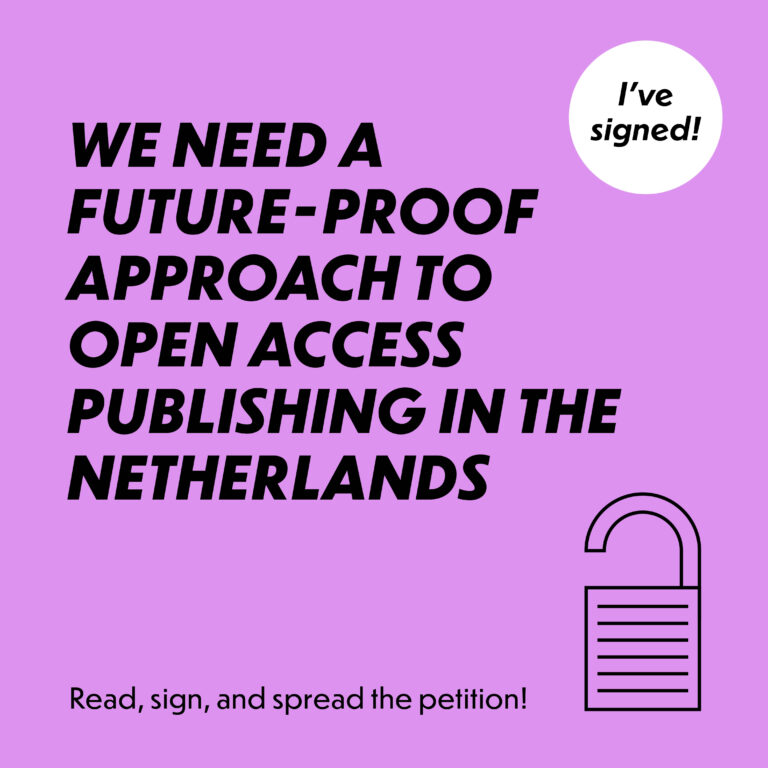
<p>I hope you are willing the read the following petition to the Dutch negotiators
to very carefully consider what their priorities are and who they represent.
You can sign anonymously (if you fear backslash) and you can just read the details
behind this well-written petition: there are many references at the bottom to
support the statements I make here, and more.</p>

<p>But I really, really hope you wish a better future for knowledge dissemination.
Just think of your next Reviewer 2, that you pay the publisher to have Reviewer 2
scold at you, or the time spent on reference formatting, just because the publisher
prefers profit over usability.</p>

<p>Join and <a href="https://openscienceretreat.eu/call-to-commitment-future-proof-oa-publishing/">sign</a>!</p>

<p><a href="https://openscienceretreat.eu/call-to-commitment-future-proof-oa-publishing/"><img src="/assets/images/0-768x768.jpg" alt="" /></a></p>]]></content><author><name>Egon Willighagen</name></author><category term="publishing" /><category term="openscience" /><category term="doi:10.1186/S13321-019-0365-4" /><category term="doi:10.1186/S13321-020-00448-1" /><category term="doi:10.5281/ZENODO.4926030" /><summary type="html"><![CDATA[If you read my blog, it should not surprise you that I have long experimented with technologies to improve knowledge dissemination, for example in HTML. And I have blogged about publishing from an author and researcher, and editor perspective, for many years (see this longer list on my old blog). Also, in the Journal of Cheminformatics we pushed for innovation, including ORCID and GitHub adoption and Citation Typing Ontology adoption.]]></summary><media:thumbnail xmlns:media="http://search.yahoo.com/mrss/" url="https://chem-bla-ics.linkedchemistry.info/assets/images/0-768x768.jpg" /><media:content medium="image" url="https://chem-bla-ics.linkedchemistry.info/assets/images/0-768x768.jpg" xmlns:media="http://search.yahoo.com/mrss/" /></entry><entry><title type="html">History, provenance, detail</title><link href="https://chem-bla-ics.linkedchemistry.info/2023/08/08/history-provenance-detail.html" rel="alternate" type="text/html" title="History, provenance, detail" /><published>2023-08-08T00:00:00+00:00</published><updated>2023-08-08T00:00:00+00:00</updated><id>https://chem-bla-ics.linkedchemistry.info/2023/08/08/history-provenance-detail</id><content type="html" xml:base="https://chem-bla-ics.linkedchemistry.info/2023/08/08/history-provenance-detail.html"><![CDATA[<p>Just a quick note: I just love the level of detail <a href="https://www.wikidata.org/">Wikidata</a> allows us to use. One of the marvels is the
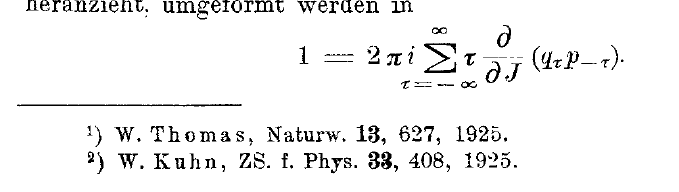
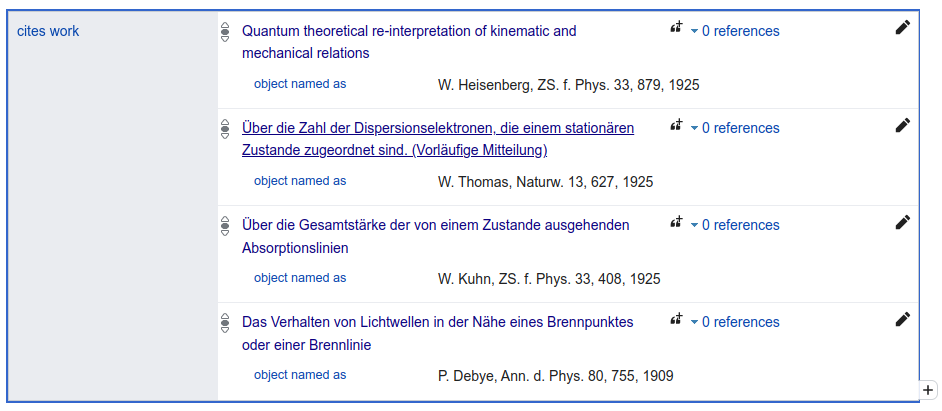
practices of <code class="language-plaintext highlighter-rouge">named as</code>, which can be used in statements for subject and objects. The notion and importance here is that things are
referred to in different ways, and these properties allows us to link the interpretation with the source. For example,
<a href="https://scholia.toolforge.org/author/Q58978">Max Born</a>’s seminal work <em><a href="https://scholia.toolforge.org/work/Q55867811">Zur Quantenmechanik</a></em>
(doi:<a href="https://doi.org/10.1007/BF01328531">10.1007/BF01328531</a>) uses a very short notation to cite other literature, as footnotes,
and DOIs did not exist yet.</p>

<p><img src="/assets/images/old_references.png" alt="Screenshot of two references as footnotes on a page with a mathematical formula from the old Born paper from 1925." /></p>

<p>So, in Wikidata, you can <a href="https://www.wikidata.org/wiki/Q55867811#P2860">capture this like this</a>:</p>

<p><img src="/assets/images/new_old_references.png" alt="Screenshot of the FAIR references from the 1925 Born paper." /></p>]]></content><author><name>Egon Willighagen</name></author><category term="wikidata" /><category term="publishing" /><category term="justdoi:10.1007/BF01328531" /><summary type="html"><![CDATA[Just a quick note: I just love the level of detail Wikidata allows us to use. One of the marvels is the practices of named as, which can be used in statements for subject and objects. The notion and importance here is that things are referred to in different ways, and these properties allows us to link the interpretation with the source. For example, Max Born’s seminal work Zur Quantenmechanik (doi:10.1007/BF01328531) uses a very short notation to cite other literature, as footnotes, and DOIs did not exist yet.]]></summary><media:thumbnail xmlns:media="http://search.yahoo.com/mrss/" url="https://chem-bla-ics.linkedchemistry.info/assets/images/old_references.png" /><media:content medium="image" url="https://chem-bla-ics.linkedchemistry.info/assets/images/old_references.png" xmlns:media="http://search.yahoo.com/mrss/" /></entry><entry><title type="html">Journal Rankings</title><link href="https://chem-bla-ics.linkedchemistry.info/2023/07/06/journal-rankings.html" rel="alternate" type="text/html" title="Journal Rankings" /><published>2023-07-06T00:00:00+00:00</published><updated>2023-07-06T00:00:00+00:00</updated><id>https://chem-bla-ics.linkedchemistry.info/2023/07/06/journal-rankings</id><content type="html" xml:base="https://chem-bla-ics.linkedchemistry.info/2023/07/06/journal-rankings.html"><![CDATA[<p>I am pleased to learn that the <a href="https://www.universiteitenvannederland.nl/nl_NL/nieuws-detail/nieuwsbericht/915-p-nederlandse-universiteiten-gaan-voortaan-anders-om-met-rankings-p.html">Dutch Universities start looking at rankings of a more scientific way</a>.
It is long overdue that we take scientific peer review of the indicators used in those rankings seriously, instead of hiding beyond
<a href="https://en.wikipedia.org/wiki/Fear,_uncertainty,_and_doubt">fud</a> around the decline of quality of research.</p>

<p>So, what defines the quality of a journal? Or better, of any scholarly dissemination channel? After all, some databases do better peer review
than some journals. Sadly, I am not aware of literature that compares the quality of peer review in databases with that in scientific journals.
Also long overdue, in my opinion.</p>

<p>I hope the <a href="https://osc-international.com/">Open Science community</a> will help shape these scholarly dissemination channels, journals included.
Some ideas, the outlet:</p>

<ul>
  <li>encourages post-publication peer review</li>
  <li>communicates the post-publication peer review</li>
  <li>allows updating easily small fixes and clarifications (no hiding behind the version-of-record)</li>
  <li>ensures supp info / additional files undergo the same level of peer review</li>
  <li>use modern solutions for communication (like semantic web technologies)</li>
  <li>have clear licenses for all aspects of the <a href="/2023/07/02/qeios-open-dissemination-platform-for.html">research output</a></li>
  <li>actively fight against visual representation only, but provides all data</li>
  <li>guarantees that supp info / additional files are archived, as the output itself</li>
  <li>adopts, promotes, requires community standards (including global, unique identifiers)</li>
</ul>

<p>Okay, these items are pretty broad. Many of them are part of FAIR, but that should not surprise you, because <a href="https://doi.org/10.1162/dint_r_00024">FAIR</a>
are just applying traditional scholarly approaches, like properly keeping notebooks. It’s just a bit more “digital” then we have been taught.</p>

<p>Do we know how to do this? Yes, pretty much. This is not a technical exercise, but one of social change and particularly willingness. Basically, if you want
to keep the current way of doing things, the declare you want unreproducible, low quality research reporting. That’s your academic freedom, of course.
If I were a funder or a university, I would also expect a bit more in return for my money.</p>

<p>Let me stress, glossy articles are fine! You do not have to stop that. Media appearances, key notes, these are all also fine. They are, however,
complementary. We should not continue the habit of fancy narratives as replacement for quality research dissemination. Do both, if you must.</p>]]></content><author><name>Egon Willighagen</name></author><category term="publishing" /><category term="doi:10.1162/dint_r_00024" /><summary type="html"><![CDATA[I am pleased to learn that the Dutch Universities start looking at rankings of a more scientific way. It is long overdue that we take scientific peer review of the indicators used in those rankings seriously, instead of hiding beyond fud around the decline of quality of research.]]></summary></entry><entry><title type="html">Qeios, an open dissemination platform for research output</title><link href="https://chem-bla-ics.linkedchemistry.info/2023/07/02/qeios-open-dissemination-platform-for.html" rel="alternate" type="text/html" title="Qeios, an open dissemination platform for research output" /><published>2023-07-02T00:00:00+00:00</published><updated>2023-07-02T00:00:00+00:00</updated><id>https://chem-bla-ics.linkedchemistry.info/2023/07/02/qeios-open-dissemination-platform-for</id><content type="html" xml:base="https://chem-bla-ics.linkedchemistry.info/2023/07/02/qeios-open-dissemination-platform-for.html"><![CDATA[<p>A bit over a year ago I got introduced to <a href="https://www.qeios.com/">Qeios</a> when I was asked to review an article by Michie, West, and Hasting:
<em>“Creating ontological definitions for use in science”</em> (doi:<a href="https://doi.org/10.32388/YGIF9B.2">10.32388/YGIF9B.2</a>). I wrote up my thoughts after
reading the paper, and the review was posted openly online and got a <a href="https://doi.org/10.32388/7MQYM4">DOI</a>. Not the first platform to do this
(think F1000), but it is always nice to see some publishers taking publishing seriously. Since then, I reviewed
<a href="https://www.qeios.com/read/ZJ4QDA">two</a> <a href="https://www.qeios.com/read/YCHHA7">more</a> papers.</p>

<p>One of these latter two was not a more traditional paper, but a different kind of <strong>research output</strong>: a definition, about “<em>Drive-by Curation</em>”
(doi:<a href="https://doi.org/10.32388/KBX9VO">10.32388/KBX9VO</a>). Now about this output type, collaboratively working on definitions is something core to
ontology development (e.g. see doi:<a href="https://doi.org/10.1186/s13326-015-0005-5">10.1186/s13326-015-0005-5</a>), but there is a clear need to discuss
terminology. The <a href="https://www.h2020gracious.eu/">GRACIOUS</a> project in the <a href="https://www.nanosafetycluster.eu/">EU NanoSafety Cluster</a> also recognized
this and set up a tool for this, their <a href="https://terminology-harmonizer.greendecision.eu/">Terminology Harmonizer</a>
(doi:<a href="https://doi.org/10.1016/j.impact.2021.100366">10.1016/j.impact.2021.100366</a>).</p>

<p>This GRACIOUS tool, much more than what Qeios does, helps users. Unfortunately, and why how these topics nicely come together, writing definitions,
thinking about when some zeta potential is different from another zeta potential, and the (drive-by) community curation, it needs transparency.
I understand it, but landing on a login page is for me a recipe for a silent death as it disallows people to learn, without making an (time)
investment first. That is what Qeios does differently: it is more FAIR.</p>

<p>So, that brings me to my last point in this post. Jente Houweling and I wrote up a definition for “<em>Research Output Management</em>”
(doi:<a href="https://doi.org/10.32388/ZNWI7T">10.32388/ZNWI7T</a>), based on our discussions about her research insights. See the screenshot below.</p>

<p>It has been reviewed internally, and by one independent peer (doi:<a href="https://doi.org/10.32388/C3SJTN">10.32388/C3SJTN</a>). But we would love to hear
your review too. Just follow the instructions online. We are looking forward to reading your thoughts and to refining our definition.</p>

<p><img src="/assets/images/qeios_romp.png" alt="Screenshot of the Qeios page for the Research Output Management paper." /></p>]]></content><author><name>Egon Willighagen</name></author><category term="rom" /><category term="publishing" /><category term="justdoi:10.32388/YGIF9B.2" /><category term="doi:10.32388/7MQYM4" /><category term="doi:10.32388/ZJ4QDA" /><category term="doi:10.32388/YCHHA7" /><category term="justdoi:10.32388/KBX9VO" /><category term="doi:10.1186/S13326-015-0005-5" /><category term="justdoi:10.1016/j.impact.2021.100366" /><category term="doi:10.32388/ZNWI7T" /><category term="justdoi:10.32388/C3SJTN" /><summary type="html"><![CDATA[A bit over a year ago I got introduced to Qeios when I was asked to review an article by Michie, West, and Hasting: “Creating ontological definitions for use in science” (doi:10.32388/YGIF9B.2). I wrote up my thoughts after reading the paper, and the review was posted openly online and got a DOI. Not the first platform to do this (think F1000), but it is always nice to see some publishers taking publishing seriously. Since then, I reviewed two more papers.]]></summary><media:thumbnail xmlns:media="http://search.yahoo.com/mrss/" url="https://chem-bla-ics.linkedchemistry.info/assets/images/qeios_romp.png" /><media:content medium="image" url="https://chem-bla-ics.linkedchemistry.info/assets/images/qeios_romp.png" xmlns:media="http://search.yahoo.com/mrss/" /></entry><entry><title type="html">Scholarly journals should use “Archived on” instead of “Accessed on”</title><link href="https://chem-bla-ics.linkedchemistry.info/2021/08/28/scholarly-journals-should-use-archived.html" rel="alternate" type="text/html" title="Scholarly journals should use “Archived on” instead of “Accessed on”" /><published>2021-08-28T00:00:00+00:00</published><updated>2021-08-28T00:00:00+00:00</updated><id>https://chem-bla-ics.linkedchemistry.info/2021/08/28/scholarly-journals-should-use-archived</id><content type="html" xml:base="https://chem-bla-ics.linkedchemistry.info/2021/08/28/scholarly-journals-should-use-archived.html"><![CDATA[<p>Publishing habits changes very slowly, too slowly. The whole industry is incredibly inert, which can lead to severe frustration
as <a href="https://chem-bla-ics.linkedchemistry.info/2021/06/11/conflict-of-interest-or-why-i-am.html">it did for me <i class="fa-solid fa-recycle fa-xs"></i></a>. But sometimes small
changes can do so much.</p>

<p>Linkrot, the phenomenon that URLs are not persistent, has been studied, including the in scholarly settings (see
<a href="https://doi.org/10.3998/3336451.0004.210">1998</a>,
<a href="https://www.jstor.org/stable/20863780">2000</a>,
<a href="https://doi.org/10.1353/pla.2003.0098">2003</a>,
<a href="https://doi.org/10.1002/bmb.2003.494031010165">2006</a>,
<a href="https://doi.org/10.1300/J123v49n03_10">2008</a>,
<a href="https://doi.org/10.1371/journal.pone.0115253">2014</a>,
<a href="https://doi.org/10.18329/09757597/2015/8105">2015</a>,
<a href="https://doi.org/10.1108/GKMC-06-2019-0067">2000</a>,
<a href="https://journal.code4lib.org/articles/15509">2021</a>,
and probably many more). Indeed, scholarly publishers started introducing the following: URLs should be accompanied with an
“accessed on” statement. Indeed, you can find this in many bibliographic formatting standards.</p>

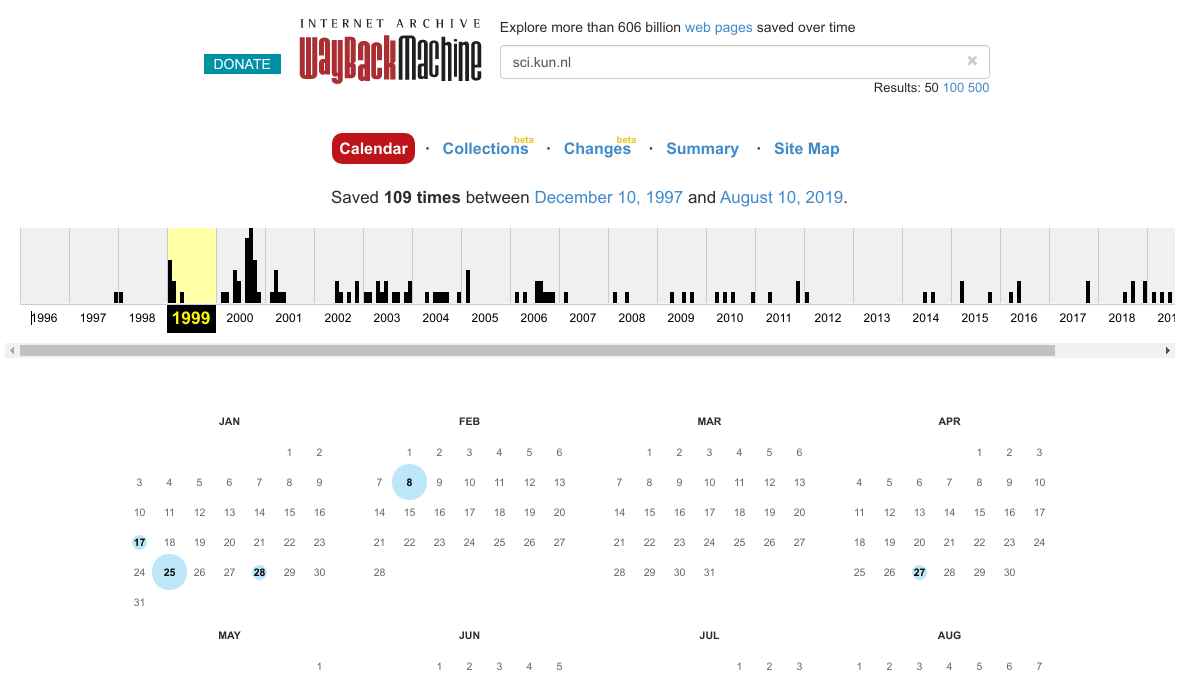
<p>Indeed, this must change, and we already have a solution <a href="https://en.wikipedia.org/wiki/Internet_Archive">since 1996</a>:
the <a href="https://archive.org/web/">Internet Archive</a> (tho the archive goes back much longer). I call all publishers to change
their “Accessed on” to “Archived on”. Two simpel solutions that can compliment each other:</p>

<h2 id="authors-archive-upon-submission">Authors archive upon submission</h2>

<p>This solution is simply introduced by updating author guidelines. Surely it will take a bit of time for bibliography software
to be updated, and for the time being we still write “Accessed on” until there is proper support of “Archived on”.</p>

<h2 id="journals-archive-upon-acceptance">Journals archive upon acceptance</h2>

<p>This solution looks for all URLs in journal articles and archives them. It doesn’t matter if the author already did this,
because the Internet Archive has no trouble handling this:</p>

<p><img src="/assets/images/Screenshot_20210828_102732.png" alt="" /></p>

<center>Screenshot of the WaybackMachine showing <a href="https://web.archive.org/web/19990615000000*/sci.kun.nl">many captures of the sci.kun.nl domain.</a></center>
<p><br /></p>

<p>BTW, projects like Wikipedia have <a href="https://meta.wikimedia.org/wiki/InternetArchiveBot">automated the process</a> of
archiving URLs and I see no reason why publishers could not do this.</p>]]></content><author><name>Egon Willighagen</name></author><category term="publishing" /><category term="justdoi:10.3998/3336451.0004.210" /><category term="justdoi:10.1353/pla.2003.0098" /><category term="justdoi:10.1002/bmb.2003.494031010165" /><category term="justdoi:10.1300/J123v49n03_10" /><category term="justdoi:10.1371/journal.pone.0115253" /><category term="justdoi:10.18329/09757597/2015/8105" /><category term="justdoi:10.1108/GKMC-06-2019-0067" /><summary type="html"><![CDATA[Publishing habits changes very slowly, too slowly. The whole industry is incredibly inert, which can lead to severe frustration as it did for me . But sometimes small changes can do so much.]]></summary><media:thumbnail xmlns:media="http://search.yahoo.com/mrss/" url="https://chem-bla-ics.linkedchemistry.info/assets/images/Screenshot_20210828_102732.png" /><media:content medium="image" url="https://chem-bla-ics.linkedchemistry.info/assets/images/Screenshot_20210828_102732.png" xmlns:media="http://search.yahoo.com/mrss/" /></entry></feed>