<?xml version="1.0" encoding="utf-8"?><feed xmlns="http://www.w3.org/2005/Atom" ><generator uri="https://jekyllrb.com/" version="4.3.4">Jekyll</generator><link href="https://chem-bla-ics.linkedchemistry.info/feed/by_tag/pdb.xml" rel="self" type="application/atom+xml" /><link href="https://chem-bla-ics.linkedchemistry.info/" rel="alternate" type="text/html" /><updated>2026-04-19T09:50:36+00:00</updated><id>https://chem-bla-ics.linkedchemistry.info/feed/by_tag/pdb.xml</id><title type="html">chem-bla-ics</title><subtitle>Chemblaics (pronounced chem-bla-ics) is the science that uses open science and computers to solve problems in chemistry, biochemistry and related fields.</subtitle><author><name>Egon Willighagen</name></author><entry><title type="html">CDK Bug Squash Party - Day 3 and 4</title><link href="https://chem-bla-ics.linkedchemistry.info/2006/09/22/cdk-bug-squash-party-day-3-and-4.html" rel="alternate" type="text/html" title="CDK Bug Squash Party - Day 3 and 4" /><published>2006-09-22T00:00:00+00:00</published><updated>2006-09-22T00:00:00+00:00</updated><id>https://chem-bla-ics.linkedchemistry.info/2006/09/22/cdk-bug-squash-party-day-3-and-4</id><content type="html" xml:base="https://chem-bla-ics.linkedchemistry.info/2006/09/22/cdk-bug-squash-party-day-3-and-4.html"><![CDATA[<p>Because I was struggling hard with <a href="http://sourceforge.net/mailarchive/forum.php?thread_id=30594266&amp;forum_id=2178">default values for cdk.interfaces fields</a>,
I did not have time to write up the <a href="http://wiki.cubic.uni-koeln.de/cdkwiki/doku.php?id=bsp200609">Bug Squash Party</a> report for day 3 (see also
<a href="https://chem-bla-ics.linkedchemistry.info/2006/09/18/cdk-bug-squash-party-day-1.html">day 1 <i class="fa-solid fa-recycle fa-xs"></i></a> and
<a href="https://chem-bla-ics.linkedchemistry.info/2006/09/20/cdk-bug-squash-party-day-2.html">day 2 <i class="fa-solid fa-recycle fa-xs"></i></a>).
But here it is.</p>

<h1 id="day-3">Day 3</h1>

<p>Kai worked hard on getting the <code class="language-plaintext highlighter-rouge">cdk.interfaces</code> API cleaned up, as <a href="http://wiki.cubic.uni-koeln.de/cdkwiki/doku.php?id=refactoringkernelclasses">agreed upon earlier</a>.
Christian added a test for the <a href="http://cheminfo.informatics.indiana.edu/~rguha/code/java/nightly/api/org/openscience/cdk/geometry/GeometryTools.html">RMSD calculator</a>
(see <code class="language-plaintext highlighter-rouge">getAllAtomRMSD()</code>), and cleaned up his code a bit. Stefan continued his bug-squashing on JChemPaint and fixed another one or two bugs.</p>

<p>Rajarshi uploaded a patch to set undefined atomic properties, like partial and formal charges and the implicit hydrogen count, to <code class="language-plaintext highlighter-rouge">UNSET</code> by default.
However, this broke the CDK at many places, as apparently many class methods assume the default to be zero. After discussing the issue at the CUBIC,
it turned out that this was sort of the intended, though undocumented, behavior: use the <a href="http://java.sun.com/docs/books/tutorial/java/nutsandbolts/datatypes.html">default Java values</a>.</p>

<p>And I added missing <code class="language-plaintext highlighter-rouge">clone()</code> methods, closing one bug on SourceForge, added files for Eclipse to know how to build the CDK with Ant (thanx
to Nico for similar files for <a href="http://www.jmol.org/">Jmol</a>), and got CDK compiled again against <a href="http://www.classpath.org/">Classpath</a>.</p>

<h1 id="day-4">Day 4</h1>

<p>Miguel uploaded his first patched for support saving <a href="http://cheminfo.informatics.indiana.edu/~rguha/code/java/nightly/api/org/openscience/cdk/protein/data/PDBPolymer.html">PDBPolymer</a>
data structures into and restoring them again from CML, addressing an <a href="https://sourceforge.net/tracker/index.php?func=detail&amp;aid=1085912&amp;group_id=20024&amp;atid=120024">almost two-year-old bug</a>.
He created new cdk.interfaces for them, to address module dependencies, but a large set of JUnit tests are <a href="http://cheminfo.informatics.indiana.edu/~rguha/code/java/nightly/test/result-data.html">yet missing</a>.</p>

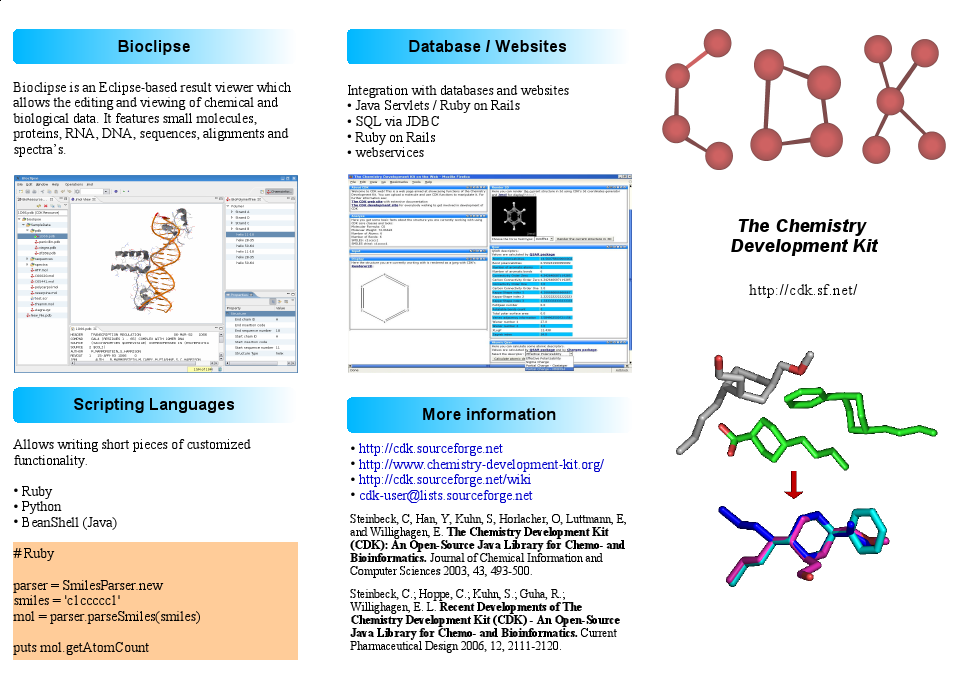
<p>Kai continued his cdk.interfaces refactoring, working on the more involved changes. Stefan, Tobias, and me worked on a poster and three three-fold
flyers for our CDK booth at <a href="http://www.inf.uni-konstanz.de/complife06/">CompLife2006</a>, so have not been very productive in bug squashing.
But we are happy with the result. Below is a screenshot on one side of the main CDK folder:</p>

<p><img src="/assets/images/flyerScreeny.png" alt="" /></p>

<p>With <a href="http://cheminfo.informatics.indiana.edu/~rguha/code/java/nightly/junitsummary.html">77 failing JUnit test</a>, and still a too large number of
<a href="http://sourceforge.net/tracker/?atid=120024&amp;group_id=20024&amp;func=browse">open bugs on SourceForge</a>, there is plenty of things to do today.</p>]]></content><author><name>Egon Willighagen</name></author><category term="cdk" /><category term="bsp" /><category term="java" /><category term="pdb" /><category term="conference" /><summary type="html"><![CDATA[Because I was struggling hard with default values for cdk.interfaces fields, I did not have time to write up the Bug Squash Party report for day 3 (see also day 1 and day 2 ). But here it is.]]></summary><media:thumbnail xmlns:media="http://search.yahoo.com/mrss/" url="https://chem-bla-ics.linkedchemistry.info/assets/images/flyerScreeny.png" /><media:content medium="image" url="https://chem-bla-ics.linkedchemistry.info/assets/images/flyerScreeny.png" xmlns:media="http://search.yahoo.com/mrss/" /></entry><entry><title type="html">Complex PDB documents using the Bioclipse ChildResourceCreator</title><link href="https://chem-bla-ics.linkedchemistry.info/2006/09/14/complex-pdb-documents-using-bioclipse.html" rel="alternate" type="text/html" title="Complex PDB documents using the Bioclipse ChildResourceCreator" /><published>2006-09-14T00:00:00+00:00</published><updated>2006-09-14T00:00:00+00:00</updated><id>https://chem-bla-ics.linkedchemistry.info/2006/09/14/complex-pdb-documents-using-bioclipse</id><content type="html" xml:base="https://chem-bla-ics.linkedchemistry.info/2006/09/14/complex-pdb-documents-using-bioclipse.html"><![CDATA[<p>Some time ago I blogged about the <a href="https://chem-bla-ics.linkedchemistry.info/2006/08/22/bioclipse-gets-new-extension-point.html">ChildResourceCreator extension point in Bioclipse <i class="fa-solid fa-recycle fa-xs"></i></a>
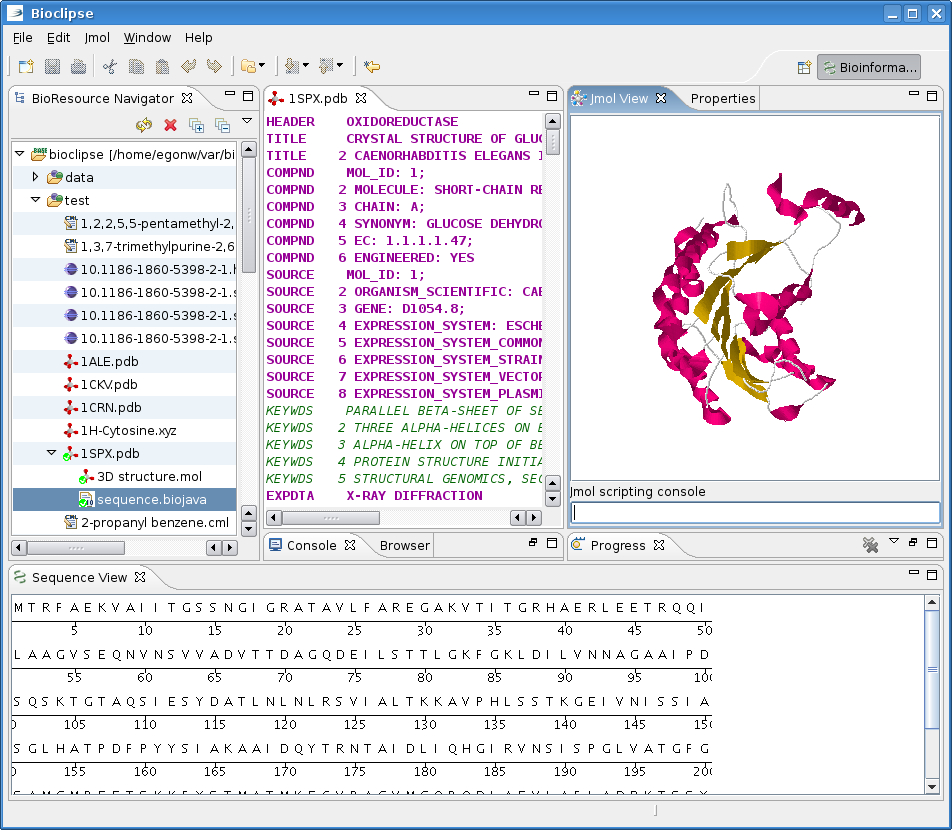
and hinted as using that for <a href="http://www.rcsb.org/pdb/">PDB files</a>. which contain 3D molecular models, sequences and bibliographic information. Using the new extension point,
<a href="http://www.bioclipse.net/">Bioclipse</a> now treats PDB files as complex documents, creating child resources for the 3D molecular model (using the
<a href="http://cdk.sf.net/">CDK</a> plugin), and a sequence resource (using the <a href="http://www.biojava.org/">BioJava</a> plugin).</p>

<p><img src="/assets/images/bioclipseBioJavaSupport.png" alt="" /></p>]]></content><author><name>Egon Willighagen</name></author><category term="bioclipse" /><category term="biojava" /><category term="cdk" /><category term="pdb" /><category term="jmol" /><summary type="html"><![CDATA[Some time ago I blogged about the ChildResourceCreator extension point in Bioclipse and hinted as using that for PDB files. which contain 3D molecular models, sequences and bibliographic information. Using the new extension point, Bioclipse now treats PDB files as complex documents, creating child resources for the 3D molecular model (using the CDK plugin), and a sequence resource (using the BioJava plugin).]]></summary><media:thumbnail xmlns:media="http://search.yahoo.com/mrss/" url="https://chem-bla-ics.linkedchemistry.info/assets/images/bioclipseBioJavaSupport.png" /><media:content medium="image" url="https://chem-bla-ics.linkedchemistry.info/assets/images/bioclipseBioJavaSupport.png" xmlns:media="http://search.yahoo.com/mrss/" /></entry><entry><title type="html">Uncertainty in NMR based 3D protein models</title><link href="https://chem-bla-ics.linkedchemistry.info/2006/04/02/uncertainty-in-nmr-based-3d-protein.html" rel="alternate" type="text/html" title="Uncertainty in NMR based 3D protein models" /><published>2006-04-02T00:00:00+00:00</published><updated>2006-04-02T00:00:00+00:00</updated><id>https://chem-bla-ics.linkedchemistry.info/2006/04/02/uncertainty-in-nmr-based-3d-protein</id><content type="html" xml:base="https://chem-bla-ics.linkedchemistry.info/2006/04/02/uncertainty-in-nmr-based-3d-protein.html"><![CDATA[<p>While I was working on implementing proper author-given chain IDs in <a href="http://www.pdb.org/">PDB</a> structures for
<a href="http://www.jmol.org/">Jmol</a>’s mmCIF reader today, I thought it was interesting to mention the recent article
<em>Traditional Biomolecular Structure Determination by NMR Spectroscopy Allows for Major Errors by Nabuurs</em>
(DOI:<a href="http://dx.doi.org/10.1371/journal.pcbi.0020009">10.1371/journal.pcbi.0020009</a>, open access), working at the
<a href="http://www.cmbi.ru.nl/">CMBI</a>, two floors away from my former working location at the
<a href="https://www.ru.nl/">Radboud University Nijmegen</a>.</p>

<p>Nabuurs discusses in this article the uncertainties that come with NMR derived 3D molecular structures of proteins.
These studies do not give factual data on atomic coordinates, but generally give facts about interatomic distances.
Solving the 3D geometry is then an optimization problem where the task is to find the 3D geometry that best
reproduces the factual interatomic distances.</p>

<p>Now, this optimization has many closeby, i.e. in terms of matching the experimental data, minima, corresponding,
possibly, to quite different structures.</p>

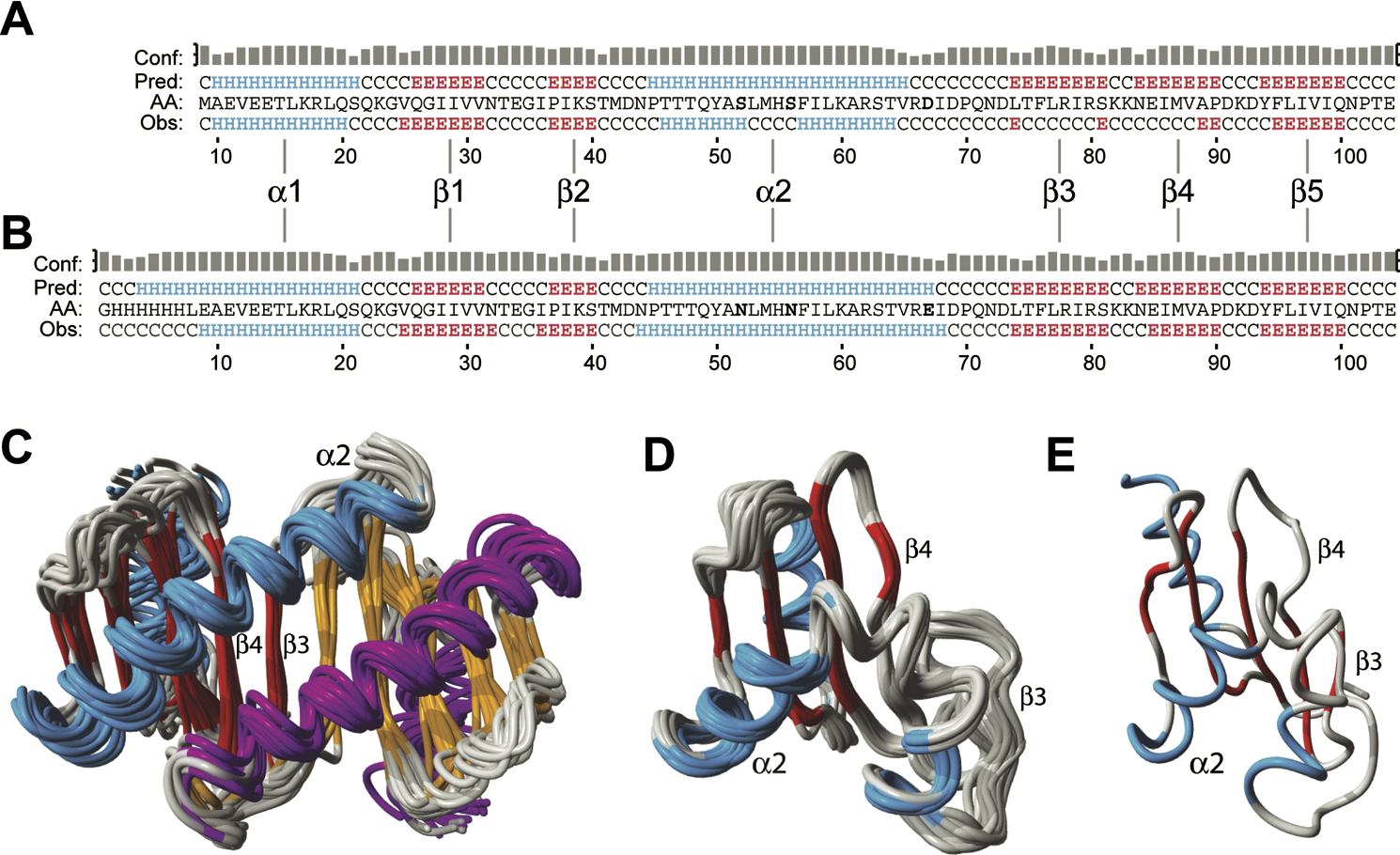
<p>This is nicely demonstrated in the article, by comparing the folds of <a href="http://www.pdb.org/pdb/explore.do?structureId=1Y4O">1Y4O</a>
and <a href="http://www.pdb.org/pdb/explore.do?structureId=1TGQ">1TGQ</a>, as shown in the figure below
(<a href="http://www.plos.org/oa/index.html">CCAL</a> license):</p>

<p><img src="/assets/images/pcbi.0020009.g001.png" alt="Figure 1 from the article: Sequence and Structure Ensembles of Two DLC2A Structures." /></p>

<p>It is interesting to note that 1TGQ got replaced by <a href="http://www.pdb.org/pdb/explore.do?structureId=2B95">2B95</a> about the same
time the article by Nabuurs was published, which shows a 3D model that is homologous with that of 1Y4O, and different from
that in the Nabuurs article.</p>]]></content><author><name>Egon Willighagen</name></author><category term="pdb" /><category term="crystal" /><category term="pdb" /><category term="cif" /><category term="justdoi:10.1371/JOURNAL.PCBI.0020009" /><summary type="html"><![CDATA[While I was working on implementing proper author-given chain IDs in PDB structures for Jmol’s mmCIF reader today, I thought it was interesting to mention the recent article Traditional Biomolecular Structure Determination by NMR Spectroscopy Allows for Major Errors by Nabuurs (DOI:10.1371/journal.pcbi.0020009, open access), working at the CMBI, two floors away from my former working location at the Radboud University Nijmegen.]]></summary></entry><entry><title type="html">Uncertainty in NMR based 3D protein models</title><link href="https://chem-bla-ics.linkedchemistry.info/2006/04/02/uncertainty-in-nmr-based-3d-protein.html" rel="alternate" type="text/html" title="Uncertainty in NMR based 3D protein models" /><published>2006-04-02T00:00:00+00:00</published><updated>2006-04-02T00:00:00+00:00</updated><id>https://chem-bla-ics.linkedchemistry.info/2006/04/02/uncertainty-in-nmr-based-3d-protein</id><content type="html" xml:base="https://chem-bla-ics.linkedchemistry.info/2006/04/02/uncertainty-in-nmr-based-3d-protein.html"><![CDATA[<p>While I was working on implementing proper author-given chain IDs in <a href="http://www.pdb.org/">PDB</a> structures for
<a href="http://www.jmol.org/">Jmol</a>’s mmCIF reader today, I thought it was interesting to mention the recent article
<em>Traditional Biomolecular Structure Determination by NMR Spectroscopy Allows for Major Errors by Nabuurs</em>
(DOI:<a href="http://dx.doi.org/10.1371/journal.pcbi.0020009">10.1371/journal.pcbi.0020009</a>, open access), working at the
<a href="http://www.cmbi.ru.nl/">CMBI</a>, two floors away from my former working location at the
<a href="https://www.ru.nl/">Radboud University Nijmegen</a>.</p>

<p>Nabuurs discusses in this article the uncertainties that come with NMR derived 3D molecular structures of proteins.
These studies do not give factual data on atomic coordinates, but generally give facts about interatomic distances.
Solving the 3D geometry is then an optimization problem where the task is to find the 3D geometry that best
reproduces the factual interatomic distances.</p>

<p>Now, this optimization has many closeby, i.e. in terms of matching the experimental data, minima, corresponding,
possibly, to quite different structures.</p>

<p>This is nicely demonstrated in the article, by comparing the folds of <a href="http://www.pdb.org/pdb/explore.do?structureId=1Y4O">1Y4O</a>
and <a href="http://www.pdb.org/pdb/explore.do?structureId=1TGQ">1TGQ</a>, as shown in the figure below
(<a href="http://www.plos.org/oa/index.html">CCAL</a> license):</p>

<p><img src="/assets/images/pcbi.0020009.g001.png" alt="Figure 1 from the article: Sequence and Structure Ensembles of Two DLC2A Structures." /></p>

<p>It is interesting to note that 1TGQ got replaced by <a href="http://www.pdb.org/pdb/explore.do?structureId=2B95">2B95</a> about the same
time the article by Nabuurs was published, which shows a 3D model that is homologous with that of 1Y4O, and different from
that in the Nabuurs article.</p>]]></content><author><name>Egon Willighagen</name></author><category term="pdb" /><category term="crystal" /><category term="pdb" /><category term="cif" /><category term="justdoi:10.1371/JOURNAL.PCBI.0020009" /><summary type="html"><![CDATA[While I was working on implementing proper author-given chain IDs in PDB structures for Jmol’s mmCIF reader today, I thought it was interesting to mention the recent article Traditional Biomolecular Structure Determination by NMR Spectroscopy Allows for Major Errors by Nabuurs (DOI:10.1371/journal.pcbi.0020009, open access), working at the CMBI, two floors away from my former working location at the Radboud University Nijmegen.]]></summary></entry></feed>