<?xml version="1.0" encoding="utf-8"?><feed xmlns="http://www.w3.org/2005/Atom" ><generator uri="https://jekyllrb.com/" version="4.3.4">Jekyll</generator><link href="https://chem-bla-ics.linkedchemistry.info/feed/by_tag/oxford.xml" rel="self" type="application/atom+xml" /><link href="https://chem-bla-ics.linkedchemistry.info/" rel="alternate" type="text/html" /><updated>2026-04-19T09:50:36+00:00</updated><id>https://chem-bla-ics.linkedchemistry.info/feed/by_tag/oxford.xml</id><title type="html">chem-bla-ics</title><subtitle>Chemblaics (pronounced chem-bla-ics) is the science that uses open science and computers to solve problems in chemistry, biochemistry and related fields.</subtitle><author><name>Egon Willighagen</name></author><entry><title type="html">Oxford… #2</title><link href="https://chem-bla-ics.linkedchemistry.info/2010/08/06/oxford-2.html" rel="alternate" type="text/html" title="Oxford… #2" /><published>2010-08-06T00:00:00+00:00</published><updated>2010-08-06T00:00:00+00:00</updated><id>https://chem-bla-ics.linkedchemistry.info/2010/08/06/oxford-2</id><content type="html" xml:base="https://chem-bla-ics.linkedchemistry.info/2010/08/06/oxford-2.html"><![CDATA[<p>The <a href="/2010/08/01/oxford.html">Predictive Toxicology <i class="fa-solid fa-recycle fa-xs"></i></a> meeting is over. It was a great meeting, by any standard.
Very much recommended, and many thanx to Barry for the organization! The meeting was a true workshop, with a mix of presentations and getting
work done. I participated in a group that looked at mutagenicity of potential anti-malaria drugs from the datasets of GSK and Novartis recently
release as Open Data. We used various tools to predict properties, and plan to make all our results freely available soon. Otherwise, it was
also great to meet Nina again (with whom I <a href="https://chem-bla-ics.blogspot.com/2010/08/using-bioclipse-to-upload-data-to.html">talked about OpenTox</a>),
and to meet other CDK users, including Patrik (<a href="https://web.archive.org/web/20100918124243/https://www.farma.ku.dk/smartcyp/">SMARTCyp <i class="fa-solid fa-box-archive fa-xs"></i></a>,
doi:<a href="https://doi.org/10.1021/ml100016x">10.1021/ml100016x</a>) and David (<a href="http://inkspotscience.com/">Inkspot</a>).</p>

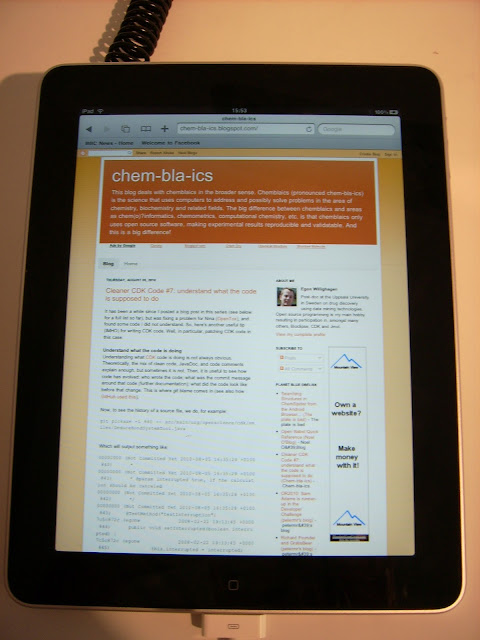
<p>In the afternoon I walked around a bit more in Oxford, did some more shopping… and visited the Apple shop and played with an iPad. It’s
indeed a great piece of hardware. Looking forward to the first Android versions :)</p>

<p><img src="/assets/images/DSCI0107.JPG" alt="" /></p>]]></content><author><name>Egon Willighagen</name></author><category term="cdk" /><category term="oxford" /><category term="oxfordadmet2010" /><category term="justdoi:10.1021/ml100016x" /><category term="conference" /><summary type="html"><![CDATA[The Predictive Toxicology meeting is over. It was a great meeting, by any standard. Very much recommended, and many thanx to Barry for the organization! The meeting was a true workshop, with a mix of presentations and getting work done. I participated in a group that looked at mutagenicity of potential anti-malaria drugs from the datasets of GSK and Novartis recently release as Open Data. We used various tools to predict properties, and plan to make all our results freely available soon. Otherwise, it was also great to meet Nina again (with whom I talked about OpenTox), and to meet other CDK users, including Patrik (SMARTCyp , doi:10.1021/ml100016x) and David (Inkspot).]]></summary></entry><entry><title type="html">Oxford…</title><link href="https://chem-bla-ics.linkedchemistry.info/2010/08/01/oxford.html" rel="alternate" type="text/html" title="Oxford…" /><published>2010-08-01T00:00:00+00:00</published><updated>2010-08-01T00:00:00+00:00</updated><id>https://chem-bla-ics.linkedchemistry.info/2010/08/01/oxford</id><content type="html" xml:base="https://chem-bla-ics.linkedchemistry.info/2010/08/01/oxford.html"><![CDATA[<p>Yesterday I arrived in <a href="http://en.wikipedia.org/wiki/Oxford">Oxford</a>, after a 3.5 hour bus transfer from
<a href="http://en.wikipedia.org/wiki/London_Stansted_Airport">London Stansted</a>. Long, boring ride (though I might have seen a few
<a href="https://web.archive.org/web/20100728051221/http://www.rspb.org.uk/wildlife/birdguide/name/r/redkite/index.aspx">red kites <i class="fa-solid fa-box-archive fa-xs"></i></a>, but seeing that they were near extinct, I am
wondering what other large bird of prey has strong split tail like a swallow). Showed once more that the UK infrastructure has
hardly changed since the 19th century. Enjoying an undergraduate room at one of the colleges. Pretty basic, but makes me feel
more like a human than a tourist. Yes!, undergraduate students are human too! One of the advantages is you get an excellent
internet connection :)</p>

<p>Anyways, going to the <a href="https://web.archive.org/web/20111001000000*/http://echeminfo.com/comty_oxfordadmet10">Predictive Toxicology <i class="fa-solid fa-box-archive fa-xs"></i></a> workshop, thanx to the bursary award I received from
<a href="https://web.archive.org/web/20110207193345/http://echeminfo.com/">echeminfo <i class="fa-solid fa-box-archive fa-xs"></i></a>
(see <a href="http://chem-bla-ics.blogspot.com/2010/03/oxford-august-2010-echeminfo-predictive.html">Oxford, August 2010: eCheminfo Predictive ADME &amp; Toxicology 2010 Workshop</a>).</p>

<p>This afternoon I walked around a bit, watching all the old buildings. But I guess being here without anyone to share it with,
and that it looks just like <a href="http://en.wikipedia.org/wiki/Cambridge">Cambridge</a>, makes me not-so-much impressed. Moreover, it’s too
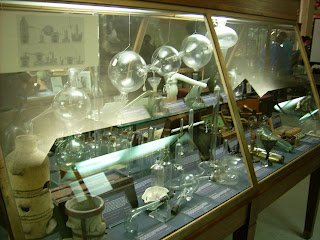
busy with tourists and people randomly wearing Oxford University sweatshirts. Small and nice was the
<a href="http://www.mhs.ox.ac.uk/">Museum of the History of Science</a>, with some nice chemical pieces, like this one:</p>

<p><img src="/assets/images/DSCI0089.JPG" alt="" /></p>

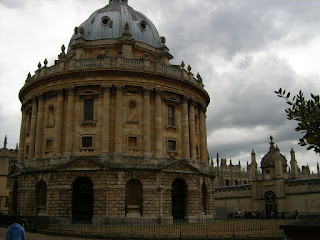
<p>Buildings like the <a href="http://en.wikipedia.org/wiki/Radcliffe_Camera">Radcliffe Camera</a> are nice on the outside, but closed.
Seems I have to become a fellow first. This is what it looked like today:</p>

<p><img src="/assets/images/DSCI0094.JPG" alt="" /></p>

<p>Quite interesting too was the Oxford University Press shop. I’m a sucker for books. Apparently, you can just write a book
and publish it. For example, an extensive list of <a href="http://ukcatalogue.oup.com/category/academic/series/general/opr.do">dictionaries on about anything</a>…
and since I have been writing several book chapters right now, perhaps this is actually an interesting route…</p>

<p>But the question is, of course, how long will we keep reading books… they’re the
<a href="https://blogs.ch.cam.ac.uk/pmr/2008/04/29/why-pdf-is-a-hamburger/">hamburgers <i class="fa-solid fa-recycle fa-xs"></i></a> of educational material… Kindle and alikes will soon drop in
price, and cost some €30 euro. But e-book prices will have to drop too, and I still do not get why an e-book is more expensive than a paperback…
(see <a href="http://chem-bla-ics.blogspot.com/2010/07/amazon-kindle-edition-is-more-expensive.html">Amazon, the Kindle edition is more expensive than the paperback??</a>).
But then again… they are rich, and I am not.</p>

<p>There was some recent talk about the fact that no one can be Open to the full. You either do Open Data or Open Source, and
make a living from the rest. That’s where I nicely show I know bullocks of economics. I do
<a href="http://bodr.sf.net/">BODR</a>, <a href="http://cdk.sf.net/">CDK</a>, … all Open, all for free.</p>

<p>OK. That’s a plus for Oxford… it makes you think about things. Perhaps there is something to
<a href="http://en.wikipedia.org/wiki/Morphic_field#Morphogenetic_field">morphogenetic</a> fields…</p>]]></content><author><name>Egon Willighagen</name></author><category term="oxford" /><category term="oxfordadmet2010" /><category term="publishing" /><category term="science" /><category term="toxicology" /><category term="conference" /><summary type="html"><![CDATA[Yesterday I arrived in Oxford, after a 3.5 hour bus transfer from London Stansted. Long, boring ride (though I might have seen a few red kites , but seeing that they were near extinct, I am wondering what other large bird of prey has strong split tail like a swallow). Showed once more that the UK infrastructure has hardly changed since the 19th century. Enjoying an undergraduate room at one of the colleges. Pretty basic, but makes me feel more like a human than a tourist. Yes!, undergraduate students are human too! One of the advantages is you get an excellent internet connection :)]]></summary></entry></feed>