<?xml version="1.0" encoding="utf-8"?><feed xmlns="http://www.w3.org/2005/Atom" ><generator uri="https://jekyllrb.com/" version="4.3.4">Jekyll</generator><link href="https://chem-bla-ics.linkedchemistry.info/feed/by_tag/opentox.xml" rel="self" type="application/atom+xml" /><link href="https://chem-bla-ics.linkedchemistry.info/" rel="alternate" type="text/html" /><updated>2026-06-07T16:43:55+00:00</updated><id>https://chem-bla-ics.linkedchemistry.info/feed/by_tag/opentox.xml</id><title type="html">chem-bla-ics</title><subtitle>Chemblaics (pronounced chem-bla-ics) is the science that uses open science and computers to solve problems in chemistry, biochemistry and related fields.</subtitle><author><name>Egon Willighagen</name></author><entry><title type="html">New paper: A template wizard for the cocreation of machine-readable data-reporting to harmonize the evaluation of (nano)materials</title><link href="https://chem-bla-ics.linkedchemistry.info/2024/05/27/from-spreadsheets-to-rdf.html" rel="alternate" type="text/html" title="New paper: A template wizard for the cocreation of machine-readable data-reporting to harmonize the evaluation of (nano)materials" /><published>2024-05-27T00:00:00+00:00</published><updated>2024-05-27T00:00:00+00:00</updated><id>https://chem-bla-ics.linkedchemistry.info/2024/05/27/from-spreadsheets-to-rdf</id><content type="html" xml:base="https://chem-bla-ics.linkedchemistry.info/2024/05/27/from-spreadsheets-to-rdf.html"><![CDATA[<p>I was about to call this blog post <em>From spreadsheets to RDF</em>, after <a href="https://chem-bla-ics.linkedchemistry.info/2024/05/20/from-papers-to-rdf.html">the post last week</a>.
But then I decided to just use the pattern I typically use. Why I wanted to use that shorter term in the first
place was that one of the thing I like about the <a href="https://sourceforge.net/projects/ambit/">AMBIT software</a>
(of OpenTox and eNanoMapper fame) is its
RDF support (see doi:<a href="https://doi.org/10.1186/1756-0500-4-487">10.1186/1756-0500-4-487</a>). But
<a href="https://chem-bla-ics.linkedchemistry.info/tag/rdf">RDF</a>, ontologies,
those are hard things. And unlike mathematics, we do not have simple objects like integer numbers or simple
operators. Well, I think we do, and we talk about them. But there is no obligatory education. Just like
any biologist needs to know what <em>1 + 2</em> means, I think any biologist needs basic knowledge about how
knowledge graphs work. But sometimes feels like a taboo, like cursing in the life sciences church.</p>

<p>So, there we are. This is where spreadsheets come in. If done well, they combine aspects of knowledge graphs
with usability and can even cover a good bit of the learnability. This is what is described in this new
paper about templates in the <a href="https://www.nanosafetycluster.eu/">EU NanoSafety Cluster</a>: <em>A template wizard
for the cocreation of machine-readable data-reporting to harmonize the evaluation of (nano)materials</em>
(doi:<a href="https://doi.org/10.1038/s41596-024-00993-1">10.1038/s41596-024-00993-1</a>).</p>

<p>The learnability comes in with the spreadsheet templates (“this is how we did it”) and a “wizard” around
it guides the user with the selection of a template but also can provide feedback on the template. The
technical term for that is “validator”, but it can be tought of as a spelling checker. Computers are good at
finding contradictions (the lack of a pattern), though less good at ranking the alternatives (which is
the cause of hallucinations in AI approaches).</p>

<p>And to return to the RDF, software like AMBIT can read these templates, use the semantics linked to the
template, and make the FAIR static spreadsheets (good for archiving on Zenodo!) available as FAIR interactive
data (good for exploration and machine learning), and as RDF (good for data integration).</p>

<p>Congrats to <a href="http://orcid.org/0000-0002-4322-6179">Nina</a> and the various EU NanoSafety Cluster projects!</p>]]></content><author><name>Egon Willighagen</name></author><category term="rdf" /><category term="opentox" /><category term="fair" /><category term="doi:10.1186/1756-0500-4-487" /><category term="doi:10.1038/S41596-024-00993-1" /><summary type="html"><![CDATA[I was about to call this blog post From spreadsheets to RDF, after the post last week. But then I decided to just use the pattern I typically use. Why I wanted to use that shorter term in the first place was that one of the thing I like about the AMBIT software (of OpenTox and eNanoMapper fame) is its RDF support (see doi:10.1186/1756-0500-4-487). But RDF, ontologies, those are hard things. And unlike mathematics, we do not have simple objects like integer numbers or simple operators. Well, I think we do, and we talk about them. But there is no obligatory education. Just like any biologist needs to know what 1 + 2 means, I think any biologist needs basic knowledge about how knowledge graphs work. But sometimes feels like a taboo, like cursing in the life sciences church.]]></summary></entry><entry><title type="html">Looking for a PhD and a Postdoc to work on Open Science Nanosafety</title><link href="https://chem-bla-ics.linkedchemistry.info/2013/11/08/looking-for-phd-and-postdoc-to-work-on.html" rel="alternate" type="text/html" title="Looking for a PhD and a Postdoc to work on Open Science Nanosafety" /><published>2013-11-08T00:00:00+00:00</published><updated>2013-11-08T00:00:00+00:00</updated><id>https://chem-bla-ics.linkedchemistry.info/2013/11/08/looking-for-phd-and-postdoc-to-work-on</id><content type="html" xml:base="https://chem-bla-ics.linkedchemistry.info/2013/11/08/looking-for-phd-and-postdoc-to-work-on.html"><![CDATA[<p>I am happy that I got my first research grant awarded (EU FP7), which should start after all the contracts are signed,
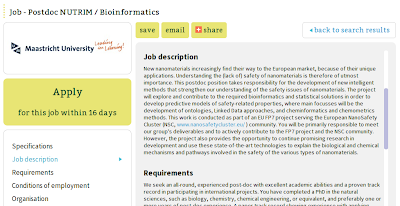
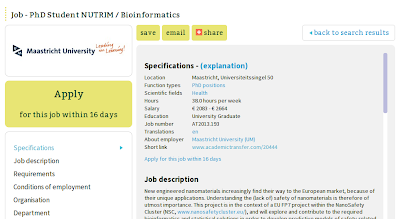
etc, somewhere early 2014. The project is about setting up data needs for the analysis of nanosafety studies. And for this,
I have the below two position vacancies available now. If you are keen on doing Open Science (CDK, Bioclipse, OpenTox, WikiPathways, …, …),
working within the European <a href="http://www.nanosafetycluster.eu/">NanoSafety Cluster</a>, and have an affinity with understanding the
systems biology of nanomaterials, then you may be interested in applying.</p>

<p><strong>PhD position</strong></p>

<p><img src="/assets/images/vac1.png" alt="" /></p>

<p><strong>Postdoc position</strong></p>

<p><img src="/assets/images/vac2.png" alt="" /></p>]]></content><author><name>Egon Willighagen</name></author><category term="nanosafety" /><category term="enanomapper" /><category term="opentox" /><category term="ontology" /><summary type="html"><![CDATA[I am happy that I got my first research grant awarded (EU FP7), which should start after all the contracts are signed, etc, somewhere early 2014. The project is about setting up data needs for the analysis of nanosafety studies. And for this, I have the below two position vacancies available now. If you are keen on doing Open Science (CDK, Bioclipse, OpenTox, WikiPathways, …, …), working within the European NanoSafety Cluster, and have an affinity with understanding the systems biology of nanomaterials, then you may be interested in applying.]]></summary><media:thumbnail xmlns:media="http://search.yahoo.com/mrss/" url="https://chem-bla-ics.linkedchemistry.info/assets/images/vac1.png" /><media:content medium="image" url="https://chem-bla-ics.linkedchemistry.info/assets/images/vac1.png" xmlns:media="http://search.yahoo.com/mrss/" /></entry><entry><title type="html">OpenTox Virtual Seminar, Thursday April 1, 11.00 CEST</title><link href="https://chem-bla-ics.linkedchemistry.info/2010/04/01/opentox-virtual-seminar-thursday-april.html" rel="alternate" type="text/html" title="OpenTox Virtual Seminar, Thursday April 1, 11.00 CEST" /><published>2010-04-01T00:00:00+00:00</published><updated>2010-04-01T00:00:00+00:00</updated><id>https://chem-bla-ics.linkedchemistry.info/2010/04/01/opentox-virtual-seminar-thursday-april</id><content type="html" xml:base="https://chem-bla-ics.linkedchemistry.info/2010/04/01/opentox-virtual-seminar-thursday-april.html"><![CDATA[<p>Today I gave a presentation of my research, the <a href="http://www.blogger.com/cdk.sf.net">CDK</a>, <a href="http://www.bioclipse.net/">Bioclipse</a>,
and <a href="http://chem-bla-ics.blogspot.com/search/label/RDF">recent RDF work</a>:</p>

<p><a href="https://doi.org/10.5281/zenodo.3366049"><img src="/assets/images/opentox_2010_slides_cover.png" alt="" /></a></p>

<p>Because the virtual talk required me to reboot into Windows, I could not give a live demo of the development version of Bioclipse, showing new stuff in action. The audience had to with just screenshots :( I’ll try to make a screencast soon.</p>

<p>The <a href="http://wiki.bioclipse.net/index.php?title=OpenTox">Bioclipse OpenTox</a> plugin currently has this functionality:</p>

<ol>
  <li>download data sets (myexperiment:<a href="http://www.myexperiment.org/workflows/1008">1008</a>)</li>
  <li>list available algorithms and descriptors (myexperiment:<a href="http://www.myexperiment.org/workflows/1204">1204</a>)</li>
</ol>]]></content><author><name>Egon Willighagen</name></author><category term="cdk" /><category term="bioclipse" /><category term="rdf" /><category term="doi:10.5281/ZENODO.3366049" /><category term="sparql" /><category term="opentox" /><summary type="html"><![CDATA[Today I gave a presentation of my research, the CDK, Bioclipse, and recent RDF work:]]></summary><media:thumbnail xmlns:media="http://search.yahoo.com/mrss/" url="https://chem-bla-ics.linkedchemistry.info/assets/images/opentox_2010_slides_cover.png" /><media:content medium="image" url="https://chem-bla-ics.linkedchemistry.info/assets/images/opentox_2010_slides_cover.png" xmlns:media="http://search.yahoo.com/mrss/" /></entry><entry><title type="html">Oxford, August 2010: eCheminfo Predictive ADME &amp;amp; Toxicology 2010 Workshop</title><link href="https://chem-bla-ics.linkedchemistry.info/2010/03/22/oxford-august-2010-echeminfo-predictive.html" rel="alternate" type="text/html" title="Oxford, August 2010: eCheminfo Predictive ADME &amp;amp; Toxicology 2010 Workshop" /><published>2010-03-22T00:00:00+00:00</published><updated>2010-03-22T00:00:00+00:00</updated><id>https://chem-bla-ics.linkedchemistry.info/2010/03/22/oxford-august-2010-echeminfo-predictive</id><content type="html" xml:base="https://chem-bla-ics.linkedchemistry.info/2010/03/22/oxford-august-2010-echeminfo-predictive.html"><![CDATA[<p>The first week of August I will attend the <a href="http://echeminfo.com/COMTY_oxfordadmet10">eCheminfo Predictive ADME &amp; Toxicology Workshop</a>
(<a href="http://events.linkedin.com/eCheminfo-Predictive-ADME-Toxicology/pub/271590">LinkedIn Event</a>) for which I received a
<a href="http://barryhardy.blogs.com/cheminfostream/2010/02/bursary-award-applications-echeminfo-oxford-2010-workshops.html">Bursary Award</a>.
It will be my first time in Oxford, and I am very much looking forward to it!</p>

<p>The meeting is also bound to be fun. I have not done much in the area of toxicology other than the more general QSAR/QSPR model
building with chemometrics. But I have been recently taking to Nina and other of the <a href="http://www.opentox.org/">OpenTox</a> community,
and started to play a bit with the data and computation API they are developing.</p>

<p><img src="/assets/images/bioclipseOpenTox.png" alt="" /></p>

<p>I started a Bioclipse plugin recently (see screenshot), and placed the source code in <a href="http://gitorious.org/bioclipse-opentox/bioclipse-opentox">this bioclipse-opentox</a>
Git repository on <a href="http://gitorious.org/">Gitorious</a> (<a href="http://github.com/egonw">my GitHub account</a> is already over the formal limit).
The functionality is still quite limited, and the manager currently only provides methods to download data sets
(<a href="http://www.myexperiment.org/workflows/1192">myexperiment:1192</a>):</p>

<div class="language-javascript highlighter-rouge"><div class="highlight"><pre class="highlight"><code><span class="c1">// query a service using the OpenTox API 1.1</span>
<span class="c1">// See: http://www.opentox.org/dev/apis/api-1.1</span>

<span class="kd">var</span> <span class="nx">service</span> <span class="o">=</span> <span class="dl">"</span><span class="s2">http://apps.ideaconsult.net:8180/ambit2/</span><span class="dl">"</span><span class="p">;</span>

<span class="kd">var</span> <span class="nx">datasets</span> <span class="o">=</span> <span class="nx">opentox</span><span class="p">.</span><span class="nf">listDataSets</span><span class="p">(</span><span class="nx">service</span><span class="p">);</span>
<span class="k">for </span><span class="p">(</span><span class="kd">set</span><span class="o">=</span><span class="mi">0</span><span class="p">;</span> <span class="kd">set</span><span class="o">&lt;</span><span class="nx">datasets</span><span class="p">.</span><span class="nf">size</span><span class="p">();</span> <span class="kd">set</span><span class="o">++</span><span class="p">)</span> <span class="p">{</span>
  <span class="kd">var</span> <span class="nx">dataset</span> <span class="o">=</span> <span class="nx">datasets</span><span class="p">.</span><span class="nf">get</span><span class="p">(</span><span class="kd">set</span><span class="p">);</span>
  <span class="nx">js</span><span class="p">.</span><span class="nf">say</span><span class="p">(</span><span class="dl">"</span><span class="s2">Downloading set: </span><span class="dl">"</span> <span class="o">+</span> <span class="nx">dataset</span><span class="p">);</span>
  <span class="nx">ui</span><span class="p">.</span><span class="nf">open</span><span class="p">(</span>
    <span class="nx">opentox</span><span class="p">.</span><span class="nf">downloadDataSetAsMDLSDfile</span><span class="p">(</span>
       <span class="nx">service</span><span class="p">,</span> <span class="nx">dataset</span><span class="p">,</span> <span class="dl">"</span><span class="s2">/OpenTox/ambit</span><span class="dl">"</span> <span class="o">+</span> <span class="nx">dataset</span> <span class="o">+</span> <span class="dl">"</span><span class="s2">.sdf</span><span class="dl">"</span>
    <span class="p">)</span>
  <span class="p">)</span>
<span class="p">}</span>
</code></pre></div></div>

<p>Behind this plugin is again the RDF plugin, as OpenTox uses RDF too, a few simple SPARQL queries was all that needed to be defined.
And <a href="http://chem-bla-ics.blogspot.com/2010/03/rdf-powered-qsar-wizard-sparql-end.html">again</a>, the Bioclipse pluigin
code base is pretty small.</p>]]></content><author><name>Egon Willighagen</name></author><category term="bioclipse" /><category term="qsar" /><category term="toxicology" /><category term="opentox" /><category term="ambit" /><summary type="html"><![CDATA[The first week of August I will attend the eCheminfo Predictive ADME &amp; Toxicology Workshop (LinkedIn Event) for which I received a Bursary Award. It will be my first time in Oxford, and I am very much looking forward to it!]]></summary><media:thumbnail xmlns:media="http://search.yahoo.com/mrss/" url="https://chem-bla-ics.linkedchemistry.info/assets/images/bioclipseOpenTox.png" /><media:content medium="image" url="https://chem-bla-ics.linkedchemistry.info/assets/images/bioclipseOpenTox.png" xmlns:media="http://search.yahoo.com/mrss/" /></entry></feed>