<?xml version="1.0" encoding="utf-8"?><feed xmlns="http://www.w3.org/2005/Atom" ><generator uri="https://jekyllrb.com/" version="4.3.4">Jekyll</generator><link href="https://chem-bla-ics.linkedchemistry.info/feed/by_tag/openscience.xml" rel="self" type="application/atom+xml" /><link href="https://chem-bla-ics.linkedchemistry.info/" rel="alternate" type="text/html" /><updated>2026-11-22T12:40:33+00:00</updated><id>https://chem-bla-ics.linkedchemistry.info/feed/by_tag/openscience.xml</id><title type="html">chem-bla-ics</title><subtitle>Chemblaics (pronounced chem-bla-ics) is the science that uses open science and computers to solve problems in chemistry, biochemistry and related fields.</subtitle><author><name>Egon Willighagen</name></author><entry><title type="html">Creating Preferred IUPAC names</title><link href="https://chem-bla-ics.linkedchemistry.info/2026/11/01/creating-preferred-iupac-names.html" rel="alternate" type="text/html" title="Creating Preferred IUPAC names" /><published>2026-11-01T00:00:00+00:00</published><updated>2026-11-01T00:00:00+00:00</updated><id>https://chem-bla-ics.linkedchemistry.info/2026/11/01/creating-preferred-iupac-names</id><content type="html" xml:base="https://chem-bla-ics.linkedchemistry.info/2026/11/01/creating-preferred-iupac-names.html"><![CDATA[<p>Language models model languages. The simpler the language, the simpler the model. Large language models (LLMs)
do more: they do not merely capture a language, but also model what you can say with them. And you can
map one model to another, and use that to translate things between langauges. Have a numerical representation,
and you can have your LLM run on a processing unit (CPU, or more likely, GPU).
More and more models are available (mostly proprietary, commercial) to use this. Chat bots, translation
tools, grammar checkers, generative models. And because of the numerical representation, it is also
easy enough to combine language with numerical data.</p>

<p>And I guess converting a SMILES to something else should not surprise me. Using SMILES as molecular
descriptor has been around for some time. Using a generative model to generate an IUPAC name is another
example. STOUT had been doing that for some time (doi:<a href="https://doi.org/10.1186/s13321-021-00512-4">10.1186/s13321-021-00512-4</a>).
But based on deep learning, it is based on probabilities. Or recovering SMILES strings from
Morgan fingerprints (doi:<a href="https://doi.org/10.59350/srwee-de037">10.59350/srwee-de037</a>).</p>

<p>The alternative is to generate IUPAC names using the IUPAC rules. Computational tools that do this have
been around for a long time. The IUPAC naming rules are defined in the blue books, see
<a href="https://iupac.org/what-we-do/books/bluebook/">this page</a>. At some point in the nineties, based on the
work of the <em>Woordenboek Organische Chemie</em>, I proposed to make a HTML version of the Dutch translation.
The never happened.</p>

<p>Now, these LLMs have become quite powerful that they can do a ton of things. They can without problem
use external tools. That makes a lot of sense: why would you predict something when you can look it up
or easily computer. That helps with exact validation. For example, Claude is said to validate JSON to
make sure it never outputs JSON that is not valid (which it does without that validator).</p>

<p>So, why not translation the IUPAC rules into a program and use that program to deterministically calculate
IUPAC names? Or even Preferred IUPAC names (PINs)? Wikidata wants those. The lack of a tool to
determine if a name is a PIN or to just calculate it <a href="https://www.wikidata.org/wiki/Wikidata:Property_proposal/IUPAC_name">blocked</a>
the addition of a Wikidata property earlier this year.</p>

<p><a href="https://www.embl.org/people/person/noel-o-boyle/">Noel O’Boyle</a> (now EMBL-EBI) found and
<a href="https://baoilleach.blogspot.com/2026/10/assessing-open-source-iupac-name.html">compared three open source tools</a>,
each with a matching preprint: <a href="https://github.com/oxpig/nispo">NISPO</a> (doi:<a href="https://doi.org/10.48550/arXiv.2607.26113">10.48550/arXiv.2607.26113</a>),
<a href="https://github.com/lamalab-org/openclatura">OpenClatura</a> (doi:<a href="https://doi.org/10.26434/chemrxiv.15006114/v2">10.26434/chemrxiv.15006114/v2</a>),
and <a href="https://github.com/Steinbeck-Lab/Orthonym">Orthonym</a> (doi:<a href="https://doi.org/10.26434/chemrxiv.15009769/v1">10.26434/chemrxiv.15009769/v1</a>).
They yield 85-95% valid IUPAC names, as reported in Noel’s blog post. Of these, Orthonym by default
returns PINs and then the yield is a good bit lower.</p>

<p>A fourth tool is mentioned in the blog: <a href="https://github.com/iwyoo/smiles-to-iupac">smiles-to-iupac</a>,
but no compared. The author of this tool, <a href="https://github.com/iwyoo">Inwan Yoo</a>, has been actively
<a href="https://github.com/dan2097/opsin/pulls?q=is%3Apr+author%3Aiwyoo">contributing to</a>
<a href="https://github.com/dan2097/opsin/issues?q=is%3Apr+author%3Aiwyoo">the OPSIN tool</a>.</p>

<p>There is much to like about this, even the “competition”. These projects will be compared.
Where the differ, it will highlight where all tools have it wrong, some of the tools,
and even none of the tools, and the IUPAC rules turn out to be “wrong” (more likely, ambiguous).
The same for OPSIN (doi:<a href="https://doi.org/10.1021/ci100384d">10.1021/ci100384d</a>). I think this is a win for the open science chemistry community and
looking forward to what will happen in the next few months.</p>

<p>And, I will need to find some time to see how many Wikidata SMILES I can convert into PINs.</p>]]></content><author><name>Egon Willighagen</name></author><category term="iupac" /><category term="cheminf" /><category term="cito:citesForInformation:10.1186/s13321-021-00512-4" /><category term="justdoi:10.59350/srwee-de037" /><category term="opensource" /><category term="openscience" /><category term="cito:citesAsPotentialSolution:10.48550/arXiv.2607.26113" /><category term="cito:citesAsPotentialSolution:10.26434/chemrxiv.15006114/v2" /><category term="cito:citesAsPotentialSolution:10.26434/chemrxiv.15009769/v1" /><category term="cito:citesAsAuthority:10.1021/CI100384D" /><summary type="html"><![CDATA[Language models model languages. The simpler the language, the simpler the model. Large language models (LLMs) do more: they do not merely capture a language, but also model what you can say with them. And you can map one model to another, and use that to translate things between langauges. Have a numerical representation, and you can have your LLM run on a processing unit (CPU, or more likely, GPU). More and more models are available (mostly proprietary, commercial) to use this. Chat bots, translation tools, grammar checkers, generative models. And because of the numerical representation, it is also easy enough to combine language with numerical data.]]></summary></entry><entry><title type="html">Open Science and Recognition &amp;amp; Rewards</title><link href="https://chem-bla-ics.linkedchemistry.info/2026/10/05/open-science-recognition-and-rewards.html" rel="alternate" type="text/html" title="Open Science and Recognition &amp;amp; Rewards" /><published>2026-10-05T00:00:00+00:00</published><updated>2026-10-05T00:00:00+00:00</updated><id>https://chem-bla-ics.linkedchemistry.info/2026/10/05/open-science-recognition-and-rewards</id><content type="html" xml:base="https://chem-bla-ics.linkedchemistry.info/2026/10/05/open-science-recognition-and-rewards.html"><![CDATA[<p>In the past 10~ish years there has been a national push towards two themes aimed to improve things
at our (academic) research institutes: Open Science and Recognition &amp; Rewards. The first addresses
the needs to allow (more) people to do research, while the second addresses the conditions under
which we do research. The two Maastricht University pages about how my university looks at these
topics are;</p>

<ul>
  <li><a href="https://www.maastrichtuniversity.nl/about-um/what-we-stand-for/recognition-rewards">Open Science</a></li>
  <li><a href="https://www.maastrichtuniversity.nl/about-um/what-we-stand-for/recognition-rewards">Recognition &amp; Rewards</a></li>
</ul>

<p>The provide a good number of additional pointers for important context.</p>

<p>Recognition &amp; Rewards generally is a very complex question. Just thinking about how people reply
to the <a href="https://en.wikipedia.org/wiki/2024_Cornell_University_rape_allegations">Cornell University rape allegations</a>.
Not every researchers is evaluated in the same way.</p>

<p>And then there is the highly complex approach how to compare researchers when the question of
promotion comes up: qualification or quantification. They both measure certain aspects of our
performance, but not all metrics (qualitative or quantitative) actually measure the performance
of the researcher. The journal impact factor is a clear example of that. The H-index is more
personal but also does not really measure what you want to use it for.
These things too return with <a href="https://open-science-monitoring.org/">Open science monitoring</a>.
We have to monitor such efforts critically (like we do with everything, the researchers we are).</p>

<p>The dynamics are fascinating. But they are also essential to my work. I am line manager of
multiple researchers, each with their own career paths. Under to modern HR, any Maastricht
University researcher can opt to use <a href="https://www.maastrichtuniversity.nl/over-de-um/waar-we-voor-staan/erkennen-waarderen/um-career-policy-compass">career compass</a>
option. This career policy gives our employees more freedom how to be evaluated. For example,
it gives more room for recognition for teaching and for patient care. But all routes have
four obligatory topics:</p>

<ul>
  <li>Academic citizenship</li>
  <li>Personal and professional leadership</li>
  <li>Team performance</li>
  <li>Impact &amp; Open Science</li>
</ul>

<p>In the evaluation meetings with your <em>development board</em> you will discuss how you
did on the activities related to your personal career compass. And then again the
qualifications and quantification come up. And that opens the can of worms.</p>

<p>Now, because open science and team science are used a lot in the
<a href="https://www.maastrichtuniversity.nl/research/translational-genomics/research/themes">Theme Bioinformatics</a>
of our <a href="https://www.maastrichtuniversity.nl/research/translational-genomics">Department of Translational Genomics</a>,
I like to know what options I have to recognize and reward that.</p>

<p>That is why I signed up for the <a href="https://library.maastrichtuniversity.nl/course/recognising-rewarding-open-science/">Recognising and Rewarding Open Science</a>
programme that started last week.</p>]]></content><author><name>Egon Willighagen</name></author><category term="openscience" /><category term="rnr" /><category term="maastricht" /><summary type="html"><![CDATA[In the past 10~ish years there has been a national push towards two themes aimed to improve things at our (academic) research institutes: Open Science and Recognition &amp; Rewards. The first addresses the needs to allow (more) people to do research, while the second addresses the conditions under which we do research. The two Maastricht University pages about how my university looks at these topics are;]]></summary></entry><entry><title type="html">New paper: “ToxTempAssistant: using large language models to standardise cell-based toxicological test method descriptions”</title><link href="https://chem-bla-ics.linkedchemistry.info/2026/10/03/new-paper-toxtempassistant-using-large-language-models-to-standardise-cell-based-toxicological-test-method-descriptions.html" rel="alternate" type="text/html" title="New paper: “ToxTempAssistant: using large language models to standardise cell-based toxicological test method descriptions”" /><published>2026-10-03T00:00:00+00:00</published><updated>2026-10-03T00:00:00+00:00</updated><id>https://chem-bla-ics.linkedchemistry.info/2026/10/03/new-paper-toxtempassistant-using-large-language-models-to-standardise-cell-based-toxicological-test-method-descriptions</id><content type="html" xml:base="https://chem-bla-ics.linkedchemistry.info/2026/10/03/new-paper-toxtempassistant-using-large-language-models-to-standardise-cell-based-toxicological-test-method-descriptions.html"><![CDATA[<p><a href="https://orcid.org/0009-0005-3680-0645">Jente Houweling</a> published her first PhD thesis chapter earlier this year:
“ToxTempAssistant: using large language models to standardise cell-based toxicological test method descriptions”
(doi:<a href="https://doi.org/10.1080/2833373X.2026.2638036">10.1080/2833373X.2026.2638036</a>). So far, I have been blogging about
many of the articles on which I am (co-)author. To put it in context. To reflect on the work. I have been postponing
writing about this paper because there is a lot to reflect on. I will pick out two things. First, I look at the use
of AI. The second is the unique, innovative publishing model of the journal where the article was published.
If you want to just see it in action, ToxTempAssistant is <a href="https://toxtempassistant.vhp4safety.nl/">running</a>
on the Virtual Human Platform for safety assessment.</p>

<p>Before we go there, just a quick note on what ToxTemps are and ToxTempAssistent actually is:</p>

<blockquote>
  <p>The ToxTemp template, based on OECD Guidance Document 211, standardises reporting for cell-based NAMs. However,
completing its 77 questions constitutes a substantial bottleneck. The aim of this study is to introduce ToxTempAssistant,
a Large Language Model (LLM)-assisted web tool that supports toxicologists in drafting ToxTemp documents based on
user-supplied context documents. This study quantifies the tool’s baseline performance under controlled conditions.
ToxTempAssistant uses grounded, per-question prompting with mandatory source attribution.</p>
</blockquote>

<h2 id="the-llm-aspects">The LLM aspects</h2>

<p>AI is very old. Arguably, <a href="https://chem-bla-ics.linkedchemistry.info/2009/05/04/thesis-and-copyright-transfer.html">my PhD thesis</a>
had this as key topic, though I preferred to use to term chemometric or machine learning.
Critical thinking has been essential to this field for a long time, and much of the PhD thesis is actually
about critically assessing the performance of the methods used in the thesis. There is decades of research
how you do this. Sadly, when it comes to Large Language Models (LLMs), these are not routinely used.</p>

<p>LLMs are indeed something new. I have seen <a href="https://en.wikipedia.org/wiki/Natural_language_processing">natural language processing</a>
research when I was Cambridge with Peter Murray-Rust. The current LLMs are different, less deterministic, more probabilistic.
From a chemometrics perspective, that makes sense. Language is complex, and not so deterministic in itself. Moreover,
when representing words, sentences as numbers, you can integrate any resource (think data tables, images, etc). Even more,
digital representation was even more the central theme of my PhD thesis.</p>

<p>But because of the nature of the method, the nature of how the commercial, better known models are trained (and the
impact on the notion of copyright), the impact on the <a href="https://en.wikipedia.org/wiki/Climate_crisis">climate emergency</a>,
the black box that these LLMs often are, there are so many technical, scientific, and ethical reasons to stay away from them.</p>

<p>You can write books about that. Literally (I did not read them yet):</p>

<ul>
  <li><a href="https://en.wikipedia.org/wiki/The_Nerd_Reich">The Nerd Reich</a></li>
  <li><a href="https://en.wikipedia.org/wiki/The_AI_Con">The AI Con</a></li>
</ul>

<p>(I have the feeling I am missing one title I wanted to highlight. If I remember, I will add it.)</p>

<p>And more <a href="https://www.goodreads.com/shelf/show/ai-critique">here</a> and <a href="https://womeninaiethics.org/ai-ethics-book-list-for-2024/">here</a>.
And I am looking forward to reading <em>Deep Unlearning: The Rise of AI and the Radicalization of a Tech Idealist</em>.
Also, I recommend at least following <a href="http://dair-community.social/@timnitGebru">Timnit Gebru</a> and
<a href="https://dair-community.social/@emilymbender">Emily Bender</a>.</p>

<p>A year ago, I signed the <a href="https://chem-bla-ics.linkedchemistry.info/2025/08/18/ai-technologies-in-academia.html">Open Letter: Stop the Uncritical Adoption of AI Technologies in Academia</a>,
now signed by more than 2,000 people (it is <a href="https://openletter.earth/open-letter-stop-the-uncritical-adoption-of-ai-technologies-in-academia-b65bba1e">not too late</a>).</p>

<p>So, with all these things mind, I am happy that Jente did critically adopt LLMs in her work. The paper includes
various experiments to explore the impact of various model parameters on generating nonsense. She also explored
to use of alternative LLMs platforms, opening the option that some day it runs on other, more ethical platforms.
ToxTempAssistant, moreover, limits the material it takes information from, from a limited set of sources, provided
by the users. Of course, the model itself is still training on resources with questionable provenance.</p>

<p>Jente’s paper describes the use of positive and negative controls to put the performance in perspective.
In doing so, the paper formalizes how to evaluate the use of LLMs in situations where the LLM is used
to summarize other reports, a common thing to do. This allows us to monitor the impact of, for example,
new LLM releases.</p>

<p>The results are promising and various independent projects have shown interest in adoption. The ToxTemp
reports are important for safety assessment: they provide essential context to experimental results and
as such essential to the FAIR-ness of toxicology data.</p>

<h2 id="open-peer-review">Open Peer Review</h2>

<p>The ToxTempAssistant paper is published in the relatively new journal <a href="https://www.tandfonline.com/journals/tebt20">Evidence-Based Toxicology</a> (EBT):</p>

<blockquote>
  <p>Evidence-Based Toxicology is a broad-focus, gold open-access journal, created to support the use of open science practices and
evidence-based methods in toxicology and environmental health.</p>
</blockquote>

<p>So, CC-BY license (gold open access) and support for Open Science. And Open Peer Review, as we will see. Also,
I understand it is not a diamond open access journal, so expect APCs.</p>

<p>The journal has <a href="https://zenodo.org/communities/ebt/records">a community on Zenodo</a> for preprints and peer-reviews.
I think this is a really nice choice. Of course, a journal specific preprint server has downsides too. For example,
if it gets rejected from EBT, do you use the EBT preprint server when submitting to another journal? Do you upload
a new version (after all, you should address some of the comments why it was rejected) to another preprint server?</p>

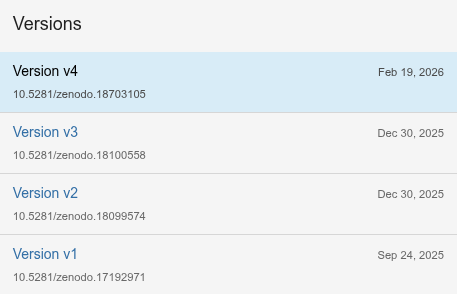
<p>The EBT preprint gets a record and revisions are uploaded as new versions to the same Zenodo record
(doi<a href="https://doi.org/10.5281/zenodo.17192970">10.5281/zenodo.17192970</a>):</p>

<p><img src="/assets/images/ebt_preprint_tta.png" alt="" /></p>

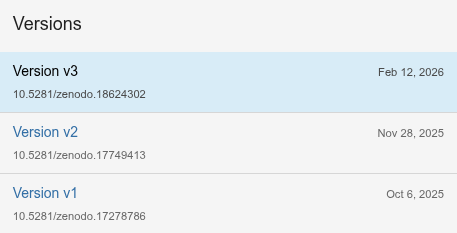
<p>But because EBT uses open peer review, there is a parallel Zenodo entry with the reviews
(doi<a href="https://doi.org/10.5281/zenodo.17278785">10.5281/zenodo.17278785</a>):</p>

<p><img src="/assets/images/ebt_preprint_tta_reviews.png" alt="" /></p>

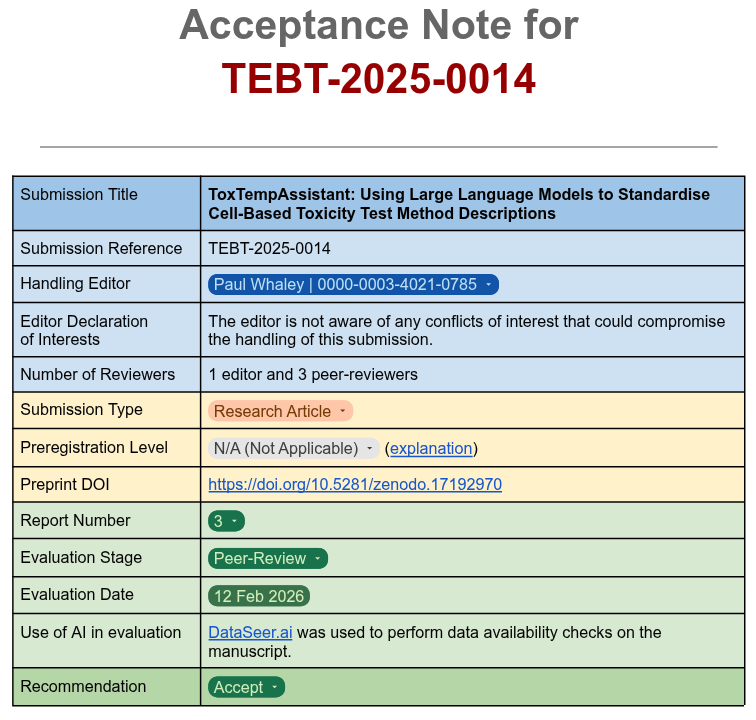
<p>The last version here is the acceptance notice:</p>

<p><img src="/assets/images/ebt_preprint_tta_acceptance.png" alt="" /></p>

<p>One of the reviewer suggestions was to use the TRIPOD-LLM template
(doi:<a href="https://doi.org/10.1038/s41591-024-03425-5">10.1038/s41591-024-03425-5</a>), which was included in a
later revision. That made a lot of sense and is a nice example how the journal actively works
on applying open science ideas. The journal webpage writes:</p>

<blockquote>
  <p>We define “open science” as the set of practices aimed at improving the transparency, validity,
reproducibility, and accessibility of scientific research, while promoting equality of
opportunity to participate in and benefit from the products of said research.</p>
</blockquote>

<p>One comment here is that the template asks on what page that point of the checklist is discussed
in the article. That is nice, but links it directly to the revision of the manuscript that
form applies too, but that is not reported in the template. Not ideal. Then again, the point
is the checking, so maybe not a big deal.</p>

<p>Another comment is that it seems the journal website’s page for the article does not seem to actually
link to the preprints nor the peer-review reports (or acceptance note). So, in time, these
open science aspects of this article will likely get lost in time. Who will find those reports
if the article does not cite them? This will require Taylor&amp;Francis to modernize the publishing
model, and I sincerely doubt that that will ever happen.</p>

<p>Prof. <a href="https://orcid.org/0000-0002-6465-4498">Anne Kienhuis</a>, one of the co-authors, suggested
this journal lead by Prof. <a href="https://orcid.org/0000-0003-4021-0785">Paul Whaley</a>.
And I am happy to have seen this new approach in action and like to thank Paul for pushing for
these innovations. I recommend trying it yourself for your next toxicology work.</p>]]></content><author><name>Egon Willighagen</name></author><category term="fair" /><category term="llm" /><category term="vhp4safety" /><category term="mycito:discusses:10.1080/2833373X.2026.2638036" /><category term="cito:citesForInformation:10.14573/altex.1909271" /><category term="openscience" /><category term="cito:citesAsEvidence:10.5281/zenodo.17278785" /><category term="cito:citesAsEvidence:10.5281/zenodo.17192970" /><category term="cito:discusses:10.1038/s41591-024-03425-5" /><summary type="html"><![CDATA[Jente Houweling published her first PhD thesis chapter earlier this year: “ToxTempAssistant: using large language models to standardise cell-based toxicological test method descriptions” (doi:10.1080/2833373X.2026.2638036). So far, I have been blogging about many of the articles on which I am (co-)author. To put it in context. To reflect on the work. I have been postponing writing about this paper because there is a lot to reflect on. I will pick out two things. First, I look at the use of AI. The second is the unique, innovative publishing model of the journal where the article was published. If you want to just see it in action, ToxTempAssistant is running on the Virtual Human Platform for safety assessment.]]></summary><media:thumbnail xmlns:media="http://search.yahoo.com/mrss/" url="https://chem-bla-ics.linkedchemistry.info/assets/images/ebt_preprint_tta_acceptance.png" /><media:content medium="image" url="https://chem-bla-ics.linkedchemistry.info/assets/images/ebt_preprint_tta_acceptance.png" xmlns:media="http://search.yahoo.com/mrss/" /></entry><entry><title type="html">WikiPathways: biological pathways across the species</title><link href="https://chem-bla-ics.linkedchemistry.info/2026/09/09/wikipathways-biological-pathways-across-the-species.html" rel="alternate" type="text/html" title="WikiPathways: biological pathways across the species" /><published>2026-09-09T00:00:00+00:00</published><updated>2026-09-09T00:00:00+00:00</updated><id>https://chem-bla-ics.linkedchemistry.info/2026/09/09/wikipathways-biological-pathways-across-the-species</id><content type="html" xml:base="https://chem-bla-ics.linkedchemistry.info/2026/09/09/wikipathways-biological-pathways-across-the-species.html"><![CDATA[<p>I was not there. I only joined the <a href="https://wikipathways.org/">WikiPathways</a> project in late 2011, just as a contributor.
And it was just before joining the
<a href="https://www.maastrichtuniversity.nl/research/bioinformatics">BiGCaT research team</a> of Prof. Chris Evelo in January 2012,
where I started a project in the <a href="https://en.wikipedia.org/wiki/OpenPHACTS">Open PHACTS</a> project, not really about WikiPathways,
but the open science WikiPathways was the main reason for me to join the group. Open PHACTS was close to my research and
just created that opportunity.</p>

<p>WikiPathways was already around five years old when I created my account. It was created in January 2007
(doi:<a href="https://doi.org/10.1038/npre.2010.5361.1">10.1038/npre.2010.5361.1</a>). It was first formally published in 2008
(doi:<a href="https://doi.org/10.1371/journal.pbio.0060184">10.1371/journal.pbio.0060184</a>), so the project is about 20 years
old (maybe a new WikiPathways conference next year?). The launch made it to Science
(doi:<a href="https://doi.org/10.1126/science.321.5889.623c">10.1126/science.321.5889.623c</a>):</p>

<blockquote>
  <p>The makers of GenMAPP [..] have launched a site for
sharing findings on metabolic pathways. [..]
WikiPathways (wikipathways.org) offers a way to integrate
information on these complex networks [..]
The site has more than 300 registered users and contains
information on 500 metabolic pathways in seven species,
including humans.</p>
</blockquote>

<p>And Nature (doi:<a href="https://doi.org/10.1038/455022A">10.1038/455022A</a>):</p>

<blockquote>
  <p>Alexander Pico remembers just when the idea hit him. In January 2007, he and his boss, Bruce Conklin, were discussing
how to push their software tool for visualizing intracellular signalling pathways to the next level of interactivity —
when Pico blurted out, “What we really need is a wiki!”</p>
</blockquote>

<p>Just like review article curate and put primary literature in context, so that WikiPathways.
They pitched it at the time as modelled after Wikipedia, but surely it is also just as well modelled
after traditional knowledge dissemination approaches. One can easily argue that the wiki approach is
essential: anyone can create an account. And this has been held against WikiPathways. But if you look
at the who actually edits WikiPathways, these are only people working in an academic research
environment.</p>

<p>WikiPathways is, of course, used as a reference knowledgebase, and the use in pathway enrichment and
networking approaches are perhaps the best known. Another aspect of a wiki, however, is the community approach:
a community can work out a collection of machine-readable (FAIR) pathway models, even when the discovery is in full swing.
WikiPathways is also a platform to exchange knowledge, discuss literature, do research. The use to of
this feature turned out <a href="https://chem-bla-ics.linkedchemistry.info/2020/05/07/new-project-covid-19-disease-maps.html">really useful at the start of the COVID-19 pandemic</a>.</p>

<h2 id="genomes-species-and-pathways">Genomes, species, and pathways</h2>

<p>The set of full genome assemblies was not that large; in 2021 there were 3278 genome assemblies for animal species
(doi:<a href="https://doi.org/10.1073/pnas.2109019118">10.1073/pnas.2109019118</a> and the <em>Genomes on a Tree</em>
(doi:<a href="https://doi.org/10.12688/wellcomeopenres.18658.1">10.12688/wellcomeopenres.18658.1</a>) reports 27883 assemblies
for <a href="https://goat.genomehubs.org/search?result=taxon&amp;taxonomy=ncbi&amp;includeEstimates=true&amp;report=histogram&amp;x=assembly_date&amp;rank=species&amp;cat=assembly_level%5B4%5D%3Dscaffold%2Cchromosome%2Ccontig%2Ccomplete%20genome&amp;stacked=true&amp;excludeAncestral%5B0%5D=assembly_span&amp;excludeMissing%5B0%5D=assembly_span&amp;caption=Progress%20of%20genome%20assemblies%20published%20on%20INSDC%20over%20time%2C%20by%20assembly%20level&amp;offset=0&amp;xOpts=&amp;fields=assembly_date%2Cgenome_size%2Cassembly_level%2Cassembly_span%2Cchromosome_number%2Chaploid_number&amp;includeDescendants=false&amp;emptyColumns=false&amp;query=tax_rank%28species%29%20AND%20assembly_date%3E%3D1925-01-01%20AND%20assembly_date%3C2027-01-01%20AND%20assembly_level%3Dcomplete%20genome#tax_rank(species)%20AND%20assembly_date%3E%3D1925-01-01%20AND%20assembly_date%3C2027-01-01%20AND%20assembly_level%3Dcomplete%20genome">664 complete genomes</a>.</p>

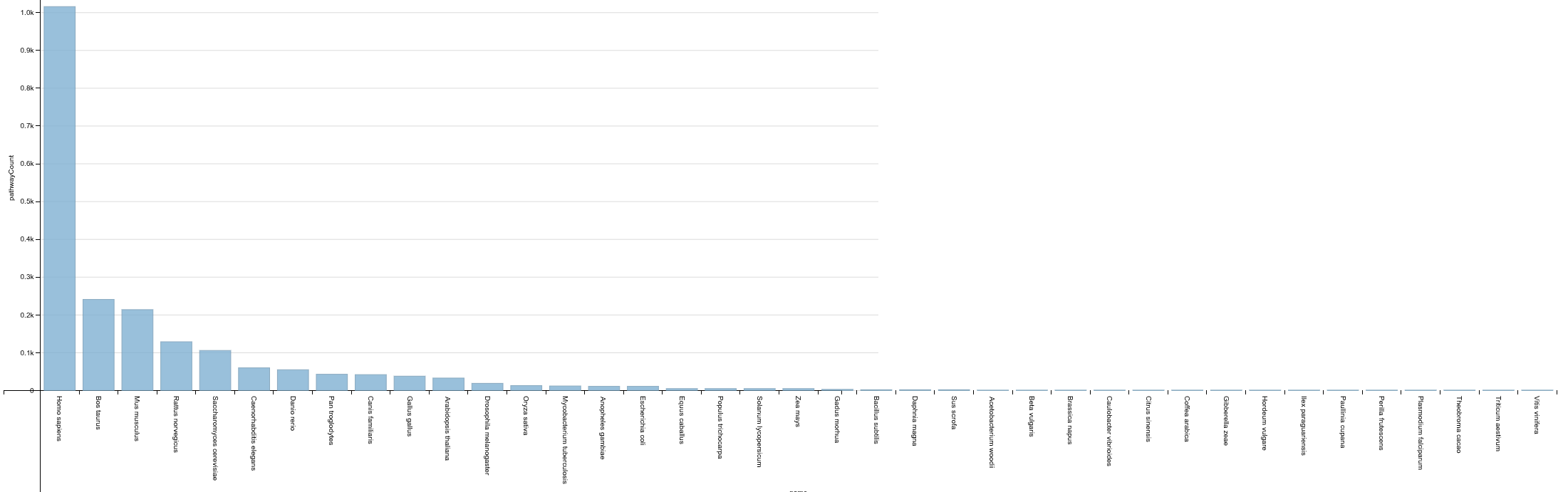
<p>For WikiPathways, seven species in 2008 grew to <a href="https://www.wikipathways.org/browse/organisms">39 species today</a> today,
though many of them only have a few curated pathways. Indeed, human is still the predominent species, in number of
pathways (visualized with <a href="https://edu.nl/8644d">this SPARQL query</a>).</p>

<p><a href="https://query.wikidata.org/#%23defaultView%3ABarChart%0APREFIX%20dc%3A%20%3Chttp%3A%2F%2Fpurl.org%2Fdc%2Felements%2F1.1%2F%3E%0APREFIX%20wp%3A%20%3Chttp%3A%2F%2Fvocabularies.wikipathways.org%2Fwp%23%3E%0A%0ASELECT%20%2a%20WHERE%20%7B%0A%20%20SELECT%20DISTINCT%20%28str%28%3Flabel%29%20as%20%3Fname%29%20%3Forganism%20%28count%28%3Fpw%29%20as%20%3FpathwayCount%29%0A%20%20WHERE%20%7B%0A%20%20%20%20SERVICE%20%3Chttps%3A%2F%2Fsparql.wikipathways.org%2Fsparql%3E%20%7B%0A%20%20%20%20%20%20%3Fpw%20dc%3Atitle%20%3Ftitle%20%3B%0A%20%20%20%20%20%20%20%20wp%3Aorganism%20%3Forganism%20%3B%0A%20%20%20%20%20%20%20%20wp%3AorganismName%20%3Flabel%20.%0A%20%20%20%20%7D%0A%20%20%7D%20GROUP%20BY%20%3Flabel%20%3Forganism%0A%7D%0AORDER%20BY%20DESC%28%3FpathwayCount%29"><img src="/assets/images/wp_pws_per_species.png" alt="" /></a></p>

<p>That said, several communities have worked in the past to create
<a href="https://chem-bla-ics.linkedchemistry.info/2026/02/22/where-do-the-wikipathways-come-from.html">sets of pathways</a>
around specific species. In that post, I already mentioned Wormbase, but we also have a collection of pathways
from <a href="https://pathway.yeastgenome.org/">YeastPathways</a> (doi:<a href="https://doi.org/10.1093/genetics/iyae185">10.1093/genetics/iyae185</a>),
for example <a href="https://www.wikipathways.org/pathways/WP137">wikipathways:WP137</a>.
Now, the yeast pathways are not in sync with the upstream SDG YeastPathways, I think, so there is some
curation to do on our side (from the 2025 Genetics paper):</p>

<blockquote>
  <p>As the first major update since 2012, we updated 62 pathways with expert summaries on
pathway genetics, biochemistry, regulation, and more. Thirty-three new pathways with
specificity for yeast biochemistry were propagated from MetaCyc at SRI (Caspi et al. 2018),
and 105 existing pathways were edited for proper enzymatic classification, reaction
connectivity, and gene attribution. Compounds that were previously missing a chemical
structure have also now been updated, along with the stoichiometry and scheme of many
pathway reactions.</p>
</blockquote>

<p>In similar style, WikiPathways has had similar project around setting up a pathway collection
for a new species, like cow in a project by <a href="https://www.wikipathways.org/authors/Zari.html">Zahra Roudbari</a>
(doi:<a href="https://doi.org/10.3389/fgene.2019.01370">10.3389/fgene.2019.01370</a>).
And more recently <a href="https://www.wikipathways.org/organisms/cod">atlantic cod</a>
(ongoing research by <a href="https://www.wikipathways.org/authors/MadhushriMSV.html">Madhushri S. Varunjikar</a>
from the Norwegian <a href="https://www.hi.no/">Institute of Marine Research</a>).</p>

<h2 id="homology-converted-pathways">Homology converted pathways</h2>

<p>But WikiPathays also has a feature to convert pathways from one species to another. With more and
more whole genome assemblies becoming available, so are mappings of genes between one species and
another. This is the basis of that cow project (from <a href="https://doi.org/10.3389/fgene.2019.01370">the article</a>):</p>

<blockquote>
  <p>The online biological pathway repository, WikiPathways (Slenter et al., 2017), contains pathways
of different species, however a B. taurus collection was missing.</p>
</blockquote>

<p>And:</p>

<blockquote>
  <p>Second, the WikiPathways homology based the homology mapper which is available at GitHub
(https://github.com/PathVisio/homology.mapper) was updated to improve homology coverage for gene
products that were annotated with different data sources. The pathways were converted from human
pathways, with a required minimum successful conversion of at least 50% of the original human genes.</p>
</blockquote>

<p>The question is, of course, what is the best model species to use. That decision can be based on
multiple aspect, including the use case. There is freedom.</p>

<p>So, when this week the book chapter <em>Xenbase: A Guide to the Xenopus Genetics and Genomics Knowledgebase</em>
was published (doi:<a href="https://doi.org/10.1007/978-1-0716-5360-9_3">10.1007/978-1-0716-5360-9_3</a>), and
I was pinged WikiPathways was cited, I started reading.</p>

<blockquote>
  <p>WikiPathways are linked via gene symbol (Fig. 6A, black arrow) link redirects to a pre-set gene
symbol search on this community-curated open science resource [20].</p>
</blockquote>

<p>The linking via gene symbol made me write up this post. If they have the mappings, then with
the <a href="https://github.com/PathVisio/homology.mapper">GPML Homology Mapper</a> we can create pathways
for the two frog species (<em>X. laevis</em> and <em>X. tropicalis</em>).</p>

<h2 id="species-specific-curation">Species specific curation</h2>

<p>And there are reasons to do that. WikiPathways allows you to cite literature, at a pathway level,
for a gene, protein, or metabolite, and even at the level of an interaction. That literature is
species specific. The curation can also work out what to do with those parts of pathways for
which no genes were mapped. Having this is machine-readable knowledge has shown to be of
great usability, at the very least making the knowledge much, much easier to find.</p>

<p>And that brings us back to another role of review articles, of book chapters giving expert overviews,
but also of wiki’s: put knowledge in perspective of the literature from which it is derived.
I wish pathways database, generally, are used to communicate and get peer reviewed the fruits
of the work studying the biological processes on all these species.</p>

<p>With more than 600 full genomes and 39 species in WikiPathays, we have an exciting and growing seed.</p>]]></content><author><name>Egon Willighagen</name></author><category term="wikipathways" /><category term="openscience" /><category term="justdoi:10.1371/journal.pbio.0060184" /><category term="justdoi:10.1126/science.321.5889.623c" /><category term="justdoi:10.12688/wellcomeopenres.18658.1" /><category term="justdoi:10.1073/pnas.2109019118" /><category term="justdoi:10.1093/genetics/iyae185" /><category term="justdoi:10.1038/npre.2010.5361.1" /><category term="justdoi:10.1038/455022A" /><category term="justdoi:10.3389/fgene.2019.01370" /><category term="justdoi:10.1007/978-1-0716-5360-9_3" /><summary type="html"><![CDATA[I was not there. I only joined the WikiPathways project in late 2011, just as a contributor. And it was just before joining the BiGCaT research team of Prof. Chris Evelo in January 2012, where I started a project in the Open PHACTS project, not really about WikiPathways, but the open science WikiPathways was the main reason for me to join the group. Open PHACTS was close to my research and just created that opportunity.]]></summary><media:thumbnail xmlns:media="http://search.yahoo.com/mrss/" url="https://chem-bla-ics.linkedchemistry.info/assets/images/wp_pws_per_species_thumbnail.png" /><media:content medium="image" url="https://chem-bla-ics.linkedchemistry.info/assets/images/wp_pws_per_species_thumbnail.png" xmlns:media="http://search.yahoo.com/mrss/" /></entry><entry><title type="html">Scientias, oudheidkunde, en wetenschap, hoe dan</title><link href="https://chem-bla-ics.linkedchemistry.info/2026/08/07/scientias-oudheidkunde-wetenschap-hoe-dan.html" rel="alternate" type="text/html" title="Scientias, oudheidkunde, en wetenschap, hoe dan" /><published>2026-08-07T00:00:00+00:00</published><updated>2026-08-07T00:00:00+00:00</updated><id>https://chem-bla-ics.linkedchemistry.info/2026/08/07/scientias-oudheidkunde-wetenschap-hoe-dan</id><content type="html" xml:base="https://chem-bla-ics.linkedchemistry.info/2026/08/07/scientias-oudheidkunde-wetenschap-hoe-dan.html"><![CDATA[<p>Communication of science is important to me and it comes in many formats. Educational resources, research articles, text books, popular science magazines, blogs,
TV shows, podcasts, etc (in no particular order). Somewhere during the pandemic, I started listening to podcasts. I had done that, in the early days,
but those early podcasts… well, let’s say, the format had not materialized yet. But also that it can be quite helpful to not play the podcast at the
normal speeds, but at, say 1.25x. Podcasts, like any of the above format have a style, an audience in mind. Maybe the audience is first year students,
peer in the research field, or the general audience. Or a politician that wants to get credibility. There are several podcasts that I have been listening.
Not as education. The may have episode notes, but not proper scientific references. References is one thing important in the communication. Context is another.</p>

<p>I have many books in my house on these aspects of science. From text books, to primary literature, to links to blog posts. It is not my research field,
and (scientific) communication is very much a research field. “It makes sense”, does not do, but the awareness of some of the things should be basic
academic training. Or probably earlier. Every writing has context. Not a random pointer, but a friend has recently written with several others an
interesting chapter on reading scientific literature (doi:<a href="https://doi.org/10.1515/9783110782844-010">10.1515/9783110782844-010</a>,
<a href="https://uplopen.com/reader/chapters/pdf/10.1515/9783110782844-010">pdf</a>).</p>

<h2 id="scientias">Scientias</h2>

<p>And while I started the <a href="https://scientias.nl/nieuws/video/podcast/">Scientias</a> (with (<em>the</em>) <a href="https://mastodon.nl/@Diederikjekel">Diederik Jekel</a> and
<a href="https://mastodon.nl/@krijnsoeteman">Krijn Soeteman</a>) episode to hear more about
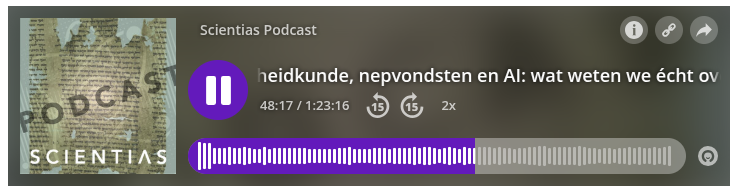
the science behind “history”, there were several topics in the [Over oudheidkunde, nepvondsten en AI: wat weten we écht over het verleden?] episode
about the above things, with <a href="https://mastodon.social/@JonaLendering">Jona Lendering</a> as guest.</p>

<p><img src="/assets/images/scientias_episode.png" alt="" /></p>

<p>The things I heard that I got excited about (enough to sit down and write down these thougths) were small comments, other things were
more prominent. One more obvious discussion was that a lot of science news is focusing on new facts, and not the science behind it. Not just
the methods, but also the stack of assumptions, how they were combined,
valued, etc. As Lendering explains how a researcher does that (translated into English by me, with assumptions on the true intention):</p>

<blockquote>
  <p>This is a hypothesis. Now I stack this hypothesis on the previous hypothesis, and I stack another hypothesis on that, and then I stack
a hypothesis on that.</p>
</blockquote>

<p>Most science news outlets find that too complicated (for their audience). To me it feels they think their audience is too stupid to understand
the full story. Now, the Scientias Podcast made it a unique selling point to explain how those facts were derived from experiments, because they
find the full background and experiments behind our knowledge important, exciting. and relevant. I do.</p>

<p>And if I understood Lendering correctly, he too says there actually is plenty of room of that. The full story is more complicated and I cannot
do this justice. There is a growing body of scientific literature that cannot be captured in a single blog post. I will not even try. It will
likely just <a href="https://mainzerbeobachter.com/2017/07/31/mom-het-backfire-effect/">backfire</a>.</p>

<p>And I agree. That is not relevant to them nor their point, but it does explain I was excited about the post. It is always nice to hear like-minded people.
I do not hear this position about scientific communication a lot, but very, very much agree and try to practice.</p>

<h2 id="stacking">Stacking</h2>

<p>Lendering about the book he described in the above quote:</p>

<blockquote>
  <p>I think the conclusions are absolutely wrong, because it stacked too many uncertainties in a row.</p>
</blockquote>

<p>I love this quote. Lendering is talking here about archeology, but it applies to at least chemistry and the life sciences too.
I once wrote a grant application to the Swedisch national research funder VR, their equivalent of the NWO
on that topic (which got rejected, <em>because the candidate has too many international collaborations</em>,
despite scores in the fundable range).</p>

<p>It also very much resonates with the whole topic of LLMs, where exactly that is happening: the stacking of many uncertainties.
The real problem of AI since the 2000s is not the availability of great machine learning methods, but the facts to learn from,
and how well those methods can put those facts in perspective (think Red Riding Hood). That is why my research focus swifted
from chemometrics (the old name for <em>AI in chemistry</em>) and knowledge representation, to knowledge representation and interoperability.</p>

<h2 id="the-science-behind-archeology-and-history">The science behind archeology and history</h2>

<p>Most of the podcast is about archeology and how history is discovered. And the whole podcast does a wonderful job at explaining
how much has changed in the past 30 years. What I learned as a kid about the Romans has been updated in many ways. The the oldest
known documented genocide, in Belgica that started with a Roman military camp on the hill that I can see from my work office, has
peaked my interest in Roman history. But what fascinates me most are not the narratives but the science behind it. The new
chemical and biological approaches giving new evidence that puts archeological evidence in a richer context. Just listen (or
watch) the podcast. And I haven’t read it, but I understood <a href="https://mainzerbeobachter.com/mijn-boeken/oudheidkunde-is-een-wetenschap/">Oudheidkunde is een wetenschap</a>
covers a good bit of it.</p>

<p>Do I think that Nijmegen is the oldest Dutch city, and not Maastricht? Of course, I lived in Nijmegen for a large part of my life.
The competition between the place I studied before and study now is just great amusement. Bring on the popcorn.
And that aquaduct in Nijmegen? I cycled everyday on a Roman dike used for that aquaduct. As a researcher, I really
do not care the exact dates, or what material that aquaduct was made of. How we could learn those things, well,
yeah, the chemistry of physics behind that is cool too. Bring on the nerdy science.</p>

<h2 id="what-science-should-be-like">What science should be like</h2>

<p>Another topic in the above theme is what science should be. Lendering is negative about the research schools and
research institutes (in the Dutch implementation) and explains that different disciplines should communicate and collaborate
more. Since my field is in between two established research fields, I can painfully confirm that many (Dutch) researchers
are much to focused on their own narrow specialism, that they lost context to put that specialism in a wider context.</p>

<blockquote>
  <p>You only start writing a publication, after you collected and looked at all evidence.</p>
</blockquote>

<p>Lendering then talks about how modern science may have deviated too much from this. For people who have been following
the Open Science news, they have seen a good body of scientific literature that show that this indeed is not always
to case (sic). For example, Lendering states:</p>

<blockquote>
  <p>There is no substantial peer review anymore. Really weird publications happen, that should never have been published.</p>
</blockquote>

<p>Really, bold, perhaps, but sadly too close to reality with enough primary literature that has studied these issues
(some of which you can find convered in my blog posts).
Commercial publishers expect a peer review in 10 working days. They value speed over quality. It is there business model.
But also researchers that simply submit the manuscript as-is to the next journal, when the previous journal clearly outlined
limitations. There are reasons why I had to step down as editor from Springer Nature.</p>

<h2 id="calls-for-action">Calls for Action</h2>

<p>Before I write a blog post that takes you more time than to listen to the podcast, there are two more quotes I like to cover:</p>

<blockquote>
  <p>I could not resist the opportunity to mention paywalls. And what has been behind paywalls is not released
as open access. And there are not plans for this.</p>
</blockquote>

<p>Lendering continues with a good example from desinformation on why this must change. Again, I am very excited about
this statement, which I have been arguing for too.</p>

<p>The next quote I shortened a bit, because I want you to listen to the full discussion in the podcast, but here
I do not want to focus on the very convincingly bad urgency of the given example:</p>

<blockquote>
  <p>there is a theory from the 19th century, and that theory has been disproved since then. [..]
But due to digitization projects, old literature is available, with the old disproven theories too.
This is in itself not an issue. However, because the correcting literature from the last 30 years
are hidden behind the paywall, is the disproven theory unchallenged.</p>
</blockquote>

<p>There are many aspects of just this part, and many relate to how knowledge and how we got to knowledge
is spread, reused, etc. Bascially, the FAIR data principles are in that sense just a reformalisation of a much
older and bigger problem. And I think Lendering is spot on with this observation. Translating this to the
bigger issues, the commercial publishers can lecture researchers about FAIR data, but as long as the
with strong determination frustrate scientific progress with paywalls, etc, then we will not make the
progress we deserve and need.</p>

<h3 id="action-1-all-dutch-literature-must-become-green-open-access">Action 1: all Dutch literature must become green Open Access</h3>

<p>While The Netherlands is just a small player, our national effort towards Open Access has made a clear
world wide impact. So has Open Science, and FAIR data, two other (but distinct) movements to improve
knowledge dissemination, and both where The Netherlands has made a significant international contribution.</p>

<p>So, Dutch universities should work harder to make the next step, after CC-BY licensing and the
<a href="https://www.openaccess.nl/nl/beleid/open-access-in-het-nederlandse-auteursrecht-taverne-regeling">Taverne</a>
green Open Access law. Let’s remove that small print of 100% Open Access that says, “but only of new
literature”. Open scientists have been working on this for long enough; it is just policy, laws, and
the mere willingness. Practically, every Dutch university can just tomorrow contact all (emeritus)
professors and make all their literature available under the Taverne rules. Many university libraries
have already started this, but this must have UNL backing with a clear mandate to make 100% of all
Dutch works available, across the full history.</p>

<p>I repeat, this is not a technical question. It is just doing it.</p>

<p>This goes for every Dutch researcher that want to have their research have the impact it can have.
Go to your university library, and send them publisher PDFs of all articles (and book chapters) you
ever published at that university. Yes, you can even email the library where you did your PhD.</p>

<p>Taverne is not the full story. Authors have to give permission, via opt-in or opt-out arrangements
with their universities. That is a problem when the researcher is no longer around. But can
we at least start with all that paywalled literature of which researchers can give that permission,
please, for the <em>full</em> appointments, going back in time? For the rest, well, we have to start
lobbying with our government. That is quite modern and should be trivial.</p>

<p>I think this is essential: you cannot fully understand the impact of an article if you do
not have access to the cited and citing literature because it is behind a paywall.</p>

<h3 id="action-2-make-the-context-of-literature-easier-to-record-and-easier-to-access">Action 2: make the context of literature easier to record and easier to access</h3>

<p>The other point Lendering made is about the self-correcting nature of science (or lack thereof).
The peer review problems were mentioned in the podcast, as well as people not easily finding literature
that disproves earlier literature. It can be a lot simpler to get informed about the status of any
research work. But right now, even something as simple as getting PubPeer and RetractionWatch
information about a References list is non-trivial. The choice of commercial publishers to favor
PDF over (scientific) HTML has been one driven by perverse incentive, not by scientific needs.
Similarly, it is trivial to learn that an article has been disproven, but not simple. University
libraries are not yet equiped correctly or funded appropriately to allow researchers (and the
general local audience who can also enter university libraries to learn stuff).</p>

<p>My gauntlet to Springer Nature about <a href="https://chem-bla-ics.linkedchemistry.info/tag/cito">CiTO citation intent annotations</a>
has yet been underwhelming, despite an in my opinion hopeful and promising pilot. I cannot complain,
and <a href="https://qlever.scholia.wiki/cito/">the interest is there</a>, but it was too difficult for Springer Nature.
And with that we are back with the one of the other main themes of the podcast.</p>

<p>With that, I isolated just a few moments from the podcast. I insist you listen to the full
podcast to get the proper context of the above quotes. If people want to learn more about
the context I see, I invite you to browse my blog (<a href="https://chem-bla-ics.linkedchemistry.info/archive/">newer posts</a>
and <a href="https://chem-bla-ics.blogspot.com/">older posts</a>).</p>

<p>Finally, thank you Krijn, thank you Jona, for this awesome 83 minutes and 16 seconds at 1.25x
speed!</p>]]></content><author><name>Egon Willighagen</name></author><category term="science" /><category term="cito:citesAsRecommendedReading:10.1515/9783110782844-010" /><category term="openscience" /><summary type="html"><![CDATA[Communication of science is important to me and it comes in many formats. Educational resources, research articles, text books, popular science magazines, blogs, TV shows, podcasts, etc (in no particular order). Somewhere during the pandemic, I started listening to podcasts. I had done that, in the early days, but those early podcasts… well, let’s say, the format had not materialized yet. But also that it can be quite helpful to not play the podcast at the normal speeds, but at, say 1.25x. Podcasts, like any of the above format have a style, an audience in mind. Maybe the audience is first year students, peer in the research field, or the general audience. Or a politician that wants to get credibility. There are several podcasts that I have been listening. Not as education. The may have episode notes, but not proper scientific references. References is one thing important in the communication. Context is another.]]></summary><media:thumbnail xmlns:media="http://search.yahoo.com/mrss/" url="https://chem-bla-ics.linkedchemistry.info/assets/images/scientias_episode.png" /><media:content medium="image" url="https://chem-bla-ics.linkedchemistry.info/assets/images/scientias_episode.png" xmlns:media="http://search.yahoo.com/mrss/" /></entry><entry><title type="html">Schema-Driven Interoperability of Biomedical Data Resources for Improved Knowledge Dissemination and Reuse (SchemaInterop)</title><link href="https://chem-bla-ics.linkedchemistry.info/2026/06/15/schema-driven-interoperability.html" rel="alternate" type="text/html" title="Schema-Driven Interoperability of Biomedical Data Resources for Improved Knowledge Dissemination and Reuse (SchemaInterop)" /><published>2026-06-15T00:00:00+00:00</published><updated>2026-06-15T00:00:00+00:00</updated><id>https://chem-bla-ics.linkedchemistry.info/2026/06/15/schema-driven-interoperability</id><content type="html" xml:base="https://chem-bla-ics.linkedchemistry.info/2026/06/15/schema-driven-interoperability.html"><![CDATA[<p>Today starts a new project. NWO’s <a href="https://www.openscience.nl/">Open Science NL</a> awarded <a href="http://orcid.org/0000-0002-4904-3269">Dr Tooba Abbassi-Daloii</a>
(Amsterdam UMC) with a grant to work on the interoperability between biomedical databases which all have different scope and design
(doi:<a href="https://doi.org/10.61686/AQNSM35060">10.61686/AQNSM35060</a>)). This project will create an open, interoperable framework to connect these databases,
enabling efficient access and data use. By applying schema harmonization, aligning database designs, and using open science approaches, it promotes data
transparency, reusability, and interoperability. Our approach implements the FAIR principles, ensuring analysis across databases is accurate and
transparent, e.g., when combining gene expression data with gene variant knowledge. The project brings together researchers from the Amsterdam UMC,
Universiteit Maastricht, and Leiden University Medical Center.</p>

<p>The full proposal can be read in the Open Science NL Collection on Zenodo (doi:<a href="https://doi.org/10.5281/zenodo.19704231">10.5281/zenodo.19704231</a>).</p>]]></content><author><name>Egon Willighagen</name></author><category term="openscience" /><category term="doi:10.5281/ZENODO.19704231" /><category term="schemainterop" /><summary type="html"><![CDATA[Today starts a new project. NWO’s Open Science NL awarded Dr Tooba Abbassi-Daloii (Amsterdam UMC) with a grant to work on the interoperability between biomedical databases which all have different scope and design (doi:10.61686/AQNSM35060)). This project will create an open, interoperable framework to connect these databases, enabling efficient access and data use. By applying schema harmonization, aligning database designs, and using open science approaches, it promotes data transparency, reusability, and interoperability. Our approach implements the FAIR principles, ensuring analysis across databases is accurate and transparent, e.g., when combining gene expression data with gene variant knowledge. The project brings together researchers from the Amsterdam UMC, Universiteit Maastricht, and Leiden University Medical Center.]]></summary></entry><entry><title type="html">The launch of the Virtual Human Platform</title><link href="https://chem-bla-ics.linkedchemistry.info/2026/06/06/the-launch-of-the-virtual-human-platform.html" rel="alternate" type="text/html" title="The launch of the Virtual Human Platform" /><published>2026-06-06T00:00:00+00:00</published><updated>2026-06-06T00:00:00+00:00</updated><id>https://chem-bla-ics.linkedchemistry.info/2026/06/06/the-launch-of-the-virtual-human-platform</id><content type="html" xml:base="https://chem-bla-ics.linkedchemistry.info/2026/06/06/the-launch-of-the-virtual-human-platform.html"><![CDATA[<p><img src="/assets/images/vhp_platform.png" style="width: 30%; display: block; margin-left: auto; margin-right: auto; float: right" alt="Screenshot of the Virtual Human Platform website, showing a logo, three section panels (Case Studies, Tools, Methods, Data), and a short description. The page is just the top part and includes several menus at the top." />
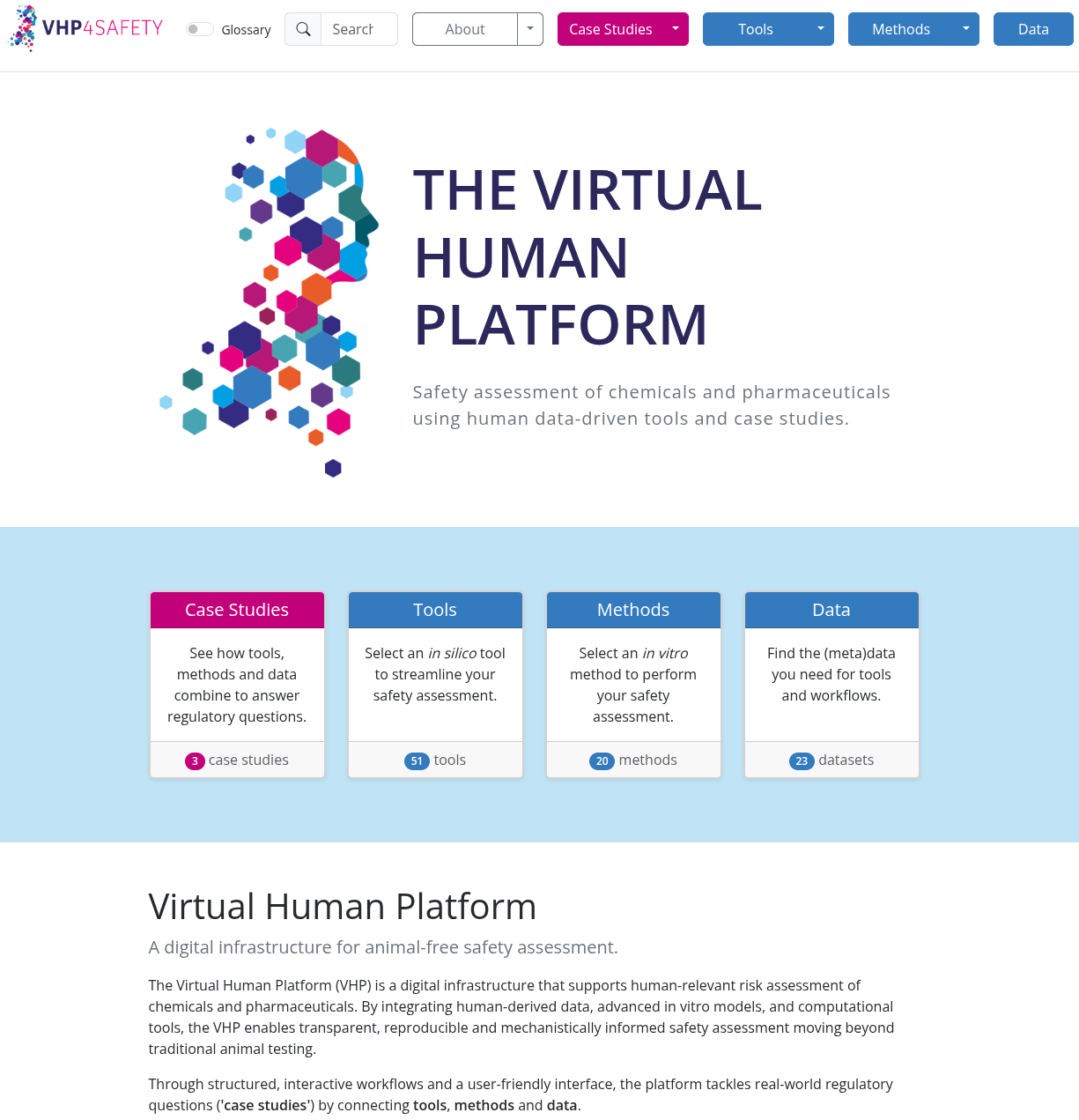
Nine days ago, the <a href="https://vhp4safety.nl/">VHP4Safety</a> project
(see <a href="https://chem-bla-ics.linkedchemistry.info/tag/vhp4safety">these posts</a>)
held a launch event in Utrecht for the
<a href="https://platform.vhp4safety.nl/">Virtual Human Platform</a> (VHP), a key result of the
<a href="https://www.nwo.nl/en/researchprogrammes/dutch-research-agenda-nwa">Dutch Research Agenda</a> (NWA,
from the Dutch <em>Nationale Wetenschapsagenda</em>). Despite the name, the NWA is just one part
of the NWO funding mechanisms, but like the <a href="https://www.openscience.nl/en/about-us">NWO Open Science programme</a>
it is funding with a specific purpose. And the purpose of the NWA is to answer
research and societal questions that the Dutch people together defined and a public
consultation (many years ago). VHP4Safety is answering to one of those questions.</p>

<h2 id="co-creation">Co-creation</h2>

<p>The project is still running another few months, but the <a href="https://www.sciencrew.com/c/9347/a/335652577?title=Launch_of_the_Virtual_Human_Platform">launch last week</a>
gives us the opportunity to include feedback from the stakeholders from the Dutch
society, many of which have been involved in the project via designathons and
hackathons (see doi:<a href="https://doi.org/10.14573/altex.2407211">10.14573/altex.2407211</a>).</p>

<p>The VHP4Safety platform is a co-creation created by most of the people working
on the VHP4Safety grant. Some people focused on innovation and education (RL3),
others on the regulatory questions (RL2), and some on the development of the
platform (RL1). The research line 1 (RL1) included a work package on the
technological development, work package 1.1, and that was led by Maastricht
University (Ozan and me) and the Applied University of Utrecht (Dr. Marc Teunis).
This project would not be together without the leadership by
Prof. dr. ir. Juliette Legler, Dr. Cyrille Krul, and Prof. dr. Anne Kienhuis
 (see <a href="https://video.edu.nl/w/rvUKc7J4E4HEt2TEbJEQt9">this video</a>).</p>

<h2 id="not-just-technology">Not just technology</h2>

<p>I have to give a huge shout out to Ozan whom had the daunting task
to set up something like OpenRiskNet (doi:<a href="https://doi.org/10.1016/j.toxlet.2018.06.617">10.1016/j.toxlet.2018.06.617</a>),
a project with at least twice as much
funding for operating and documenting just the technical platform, but also
help other partners getting their work on the platform. Also shout outs to 
Luc who in our group first explored how to translate the OpenRiskNet platform
to VHP4Safety with <a href="https://en.wikipedia.org/wiki/Kubernetes">kubernetes</a> from
which we concluded that that was not an option for us. And to Sean in our group
who introduced us to <a href="https://www.geeksforgeeks.org/devops/introduction-to-docker-swarm-mode/">Docker Swarm</a>.</p>

<p>But that is just one aspect of the technological layers. The design outlined
in the original proposal is based on earlier projects, including OpenRiskNet,
eNanoMapper, OpenRiskNet, Open PHACTS, NanoCommons, SbD4Nano and many others.
It is based on open standards developed and/or adopted by
<a href="https://elixir-europe.org/">ELIXIR Europe</a> projects and many other organisations.</p>

<p>And then we have not even covered the content on the platform.</p>

<h2 id="a-virtual-human">A virtual human</h2>

<p>Building full virtual human is an ambition. Many <a href="https://en.wikipedia.org/wiki/Digital_twin">digital twins</a>
capture just one part of human biology. For safety assessment we need many models,
data from experiments, and knowledge bases. And we need a clear narrative that
describes how those isolated solutions are integrated so that regulatory questions
can be answered. That co-created combination is the launched <em>virtual human platform</em>.</p>

<p>Underlying the VHP is a good bit of open science, though it also integrated 
proprietary solutions, currently needed to be able to replace animal testing.
And our modular co-creation resulted in <a href="https://github.com/VHP4Safety">many separate git repositories</a>.
This allows distributed development models and all contributors to take ownership
of the development of their contributions. Marc and Frank introduced a agile computing
approach that we adopted to guide the development of the full platform.</p>

<p>There is so much to write up about the platform (and we will), but for now I want
to highlight a few essential git repositories underlying the 1.0 version of the
platform we launched last week (along with the number of contributors in the past two years):</p>

<ul>
  <li><a href="https://github.com/VHP4Safety/virtual-human-platform">virtual-human-platform</a> (<a href="https://github.com/VHP4Safety/virtual-human-platform/graphs/contributors?from=6%2F1%2F2024">10 contributors</a>): software that provide the platform UX</li>
  <li><a href="https://github.com/VHP4Safety/cloud">cloud</a> (<a href="https://github.com/VHP4Safety/cloud/graphs/contributors?from=6%2F1%2F2024">11 contributors</a>): collects the meta data about (computational) services</li>
  <li><a href="https://github.com/VHP4Safety/ui-casestudy-config">ui-casestudy-config</a> (<a href="https://github.com/VHP4Safety/ui-casestudy-config/graphs/contributors?from=5%2F31%2F2025">7 contributors</a>): collects the details of the narratives of the case studies</li>
</ul>

<p>This includes <a href="https://github.com/aniekdewinter">Aniek</a>, <a href="https://github.com/FW94">Fabian</a>,
<a href="https://github.com/iaortega">Isaac</a>, <a href="https://github.com/senseibelbi">Ivo</a>,
<a href="https://github.com/jmillanacosta">Javier</a>, <a href="https://github.com/johannehouweling">Jente</a>,
<a href="https://github.com/LindeSchoenmaker">Linde</a>, <a href="https://github.com/marvinm2">Marvin</a>,
<a href="https://github.com/mirthhe">Myrthe</a>, <a href="https://github.com/saadlodhi0916">Saad</a>,
<a href="https://github.com/ShakiraPortfolio">Shakira</a>, and <a href="https://github.com/youphendriks">Youp</a>,
in addition to the earlier named <a href="https://github.com/ozancinar">Ozan</a> and
<a href="https://github.com/Maddocent">Marc</a>.</p>

<p>This excludes the many contributions via the designathons and hackathons that are
behind many of the commits to these repositories. And this also excludes the
many <a href="https://github.com/VHP4Safety/">other source code repositories</a> for tools
and services developed and made available on this VHP, with even more researchers.</p>

<p>Very much aware of all the work that is still ahead of us, I am happy with the
important milestone of this release. Thank you to
<a href="https://github.com/orgs/VHP4Safety/people">everyone who contributed to this co-creation</a>,
all the <a href="https://www.sciencrew.com/c/9319/a/329042452?title=VHP4Safety_Partners">involved institutes</a>,
NWO for <a href="https://www.nwo.nl/en/projects/nwa129219272">the funding</a>, and the Dutch
public for the important NWA question.</p>

<p>The project delivered!</p>]]></content><author><name>Egon Willighagen</name></author><category term="vhp4safety" /><category term="bioschemas" /><category term="openscience" /><category term="elixir" /><category term="doi:10.14573/ALTEX.2407211" /><category term="justdoi:10.1016/j.toxlet.2018.06.617" /><summary type="html"><![CDATA[Nine days ago, the VHP4Safety project (see these posts) held a launch event in Utrecht for the Virtual Human Platform (VHP), a key result of the Dutch Research Agenda (NWA, from the Dutch Nationale Wetenschapsagenda). Despite the name, the NWA is just one part of the NWO funding mechanisms, but like the NWO Open Science programme it is funding with a specific purpose. And the purpose of the NWA is to answer research and societal questions that the Dutch people together defined and a public consultation (many years ago). VHP4Safety is answering to one of those questions.]]></summary><media:thumbnail xmlns:media="http://search.yahoo.com/mrss/" url="https://chem-bla-ics.linkedchemistry.info/assets/images/vhp_platform.png" /><media:content medium="image" url="https://chem-bla-ics.linkedchemistry.info/assets/images/vhp_platform.png" xmlns:media="http://search.yahoo.com/mrss/" /></entry><entry><title type="html">Open Science Festival Limburg</title><link href="https://chem-bla-ics.linkedchemistry.info/2026/04/27/open-science-festival-limburg.html" rel="alternate" type="text/html" title="Open Science Festival Limburg" /><published>2026-04-27T00:00:00+00:00</published><updated>2026-04-27T00:00:00+00:00</updated><id>https://chem-bla-ics.linkedchemistry.info/2026/04/27/open-science-festival-limburg</id><content type="html" xml:base="https://chem-bla-ics.linkedchemistry.info/2026/04/27/open-science-festival-limburg.html"><![CDATA[<p>One of the things I have been busy with in the past weeks (besides contributing to grant proposals) is the organization
of the June 11-12 <a href="https://www.openscience-maastricht.nl/events/open-science-festival-2026/">Open Science Festival Limburg</a>!
Open Science Festivals provide a great platform to talk science in an open way, with people that all find reuse of
science more important. The creativity present at such events is just so energizing.</p>

<p>This is the second time a local Open Science Festival is organized in the area, with an
<a href="https://www.openscience-maastricht.nl/events/open-science-festival-2023/">Open Science Festival Maastricht</a> in 2023.
Of course, a year later Maastricht also hosted the <a href="https://opensciencefestival.nl/open-science-festival-2024">2024 national Open Science Festival</a>.</p>

<p>This year’s event is co-organized by the (new) Open Science Community Parkstad and the
<a href="https://opensciencefestival.nl/open-science-festival-2024">Open Science Community Maastricht</a>,
with interdisciplinarity as main theme. The event will take day over two days, <a href="https://www.openscience-maastricht.nl/11-june-2026/">June 11 in Heerlen</a>,
and <a href="https://www.openscience-maastricht.nl/12-june-2026/">June 12 in Maastricht</a>. You can <a href="https://www.openscience-maastricht.nl/events/open-science-festival-2026/">register</a>
for either or for both days. Each days have plenary sessions and several parallel workshops,
where you will dive into one of the many aspects of open science.</p>

<p>Looking forward to welcoming you in Limburg!</p>]]></content><author><name>Egon Willighagen</name></author><category term="openscience" /><category term="osflimburg" /><summary type="html"><![CDATA[One of the things I have been busy with in the past weeks (besides contributing to grant proposals) is the organization of the June 11-12 Open Science Festival Limburg! Open Science Festivals provide a great platform to talk science in an open way, with people that all find reuse of science more important. The creativity present at such events is just so energizing.]]></summary></entry><entry><title type="html">CDK 2.12</title><link href="https://chem-bla-ics.linkedchemistry.info/2026/03/08/cdk-2.12.html" rel="alternate" type="text/html" title="CDK 2.12" /><published>2026-03-08T00:00:00+00:00</published><updated>2026-03-08T00:00:00+00:00</updated><id>https://chem-bla-ics.linkedchemistry.info/2026/03/08/cdk-2.12</id><content type="html" xml:base="https://chem-bla-ics.linkedchemistry.info/2026/03/08/cdk-2.12.html"><![CDATA[<p><a href="https://github.com/cdk/cdk/releases/tag/cdk-2.12">Version 2.12</a> of the <a href="https://cdk.github.io/">Chemistry Development Kit</a> has been released.
It is the last release with contributions by <a href="https://www.nwo.nl/en/projects/osf232097">our NWO Open Science grant</a>.
This release adds some nice new APIs:</p>

<ul>
  <li>harmonize hydrogens to various states: depiction, stereo, minimal, and unsafe (useful for depictions)</li>
  <li>generate wedge bonds based on coordinates and stereochemistry</li>
  <li>more Markush / RGroup support</li>
  <li>atropisomers via CXSMILES</li>
  <li>sugar extraction</li>
</ul>

<p>I also update the following libraries/tools to use CDK 2.12:</p>

<ul>
  <li><a href="https://github.com/enanomapper/nanojava/releases/tag/nanojava-2.0.6">NanoJava 2.16</a></li>
  <li><a href="https://github.com/egonw/bacting/releases/tag/bacting-1.0.10">Bacting 1.0.10</a> (and the Python pyBacting will follow asap)</li>
</ul>]]></content><author><name>Egon Willighagen</name></author><category term="cdk" /><category term="openscience" /><category term="justdoi:10.5281/zenodo.18850648" /><summary type="html"><![CDATA[Version 2.12 of the Chemistry Development Kit has been released. It is the last release with contributions by our NWO Open Science grant. This release adds some nice new APIs:]]></summary></entry><entry><title type="html">Open Infrastructures #1: Research Software Directory</title><link href="https://chem-bla-ics.linkedchemistry.info/2025/12/29/open-infrastructures.html" rel="alternate" type="text/html" title="Open Infrastructures #1: Research Software Directory" /><published>2025-12-29T00:00:00+00:00</published><updated>2025-12-29T00:00:00+00:00</updated><id>https://chem-bla-ics.linkedchemistry.info/2025/12/29/open-infrastructures</id><content type="html" xml:base="https://chem-bla-ics.linkedchemistry.info/2025/12/29/open-infrastructures.html"><![CDATA[<blockquote>
  <p>Research software is an integral part of scientific investigations.</p>
</blockquote>

<p>This is what Struck wrote in 2018 in a contribution to the 2018 IEEE 14th International Conference on e-Science (e-Science)
(doi:<a href="https://doi.org/10.1109/eScience.2018.00016">10.1109/eScience.2018.00016</a>). I very much agree with this,
and the notion is gaining ground in the academic community. Their paper <em>“identifies challenges, risks and new opportunities
in research software publication and discovery”</em>.</p>

<p>At the same conference, Spaaks <em>et al.</em> presented a lightning talk about the
<a href="https://research-software-directory.org/software/rsd-ng">Research Software Directory</a> (RSD),
<em>“a content management system for research software, which promotes the visibility, reuse, and impact of research software”</em>
(doi:<a href="https://doi.org/10.1109/eScience.2018.00013">10.1109/eScience.2018.00013</a>).</p>

<p>I wonder who spoke first at the meeting.</p>

<p>Anyway, I learned about RSD a while ago already and have been using it for some of our
group’s research software. We don’t have a collection for our group, but you will find them
under the <a href="https://research-software-directory.org/organisations/maastricht-university">Maastricht University organisation page</a>.</p>

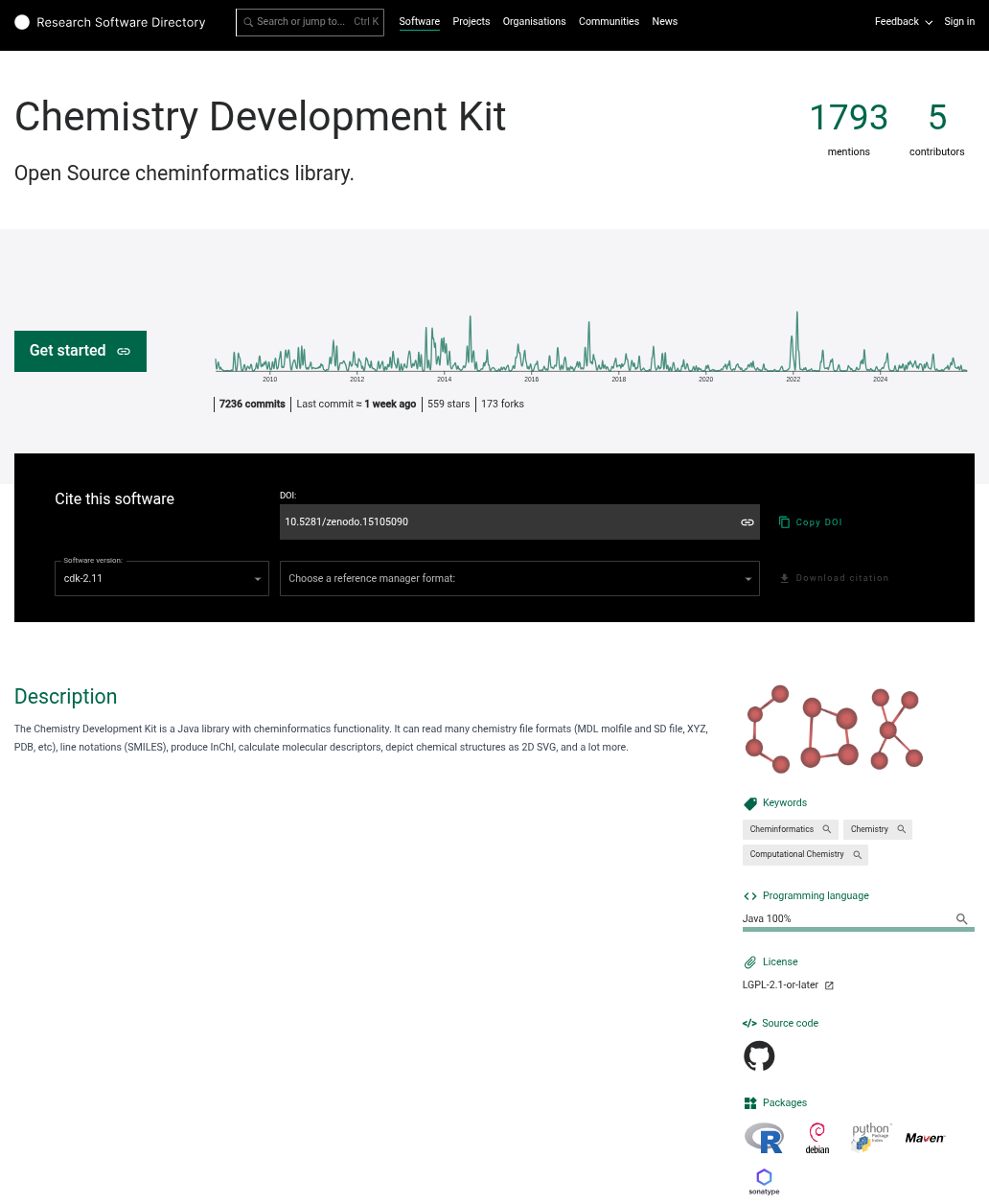
<p>And as sketched by Struck and implemented by Spaaks <em>et al.</em>, RSD gives rich context
to the research software. It can track the activity on the project (for GitHub, GitLab,
<a href="https://github.com/research-software-directory/RSD-as-a-service/issues/1605">Codeberg</a> etc),
track citations to key literature, and can have links to distributions where the software is published
(like Debian, CRAN, <a href="https://github.com/research-software-directory/RSD-as-a-service/issues/1606">Bioconductor</a>, etc).</p>

<p>This is what it looks like for the <a href="https://research-software-directory.org/software/cdk">Chemistry Development Kit</a>:</p>

<p><img src="/assets/images/rsd.png" alt="" /></p>

<p>I like initiatives like this, as they help the community work out open standards to exchange
metadata, and encourage other projects by reusing their APIs.</p>]]></content><author><name>Egon Willighagen</name></author><category term="justdoi:10.1109/eScience.2018.00016" /><category term="justdoi:10.1109/eScience.2018.00013" /><category term="cdk" /><category term="openscience" /><summary type="html"><![CDATA[Research software is an integral part of scientific investigations.]]></summary><media:thumbnail xmlns:media="http://search.yahoo.com/mrss/" url="https://chem-bla-ics.linkedchemistry.info/assets/images/rsd.png" /><media:content medium="image" url="https://chem-bla-ics.linkedchemistry.info/assets/images/rsd.png" xmlns:media="http://search.yahoo.com/mrss/" /></entry></feed>