<?xml version="1.0" encoding="utf-8"?><feed xmlns="http://www.w3.org/2005/Atom" ><generator uri="https://jekyllrb.com/" version="4.3.4">Jekyll</generator><link href="https://chem-bla-ics.linkedchemistry.info/feed/by_tag/openphacts.xml" rel="self" type="application/atom+xml" /><link href="https://chem-bla-ics.linkedchemistry.info/" rel="alternate" type="text/html" /><updated>2026-11-18T10:37:59+00:00</updated><id>https://chem-bla-ics.linkedchemistry.info/feed/by_tag/openphacts.xml</id><title type="html">chem-bla-ics</title><subtitle>Chemblaics (pronounced chem-bla-ics) is the science that uses open science and computers to solve problems in chemistry, biochemistry and related fields.</subtitle><author><name>Egon Willighagen</name></author><entry><title type="html">Programming in the Life Sciences #21: 2014 Screenshots #1</title><link href="https://chem-bla-ics.linkedchemistry.info/2015/01/11/programming-in-life-sciences-21-2014.html" rel="alternate" type="text/html" title="Programming in the Life Sciences #21: 2014 Screenshots #1" /><published>2015-01-11T00:00:00+00:00</published><updated>2015-01-11T00:00:00+00:00</updated><id>https://chem-bla-ics.linkedchemistry.info/2015/01/11/programming-in-life-sciences-21-2014</id><content type="html" xml:base="https://chem-bla-ics.linkedchemistry.info/2015/01/11/programming-in-life-sciences-21-2014.html"><![CDATA[<p>December saw the end of this year’s PRA3006 course (aka <a href="http://chem-bla-ics.blogspot.nl/2013/10/programming-in-life-sciences-1-six-day.html">#mcspils</a>).
Time to blog some screenshots of the student projects. Like last year, the aim is to use the <a href="https://dev.openphacts.org/">Open PHACTS API</a>
to collect data with <a href="https://github.com/openphacts/ops.js">ops.js</a> and which should then be visualized in a HTML page, preferably with
<a href="http://d3js.org/">d3.js</a>. This year, all projects reached that goal.</p>

<h2 id="ace-inhibitors">ACE inhibitors</h2>

<p>The first team (Mischa-Alexander and Hamza) focused on the <a href="https://en.wikipedia.org/wiki/ACE_inhibitor">ACE inhibitors</a> (type:”drug class”) and the
<a href="http://wikipathways.org/index.php/Pathway:WP554">WP554 from WikiPathways</a>. The use a tree structure to list inhibitors along with their activity:</p>

<p><img src="/assets/images/pra3006_screenshot1.png" alt="" /></p>

<p>The source code for this project is available under a MIT license.</p>

<h2 id="diabetes">Diabetes</h2>

<p>The second team (Catherine and Moritz) looked at compounds hitting diabetes mellitus targets. They take advantage from the new disease API methods and
first ask for all targets for the disease, and then query for all compounds. Mind you, the compounds are not filtered by activity, so it mostly shows
interactions that real targets.</p>

<p><img src="/assets/images/pra3006_screenshot2.png" alt="" /></p>

<p>This product too is available with the MIT license.</p>

<h2 id="tuberculosis">Tuberculosis</h2>

<p>The third project (Nadia en Loic) also goes from disease to targets and they looked at tuberculosis.</p>

<p><img src="/assets/images/pra3006_screenshot3.png" alt="" /></p>

<h2 id="asynchronous-calls">Asynchronous calls</h2>

<p>If you know the ops.js, d3.js, and JavaScript a bit, you know that these projects are not trivial. The remote web service calls are made in an
asynchronous manner: each call comes with a callback function that gets called when the server returns an answer, at some future point in time.
Therefore, if you want to visualization, for example, compounds with activities against targets for a particular disease, you need two web service
calls, with the second made in the callback function of the first call. Now, try to globally collect the data from that with JavaScript and HTML,
and make sure to call the visualization call when all information is collected! But even without that, the students need to convert the returned
web service answer into a format that d3.js can handle. In short: quite a challenge for six practical days!</p>]]></content><author><name>Egon Willighagen</name></author><category term="pra3006" /><category term="openphacts" /><summary type="html"><![CDATA[December saw the end of this year’s PRA3006 course (aka #mcspils). Time to blog some screenshots of the student projects. Like last year, the aim is to use the Open PHACTS API to collect data with ops.js and which should then be visualized in a HTML page, preferably with d3.js. This year, all projects reached that goal.]]></summary><media:thumbnail xmlns:media="http://search.yahoo.com/mrss/" url="https://chem-bla-ics.linkedchemistry.info/assets/images/pra3006_screenshot1.png" /><media:content medium="image" url="https://chem-bla-ics.linkedchemistry.info/assets/images/pra3006_screenshot1.png" xmlns:media="http://search.yahoo.com/mrss/" /></entry><entry><title type="html">Programming in the Life Sciences #13: Another screenshot</title><link href="https://chem-bla-ics.linkedchemistry.info/2013/12/06/programming-in-life-sciences-13-another.html" rel="alternate" type="text/html" title="Programming in the Life Sciences #13: Another screenshot" /><published>2013-12-06T00:10:00+00:00</published><updated>2013-12-06T00:10:00+00:00</updated><id>https://chem-bla-ics.linkedchemistry.info/2013/12/06/programming-in-life-sciences-13-another</id><content type="html" xml:base="https://chem-bla-ics.linkedchemistry.info/2013/12/06/programming-in-life-sciences-13-another.html"><![CDATA[<p>I got a one more source code zip file from the <a href="http://www.maastrichtuniversity.nl/web/Schools/MaastrichtScienceProgramme.htm">Maastricht Science Programme</a>
students (see also the <a href="http://chem-bla-ics.blogspot.nl/2013/12/programming-in-life-sciences-12-first.html">first two screenshots</a>). Vincent and Błażej extended the
<a href="http://d3js.org/">d3.js</a> tree view, showing classification information from <a href="http://www.ebi.ac.uk/chebi/">ChEBI</a> (they also
<a href="https://github.com/openphacts/ops.js/pull/2">submitted</a> <a href="https://github.com/openphacts/ops.js/pull/3">three</a>
<a href="https://github.com/openphacts/ops.js/pull/4">patches</a> to the <a href="http://www.openphacts.org/">Open PHACTS</a> <a href="https://github.com/openphacts/ops.js">ops.js</a>):</p>

<p><img src="/assets/images/blazejAndVincent.png" alt="" /></p>]]></content><author><name>Egon Willighagen</name></author><category term="pra3006" /><category term="openphacts" /><category term="chebi" /><summary type="html"><![CDATA[I got a one more source code zip file from the Maastricht Science Programme students (see also the first two screenshots). Vincent and Błażej extended the d3.js tree view, showing classification information from ChEBI (they also submitted three patches to the Open PHACTS ops.js):]]></summary><media:thumbnail xmlns:media="http://search.yahoo.com/mrss/" url="https://chem-bla-ics.linkedchemistry.info/assets/images/blazejAndVincent.png" /><media:content medium="image" url="https://chem-bla-ics.linkedchemistry.info/assets/images/blazejAndVincent.png" xmlns:media="http://search.yahoo.com/mrss/" /></entry><entry><title type="html">Programming in the Life Sciences #12: First screenshots</title><link href="https://chem-bla-ics.linkedchemistry.info/2013/12/06/programming-in-life-sciences-12-first.html" rel="alternate" type="text/html" title="Programming in the Life Sciences #12: First screenshots" /><published>2013-12-06T00:00:00+00:00</published><updated>2013-12-06T00:00:00+00:00</updated><id>https://chem-bla-ics.linkedchemistry.info/2013/12/06/programming-in-life-sciences-12-first</id><content type="html" xml:base="https://chem-bla-ics.linkedchemistry.info/2013/12/06/programming-in-life-sciences-12-first.html"><![CDATA[<p>Yesterday was the last <a href="http://chem-bla-ics.blogspot.nl/2013/10/programming-in-life-sciences-1-six-day.html">Programming in the Life Sciences</a> practical day,
and the 2nd and 3rd year B.Sc. <a href="http://www.maastrichtuniversity.nl/web/Schools/MaastrichtScienceProgramme.htm">MSC</a> students presented their results yesterday
afternoon. I am impressed with the results that they reached in only six practical days. I have suggested them to upload the presentations to SlideShare or
<a href="http://figshare.com/">FigShare</a> (with the advantage that you get a DOI), and asked them to send them their tools. Below are some screenshots.</p>

<p>The first app is by Tim and Taís, and look up activities from the <a href="http://www.openphacts.org/">Open PHACTS</a> platform and filters it for activities related
to a set of five anti-oxidants (see also <a href="http://figshare.com/articles/Tais_and_Tim_Final_Presentation_pptx/870474">their FigShare</a>):</p>

<p><img src="/assets/images/timAndTais.png" alt="" /></p>

<p>The next app is by Janneke and Lukas and uses the Open PHACTS <a href="https://dev.openphacts.org/">API</a> to report on single protein targets for the compound
the user enters (see also <a href="http://www.slideshare.net/lukasfreedaheimfriedeheim/target-search-janneke-mes-lukas-friedeheim">their SlideShare</a>):</p>

<p><img src="/assets/images/jannekeAndLukas.png" alt="" /></p>

<p>More apps will follow soon.</p>]]></content><author><name>Egon Willighagen</name></author><category term="pra3006" /><category term="openphacts" /><category term="justdoi:10.6084/m9.figshare.870474.v1" /><summary type="html"><![CDATA[Yesterday was the last Programming in the Life Sciences practical day, and the 2nd and 3rd year B.Sc. MSC students presented their results yesterday afternoon. I am impressed with the results that they reached in only six practical days. I have suggested them to upload the presentations to SlideShare or FigShare (with the advantage that you get a DOI), and asked them to send them their tools. Below are some screenshots.]]></summary><media:thumbnail xmlns:media="http://search.yahoo.com/mrss/" url="https://chem-bla-ics.linkedchemistry.info/assets/images/jannekeAndLukas.png" /><media:content medium="image" url="https://chem-bla-ics.linkedchemistry.info/assets/images/jannekeAndLukas.png" xmlns:media="http://search.yahoo.com/mrss/" /></entry><entry><title type="html">Programming in the Life Sciences #4: communication from within HTML</title><link href="https://chem-bla-ics.linkedchemistry.info/2013/10/09/programming-in-life-sciences-4.html" rel="alternate" type="text/html" title="Programming in the Life Sciences #4: communication from within HTML" /><published>2013-10-09T00:00:00+00:00</published><updated>2013-10-09T00:00:00+00:00</updated><id>https://chem-bla-ics.linkedchemistry.info/2013/10/09/programming-in-life-sciences-4</id><content type="html" xml:base="https://chem-bla-ics.linkedchemistry.info/2013/10/09/programming-in-life-sciences-4.html"><![CDATA[<p>The purpose of a web service is that you give it a question or task, and that it returns an answer. For example, we can ask the
<a href="http://www.openphacts.org/">Open PHACTS</a> platform what compounds it knows with aspirin in the name. We pass the question (with the
<a href="http://chem-bla-ics.blogspot.nl/2013/10/programming-in-life-sciences-2-accounts.html">API key</a>) and get a list of matching compounds.
Now, this communication is complex: it happens at many levels, which are spelled out in the
<a href="https://en.wikipedia.org/wiki/Internet_model">Internet Model</a>. There are various variants of the stack of communication layers,
but we are interested mostly in the top layers, at the <em>application layer</em>. In fact, for this course this model only serves as
supporting information for those who want to learn more.</p>

<p>Practically, what matters here is how to ask the question and how to understand the answer.</p>

<p>We are supported in these practicalities with JavaScript libraries, in particular the <a href="https://github.com/openphacts/ops.js">ops.js</a>
library and general <a href="https://en.wikipedia.org/wiki/JSON">JSON</a> functionality provided by most browsers (unless the student decided to use
a <em>different</em> programming language, in which there are different libraries). Personally, I have only very limited JavaScript experience,
and this mostly goes back to the good old <a href="http://www.biomedcentral.com/1471-2105/8/487">Userscript and Greasemonkey days</a> (wow! the
paper is actually the <a href="http://www.altmetric.com/details.php?citation_id=103983">4th highest scoring BMC Bioinformatics article!</a>).
But because my JavaScript knowledge is limited and rusty, I spent a good part of today, to get a basic example running. Very basic,
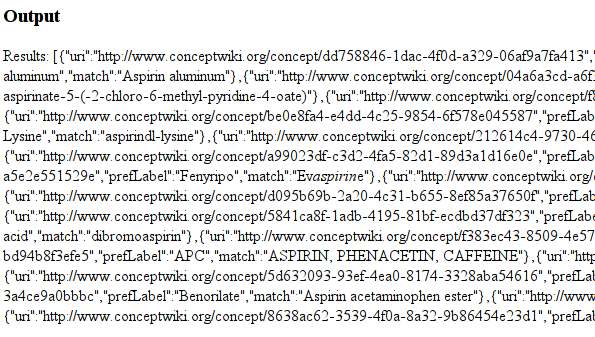
and barely exceeding the communication details. That is, this is the output in the browser:</p>

<p><img src="/assets/images/mcspils_jsonOutput.png" alt="" /></p>

<p>So, what does the question look like? The question is actually hardcoded in the HTML source, but the page does take two parameters:
the <code class="language-plaintext highlighter-rouge">app_key</code> and <code class="language-plaintext highlighter-rouge">app_id</code> that come <a href="http://chem-bla-ics.blogspot.nl/2013/10/programming-in-life-sciences-2-accounts.html">with your Open PHACTS account</a>.</p>

<p>The ops.js library helps us, and wraps the Open PHACTS LDA methods in JavaScript methods. Thus, rather can crafting special HTTP calls,
we use two JavaScript calls:</p>

<div class="language-javascript highlighter-rouge"><div class="highlight"><pre class="highlight"><code><span class="kd">var</span> <span class="nx">searcher</span> <span class="o">=</span> <span class="k">new</span> <span class="nx">Openphacts</span><span class="p">.</span><span class="nc">ConceptWikiSearch</span><span class="p">(</span>
  <span class="dl">"</span><span class="s2">https://beta.openphacts.org</span><span class="dl">"</span><span class="p">,</span>
  <span class="nx">params</span><span class="p">[</span><span class="dl">"</span><span class="s2">app_id</span><span class="dl">"</span><span class="p">],</span> <span class="nx">params</span><span class="p">[</span><span class="dl">"</span><span class="s2">app_key</span><span class="dl">"</span><span class="p">]</span>
<span class="p">);</span>
<span class="nx">searcher</span><span class="p">.</span><span class="nf">byTag</span><span class="p">(</span>
  <span class="dl">'</span><span class="s1">Aspirin</span><span class="dl">'</span><span class="p">,</span> <span class="dl">'</span><span class="s1">20</span><span class="dl">'</span><span class="p">,</span> <span class="dl">'</span><span class="s1">4</span><span class="dl">'</span><span class="p">,</span> <span class="dl">'</span><span class="s1">07a84994-e464-4bbf-812a-a4b96fa3d197</span><span class="dl">'</span><span class="p">,</span>
  <span class="nx">callback</span>
<span class="p">);</span>
</code></pre></div></div>

<p>The first statement creates an LDA method object, while the second makes an actual question. I have not defined the callback variable,
which actually is a JavaScript function that looks like:</p>

<div class="language-javascript highlighter-rouge"><div class="highlight"><pre class="highlight"><code><span class="kd">var</span> <span class="nx">callback</span> <span class="o">=</span> <span class="kd">function</span><span class="p">(</span><span class="nx">success</span><span class="p">,</span> <span class="nx">status</span><span class="p">,</span> <span class="nx">response</span><span class="p">){</span>
  <span class="kd">var</span> <span class="nx">result</span> <span class="o">=</span> <span class="nx">searcher</span><span class="p">.</span><span class="nf">parseResponse</span><span class="p">(</span><span class="nx">response</span><span class="p">);</span>
  <span class="nb">document</span><span class="p">.</span><span class="nf">getElementById</span><span class="p">(</span><span class="dl">"</span><span class="s2">output</span><span class="dl">"</span><span class="p">).</span><span class="nx">innerHTML</span> <span class="o">=</span>
    <span class="dl">"</span><span class="s2">Results: </span><span class="dl">"</span> <span class="o">+</span> <span class="nx">JSON</span><span class="p">.</span><span class="nf">stringify</span><span class="p">(</span><span class="nx">result</span><span class="p">);</span>
<span class="p">};</span>
</code></pre></div></div>

<p>When the LDA web service returns data, this method gets called, providing asynchronous functionality to keep the web page responsive.
But when called, it first parses the returned data, and then puts the JSON output as text in the HTML. The output that is given in
the earlier screenshot.</p>

<p>So, hurdle taken. From here on it’s easier. Regular looping over the results, creating some HTML output, etc. The
<a href="https://gist.github.com/egonw/6902776">full source code</a> if this example is available as Gist.</p>]]></content><author><name>Egon Willighagen</name></author><category term="pra3006" /><category term="javascript" /><category term="html" /><category term="openphacts" /><category term="doi:10.1186/1471-2105-8-487" /><summary type="html"><![CDATA[The purpose of a web service is that you give it a question or task, and that it returns an answer. For example, we can ask the Open PHACTS platform what compounds it knows with aspirin in the name. We pass the question (with the API key) and get a list of matching compounds. Now, this communication is complex: it happens at many levels, which are spelled out in the Internet Model. There are various variants of the stack of communication layers, but we are interested mostly in the top layers, at the application layer. In fact, for this course this model only serves as supporting information for those who want to learn more.]]></summary><media:thumbnail xmlns:media="http://search.yahoo.com/mrss/" url="https://chem-bla-ics.linkedchemistry.info/assets/images/mcspils_jsonOutput.png" /><media:content medium="image" url="https://chem-bla-ics.linkedchemistry.info/assets/images/mcspils_jsonOutput.png" xmlns:media="http://search.yahoo.com/mrss/" /></entry><entry><title type="html">Programming in the Life Sciences #2: accounts and API keys</title><link href="https://chem-bla-ics.linkedchemistry.info/2013/10/08/programming-in-life-sciences-2-accounts.html" rel="alternate" type="text/html" title="Programming in the Life Sciences #2: accounts and API keys" /><published>2013-10-08T00:00:00+00:00</published><updated>2013-10-08T00:00:00+00:00</updated><id>https://chem-bla-ics.linkedchemistry.info/2013/10/08/programming-in-life-sciences-2-accounts</id><content type="html" xml:base="https://chem-bla-ics.linkedchemistry.info/2013/10/08/programming-in-life-sciences-2-accounts.html"><![CDATA[<p>I have outlined the scope of the <a href="http://chem-bla-ics.blogspot.nl/2013/10/programming-in-life-sciences-1-six-day.html">six-day course</a>:
the students will learn to program while hacking on the <a href="https://dev.openphacts.org/docs">Open PHACTS’ Linked Data API</a> (LDA). The first
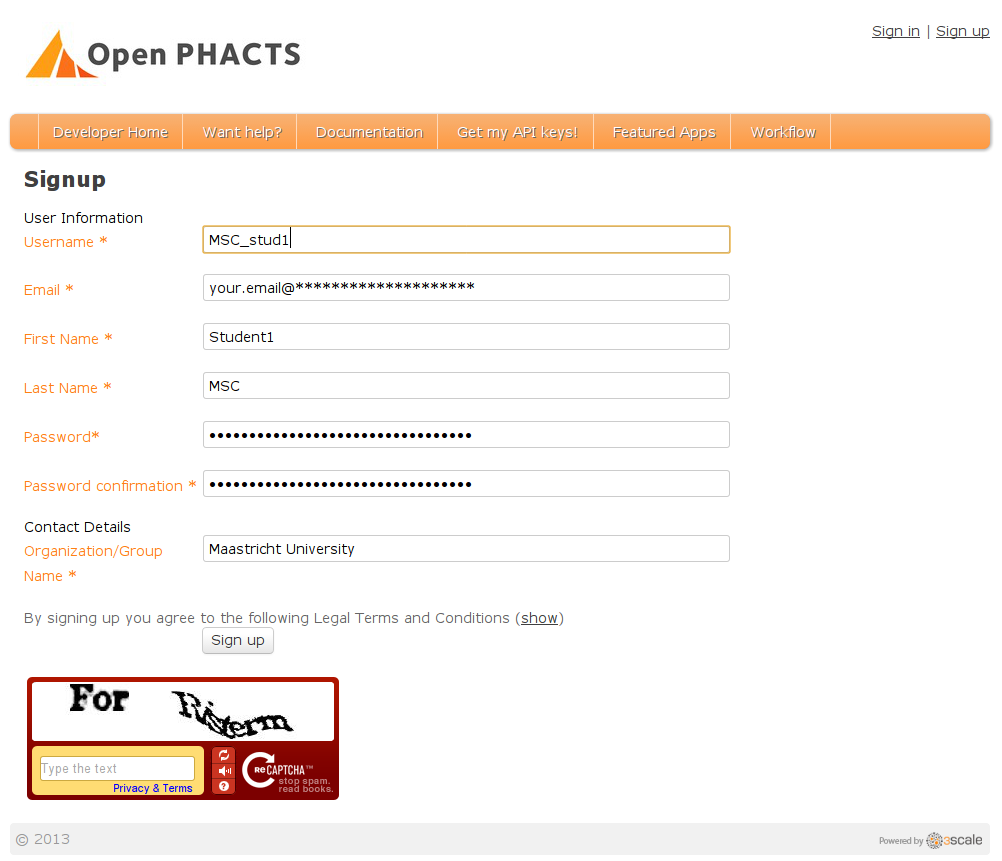
step is to get an account for the LDA. I have already done that to save time. But these are the steps to take. You go to
<a href="https://dev.openphacts.org/signup">https://dev.openphacts.org/signup</a>:</p>

<p><img src="/assets/images/gscholar1.png" alt="" /></p>

<p>You then approve the account via your email account and you are set. The account is needed to get an API key. Using this key,
Open PHACTS developers can contact you if your scripts go berserk  So, you are kindly invited to make crazy hypotheses and hack the
hell out of the platform. That’s what I hope my students will do.</p>

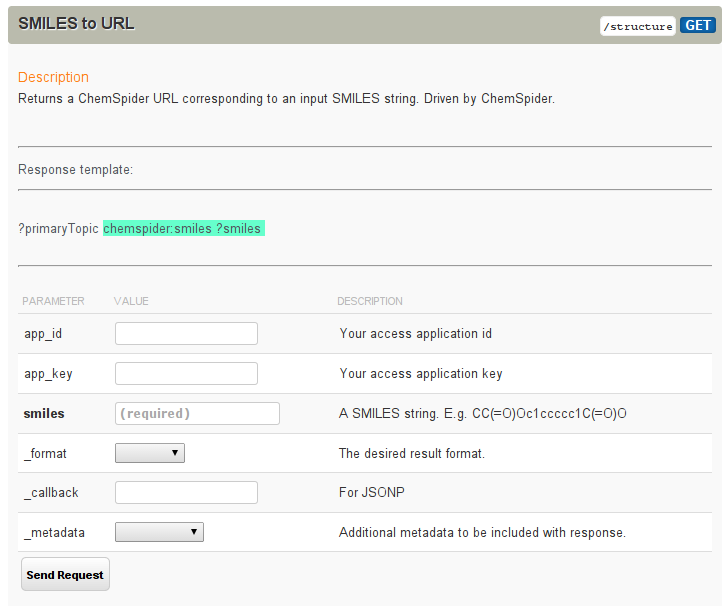
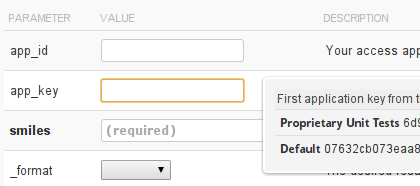
<p>To try your new key, go to the documentation page, and open, for example, the <em>SMILES to URL</em> method:</p>

<p><img src="/assets/images/mscpils.png" alt="" /></p>

<p>Here you can see what parameters this LDA method has. We focus now on the <code class="language-plaintext highlighter-rouge">app_id</code> and <code class="language-plaintext highlighter-rouge">app_key</code> fields. Each account comes by default
with a, um, default <code class="language-plaintext highlighter-rouge">app_id</code> and default <code class="language-plaintext highlighter-rouge">app_key</code>. Just click on the field and select them:</p>

<p><img src="/assets/images/mscpils1.png" alt="" /></p>

<p>Select the defaults and enter a SMILES (try: <a href="https://apps.ideaconsult.net:8080/ambit2/depict?search=CC(=O)NC1=CC=C(C=C1)O">CC(=O)NC1=CC=C(C=C1)O)</a>).
You can select the format you like (I like Turtle) and you get Linked Data back on this <a href="https://rdf.chemspider.com/1906">compound</a>.</p>

<p>Now, go explore the LDA methods.</p>]]></content><author><name>Egon Willighagen</name></author><category term="pra3006" /><category term="openphacts" /><category term="javascript" /><category term="rest" /><summary type="html"><![CDATA[I have outlined the scope of the six-day course: the students will learn to program while hacking on the Open PHACTS’ Linked Data API (LDA). The first step is to get an account for the LDA. I have already done that to save time. But these are the steps to take. You go to https://dev.openphacts.org/signup:]]></summary><media:thumbnail xmlns:media="http://search.yahoo.com/mrss/" url="https://chem-bla-ics.linkedchemistry.info/assets/images/gscholar1.png" /><media:content medium="image" url="https://chem-bla-ics.linkedchemistry.info/assets/images/gscholar1.png" xmlns:media="http://search.yahoo.com/mrss/" /></entry><entry><title type="html">Programming in the Life Sciences #1: a six day course</title><link href="https://chem-bla-ics.linkedchemistry.info/2013/10/05/programming-in-life-sciences-1-six-day.html" rel="alternate" type="text/html" title="Programming in the Life Sciences #1: a six day course" /><published>2013-10-05T00:00:00+00:00</published><updated>2013-10-05T00:00:00+00:00</updated><id>https://chem-bla-ics.linkedchemistry.info/2013/10/05/programming-in-life-sciences-1-six-day</id><content type="html" xml:base="https://chem-bla-ics.linkedchemistry.info/2013/10/05/programming-in-life-sciences-1-six-day.html"><![CDATA[<p>Our <a href="http://www.bigcat.unimaas.nl/">department</a> will soon start the course Programming in the Life Sciences for a group of some
10 students from the <a href="http://www.maastrichtuniversity.nl/web/Schools/MaastrichtScienceProgramme.htm">Maastricht Science Programme</a>.
This is the first time we give this course, and over the next weeks I will be blogging about this course. First, some information.
These are the goals, to use programming to:</p>

<ul>
  <li>have the ability to recognize various classes of chemical entities in pharmacology and to understand the basic physical and chemical interactions.</li>
  <li>be familiar with technologies for web services in the life sciences.</li>
  <li>obtain experience in using such web services with a programming language.</li>
  <li>be able to select web services for a particular pharmacological question.</li>
  <li>have sufficient background for further, more advanced, bioinformatics data analyses.</li>
</ul>

<p>So, this course will be a mix of things. I will likely start with a lecture or too about scientific programming, such as the
importance of reproducibility, licensing, documentation, and (unit) testing. To achieve these learning goals we have set a
problem. The description is:</p>

<blockquote>
  <p>In the life sciences the interactions between chemical entities is of key interest. Not only do these play an important role
in the regulation of gene expression, and therefore all cellular processes, they are also one of the primary approaches in
drug discovery. Pharmacology is the science studies the action of drugs, and for many common drugs, this is studying the
interaction of small organic molecules and protein targets.</p>

  <p>And with the increasing information in the life sciences, automation becomes increasingly important. Big data and small data
alike, provide challenges to integrate data from different experiments. The Open PHACTS platform provides web services to
support pharmacological research and in this course you will learn how to use such web services from programming languages,
allowing you to link data from such knowledge bases to other platforms, such as those for data analysis.</p>
</blockquote>

<p>So, it becomes pretty clear what the students will be doing. They only have six days, so it won’t be much. It’s just to learn
them the basic skills. The students are in their 3rd year at the university, and because of the nature of the programme they
follow, a mixed background in biology, mathematics, chemistry, and physics. So, I have a good hope they will surprise me in
what they will get done.</p>

<p>Pharmacology is the basic topic: drug-protein interaction, but the students are free to select a research question. In fact,
I will not care that much what they like to study, as long as they do it properly. They will start with
<a href="https://dev.openphacts.org/docs">Open PHACTS’ Linked Data API</a>, but here too, they are free to complement data from the
OPS cache with additional information. I hope they do.</p>

<p>Now, regarding the technology they will use. The default will be JavaScript, and in the next week I will hack up demo code
showing the integration of <a href="https://github.com/openphacts/ops.js">ops.js</a> and <a href="http://d3js.org/">d3.js</a>.
Let’s see how hard it will be; it’s new to me too. But, if the students
already are familiar with another programming language and prefer to use that, I won’t stop them.</p>

<p>(For the Dutch readers, would #mscpils be a good tag?)</p>]]></content><author><name>Egon Willighagen</name></author><category term="pra3006" /><category term="javascript" /><category term="openphacts" /><summary type="html"><![CDATA[Our department will soon start the course Programming in the Life Sciences for a group of some 10 students from the Maastricht Science Programme. This is the first time we give this course, and over the next weeks I will be blogging about this course. First, some information. These are the goals, to use programming to:]]></summary></entry><entry><title type="html">New Paper: “The ChEMBL database as linked open data”</title><link href="https://chem-bla-ics.linkedchemistry.info/2013/05/09/new-paper-chembl-database-as-linked.html" rel="alternate" type="text/html" title="New Paper: “The ChEMBL database as linked open data”" /><published>2013-05-09T00:00:00+00:00</published><updated>2013-05-09T00:00:00+00:00</updated><id>https://chem-bla-ics.linkedchemistry.info/2013/05/09/new-paper-chembl-database-as-linked</id><content type="html" xml:base="https://chem-bla-ics.linkedchemistry.info/2013/05/09/new-paper-chembl-database-as-linked.html"><![CDATA[<script src="https://d1bxh8uas1mnw7.cloudfront.net/assets/embed.js" type="text/javascript"></script>

<div class="altmetric-embed" data-badge-details="right" data-badge-type="donut" data-doi="10.1186/1758-2946-5-23" style="float: right;"></div>

<p><strong>Update</strong>: Mark wrote up a <a href="http://chembl.blogspot.co.uk/2013/05/chembl-chembl-rdf.html">blog post</a> on the RDF that the ChEMBL team itself.</p>

<p>Yesterday, the paper “The ChEMBL database as linked open data” (doi:<a href="https://doi.org/10.1186/1758-2946-5-23">10.1186/1758-2946-5-23</a>) by
Andra Waagmeester (<a href="https://twitter.com/andrawaag">@andrawaag</a>), Ola Spjuth (<a href="https://twitter.com/ola_spjuth">@ola_spjuth</a>), Peter Ansell
(<a href="http://twitter.com/p_ansell">@p_ansell</a>), Antony Williams (<a href="https://twitter.com/chemconnector">@chemconnector</a>), Valery Tkachenko,
Janna Hastings, Bin Chen (<a href="http://twitter.com/binchenindiana">@binchenindiana</a>), David J Wild (<a href="http://twitter.com/davidjohnwild">@davidjohnwild</a>),
and me appeared in the OA <a href="http://en.wikipedia.org/wiki/Journal_of_Cheminformatics">JChemInf</a> journal.</p>

<p>I am also indebted to the <a href="https://www.ebi.ac.uk/chembl/">ChEMBL</a> team (<a href="http://twitter.com/chembl">@chembl</a>) for both providing such
valuable data under a liberal Open Access license and their critical reading of the manuscript! <strong>Additionally, I would like to stress
that the ChEMBL team will create their own RDF version of ChEMBL and that this paper is not describing the version they will release.</strong></p>

<p>BTW, the <a href="https://github.com/egonw/chembl-rdf-paper/">source of the paper</a> is available from GitHub. And the
<a href="https://github.com/egonw/chembl.rdf">(original) scripts to create RDF from the MySQL dump of ChEMBL</a> are also on GitHub.</p>

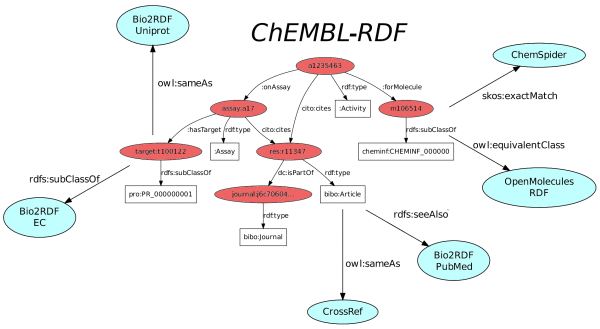
<p><img src="https://media.springernature.com/lw685/springer-static/image/art%3A10.1186%2F1758-2946-5-23/MediaObjects/13321_2012_Article_469_Figa_HTML.gif" alt="" /></p>

<p>This paper outlines the <a href="http://www.jcheminf.com/content/3/1/15">RDF</a> as it has evolved from various earlier projects. The above
diagram visualizes the basic structure (red), various Linked Data resources linked too (blue) and illustrates how various ontologies are used,
such as the <a href="http://www.plosone.org/article/info:doi/10.1371/journal.pone.0025513">CHEMINF</a>, <a href="http://bibliontology.com/">BIBO</a>,
and <a href="http://www.jbiomedsem.com/content/1/S1/S6">CiTO</a> ontologies.</p>

<p>Additionally, various applications and links are described developed by various co-authors. For example, Peter worked on the use in
<a href="http://bio2rdf.org/">Bio2RDF</a> and Bin and David on <a href="http://cheminfov.informatics.indiana.edu:8080/">Chem2Bio2RDF</a>. Andra developed
an extension for his (#altmetric) <a href="http://citedin.org/">CitedIn</a> resource, giving credit to a paper when data in it is extracted into
ChEMBL. Ola, Valery, and Anthony developed a <a href="http://www.bioclipse.net/decision-support">Bioclipse Decision Support</a> extension,
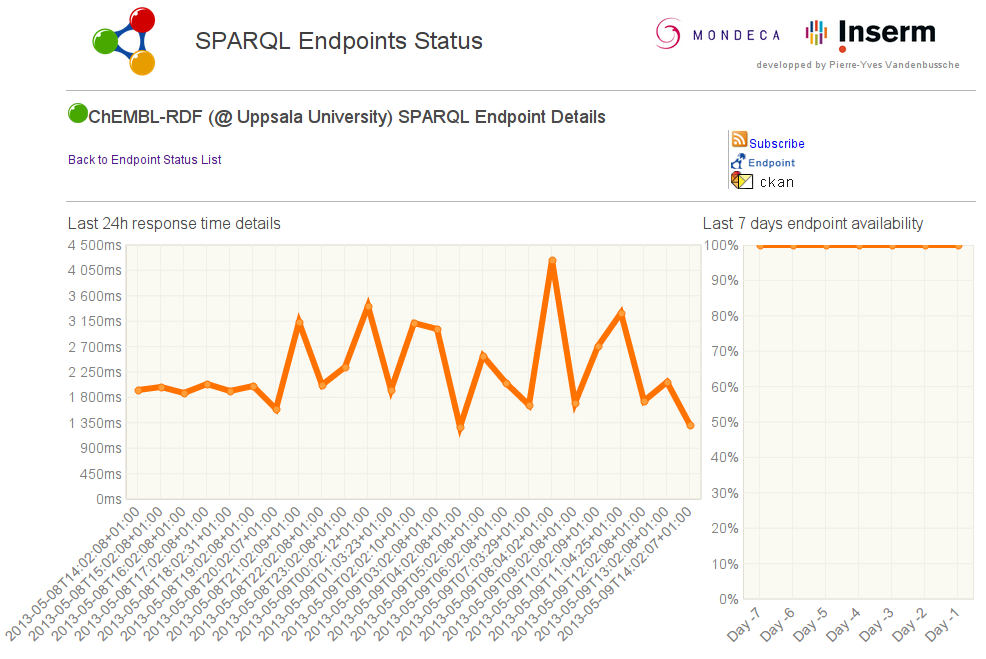
which supports a nearest neighbor search in ChEMBL using <a href="http://chemspider.com/">ChemSpider</a>. Of course, Ola also hosts
<a href="http://rdf.farmbio.uu.se/chembl/snorql/">the SPARQL end point</a> of which you can monitor the uptime at the also cool
<a href="http://labs.mondeca.com/sparqlEndpointsStatus/details/farmbio-chembl.html">mondeca.com service</a>:</p>

<p><img src="/assets/images/mondecaUptime.png" alt="" /></p>

<p>(Yes, I think I have all the cool buzzwords covered in this paper. Sadly, marketing is needed nowadays as a scientist. Where is the
time that you could rant on page after page in all your domain specific jargon, not having to worry if your reader would understand
it immediately, or without a university degree…)</p>

<p>What this paper does not describe, is all the things I did with ChEMBL-RDF in the <a href="http://www.openphacts.org/">Open PHACTS</a> project
(<a href="https://twitter.com/open_phacts">@Open_PHACTS</a>), which includes the use of <a href="http://qudt.org/">QUDT</a> and the
<a href="https://github.com/egonw/jqudt">jQUDT</a> library for unit normalization outlined in <a href="http://www.bigcat.unimaas.nl/~egonw/units/">this document</a>
and the use of VoID for link sets as described in <a href="http://www.openphacts.org/specs/2012/WD-datadesc-20121019/">this document</a>.</p>]]></content><author><name>Egon Willighagen</name></author><category term="chembl" /><category term="rdf" /><category term="cito" /><category term="cheminf" /><category term="doi:10.1186/1758-2946-5-23" /><category term="doi:10.1186/1758-2946-3-15" /><category term="ontology" /><category term="doi:10.1371/JOURNAL.PONE.0025513" /><category term="justdoi:10.1186/2041-1480-1-S1-S6" /><category term="chemspider" /><category term="openphacts" /><summary type="html"><![CDATA[]]></summary><media:thumbnail xmlns:media="http://search.yahoo.com/mrss/" url="https://chem-bla-ics.linkedchemistry.info/assets/images/mondecaUptime.png" /><media:content medium="image" url="https://chem-bla-ics.linkedchemistry.info/assets/images/mondecaUptime.png" xmlns:media="http://search.yahoo.com/mrss/" /></entry></feed>