<?xml version="1.0" encoding="utf-8"?><feed xmlns="http://www.w3.org/2005/Atom" ><generator uri="https://jekyllrb.com/" version="4.3.4">Jekyll</generator><link href="https://chem-bla-ics.linkedchemistry.info/feed/by_tag/odosos.xml" rel="self" type="application/atom+xml" /><link href="https://chem-bla-ics.linkedchemistry.info/" rel="alternate" type="text/html" /><updated>2026-11-18T10:37:59+00:00</updated><id>https://chem-bla-ics.linkedchemistry.info/feed/by_tag/odosos.xml</id><title type="html">chem-bla-ics</title><subtitle>Chemblaics (pronounced chem-bla-ics) is the science that uses open science and computers to solve problems in chemistry, biochemistry and related fields.</subtitle><author><name>Egon Willighagen</name></author><entry><title type="html">My talk at Imperial College</title><link href="https://chem-bla-ics.linkedchemistry.info/2010/12/14/my-talk-at-imperial-college.html" rel="alternate" type="text/html" title="My talk at Imperial College" /><published>2010-12-14T00:00:00+00:00</published><updated>2010-12-14T00:00:00+00:00</updated><id>https://chem-bla-ics.linkedchemistry.info/2010/12/14/my-talk-at-imperial-college</id><content type="html" xml:base="https://chem-bla-ics.linkedchemistry.info/2010/12/14/my-talk-at-imperial-college.html"><![CDATA[<p>Yesterday I was guest with <a href="http://www1.imperial.ac.uk/medicine/people/j.fonville07/">Judy</a>
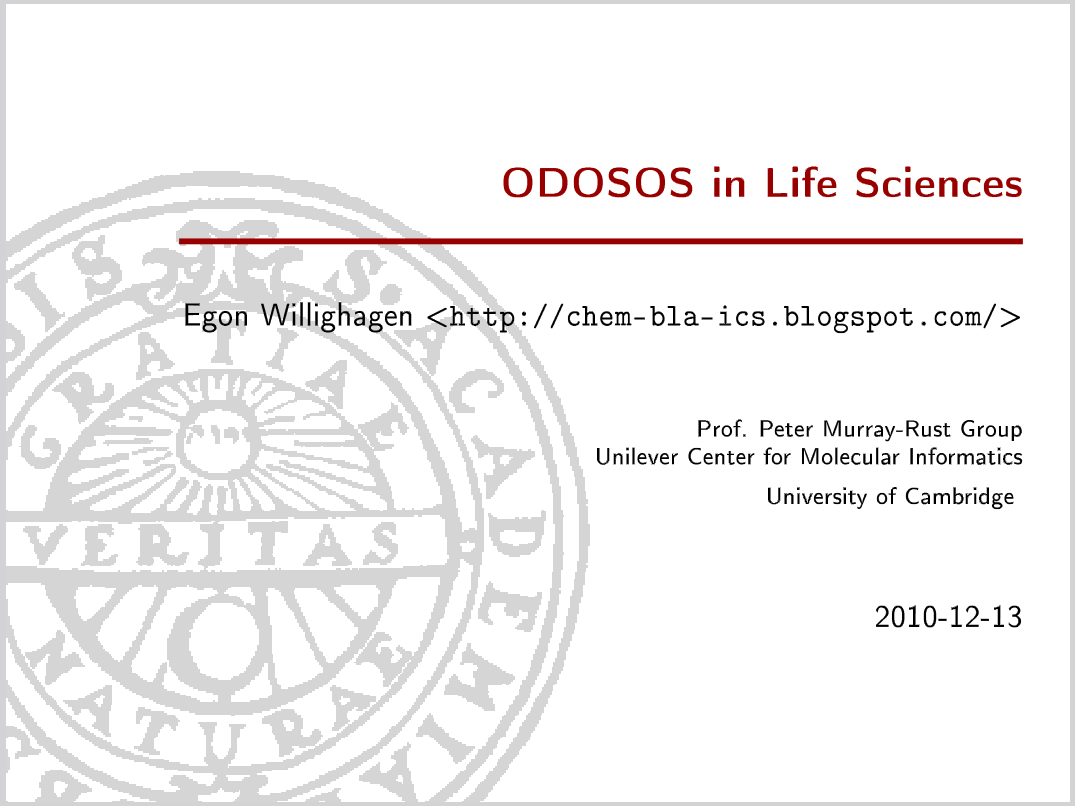
at the <a href="http://www1.imperial.ac.uk/surgeryandcancer/">Department of Surgery &amp; Cancer</a>
at <a href="http://www1.imperial.ac.uk/">Imperial College</a>, where I presented the what
I am working on. As I met up in a pub with Ron (my former PhD supervisor, who
now works on metabolomics at the <a href="http://www.iasma.it/">Istituto Agrario San Michele all’Adige</a>
in Italy) the night before, the presentation does share many slides from previous
talks, but also adds a few new ones.</p>

<p><a href="https://doi.org/10.5281/zenodo.3597909"><img src="/assets/images/odosos_imperial2010.png" alt="" /></a></p>

<p>It was great talking to Judy about her PhD research on NMR in metabolomics,
and <a href="http://www1.imperial.ac.uk/medicine/people/t.ebbels/">Tim</a> about further
work in this research. I was interesting to learn that here too they have problems
in metabolite identification quick like those when analyzing *C/MS data, and
was really happy to hear he is in contact with <a href="http://www.steinbeck-molecular.de/steinblog/">Christoph</a>
about an Open repository for metabolomics data.</p>

<p>Another ‘new’ slide was one advertising the yesterday launched <a href="http://www.openresearchcomputation.com/">Open Research
Computation</a> which I’ll blog about
in more detail later today.</p>]]></content><author><name>Egon Willighagen</name></author><category term="chemometrics" /><category term="drugdiscovery" /><category term="metabolomics" /><category term="odosos" /><category term="toxicology" /><category term="doi:10.5281/ZENODO.3597909" /><summary type="html"><![CDATA[Yesterday I was guest with Judy at the Department of Surgery &amp; Cancer at Imperial College, where I presented the what I am working on. As I met up in a pub with Ron (my former PhD supervisor, who now works on metabolomics at the Istituto Agrario San Michele all’Adige in Italy) the night before, the presentation does share many slides from previous talks, but also adds a few new ones.]]></summary><media:thumbnail xmlns:media="http://search.yahoo.com/mrss/" url="https://chem-bla-ics.linkedchemistry.info/assets/images/odosos_imperial2010.png" /><media:content medium="image" url="https://chem-bla-ics.linkedchemistry.info/assets/images/odosos_imperial2010.png" xmlns:media="http://search.yahoo.com/mrss/" /></entry><entry><title type="html">Trust has no place in science #2</title><link href="https://chem-bla-ics.linkedchemistry.info/2010/12/10/trust-has-no-place-in-science-2.html" rel="alternate" type="text/html" title="Trust has no place in science #2" /><published>2010-12-10T00:00:00+00:00</published><updated>2010-12-10T00:00:00+00:00</updated><id>https://chem-bla-ics.linkedchemistry.info/2010/12/10/trust-has-no-place-in-science-2</id><content type="html" xml:base="https://chem-bla-ics.linkedchemistry.info/2010/12/10/trust-has-no-place-in-science-2.html"><![CDATA[<p>Thanks to all who replied and shared their views. Particular thanx to <a href="http://scientopia.org/blogs/christinaslisrant/">Christina</a>
who replied in <a href="http://scientopia.org/blogs/christinaslisrant/2010/12/06/the-role-of-trust-in-science/">her blog</a>.
With <a href="https://chem-bla-ics.linkedchemistry.info/2010/12/06/trust-has-no-place-in-science.html?showComment=1291834410259#c629729480067400710">Saml <i class="fa-solid fa-recycle fa-xs"></i></a>,
and <a href="http://friendfeed.com/cpikas/ed2c2155/new-post-role-of-trust-in-science">Cameron and Bill</a>
they think this is about semantics. Linguistic tricks. I hope not; this is too
serious to get away with such. “Reliable, trustworthy, assumptions”: it’s all
working around the real issue. Similarly, splitting up ‘trust’ into ‘blind trust’
and ‘smart trust’ is just working around the real problem.</p>

<p>Indeed, my point is different. The key of science is to replace trust by facts.
Or, when talking about database, software, research papers in Nature, it is
replacing trust with <em>traceability</em>. Actually, we seem to have lost a long-standing
tradition of citing previous work when we write down the arguments we base our
argumentation on. Facts are backed up with references, providing the required
traceability.</p>

<p>Now, compare that to current electronic sciences. We ‘trust’ our database to
have done something sane. Well, don’t. They made an attempt, but made errors.
As they say with software, having zero bugs just means you have not found them
yet.</p>

<p>The real point with ‘trust’ is, is that it is completely irrelevant. It adds
zero to the scholarly discussion. Whether you trust the highly curated <a href="https://www.ebi.ac.uk/chembl/">ChEMBL
database</a> or not, it has errors. (<a href="http://baoilleach.blogspot.com/">Noel</a>
pointed out <a href="http://baoilleach.blogspot.com/2010/12/name-that-stereochemistry-when-mol.html">one source of ambiguity in the ChEMBL database</a>
this week). What does matter, instead, is if those errors are significant. Do
they affect the conclusions I draw when I use this data. That is what actually
matter. <strong>Trust has no place in science</strong>. Error has.</p>

<p>Sadly, this is basically the hypothesis of the VR grant I wrote up but <a href="https://chem-bla-ics.linkedchemistry.info/2010/11/22/more-fails-aka-no-vr-grant-awarded.html">did
not get awarded <i class="fa-solid fa-recycle fa-xs"></i></a>.
But I trust I do better next time.</p>

<p>Why this matters? Well, this is what <a href="http://www.acronymattic.com/ODOSOS.html">ODOSOS</a>
is about: bring back the traceability into science, and get rid of <em>trust</em>.</p>]]></content><author><name>Egon Willighagen</name></author><category term="chemistry" /><category term="odosos" /><category term="science" /><summary type="html"><![CDATA[Thanks to all who replied and shared their views. Particular thanx to Christina who replied in her blog. With Saml , and Cameron and Bill they think this is about semantics. Linguistic tricks. I hope not; this is too serious to get away with such. “Reliable, trustworthy, assumptions”: it’s all working around the real issue. Similarly, splitting up ‘trust’ into ‘blind trust’ and ‘smart trust’ is just working around the real problem.]]></summary></entry><entry><title type="html">Why you have not heard me much about chemometrics recently…</title><link href="https://chem-bla-ics.linkedchemistry.info/2010/11/20/why-you-have-not-heard-me-much-about.html" rel="alternate" type="text/html" title="Why you have not heard me much about chemometrics recently…" /><published>2010-11-20T00:00:00+00:00</published><updated>2010-11-20T00:00:00+00:00</updated><id>https://chem-bla-ics.linkedchemistry.info/2010/11/20/why-you-have-not-heard-me-much-about</id><content type="html" xml:base="https://chem-bla-ics.linkedchemistry.info/2010/11/20/why-you-have-not-heard-me-much-about.html"><![CDATA[<p>A casual reader my not know the background of the title of my blog. A bit over
five years ago, when I started this blog, <a href="https://chem-bla-ics.linkedchemistry.info/2005/10/15/chem-bla-ics.html">I defined chemblaics <i class="fa-solid fa-recycle fa-xs"></i></a>:</p>

<blockquote>
  <p>Chemblaics (pronounced chem-bla-ics) is the science that uses computers to address and possibly
solve problems in the area of chemistry, biochemistry and related fields. The general denomiter
seems to be molecules, but I might be wrong there. The big difference between chemblaics and
areas as cheminformatics, chemoinformatics, chemometrics, proteochemometrics, etc, is that
chemblaic only uses open source software, making experimental results reproducable and validatable.
And this is a big difference with how research in these areas is now often done.</p>
</blockquote>

<p>Later, I also identified <em>molecular chemometrics</em> (doi:<a href="http://dx.doi.org/10.1080/10408340600969601">10.1080/10408340600969601</a>)
when I reviewed important innovation in the field, which has, IMHO, a strong
overlap with chemblaics. Any reader of my blog will understand that I see semantic
technologies play a very important role here, as Open Standard for communication
Open Data between the bench chemist and the data analyst using Open Source allowing
others to reproduce, validate, and extend that work. Some have identified the
possibilities the internet brings over 10 years ago, while the use of semantic
computing goes back even further.</p>

<p>And what have the big publishers done? Nothing much yet. Not the old, not the
new. There are project ongoing, and there is a tendency (BioMed Central starts
delivering Open Data, Beilstein Institute spits RDF for a few years now, Royal
Society of Chemistry has Project Prospect), but most publishers are too late,
and not investing enough with respect to their yearly turn over. This is particularly
clear if you realize that <em>citizen and hobby scientists</em> can innovate publishing
more effectively than those projects (really!). Anyway, I do not want to talk
about publishing now, but it is just so relevant: I am not a publisher, but
publications are the primary source of knowledge (not implying at all that I
think that is the best way; it is not).</p>

<p>Instead, I am a data analyst, a chemometrician, a statistician, a cheminformatics
dude, or a (pharmaceutical) bioinformatician, depending on your field of expertise.
Really, I am a chemblaics guy: I apply and develop informatics and statistics
methods to understand chemistry (and biology) better.</p>

<p>During my PhD it became painfully clear that current science is horribly failing,
in many ways:</p>

<ul>
  <li>Firstly, we are hiring the wrong people because we care more about a co-authored
pipetting paper in Nature, than ground-breaking work in the J. Chem. Inf.
Mod. (what journal?! Exactly my point!).</li>
  <li>Secondly, we have our most bright scientists (the full time professors, assuming
that some have been hired for the right reasons) spend most of their time
on administrative work (like proposal writing, administrating big national/EU
projects).</li>
  <li>Thirdly, we spent million (in whatever currency) on large projects which end
in useless political discussions instead of getting science done.</li>
  <li>Finally, all knowledge from laborious, hard work is placed in PDF hamburgers
and lost to society (unless you spend multibucks to extract it again).</li>
</ul>

<p>There are likely several more, but these three are the most important to me
right now.</p>

<p>So, in the past years after finishing my PhD research which was on data mining
and modeling molecular data, I have spend much of my time on improving methods
in chem- and bioinformatics to handle. Hardly anyone else was doing it (several
Blue Obelisk community un-members as prominent exceptions), but someone has.</p>

<p>Why I have been doing this? Well, without good, curated data sources it is impossible
to decide why my (or others) predictive models are not working (as good as we
want them to be). Is this relevant? I would say so, yes! The field is riddled
with irreproducible studies of which one has no clue how useful they are. Trust
the authors who wrote the paper? No, thank you, but I rather verify: I am a
scientist and not a cleric. Weirdly, one would have expected this to be the
default in cheminformatics, where most stuff is electronic and reproducing results
should be cheap. Well, another fail for science, I guess.</p>

<p>So, that explains why I have not recently done so much in chemometrics. Will
I return? Surely! Right about now. There is already a paper <em>in press</em> where
we link the semantic web to (proteo)chemometrics, and more is to follow soon.</p>

<p>One example, interestingly, is pKa prediction, which has seen quite a few publications
recently, yet experimental pKa data is not available as Open Data. Why?? Let
me know if you have any clue. Yet, pKa prediction seems to be important to drug
discovery, as it gets an awful lot of attention (400+ papers in the past 10
year, of which 50+ in 2010!). But this is about to change. Samuel and I are
finishing a project that greatly simplifies knowledge aggregation and curation,
as input to statistical modeling. We now have the tools ready to do this fast
and efficiently. Right now, I am entering curated data at a speed of about 3
chemical structures a minute. That means, given I need a break now and then,
that I enter create a data set of reasonable size in a few days. Crowd-sourcing
this, the a small community can liberate data from literature in a few days.</p>

<p>This will have a huge impact on the cheminformatics and QSAR communities. They
will no longer have any excuse for making their data not available. There is
no argument anymore that curation is expensive. This will also have a huge impact
on cheminformatics and chemical data vendors. Where Open Source only had moderate
impact so far (several software vendors have already joined the Open Source
cheminformatics community), this will force them to rethink their business model.
Where they could hide behind curation where it came to text mining initiatives
(like Oscar, on which I am currently working), with cheap, expert curation knowledge
building at hand, they will be forced to rethink their added value.</p>

<p>The impact on the CDK should be clear too. We no longer depend on published
models for ALogP, XLogP, pKa, etc, predictions. Within a year, you can expect
the CDK project to release the tools to train your own models, and make choices
suitable for your user base. For example, you can make more precise models around
the structures your lab works on, or more generic models with large screening
projects. Importantly, the community will provide an Open Data knowledge base
to start from. Using our Open Standards, you can plug in your own confidential
data and make mixed, targeted models.</p>

<p>Is this possible with the cheminformatics of the past 30 years? No, and that’s
the reason why I have been away from chemometrics for a while.</p>]]></content><author><name>Egon Willighagen</name></author><category term="cheminf" /><category term="chemometrics" /><category term="odosos" /><category term="opendata" /><category term="qsar" /><category term="doi:10.1080/10408340600969601" /><summary type="html"><![CDATA[A casual reader my not know the background of the title of my blog. A bit over five years ago, when I started this blog, I defined chemblaics :]]></summary></entry><entry><title type="html">Warren DeLano and the future of PyMOL</title><link href="https://chem-bla-ics.linkedchemistry.info/2010/01/15/warren-delano-and-future-of-pymol.html" rel="alternate" type="text/html" title="Warren DeLano and the future of PyMOL" /><published>2010-01-15T00:00:00+00:00</published><updated>2010-01-15T00:00:00+00:00</updated><id>https://chem-bla-ics.linkedchemistry.info/2010/01/15/warren-delano-and-future-of-pymol</id><content type="html" xml:base="https://chem-bla-ics.linkedchemistry.info/2010/01/15/warren-delano-and-future-of-pymol.html"><![CDATA[<p>This blog is old and new news. The old news is that <a href="http://warrendelano.blogspot.com/2009/11/warren-delano-passes-away.html">Warren passed away</a> at the
end of last year, after having successfully shown how OpenSource cheminformatics (and/or bioinformatics) software can be developed in a commercial setting
(<a href="http://delanoscientific.com/">DeLano Scientific</a>), and <a href="http://pymol.org/">PyMol</a> was a huge success. Warren had a SourceForge account
(<a href="http://sourceforge.net/users/wdelano">wdelano</a>) for almost 10 years:</p>

<p><img src="/assets/images/pymol1.png" alt="" /></p>

<p>I had not blogged about it before as the news hit me hard. Surely, Warren knew a lot of people and I only was only one of many, but Warren’s memory sticked well.
I know Warren from the <a href="http://www.jmol.org/">Jmol</a> project, where we talked in the past of coming to an Open Specification for exchanging scenes between
Jmol and PyMol. Around the end of my PhD contract we even briefly, but seriously, explored doing a post-doc in his group.</p>

<p>Anyway, lot’s of people wrote up blogs (in arbitrary order: <a href="https://doi.org/10.59350/rj9fv-7mf71">Rich <i class="fa-solid fa-recycle fa-xs"></i></a>,
<a href="http://www.p212121.com/2009/11/05/passing-of-warren-delano/">P212121</a>, <a href="http://www.macresearch.org/memoriam-warren-l-delano">MacResearch</a>,
<a href="http://miningdrugs.blogspot.com/2009/11/warren-delano-in-memoriam.html">Jörg</a>, <a href="http://rosettadesigngroup.com/blog/464/reports-of-warren-delano-passing-away-terrible-tragedy-if-true/">MMB</a>,
<a href="http://shirleywho.wordpress.com/2009/11/07/in-memoriam-warren-delano/">Shirley</a>, <a href="http://pipeline.corante.com/archives/2009/11/17/warren_delano.php">Derek</a>,
<a href="http://wavefunction.fieldofscience.com/2009/11/warren-delano.html">Wavefunction</a>, <a href="http://www.openscience.org/blog/?p=300">Dan</a>,
<a href="http://barryhardy.blogs.com/cheminfostream/2009/11/warren-delano-rip.html">Barry</a>, and probably many more).
They have set up a memorial fund which will focus on promoting the Open Source ideas of Warren, including
an <a href="http://www.wldmemorialfund.org/WLDMemorialFund/Warren_L._DeLano_Memorial_Fund.html">Award</a>.</p>

<h2 id="schrödinger">Schrödinger</h2>
<p>Yesterday, I was <a href="http://rosettadesigngroup.com/blog/545/pymol-schrodinger/">pinged</a> about
<a href="http://www.schrodinger.com/news/47/">Schrödinger acquiring PyMol</a>. The press release is, as usual, short on details, but those have
become clearer during the day. Schrödinger is not new to Open Source cheminformatics, and has an
<a href="http://www.schrodinger.com/products/14/8/">product based on KNIME</a>, which is now GPL, but also has a proprietary license
for those who wish to license so.</p>

<p>But, unless I missed any other Open Source (-oriented) product, the acquisition of PyMol significantly changes the game for them:
PyMol is a major Open Source product, bigger than KNIME at the moment, I’d guess. My immediate response to the acquisition is whether
they acquired copyrights, and they did, according to <a href="http://pymol.svn.sf.net/viewvc/pymol/branches/b099/pymol/layer0/Base.h?r1=3886&amp;r2=3885&amp;pathrev=3886">this commit</a>:</p>

<p><img src="/assets/images/pymol2.png" alt="" /></p>

<p>This is important as it puts Schrödinger in charge of license changes. Fortunately, they seem rather serious about the Open Source thing, and
hired an active PyMol developer (Jason), and kept the existing Open Source license:</p>

<p><img src="/assets/images/pymol.png" alt="" /></p>

<p>Therefore, congratulations to Schrödinger for getting seriously into the Open Source community, making them the next
<a href="http://wwmm.ch.cam.ac.uk/blogs/murrayrust/?p=2059">Dr Who of PyMol</a>, and
congratulations to the family of Warren in ensuring continued development of the PyMol project! It’s hearth-warming to see that despite
the bad times they are going through, and all they options they had with the PyMol code base, they find time for and strength in
supporting Warren’s ideas about the future of cheminformatics. My thoughts are with them!</p>]]></content><author><name>Egon Willighagen</name></author><category term="odosos" /><category term="chemistry" /><category term="justdoi:10.59350/rj9fv-7mf71" /><summary type="html"><![CDATA[This blog is old and new news. The old news is that Warren passed away at the end of last year, after having successfully shown how OpenSource cheminformatics (and/or bioinformatics) software can be developed in a commercial setting (DeLano Scientific), and PyMol was a huge success. Warren had a SourceForge account (wdelano) for almost 10 years:]]></summary><media:thumbnail xmlns:media="http://search.yahoo.com/mrss/" url="https://chem-bla-ics.linkedchemistry.info/assets/images/pymol2.png" /><media:content medium="image" url="https://chem-bla-ics.linkedchemistry.info/assets/images/pymol2.png" xmlns:media="http://search.yahoo.com/mrss/" /></entry><entry><title type="html">“Open Knowledge: Reproducibility in Cheminformatics with Open Data, Open Source and Open Standards”</title><link href="https://chem-bla-ics.linkedchemistry.info/2009/04/08/open-knowledge-reproducibility-in.html" rel="alternate" type="text/html" title="“Open Knowledge: Reproducibility in Cheminformatics with Open Data, Open Source and Open Standards”" /><published>2009-04-08T00:00:00+00:00</published><updated>2009-04-08T00:00:00+00:00</updated><id>https://chem-bla-ics.linkedchemistry.info/2009/04/08/open-knowledge-reproducibility-in</id><content type="html" xml:base="https://chem-bla-ics.linkedchemistry.info/2009/04/08/open-knowledge-reproducibility-in.html"><![CDATA[<p>I have submitted today the abstract of my talk at the <a href="http://www.gdch.de/vas/tagungen/tg/5580/wissprog/symp.htm">GDCh-Wissenschaftsforum Chemie 2009</a>
<a href="http://www.dopplr.com/trip/egonw/523957">in Frankfurt in August</a> as part of the Open Notebook Science/Open Drug Discovery session:</p>

<blockquote>
  <p>“Open Knowledge: Reproducibility in Cheminformatics with Open Data,
Open Source and Open Standards”</p>

  <p>Abstract:
The Open paradigms in science have been met with strong criticism.
Nevertheless, support and use of Open models among scientists is
growing. While the Open model is certainly only one approach to doing
science, it has a few aspects that make propagation of knowledge more
transparent. Indeed, Open Data, Open Source and Open Standards
(ODOSOS) make it easier to reproduce of knowledge and promote peer
review. Various ODOSOS projects will be introduced which improve
reproducibility in cheminformatics, the underlying science of
exchanging chemical knowledge. Recent contributions of the Chemistry
Development Kit, Bioclipse, chemical ontologies and others will be
discussed that add to the repertoire of Open Cheminformatics, and how
these contribute to Open Knowledge.</p>
</blockquote>

<p>The exact details I do not know yet, and likely not before the weekend before the meeting :) But this blog gives a good impression of what you can expect.</p>]]></content><author><name>Egon Willighagen</name></author><category term="odosos" /><category term="cdk" /><category term="chemistry" /><summary type="html"><![CDATA[I have submitted today the abstract of my talk at the GDCh-Wissenschaftsforum Chemie 2009 in Frankfurt in August as part of the Open Notebook Science/Open Drug Discovery session:]]></summary></entry><entry><title type="html">Open Data versus Capatalism?</title><link href="https://chem-bla-ics.linkedchemistry.info/2009/03/03/open-data-versus-capatalism.html" rel="alternate" type="text/html" title="Open Data versus Capatalism?" /><published>2009-03-03T00:00:00+00:00</published><updated>2009-03-03T00:00:00+00:00</updated><id>https://chem-bla-ics.linkedchemistry.info/2009/03/03/open-data-versus-capatalism</id><content type="html" xml:base="https://chem-bla-ics.linkedchemistry.info/2009/03/03/open-data-versus-capatalism.html"><![CDATA[<p><a href="http://iandavis.com/blog/">Ian Davis</a> was recently <a href="http://mndoci.tumblr.com/post/82535784/open-data-is-more-important-than-open-source">quoted</a> saying
<em>open data is more important than open source</em>, which was pulled (out of context) from <a href="http://www.slideshare.net/iandavis/code4lib2009-keynote-1073812">this presentation</a>.
The context was (a slide earlier): <em>Data outlasts code</em>.</p>

<p>As far as I can see, this is <strong>utter nonsense</strong>, even within context of the slide (see also this
<a href="http://friendfeed.com/e/4a8c5012-ee18-2b72-390a-ca3298b3a57c/open-data-is-more-important-than-open/">discussion on FriendFeed</a>). Obviously, within the context of
<em>Ian</em> it does makes sense, and I hope he will respond in his blog and explain why he thinks Open Data is more special.</p>

<p>Without code, you have no way of accessing the data. Ask anyone to recover from a hard disk failure. In
<a href="http://blueobelisk.sourceforge.net/wiki/ODOSOS">ODOSOS</a> (Open Standards, Open Data, Open Source) they are all equal. You need them all for progress.
You cannot single out one as being more important than another. Why would you anyway? Politics is all I can think of… All three combine and ensure
our science is more efficient.</p>

<p><a href="http://www.abhishek-tiwari.com/">Fishy Perspective</a> (what’s in a name) comments on this in <a href="http://www.abhishek-tiwari.com/2009/03/data-vendetta.html">Data Vendetta</a>,
and I will take one quote out of context:</p>

<blockquote>
  <p>Organizations are spending lot of money do generate proprietary data to safeguard its competitive edge, why you are convinced that
they need to disclose that, no one is here for charity. Most the companies have their proprietary data policies, and they release
the data in public only when there is sufficient overlap from publicly available databases.</p>
</blockquote>

<h2 id="open-data-versus-capitalism">Open Data versus Capitalism?</h2>

<p>Companies are about money making, and there is nothing wrong with that. Others to work to make the world a better place.</p>

<p>If Rosalind had not shared her data (following <em>Data Vendetta</em>, and not going into whether she did willingly or knowingly), all current
pharmaceutical research would have been delayed by half a year(?), more(?)… who knows. Even that half year would have meant quite a lot
of death people. A lot of medicine would have not been discovered or hit the market at the same time. Capitalism is one thing, not good,
not bad, orthogonal really. <strong>Capitalism as ideology does not contradict Open Data</strong>. But sharing knowledge as Open Data always has a positive
effect on mankind.</p>

<p>If you want to make money, please do, as much as you can. But please pick carefully what you want to make money on. Be creative!
Do some innovation! Be bold! Go where no one has gone before!</p>]]></content><author><name>Egon Willighagen</name></author><category term="opendata" /><category term="openscience" /><category term="odosos" /><summary type="html"><![CDATA[Ian Davis was recently quoted saying open data is more important than open source, which was pulled (out of context) from this presentation. The context was (a slide earlier): Data outlasts code.]]></summary></entry><entry><title type="html">Re: Open Source != peer review</title><link href="https://chem-bla-ics.linkedchemistry.info/2008/11/12/re-open-source-peer-review.html" rel="alternate" type="text/html" title="Re: Open Source != peer review" /><published>2008-11-12T00:00:00+00:00</published><updated>2008-11-12T00:00:00+00:00</updated><id>https://chem-bla-ics.linkedchemistry.info/2008/11/12/re-open-source-peer-review</id><content type="html" xml:base="https://chem-bla-ics.linkedchemistry.info/2008/11/12/re-open-source-peer-review.html"><![CDATA[<p>Andrew has an <a href="http://dalkescientific.com/writings/diary/archive/2008/11/11/open_source_is_not_peer_review.html">interesting thread</a>
on the content of a slide of a recent presentation. In the comments you can read the back and forth on things; indeed, there are very many
aspects to things and he did ask a very complex question, of which he assumed that I understood what he was asking, and I indeed assumed
too that I understood what he was asking:</p>

<blockquote>
  <p>Some argue that doing good computational-based science requires open source. The argument is that scientists need to review the source
code in order to verify that it works correctly. How, they argue, can you review someone else’s paper if you can’t review the source code
used to make that paper?</p>

  <p>I like open source. (My talk goes into the philosophical differences between “open source” and “free software.”) I think there should be
support for peer review. But I don’t understand why the ability to see the source code, in order to review it for scientific quality,
requires the right to redistribute the source code to others.</p>
</blockquote>

<p>So, I <em>assumed</em> he was interested in hearing why people thing open source benefits open source. Misinterpreting the last two words, I
though access to the code and the ability to redistribute code I find bad in my peer review. There was another incorrect assumption on my
side: I had open peer review in mind, as I like so much about open source projects, instead of the peer review as in paper peer review,
prior to the preprint server age. Another thing I understood incorrectly, was that he was only referring to computational packages, not
cheminformatics in general. My mistake. Being from a GCC meeting, I assumed the latter.</p>

<p>Therefore, a lot of miscommunication. I agree to a large extend with Andrews analysis: peer review is certainly possible without Open
Source. Actually, this matches closely with the discussion between Cathedral versus Bazaar opensource projects (see
<a href="https://chem-bla-ics.linkedchemistry.info/2008/11/07/opendatasourcestandards-is-not-enough.html">my post earlier this week <i class="fa-solid fa-recycle fa-xs"></i></a>).
He argues that current opensource (cheminformatics) do not have enough eyeballs, and indicates that money buys eyeballs. Indeed it does.</p>

<p>However, the original argument I wanted to make, but failed, is that Open Source (any kind of access to the source code) is a strict
requirement for reviewing the implementation. We do not want black boxes.</p>

<p>How you organize this access to the source code is another thing, and topic of much of the discussion in Andrews blog. There are many
solutions, but all include some sort of access to the source code. Redistribution is not a requirement, though, if the review is only
send upstream, as is common in reviewing papers.</p>

<p>I feel that Open Source is a solution worth fighting for, but I do understand the argument that funding of this approach remains to be a
problem. Open Source cheminformatics is the equivalent of a preprint server; one solution to peer review, a good one, I think, not the
only one. The parallels are seemingly even stronger: you cannot review a paper by just reading the abstract and the conclusion: a paper
is not a black box either.</p>

<p>Anyway… just a tip of the iceberg touched in the discussion. Feel free to join in.</p>]]></content><author><name>Egon Willighagen</name></author><category term="odosos" /><category term="opensource" /><category term="cheminf" /><summary type="html"><![CDATA[Andrew has an interesting thread on the content of a slide of a recent presentation. In the comments you can read the back and forth on things; indeed, there are very many aspects to things and he did ask a very complex question, of which he assumed that I understood what he was asking, and I indeed assumed too that I understood what he was asking:]]></summary></entry><entry><title type="html">Open{Data|Source|Standards} is not enough: we need Open Projects</title><link href="https://chem-bla-ics.linkedchemistry.info/2008/11/07/opendatasourcestandards-is-not-enough.html" rel="alternate" type="text/html" title="Open{Data|Source|Standards} is not enough: we need Open Projects" /><published>2008-11-07T00:00:00+00:00</published><updated>2008-11-07T00:00:00+00:00</updated><id>https://chem-bla-ics.linkedchemistry.info/2008/11/07/opendatasourcestandards-is-not-enough</id><content type="html" xml:base="https://chem-bla-ics.linkedchemistry.info/2008/11/07/opendatasourcestandards-is-not-enough.html"><![CDATA[<p>The <a href="http://blueobelisk.sourceforge.net/wiki/Main_Page">Blue Obelisk</a> mantra <a href="http://blueobelisk.sourceforge.net/wiki/ODOSOS">ODOSOS</a>,
Open Data, Open Source, Open Standards, is well known, and much cited too. <a href="http://usefulchem.blogspot.com/">Jean-Claude Bradley</a>
popularized the <a href="http://en.wikipedia.org/wiki/Open_Notebook_Science">Open Notebook Science</a> (ONS). This has always been nagging me a bit,
because the <a href="http://cdk.sf.net/">CDK</a>, <a href="http://www.jmol.org/">Jmol</a>, JChemPaint and other chemistry projects have done that for much
longer, though we did not use notebooks as much, so called it just an open source project. It really is no different, IMO, though
surely, there are differences.</p>

<p>Anyway, the key thing which ONS and CDK and Jmol share, is that they use an Open Notebook. Not every Open Source or Open Data project does.
Actually, many scientific Open Source are not open Projects! They are more like the Cathedral than the wished-for Bazaar (see
<a href="http://en.wikipedia.org/wiki/The_Cathedral_and_the_Bazaar">The Cathedral and the Bazaar</a>). So, Open Source (science) projects are certainly not ONS projects by default!</p>

<p>Now, the CDK actually is ONS, it is a Bazaar. The notebooks we use include:</p>

<ul>
  <li>open project via <a href="https://sourceforge.net/mail/?group_id=20024">mailing lists</a></li>
  <li>open methods/results via <a href="https://sourceforge.net/svn/?group_id=20024">subversion</a></li>
  <li>informal reporting via blogs (e.g. <a href="http://rguha.wordpress.com/">Rajarshi</a>, <a href="http://www.steinbeck-molecular.de/steinblog/">Christoph</a>, <a href="http://cdktaverna.wordpress.com/">Thomas</a>, mine)</li>
  <li>informal reporting via <a href="http://www.cdknews.org/">CDK News</a></li>
</ul>

<p>What more would you wish for? That’s not a rhetorical question. Remember that every reader of this blog is in
<a href="https://chem-bla-ics.linkedchemistry.info/2007/11/27/be-in-my-advisory-board-1-being-good.html">my advisory board <i class="fa-solid fa-recycle fa-xs"></i></a>!</p>

<p>Unfortunately, I do not create work at a workbench myself, so I do not produce new knowledge myself, other than extracted from existing
data. That’s really a shame, and I really do hope that Jean-Claude or <a href="http://blog.openwetware.org/scienceintheopen">Cameron</a> will send
me a box to measure solubilities (see <a href="http://usefulchem.blogspot.com/2008/10/rdf-triples-for-open-notebook-science.html">here</a>,
<a href="http://usefulchem.blogspot.com/2008/11/ons-solubility-web-query.html">here</a>, and
<a href="http://anybody.cephb.fr/perso/lindenb/tmp/jcbradley.rdf">here</a>,
<a href="http://rguha.wordpress.com/2008/11/06/solubility-queries-and-the-google-visualization-api/">here</a> for first data exploration),
even though I cannot participate in the <a href="http://usefulchem.blogspot.com/2008/11/submeta-open-notebook-science-awards.html">challenge</a>.
(hint, hint :)</p>

<h2 id="from-cathedral-to-bazaar-in-life-sciences">From Cathedral to Bazaar in Life Sciences</h2>

<p>One Cathedral we ran into with <a href="http://www.bioclipse.net/">Bioclipse</a> was <a href="http://www.biocatalogue.org/">BioCatalogue</a>,
which will serve as website where people can annotate and categorize (web) services. While the project has been around for a while, the
website was rather uninformative. Fortunately, the projects is going to open up, and be more Bazaar-like. For example, they
now started a <a href="http://www.biocatalogue.org/wiki">wiki</a> and a
<a href="http://listserv.manchester.ac.uk/cgi-bin/wa?SUBED1=biocatalogue-friends&amp;A=1">mailing list</a>. I hope these efforts will continue,
so that I can contribute from my point of view!</p>

<p>The <a href="http://embraceregistry.net/">EMBRACE Registry</a> is a project with similar goals and a rather nice outcome (which I learned about on
<a href="https://chem-bla-ics.linkedchemistry.info/2008/11/03/embrace-workshop-in-uppsala.html">Monday <i class="fa-solid fa-recycle fa-xs"></i></a>). It is actually anticipate to be replaced by or merge
with BioCatalogue. So, all data I entered, <a href="http://prints.cs.man.ac.uk:8081/category/tags/cheminformatics">cheminformatics workflows</a>
(look, <a href="https://chem-bla-ics.linkedchemistry.info/2008/10/18/chemoinformatics-p0wned-by.html">no ‘o’ <i class="fa-solid fa-recycle fa-xs"></i></a>), will later be available from BioCatalogue too.
That is already my first contribution to BioCatalogue. One enormously interesting feature of the Registry, is that is allows uploading of
code to test the service. This will mean the Registry will not only poll if the service is still online (by checking the WSDL file), it
will also test if the service behaves properly. Now, immediate thoughts are mashups with <a href="http://www.myexperiment.org/">MyExperiment</a>.
Each WSDL entry in the Registry points to MyExperiment workflows that use them, and the workflow page would indicate the status of all
used WDSL services. This integration was already anticipated long before I thought about it, as the involved Cathedrals were nicely
located in the same floor in Manchester.</p>

<p>Below is a screenshot from the EMBRACE Registry for the <a href="http://www.chemspider.com/">ChemSpider</a>
<a href="http://prints.cs.man.ac.uk:8081/service/massspecapi">WDSL entry</a> for <a href="http://www.myexperiment.org/workflows/97">a workspace</a>
I <a href="https://chem-bla-ics.linkedchemistry.info/2007/11/26/metabolomics-workflows-in-taverna.html">uploaded <i class="fa-solid fa-recycle fa-xs"></i></a> about a year ago to MyExperiment:</p>

<p><img src="/assets/images/registry.png" alt="" /></p>

<p>BTW, ChemSpider has an Advisory Board of which I am member, but it is also a classical (and intentional) Cathedral project. We do share common interests though, which makes us collaborate.</p>

<h2 id="why-important">Why Important?</h2>

<p>One recurrent theme in Open Source is <a href="http://en.wikipedia.org/wiki/Given_enough_eyeballs">given enough eyeballs, all bugs are shallow</a>.
This surely applies to science as well. The difference between the two is that in current science the eyes only inspect with a delay of at
least 6 months. Current practice is that research is finished (delay), and when decided publishable written up a paper (delay, and loosing
valuable information in the process, as you can read in my blog all the time), and published (even more delay). ONS changes that, and so do
Bazaar-like open source projects, such as the CDK, Jmol and Bioclipse. They bugs are present, whether we like it or not, not just in source
code, but in science too. Theories get overthrown, but why should we like the long delays current scientific good practice? Hate it! Work
around it. Use the Bazaar. Use ONS!</p>

<p>Now, ONS actually needs Open Source, allowing them to deal effectively with the data they produce; to allow extraction of new scientific
knowledge from the measurements. If Rajarshi and Pierre would not have made their efforts, other could not easily join in, leading to
those much hated delays. Bugs should be shallow, and openness allows us to make those bugs visible. We can prove that there is a bug,
without having to reproduce data ourselves, leading to those nasty delays again. Just copy the data, compare it to your own, do your
analysis.</p>

<p>One recent project in open source chemistry dealing with making bugs visible, is the web page set up by Andreas Tille for the
<a href="http://alioth.debian.org/projects/debichem">DebiChem project</a>. His page <a href="http://cdd.alioth.debian.org/debichem/bugs/">summarizes the bugs</a>
listed for the chemistry in Debian (which includes the Blue Obelisk projects <a href="http://packages.debian.org/lenny/avogadro">Avogadro</a>,
<a href="http://packages.debian.org/lenny/bodr">BODR</a>, <a href="http://packages.debian.org/lenny/libcdk-java">CDK</a>,
<a href="http://packages.debian.org/lenny/chemical-mime-data">Chemical MIME Data</a>,
<a href="http://packages.debian.org/lenny/kalzium">Kalzium</a> and <a href="http://packages.debian.org/lenny/openbabel">OpenBabel</a>):</p>

<p><img src="/assets/images/debichem.png" alt="" /></p>

<p>This data analysis helps the projects being analyzed.</p>

<h2 id="packaging">Packaging</h2>

<p>This brings me to a last topic, for this blog: packaging using Open Standards. In order to allow those eyeballs to spot bugs, it is of the
utmost importance to package your results in Open Standards, and not just one, but likely many. For Open Source projects this ultimately
means Distribution Packages (deb or rpm). If that goal has been achieved, you know your results can be read by anyone. Software should be
installable (make, ant, cmake, etc), and Data should be readable (no PDF, but RDF, XML, JSON, or whatever standard). Preferably not Excel,
as this is too free format (as Rajarshi also <a href="http://rguha.wordpress.com/2008/11/06/solubility-queries-and-the-google-visualization-api/">indicated</a>),
but with some added conventions it may do well. Blue Obelisk project are generally doing well in terms of packaging.</p>

<p>For the CDK, which already is reasonably well packaged, I am currently working on <a href="http://cdk.svn.sourceforge.net/viewvc/cdk/cdk-eclipse/trunk/">Eclipse</a>
and <a href="http://cdk.svn.sourceforge.net/viewvc/cdk/cdk-pom/trunk/">Maven2</a> packages. The former is already being used by Bioclipse, while the
second aims at <a href="https://sourceforge.net/projects/cml">Jumbo</a> (which has just seen a
<a href="https://sourceforge.net/project/showfiles.php?group_id=51361">new release</a>. <a href="http://wwmm.ch.cam.ac.uk/blogs/downing/">Jim</a>,
I’m happy to see the CMLDOM/Jumbo split!), <a href="http://www.cdk-taverna.de/">CDK-Taverna</a>, and possibly a third (Paula, what for do you plan
to use it?). The POM export is not fully working yet, but with four research sites involved in this Open Project, I’m sure we’ll work
it out.</p>

<p>The bottom line is, scientific progress would benefit so much from a Bazaar approach. And the key thing is not collaboration; that’s
something you can do in a Cathedral-like fashion too. No, the key thing is to be Open and allow anyone, even your worst nightmare, to
comment on what you do. Let him prove you wrong, openly, that is.</p>

<p>OK, there it is. My open notebook entry for this week. Now you know what I have been up to this week.</p>]]></content><author><name>Egon Willighagen</name></author><category term="odosos" /><category term="chemspider" /><category term="workflow" /><category term="cdk" /><category term="bioclipse" /><category term="cml" /><category term="debian" /><category term="eclipse" /><category term="rdf" /><category term="jmol" /><category term="blue-obelisk" /><summary type="html"><![CDATA[The Blue Obelisk mantra ODOSOS, Open Data, Open Source, Open Standards, is well known, and much cited too. Jean-Claude Bradley popularized the Open Notebook Science (ONS). This has always been nagging me a bit, because the CDK, Jmol, JChemPaint and other chemistry projects have done that for much longer, though we did not use notebooks as much, so called it just an open source project. It really is no different, IMO, though surely, there are differences.]]></summary><media:thumbnail xmlns:media="http://search.yahoo.com/mrss/" url="https://chem-bla-ics.linkedchemistry.info/assets/images/registry.png" /><media:content medium="image" url="https://chem-bla-ics.linkedchemistry.info/assets/images/registry.png" xmlns:media="http://search.yahoo.com/mrss/" /></entry><entry><title type="html">Open Data getting more recognition</title><link href="https://chem-bla-ics.linkedchemistry.info/2007/12/17/open-data-getting-more-recognition.html" rel="alternate" type="text/html" title="Open Data getting more recognition" /><published>2007-12-17T00:00:00+00:00</published><updated>2007-12-17T00:00:00+00:00</updated><id>https://chem-bla-ics.linkedchemistry.info/2007/12/17/open-data-getting-more-recognition</id><content type="html" xml:base="https://chem-bla-ics.linkedchemistry.info/2007/12/17/open-data-getting-more-recognition.html"><![CDATA[<p>The OD part of <a href="http://blueobelisk.sourceforge.net/wiki/ODOSOS">ODOSOS</a> is getting more and more attention, and it
seems that <a href="http://wwmm.ch.cam.ac.uk/blogs/murrayrust/">Peter</a>’s Open Data battle is paying off (see his
<a href="http://en.wikipedia.org/w/index.php?title=Open_Data&amp;oldid=84679322">original OpenData article in Wikipedia</a>): an
<a href="http://www.opendatacommons.org/odc-public-domain-dedication-and-licence/">open data specific license</a> has reached
the beta stage (see this <a href="http://creativecommons.org/weblog/entry/7917">announcement</a>).</p>

<p>The idea behind this licenses seems to come down to:</p>

<blockquote>
  <p><strong>Facts are free</strong>. The Rightsholder takes the position that factual information is not covered by Copyright. This
Document however covers the Work in jurisdictions that may protect the factual information in the Work by Copyright,
and to cover any information protected by Copyright that is contained in the Work.</p>
</blockquote>

<p>I am looking forward how this license will be picked up by the community. <a href="http://pubchem.ncbi.nlm.nih.gov/">PubChem</a>
may be a good candidate to use this license; to formalize their dump into the public domain. Not just yet, though,
because things might still change. It is said that a wiki will be set up to ask for feedback. Paul has written
<a href="http://blogs.talis.com/nodalities/2007/12/licensing_open_data_creative_c.php">a nice writeup on the history of this license</a>.</p>

<p>I particularly like the quote by Tim O’Reilly from <a href="http://radar.oreilly.com/archives/2006/07/four_big_ideas_about_open_sour.html">this blog</a>:</p>

<blockquote>
  <p>One day soon, tomorrow’s Richard Stallman will wake up and realize that all the software distributed in the world
is free and open source, but that he still has no control to improve or change the computer tools that he relies
on every day. They are services backed by collective databases too large (and controlled by their service providers)
to be easily modified. Even data portability initiatives such as those starting today merely scratch the surface,
because taking your own data out of the pool may let you move it somewhere else, but much of its value depends on
its original context, now lost.</p>
</blockquote>

<p>In the past I have <a href="https://chem-bla-ics.linkedchemistry.info/2007/10/18/open-data-misconception-1-you-do-not.html">argued for the CC-BY license <i class="fa-solid fa-recycle fa-xs"></i></a>,
and so does Peter in <a href="https://blogs.ch.cam.ac.uk/pmr/2007/12/15/deepak-singh-educating-people-about-data-ownership/ on a post by Deepak on
[educating people about data ownership](http://mndoci.com/blog/2007/12/15/educating-people-about-data-ownership/).
Interestingly, the new license proposes to remove ownership as solution to *free the data* :">this recent comment <i class="fa-solid fa-recycle fa-xs"></i></a></p>]]></content><author><name>Egon Willighagen</name></author><category term="odosos" /><category term="openscience" /><summary type="html"><![CDATA[The OD part of ODOSOS is getting more and more attention, and it seems that Peter’s Open Data battle is paying off (see his original OpenData article in Wikipedia): an open data specific license has reached the beta stage (see this announcement).]]></summary></entry></feed>