<?xml version="1.0" encoding="utf-8"?><feed xmlns="http://www.w3.org/2005/Atom" ><generator uri="https://jekyllrb.com/" version="4.3.4">Jekyll</generator><link href="https://chem-bla-ics.linkedchemistry.info/feed/by_tag/nanopub.xml" rel="self" type="application/atom+xml" /><link href="https://chem-bla-ics.linkedchemistry.info/" rel="alternate" type="text/html" /><updated>2026-11-01T15:22:34+00:00</updated><id>https://chem-bla-ics.linkedchemistry.info/feed/by_tag/nanopub.xml</id><title type="html">chem-bla-ics</title><subtitle>Chemblaics (pronounced chem-bla-ics) is the science that uses open science and computers to solve problems in chemistry, biochemistry and related fields.</subtitle><author><name>Egon Willighagen</name></author><entry><title type="html">The TDCC NES Col-Lab Retreat</title><link href="https://chem-bla-ics.linkedchemistry.info/2026/02/21/the-tdcc-nes-col-lab-retreat.html" rel="alternate" type="text/html" title="The TDCC NES Col-Lab Retreat" /><published>2026-02-21T00:00:00+00:00</published><updated>2026-02-21T00:00:00+00:00</updated><id>https://chem-bla-ics.linkedchemistry.info/2026/02/21/the-tdcc-nes-col-lab-retreat</id><content type="html" xml:base="https://chem-bla-ics.linkedchemistry.info/2026/02/21/the-tdcc-nes-col-lab-retreat.html"><![CDATA[<p>Last autumn two TDCC projects started, <em>FAIR4ChemNL</em> (<a href="https://chem-bla-ics.linkedchemistry.info/2026/02/08/open-infrastructures.html">with the PeerTube channel</a>
and doi:<a href="https://doi.org/10.61686/XVYQV45374">10.61686/XVYQV45374</a>) and <em>FAIRify for metabolomics data</em>
(doi:<a href="https://doi.org/10.61686/CSGIP04334">10.61686/CSGIP04334</a>). But I haven’t written much on either yet and what the role is our research group in these projects.</p>

<p>Let’s start with what the TDCC actually are: they are <a href="https://tdcc.nl/">Thematic Digital Competence Centres</a>:</p>

<blockquote>
  <p>The Thematic Digital Competence Centres (TDCCs) are network-based initiatives set up by NWO and the Dutch academic
community to broker investments into research data management projects. The three TDCCs are national and discipline
based, with one pillar each for the Social Sciences &amp; Humanities (SSH), Natural and Engineering Sciences (NES) and
Life Sciences &amp; Health (LSH). The networks will help formulate and facilitate projects designed to promote the adoption
of open data, software and research practices, alongside the development of the necessary expertise.</p>
</blockquote>

<p>So, where initiatives like <a href="https://www.go-fair.org/">GO FAIR</a> had centers of competencies (the implementation networks),
they did not have funding for them. This was a main reason why the <em>Chemistry Implementation Network</em> (ChIN,
doi:<a href="https://doi.org/10.1162/dint_a_00035">10.1162/dint_a_00035</a>) did not take off.
The TDCCs do not provide a lot of money, but enough to support disseminating expertise and promote some key ideas.</p>

<p>The idea is that combined with other efforts, it strengthens the level of FAIR in the Dutch research community.
I have to say, this is much needed, as the level of FAIR data in journal publications is so much to wish for,
and still mostly absent.</p>

<p>The FAIR4ChemNL project already had a networking activity during the writing of the proposal, the workshop already
back in 2024 that I <a href="https://chem-bla-ics.linkedchemistry.info/2024/06/10/two-meetings.html">blogged about earlier</a>
(see also <a href="https://doi.org/10.5281/zenodo.15050550">this report</a>).
The FAIRify project is coordinated by the group that was key in the <em>Netherlands Metabolomics Center</em> (NMC), now the
<a href="https://metabolomicscentre.nl/">BeneLux Metabolomics Center</a>. During a postdoc at the NMC during my Wageningen
days, we already did a lot of FAIR competency building with <a href="https://chem-bla-ics.linkedchemistry.info/tag/metware">the MetWare project</a>.</p>

<h2 id="the-col-lab-retreat">The Col-Lab Retreat</h2>

<p>The <a href="https://tdcc.nl/about-tddc/nes/">TDCC-NES</a> organized a networking event in August last year,
the 2025 <a href="https://nescollab.nl/">TDCC-NES Col-Lab Retreat</a>. I am late with
reporting on it, but there simply was too much project management that took priority. The meeting was in the
wonderful Dutch town Schoorl, and the location is great for collaborative meetings. I had been there a year
earlier for an Open Science Retreat and was happy to go back.</p>

<p>During the unconference-style meeting <a href="https://tdcc.nl/creating-space-for-our-community-the-story-of-our-nes-col-lab-retreat/">various topics were discussed</a>
in breakout groups, and because of the two TDCC projects, I was particularly interested in the <em>Metadata and interoperability</em>
topic. Partly because this is how we can make eletronic lab notebooks automatically push metadata to
registries (and <a href="https://www.linkedin.com/in/rory-macneil-68a80011/">Rory Macneil</a> was also in Schoorl,
of <a href="https://www.researchspace.com/">RSpace/ResearchSpace</a> which already integrated with various open
platforms), and partly because I wanted to continue explore <a href="https://chem-bla-ics.linkedchemistry.info/tag/nanopub">nanopublications</a>
with <a href="https://fediscience.org/@rupdecat">Christian Meesters</a>, which could be the envelope to distribute
the metadata. For the last, I was looking at the Java library for nanopublications
(see <a href="https://github.com/Nanopublication/nanopub-java/pull/52">this PR</a>.</p>

<p>The idea that ELNs automatically share metadata about experiments is something that is attractive.
It would require no involvement from the researcher, would be fully automatic, and drive interest
(users, peer reviewers) to experiments and experimental data. Something that is still absurdly hard
is to do a search for experiments that measured the melting point of some chemical. How
awesome would it be if ELNs would automatically register chemicals from the experiment in,
for example, <a href="https://pubchem.ncbi.nlm.nih.gov/">PubChem</a>.</p>

<p>We had the idea of applying for a Lorentz Workshop, but the earliest deadline was too early, but
maybe it is time to pick up that idea again. Interoperability standards already exist, like
the aforementioned nanopubs, but also <a href="https://www.researchobject.org/ro-crate/">RO-Crates</a> that are also studied by Jente Houweling
in the VHP4Safety project (see <a href="https://platform.vhp4safety.nl/data">this Data tab</a> for a preview).</p>]]></content><author><name>Egon Willighagen</name></author><category term="fair" /><category term="doi:10.1162/DINT_A_00035" /><category term="chemistry" /><category term="metabolomics" /><category term="fair4chemnl" /><category term="fairify" /><category term="cito:citesAsEvidence:10.5281/ZENODO.15050550" /><category term="nanopub" /><category term="crate" /><category term="pubchem" /><summary type="html"><![CDATA[Last autumn two TDCC projects started, FAIR4ChemNL (with the PeerTube channel and doi:10.61686/XVYQV45374) and FAIRify for metabolomics data (doi:10.61686/CSGIP04334). But I haven’t written much on either yet and what the role is our research group in these projects.]]></summary></entry><entry><title type="html">Open Science Retreat #2: CiTO Nanopublications</title><link href="https://chem-bla-ics.linkedchemistry.info/2024/04/02/open-science-retreat-2.html" rel="alternate" type="text/html" title="Open Science Retreat #2: CiTO Nanopublications" /><published>2024-04-02T00:00:00+00:00</published><updated>2024-04-02T00:00:00+00:00</updated><id>https://chem-bla-ics.linkedchemistry.info/2024/04/02/open-science-retreat-2</id><content type="html" xml:base="https://chem-bla-ics.linkedchemistry.info/2024/04/02/open-science-retreat-2.html"><![CDATA[<p>During the <a href="http://chem-bla-ics.linkedchemistry.info/2024/03/31/open-science-retreat-1.html">Open Science Retreat</a> I organized
a short session where we looking into typing citation intentions using a new nanopublication template. First, let’s describe
nanopublications (originally used in doi:<a href="https://doi.org/10.3233/ISU-2010-0613">10.3233/ISU-2010-0613</a>) a bit.
Scholia gives <a href="https://qlever.scholia.wiki/topic/Q57814310">a nice overview of (macro?)publications on the topic <i class="fa-solid fa-recycle fa-xs"></i></a>.
The <a href="https://nanopub.net/">nanopub.net</a>
website describes that <em>[a nanopublication is a small knowledge graph snippet with metadata that is treated as an
independent (scientific) publication.]</em>. The knowledge graph, it continues, can be anything from an opinion to the link
between a disease and a gene (doi:<a href="https://doi.org/10.1109/ESCIENCE.2018.00024">10.1109/ESCIENCE.2018.00024</a>).</p>

<p>Now, in this post I will document an update of how we can use nanopublications for citation intention annotation, and
compare this to existing solutions. I have been collecting and indexing the CiTO intention annotations in Wikidata and
visualizing the corpus with Scholia at <a href="https://qlever.scholia.wiki/cito/">qlever.scholia.wiki/cito/ <i class="fa-solid fa-recycle fa-xs"></i></a>. There are
currently 22 journal articles with explicit CiTO annoation, largely thanks to a <a href="https://www.biomedcentral.com/collections/cito">Journal of Cheminformatics pilot</a>
(e.g. see doi:<a href="https://doi.org/10.1186/s13321-023-00683-2">10.1186/s13321-023-00683-2</a>). Recently,
the preprint/report server <a href="https://biohackrxiv.org/discover">BioHackrXiv</a> started
<a href="https://github.com/biohackrxiv/publication-template">CiTO support</a> too, also visible in the statistics
on Scholia with another 17 papers. A third source is data sets from bibliometric-like studies, as explained
in <a href="https://chem-bla-ics.linkedchemistry.info/2023/04/02/cito-updates-4-annotations-in-datasets.html">this post <i class="fa-solid fa-recycle fa-xs"></i></a>. Nanopublications
would be a fourth solution.</p>

<p>So, why another solutions? Like the datasets, assuming DataCite approaches, have clear provenance, but the overhead
of and needed time for creating a dataset with citation intent annotations can be limiting. And because nanopublications
can be linked to ORCID identifiers, we can even discover which citation intent annotations are created by the original
authors of articles. Another advantage is that nanopubs are basically RDF and we can query them easily, allowing
the citation intentions to migrate to Wikidata. Scholia already saw an update to recognize nanopublications as
a unique kind reference (see the new Wikidata property <a href="https://www.wikidata.org/wiki/Property:P12545">Nanopublication identifier (P12545)</a>).</p>

<h1 id="nanodash-template">NanoDash template</h1>

<p>So, if we can make it easy for people to define nanopublications with CiTO citation intent annotations, than we can
start formalizing intent annotations from a much wider range of use cases. For example, we can annotate historically
important discussions. Anyone can retrospectively annotate all their own articles, making them more FAIR. And if we
use DOI links, then it no longer is limited to journal articles, but we can use of for software and data citations too.
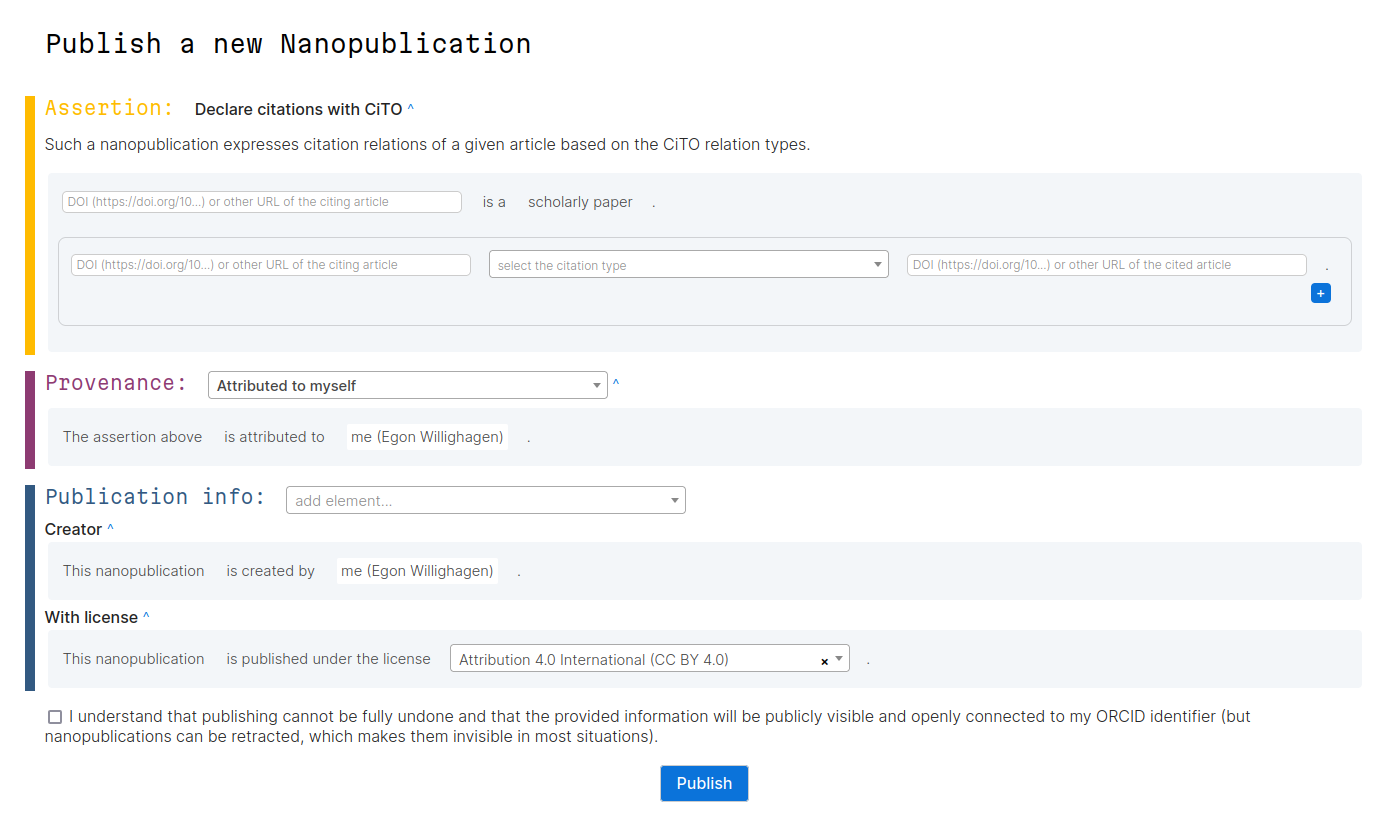
This is where <a href="https://w3id.org/np/RAX_4tWTyjFpO6nz63s14ucuejd64t2mK3IBlkwZ7jjLo">a recent template</a> comes in created by
<a href="https://orcid.org/0000-0002-1267-0234">Tobias Kuhn</a>, one of the main nanopub developers:</p>

<p><img src="/assets/images/citoPub.png" alt="" /></p>

<p>This nanopublication template defines the minimal needs of the assumptions, along with useful provenance and nanopub
info. Basically, the assertion defines that one DOI is a ScholarlyWork and using the CiTO, defines that it cites
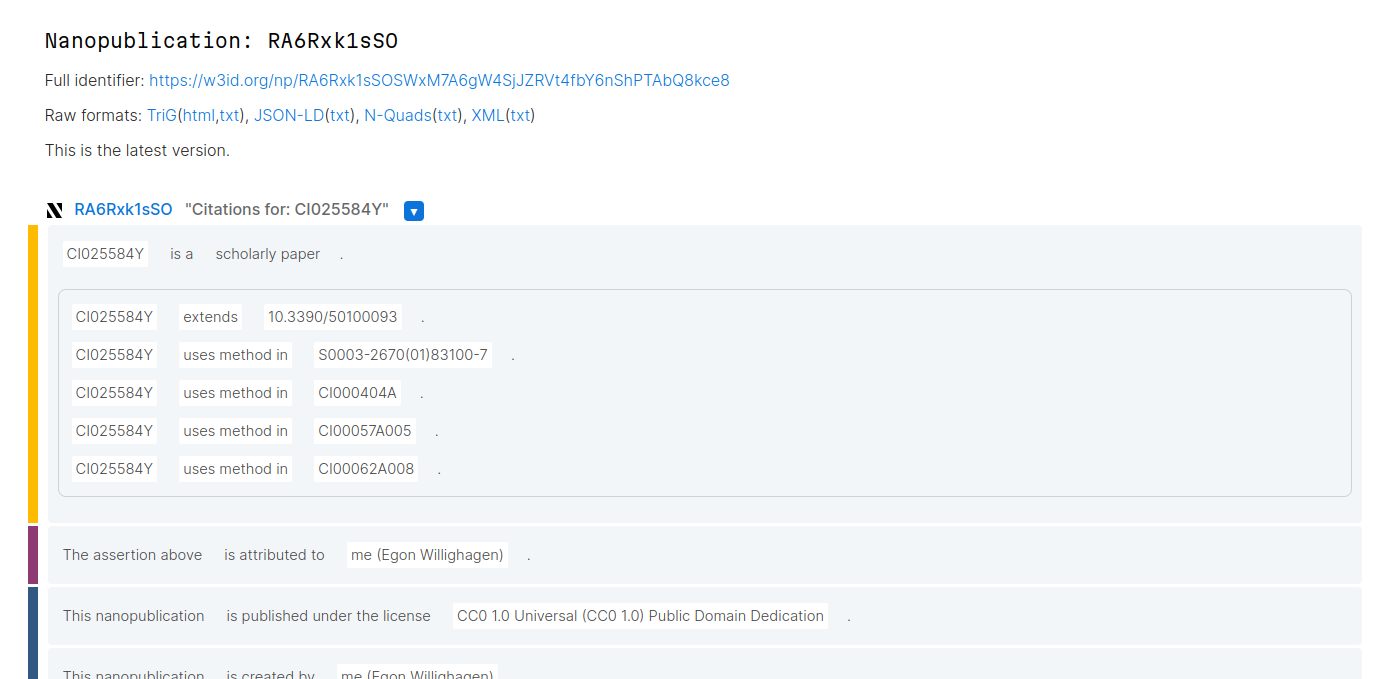
one or more article works (with DOI). For each citations, one can select any of the known CiTO intent types,
e.g. ‘extends’ or ‘uses method’ in, as in <a href="https://w3id.org/np/RA6Rxk1sSOSWxM7A6gW4SjJZRVt4fbY6nShPTAbQ8kce8">this nanopublication</a>
created with this template:</p>

<p><img src="/assets/images/citoPub2.png" alt="" /></p>

<h2 id="sparql-ing-cito-annotations">SPARQL-ing CiTO annotations</h2>

<p>Besides the template, Tobias also started a SPARQL query to which I added restrictions that the citing and cited
resources needs to have a DOI, giving us <a href="https://query.knowledgepixels.com/tools/type/2c1cce3f3152738c1009d59251409392aaaa3b0324bcb5fdfb4b7b944b8f0c18/yasgui.html#query=prefix+rdfs%3A+%3Chttp%3A%2F%2Fwww.w3.org%2F2000%2F01%2Frdf-schema%23%3E%0Aprefix+np%3A+%3Chttp%3A%2F%2Fwww.nanopub.org%2Fnschema%23%3E%0Aprefix+npa%3A+%3Chttp%3A%2F%2Fpurl.org%2Fnanopub%2Fadmin%2F%3E%0Aprefix+npx%3A+%3Chttp%3A%2F%2Fpurl.org%2Fnanopub%2Fx%2F%3E%0Aprefix+xsd%3A+%3Chttp%3A%2F%2Fwww.w3.org%2F2001%2FXMLSchema%23%3E%0Aprefix+dct%3A+%3Chttp%3A%2F%2Fpurl.org%2Fdc%2Fterms%2F%3E%0A%0Aselect+%3Fnp+%3Flabel+%3Fsubj+%3Fcitationrel+%3Fobj+%3Fdate+where+%7B%0A++graph+npa%3Agraph+%7B%0A++++%3Fnp+npa%3AhasValidSignatureForPublicKey+%3Fpubkey+.%0A++++%3Fnp+dct%3Acreated+%3Fdate+.%0A++++%3Fnp+np%3AhasAssertion+%3Fassertion+.%0A++++optional+%7B+%3Fnp+rdfs%3Alabel+%3Flabel+.+%7D%0A++++filter+not+exists+%7B+%3Fnpx+npx%3Ainvalidates+%3Fnp+%3B+npa%3AhasValidSignatureForPublicKey+%3Fpubkey+.+%7D%0A++++filter+not+exists+%7B+%3Fnp+npx%3AhasNanopubType+npx%3AExampleNanopub+.+%7D%0A++%7D%0A++graph+%3Fassertion+%7B%0A++++%3Fsubj+%3Fcitationrel+%3Fobj+.%0A++++filter(regex(str(%3Fcitationrel)%2C+%22%5Ehttp%3A%2F%2Fpurl.org%2Fspar%2Fcito%2F.*%24%22))%0A++++filter(regex(str(%3Fsubj)%2C+%22doi.org%2F10%22))%0A++++filter(regex(str(%3Fobj)%2C+%22doi.org%2F10%22))%0A++%7D%0A%7D%0A++&amp;contentTypeConstruct=text%2Fturtle&amp;contentTypeSelect=application%2Fsparql-results%2Bjson&amp;endpoint=%2Frepo%2Ftype%2F2c1cce3f3152738c1009d59251409392aaaa3b0324bcb5fdfb4b7b944b8f0c18&amp;requestMethod=POST&amp;tabTitle=Query&amp;headers=%7B%7D&amp;outputFormat=table">this query</a>:</p>

<div class="language-sparql highlighter-rouge"><div class="highlight"><pre class="highlight"><code><span class="k">prefix</span><span class="w"> </span><span class="nn">rdfs</span><span class="o">:</span><span class="w"> </span><span class="nn">&lt;http://www.w3.org/2000/01/rdf-schema#&gt;</span><span class="w">
</span><span class="k">prefix</span><span class="w"> </span><span class="nn">np</span><span class="o">:</span><span class="w"> </span><span class="nn">&lt;http://www.nanopub.org/nschema#&gt;</span><span class="w">
</span><span class="k">prefix</span><span class="w"> </span><span class="nn">npa</span><span class="o">:</span><span class="w"> </span><span class="nn">&lt;http://purl.org/nanopub/admin/&gt;</span><span class="w">
</span><span class="k">prefix</span><span class="w"> </span><span class="nn">npx</span><span class="o">:</span><span class="w"> </span><span class="nn">&lt;http://purl.org/nanopub/x/&gt;</span><span class="w">
</span><span class="k">prefix</span><span class="w"> </span><span class="nn">xsd</span><span class="o">:</span><span class="w"> </span><span class="nn">&lt;http://www.w3.org/2001/XMLSchema#&gt;</span><span class="w">
</span><span class="k">prefix</span><span class="w"> </span><span class="nn">dct</span><span class="o">:</span><span class="w"> </span><span class="nn">&lt;http://purl.org/dc/terms/&gt;</span><span class="w">

</span><span class="k">select</span><span class="w"> </span><span class="nv">?np</span><span class="w"> </span><span class="nv">?label</span><span class="w"> </span><span class="nv">?subj</span><span class="w"> </span><span class="nv">?citationrel</span><span class="w"> </span><span class="nv">?obj</span><span class="w"> </span><span class="nv">?date</span><span class="w"> </span><span class="k">where</span><span class="w"> </span><span class="p">{</span><span class="w">
  </span><span class="k">graph</span><span class="w"> </span><span class="nn">npa</span><span class="o">:</span><span class="ss">graph</span><span class="w"> </span><span class="p">{</span><span class="w">
    </span><span class="nv">?np</span><span class="w"> </span><span class="nn">npa</span><span class="o">:</span><span class="ss">hasValidSignatureForPublicKey</span><span class="w"> </span><span class="nv">?pubkey</span><span class="w"> </span><span class="p">.</span><span class="w">
    </span><span class="nv">?np</span><span class="w"> </span><span class="nn">dct</span><span class="o">:</span><span class="ss">created</span><span class="w"> </span><span class="nv">?date</span><span class="w"> </span><span class="p">.</span><span class="w">
    </span><span class="nv">?np</span><span class="w"> </span><span class="nn">np</span><span class="o">:</span><span class="ss">hasAssertion</span><span class="w"> </span><span class="nv">?assertion</span><span class="w"> </span><span class="p">.</span><span class="w">
    </span><span class="k">optional</span><span class="w"> </span><span class="p">{</span><span class="w"> </span><span class="nv">?np</span><span class="w"> </span><span class="nn">rdfs</span><span class="o">:</span><span class="ss">label</span><span class="w"> </span><span class="nv">?label</span><span class="w"> </span><span class="p">.</span><span class="w"> </span><span class="p">}</span><span class="w">
    </span><span class="k">filter</span><span class="w"> </span><span class="k">not</span><span class="w"> </span><span class="k">exists</span><span class="w"> </span><span class="p">{</span><span class="w"> </span><span class="nv">?npx</span><span class="w"> </span><span class="nn">npx</span><span class="o">:</span><span class="ss">invalidates</span><span class="w"> </span><span class="nv">?np</span><span class="w"> </span><span class="p">;</span><span class="w"> </span><span class="nn">npa</span><span class="o">:</span><span class="ss">hasValidSignatureForPublicKey</span><span class="w"> </span><span class="nv">?pubkey</span><span class="w"> </span><span class="p">.</span><span class="w"> </span><span class="p">}</span><span class="w">
    </span><span class="k">filter</span><span class="w"> </span><span class="k">not</span><span class="w"> </span><span class="k">exists</span><span class="w"> </span><span class="p">{</span><span class="w"> </span><span class="nv">?np</span><span class="w"> </span><span class="nn">npx</span><span class="o">:</span><span class="ss">hasNanopubType</span><span class="w"> </span><span class="nn">npx</span><span class="o">:</span><span class="ss">ExampleNanopub</span><span class="w"> </span><span class="p">.</span><span class="w"> </span><span class="p">}</span><span class="w">
  </span><span class="p">}</span><span class="w">
  </span><span class="k">graph</span><span class="w"> </span><span class="nv">?assertion</span><span class="w"> </span><span class="p">{</span><span class="w">
    </span><span class="nv">?subj</span><span class="w"> </span><span class="nv">?citationrel</span><span class="w"> </span><span class="nv">?obj</span><span class="w"> </span><span class="p">.</span><span class="w">
    </span><span class="k">filter</span><span class="p">(</span><span class="nb">regex</span><span class="p">(</span><span class="nb">str</span><span class="p">(</span><span class="nv">?citationrel</span><span class="p">),</span><span class="w"> </span><span class="s2">"^http://purl.org/spar/cito/.*$"</span><span class="p">))</span><span class="w">
    </span><span class="k">filter</span><span class="p">(</span><span class="nb">regex</span><span class="p">(</span><span class="nb">str</span><span class="p">(</span><span class="nv">?subj</span><span class="p">),</span><span class="w"> </span><span class="s2">"doi.org/10"</span><span class="p">))</span><span class="w">
    </span><span class="k">filter</span><span class="p">(</span><span class="nb">regex</span><span class="p">(</span><span class="nb">str</span><span class="p">(</span><span class="nv">?obj</span><span class="p">),</span><span class="w"> </span><span class="s2">"doi.org/10"</span><span class="p">))</span><span class="w">
  </span><span class="p">}</span><span class="w">
</span><span class="p">}</span><span class="w">
</span></code></pre></div></div>

<p>This includes 6 citation intentions defined by 4 nanopublications added during the Open Science Retreat:</p>

<ul>
  <li><a href="https://w3id.org/np/RAUjZE1JMu1GAvUQ_fZ4yc9-7sOSCT9xbeS0wYznkKtYk">RAUjZE1JMu</a> by <a href="https://nanodash.knowledgepixels.com/explore?id=https%3A%2F%2Forcid.org%2F0000-0002-7192-1486">me</a> for a paper by Marija Purgar</li>
  <li><a href="https://nanodash.knowledgepixels.com/explore?id=RAXgI--5gcKskgrnOI1XZoA4b3hu9RbNj3bcc2Zxeos7c">RAXgI–5gc</a> by <a href="https://nanodash.knowledgepixels.com/explore?id=https%3A%2F%2Forcid.org%2F0000-0003-2408-7588">Christian Meesters</a></li>
  <li><a href="https://nanodash.knowledgepixels.com/explore?id=RATZNhd3l_jN0y8GEi8mLIqy-uVV8tiUZIq2RJtkq6G8A">RATZNhd3l_j</a> by <a href="https://nanodash.knowledgepixels.com/explore?id=https%3A%2F%2Forcid.org%2F0000-0003-4285-690X">Taichi Oichi</a></li>
  <li><a href="https://nanodash.knowledgepixels.com/explore?id=RA6Q6wxSYyWfA3XwpOBqSNFKgQpM7ZgdVBoU2kSD-CFjw">RA6Q6wxSYy</a> by <a href="https://nanodash.knowledgepixels.com/explore?id=https%3A%2F%2Forcid.org%2F0000-0003-1559-1838">Niklas Hohmann</a></li>
</ul>

<h1 id="from-nanopublications-to-wikidata">From nanopublications to Wikidata</h1>

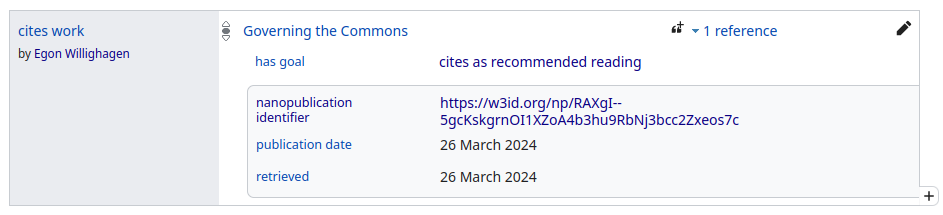
<p>Now, this query also provides me with enough information to propagate the citation intent (a fact?) to Wikidata
and cite the original nanopublication as reference. With a variation of the above SPARQL query, I can get the
five most recent new nanopublications, convert them to QuickStatements, and then enjoy them in Wikidata. This
is written up in <a href="https://github.com/egonw/ons-wikidata/blob/main/Nanopubs/createQS.groovy">this Bacting script</a>.</p>

<p>The script needs to handle some situations. For example, it will not add items for DOIs not already in Wikidata.
So, if neither of the two DOIs are known in Wikidata, then nothing gets added. If they both are, then it will
add the citation intent. There are alternative solutions, but in practice that doesn’t matter and the QuickStatements
is in all situations the same, and QuickStatements will only add the new information.</p>

<p>This is what it will <a href="https://www.wikidata.org/wiki/Q113312162#P2860">look like in Wikidata</a>:</p>

<p><img src="/assets/images/citoPub3.png" alt="" /></p>

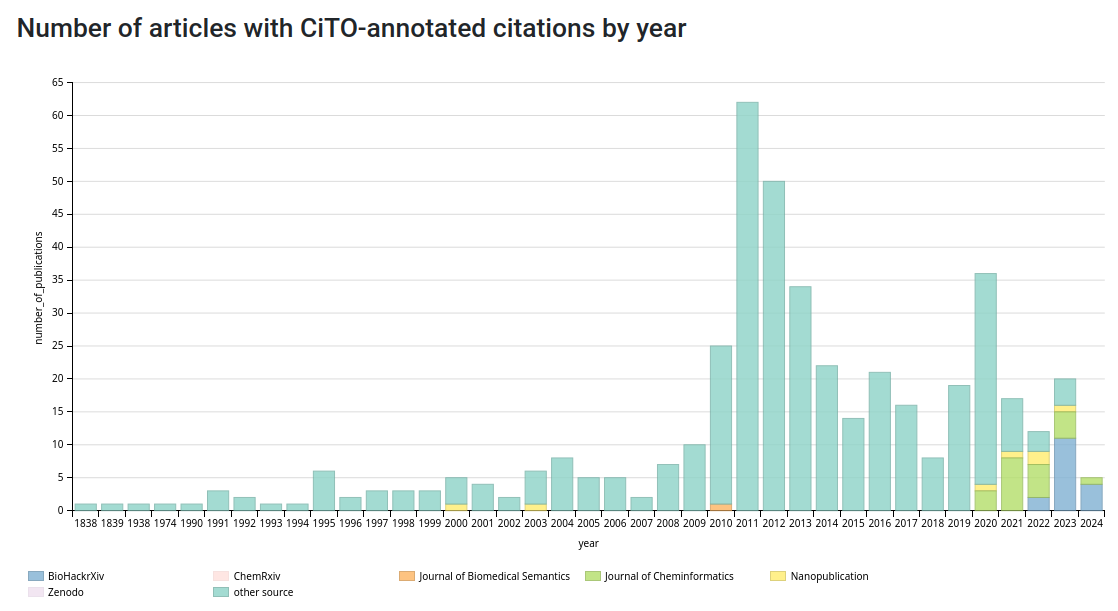
<p>And this is <a href="https://qlever.scholia.wiki/cito/#articles">what it looks <i class="fa-solid fa-recycle fa-xs"></i></a> (yellow) when we compare the contributions
from nanopublications now with the other sources:</p>

<p><img src="/assets/images/citoPubs4.png" alt="" /></p>]]></content><author><name>Egon Willighagen</name></author><category term="osr24nl" /><category term="openscience" /><category term="cito" /><category term="nanopub" /><category term="justdoi:10.3233/ISU-2010-0613" /><category term="doi:10.1109/ESCIENCE.2018.00024" /><category term="doi:10.1186/S13321-023-00683-2" /><category term="wikidata" /><summary type="html"><![CDATA[During the Open Science Retreat I organized a short session where we looking into typing citation intentions using a new nanopublication template. First, let’s describe nanopublications (originally used in doi:10.3233/ISU-2010-0613) a bit. Scholia gives a nice overview of (macro?)publications on the topic . The nanopub.net website describes that [a nanopublication is a small knowledge graph snippet with metadata that is treated as an independent (scientific) publication.]. The knowledge graph, it continues, can be anything from an opinion to the link between a disease and a gene (doi:10.1109/ESCIENCE.2018.00024).]]></summary><media:thumbnail xmlns:media="http://search.yahoo.com/mrss/" url="https://chem-bla-ics.linkedchemistry.info/assets/images/citoPub.png" /><media:content medium="image" url="https://chem-bla-ics.linkedchemistry.info/assets/images/citoPub.png" xmlns:media="http://search.yahoo.com/mrss/" /></entry><entry><title type="html">Open Science Retreat #1: impressions</title><link href="https://chem-bla-ics.linkedchemistry.info/2024/03/31/open-science-retreat-1.html" rel="alternate" type="text/html" title="Open Science Retreat #1: impressions" /><published>2024-03-31T00:00:00+00:00</published><updated>2024-03-31T00:00:00+00:00</updated><id>https://chem-bla-ics.linkedchemistry.info/2024/03/31/open-science-retreat-1</id><content type="html" xml:base="https://chem-bla-ics.linkedchemistry.info/2024/03/31/open-science-retreat-1.html"><![CDATA[<p>Last week I attended the <a href="https://openscienceretreat.eu/">Open Science Retreat</a> (<a href="https://hashtags-hub.toolforge.org/osr24nl">#osr24nl</a>)
in a quite and relaxing region in North-Holland. The meeting was how I like all meetings to be (and I count myself lucky many of my meetings
are like this): open, welcoming, constructive, diverse, and intellectually challenging. Not all scientific meetings are like this
and it is easy to end up going to obligatory meetings where the discussions are of a different level. Therefore, great thanks to
the organizers, but also to all participants, that showed not just to have a hearth for open science (getting pretty common),
but also a drive to advocate for open science. Finally, I like to thank the people that joined me in creating nanopublications for
CiTO annotations (will blog about that later), and <a href="https://twitter.com/marija_purgar/status/1773745895508451573">to Sadik and Marija</a>
with whom we worked on exploring using Wikibase for capturing knowledge about research waste in ecology (more about that later too).</p>]]></content><author><name>Egon Willighagen</name></author><category term="osr24nl" /><category term="openscience" /><category term="wikibase" /><category term="cito" /><category term="nanopub" /><summary type="html"><![CDATA[Last week I attended the Open Science Retreat (#osr24nl) in a quite and relaxing region in North-Holland. The meeting was how I like all meetings to be (and I count myself lucky many of my meetings are like this): open, welcoming, constructive, diverse, and intellectually challenging. Not all scientific meetings are like this and it is easy to end up going to obligatory meetings where the discussions are of a different level. Therefore, great thanks to the organizers, but also to all participants, that showed not just to have a hearth for open science (getting pretty common), but also a drive to advocate for open science. Finally, I like to thank the people that joined me in creating nanopublications for CiTO annotations (will blog about that later), and to Sadik and Marija with whom we worked on exploring using Wikibase for capturing knowledge about research waste in ecology (more about that later too).]]></summary></entry><entry><title type="html">What metabolites are found in which species? Nanopublications from Wikidata</title><link href="https://chem-bla-ics.linkedchemistry.info/2019/03/30/what-metabolites-are-found-in-which.html" rel="alternate" type="text/html" title="What metabolites are found in which species? Nanopublications from Wikidata" /><published>2019-03-30T00:00:00+00:00</published><updated>2019-03-30T00:00:00+00:00</updated><id>https://chem-bla-ics.linkedchemistry.info/2019/03/30/what-metabolites-are-found-in-which</id><content type="html" xml:base="https://chem-bla-ics.linkedchemistry.info/2019/03/30/what-metabolites-are-found-in-which.html"><![CDATA[<p>In December I reported about Groovy <a href="https://chem-bla-ics.linkedchemistry.info/2018/12/27/creating-nanopublications-with-groovy.html">code to create nanopublications <i class="fa-solid fa-recycle fa-xs"></i></a>.
This has been running for some time now, extracting nanopubs that assert that some
metabolite is found in some species. I send the resulting nanopubs to
<a href="https://scholia.toolforge.org/author/Q42027946">Tobias Kuhn <i class="fa-solid fa-recycle fa-xs"></i></a>, to populate his
<em>Growing Resource of Provenance-Centric Scientific Linked Data</em>
(doi:<a href="https://doi.org/10.1109/eScience.2018.00024">10.1109/eScience.2018.00024</a>,
<a href="https://arxiv.org/pdf/1809.06532.pdf">PDF</a>).</p>

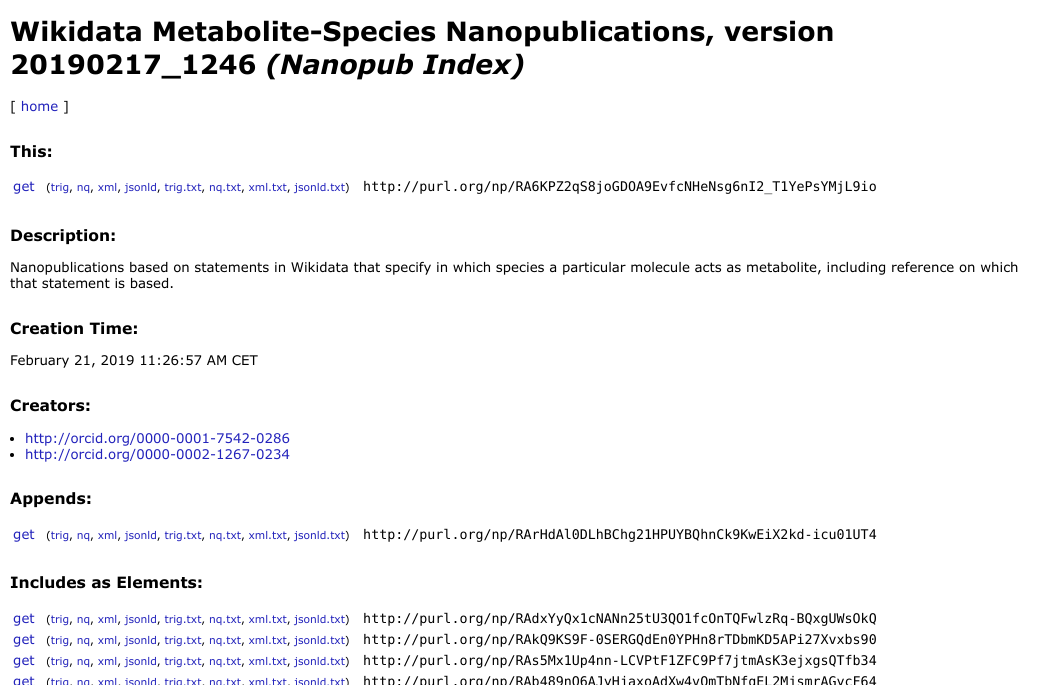
<p>Each data set comes with <a href="http://np.inn.ac/RA6KPZ2qS8joGDOA9EvfcNHeNsg6nI2_T1YePsYMjL9io">an index pointing to the individual nanopubs</a>,
and that looks like this:</p>

<p><img src="/assets/images/nanopubs.png" alt="" /></p>

<p>I wonder what options I have to to archive the full set up nanopublications on
Figshare or Zenodo, and see that DOI show up here…</p>]]></content><author><name>Egon Willighagen</name></author><category term="nanopub" /><category term="cheminf" /><category term="wikidata" /><category term="doi:10.1109/ESCIENCE.2018.00024" /><summary type="html"><![CDATA[In December I reported about Groovy code to create nanopublications . This has been running for some time now, extracting nanopubs that assert that some metabolite is found in some species. I send the resulting nanopubs to Tobias Kuhn , to populate his Growing Resource of Provenance-Centric Scientific Linked Data (doi:10.1109/eScience.2018.00024, PDF).]]></summary><media:thumbnail xmlns:media="http://search.yahoo.com/mrss/" url="https://chem-bla-ics.linkedchemistry.info/assets/images/nanopubs.png" /><media:content medium="image" url="https://chem-bla-ics.linkedchemistry.info/assets/images/nanopubs.png" xmlns:media="http://search.yahoo.com/mrss/" /></entry><entry><title type="html">Creating nanopublications with Groovy</title><link href="https://chem-bla-ics.linkedchemistry.info/2018/12/27/creating-nanopublications-with-groovy.html" rel="alternate" type="text/html" title="Creating nanopublications with Groovy" /><published>2018-12-27T00:00:00+00:00</published><updated>2018-12-27T00:00:00+00:00</updated><id>https://chem-bla-ics.linkedchemistry.info/2018/12/27/creating-nanopublications-with-groovy</id><content type="html" xml:base="https://chem-bla-ics.linkedchemistry.info/2018/12/27/creating-nanopublications-with-groovy.html"><![CDATA[<p><img style="float: right" width="200" src="/assets/images/Screenshot_20181227_075006.png" />
Yesterday, I struggled some with creating <a href="http://nanopub.org/">nanopublications</a> with <a href="https://en.wikipedia.org/wiki/Apache_Groovy">Groovy</a>.
My first attempt was an utter failure, but then I discovered <a href="https://twitter.com/txkuhn">Thomas Kuhn</a>’s
<a href="https://github.com/Nanopublication/nanopub-java/blob/master/src/main/java/org/nanopub/NanopubCreator.java">NanopubCreator</a>
and it was downhill from there.</p>

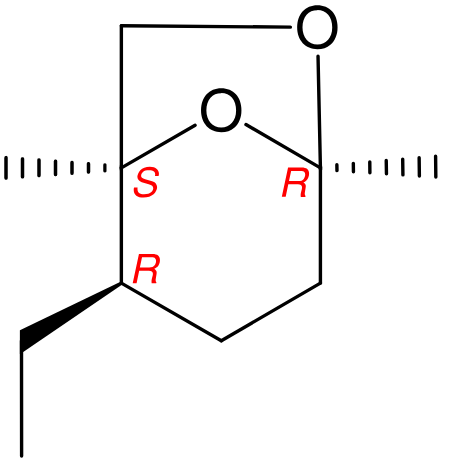
<p>On the right, a depiction is given of a compound found in Taphrorychus bicolor (doi:<a href="https://doi.org/10.1002/JLAC.199619961005">10.1002/JLAC.199619961005</a>).
Published in <em>Liebigs Annalen</em>, see <a href="https://chem-bla-ics.blogspot.com/2018/12/from-annalen-der-pharmacie-to-european.html">this post</a>
about the history of that journal.</p>

<p>There are two good things about this. First, I now have a <a href="https://github.com/egonw/wikidataNanopublications">code base</a>
that I can easily repurpose to make <em>trusty nanopublications</em> (doi:<a href="10.1007/978-3-319-07443-6_27">10.1007/978-3-319-07443-6_27</a>)
about anything structured as a table (so can you).</p>

<p>Second, I now about almost 1200 CCZero nanopublications that tell you in which species a certain metabolite
has been found. Sourced from <a href="https://wikidata.org/">Wikidata</a>, using <a href="https://query.wikidata.org/">their SPARQL end point</a>.
This collection is a bit boring that this moment, and most of them are human metabolites, where the source is either
<a href="https://tools.wmflabs.org/scholia/work/Q28601559">Recon 2.2</a> or <a href="https://wikipathways.org/">WikiPathways</a>.
But I expect (hope) to see more DOIs to show up. Think
<em><a href="https://blogs.biomedcentral.com/bmcblog/2018/11/01/challenge-reuse-additional-files-supplementary-information/">We challenge you to reuse Additional Files</a></em>.</p>

<p>Finally, you are probably interested in learning what one of the created nanopublications looks like, to I put
<a href="https://gist.github.com/egonw/5fb0994cac6f9e851f3857cd306f0890">a Gist online</a>:</p>

<pre><code class="language-trig">@prefix this: &lt;http://www.bigcat.unimaas.nl/nanopubs/wikidata/tmp/np742.RAwXcetTykN6UPVzBOyatKm30mbT6endXfDrxnarRysL0&gt; .
@prefix sub: &lt;http://www.bigcat.unimaas.nl/nanopubs/wikidata/tmp/np742.RAwXcetTykN6UPVzBOyatKm30mbT6endXfDrxnarRysL0#&gt; .
@prefix wd: &lt;http://www.wikidata.org/entity/&gt; .
@prefix np: &lt;http://www.nanopub.org/nschema#&gt; .
@prefix has-source: &lt;http://semanticscience.org/resource/SIO_000253&gt; .
@prefix has-inchikey: &lt;http://semanticscience.org/resource/CHEMINF_000399&gt; .
@prefix orcid: &lt;http://orcid.org/&gt; .
@prefix wdt: &lt;http://www.wikidata.org/prop/direct/&gt; .
@prefix owl: &lt;http://www.w3.org/2002/07/owl#&gt; .
@prefix pav: &lt;http://purl.org/pav/&gt; .
@prefix rdfs: &lt;http://www.w3.org/2000/01/rdf-schema#&gt; .
@prefix skos: &lt;http://www.w3.org/2004/02/skos/core#&gt; .

sub:Head {
        this: np:hasAssertion sub:assertion ;
                np:hasProvenance sub:provenance ;
                np:hasPublicationInfo sub:pubinfo ;
                a np:Nanopublication .
}

sub:assertion {
        wd:Q15978631 rdfs:label "Homo sapiens"@en ;
                skos:exactMatch &lt;http://purl.obolibrary.org/obo/NCBITaxon_9606&gt; .

        wd:Q27125029 has-inchikey: "APJYDQYYACXCRM-UHFFFAOYSA-O" ;
                rdfs:label "tryptaminium"@en ;
                wdt:P703 wd:Q15978631 .
}

sub:provenance {
        sub:assertion has-source: wd:Q2013 , wd:Q28601559 .

        wd:Q28601559 rdfs:label "Recon 2.2: from reconstruction to model of human metabolism"@en ;
                owl:sameAs &lt;https://doi.org/10.1007/S11306-016-1051-4&gt; .
}

sub:pubinfo {
        this: pav:createdBy orcid:0000-0001-7542-0286 .
}
</code></pre>]]></content><author><name>Egon Willighagen</name></author><category term="nanopub" /><category term="wikidata" /><category term="groovy" /><category term="justdoi:10.1007/978-3-319-07443-6_27" /><category term="justdoi:10.1002/JLAC.199619961005" /><summary type="html"><![CDATA[Yesterday, I struggled some with creating nanopublications with Groovy. My first attempt was an utter failure, but then I discovered Thomas Kuhn’s NanopubCreator and it was downhill from there.]]></summary><media:thumbnail xmlns:media="http://search.yahoo.com/mrss/" url="https://chem-bla-ics.linkedchemistry.info/assets/images/Screenshot_20181227_075006.png" /><media:content medium="image" url="https://chem-bla-ics.linkedchemistry.info/assets/images/Screenshot_20181227_075006.png" xmlns:media="http://search.yahoo.com/mrss/" /></entry><entry><title type="html">Two conference proceedings: nanopublications and Scholia</title><link href="https://chem-bla-ics.linkedchemistry.info/2017/10/15/two-conference-proceedings.html" rel="alternate" type="text/html" title="Two conference proceedings: nanopublications and Scholia" /><published>2017-10-15T00:00:00+00:00</published><updated>2017-10-15T00:00:00+00:00</updated><id>https://chem-bla-ics.linkedchemistry.info/2017/10/15/two-conference-proceedings</id><content type="html" xml:base="https://chem-bla-ics.linkedchemistry.info/2017/10/15/two-conference-proceedings.html"><![CDATA[<p><img style="float: right;" src="/assets/images/Screenshot_20171015_131507.png" width="300" alt="The nanopublication conference article in Scholia." />
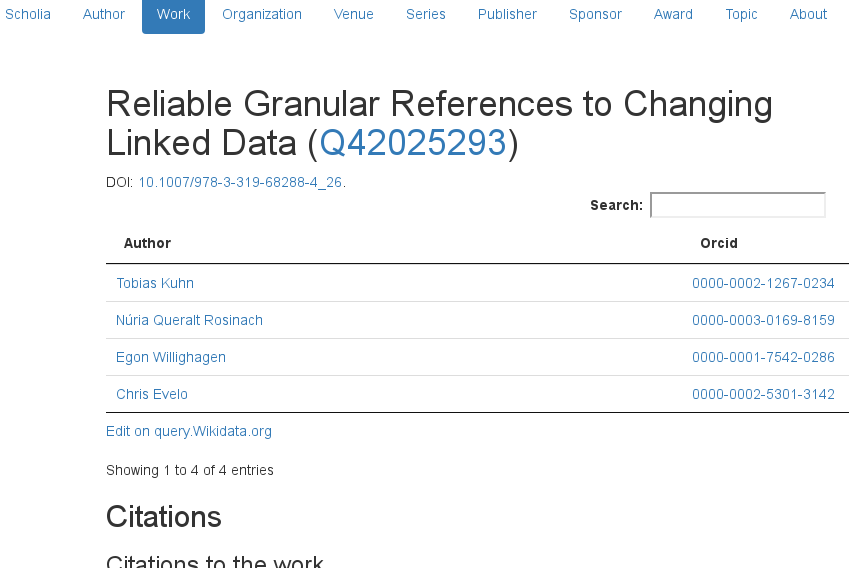
It takes effort to move scholarly publishing forward. And the traditional publishers have not all shown to
be good at that: we’re still basically stuck with machine-broken channels like PDFs and ReadCubes. They seem
to all love text mining, but only if they can do it themselves.</p>

<p>Fortunately, there are plenty of people who do like to make a difference and like to innovate. I find this
important, because if we do not do it, who will. Two people who make an effort are two researchers who
recently published their work as conference proceedings: <a href="http://www.tkuhn.org/">Tobias Kuhn</a> and
<a href="https://github.com/fnielsen">Finn Nielsen</a>. And I am happy to have been able to contribute to both efforts.</p>

<h2 id="nanopublications">Nanopublications</h2>

<p>Tobias works on <a href="https://web.archive.org/web/20171004200524/http://nanopub.org/wordpress/">nanopublications <i class="fa-solid fa-box-archive fa-xs"></i></a>
which innovates how we make knowledge machine
readable. And I have stressed how important this is in my blog for years. Nanopublications describe how
knowledge is captures, makes it FAIR, but importantly, it links the knowledge to the research that led to the
knowledge. His <a href="https://doi.org/10.1007/978-3-319-68288-4_26">recent conference proceedings</a>
details how nanopublications can be used to establish incremental
knowledge. That is, given two sets of nanopubblications, it determines which have been removed, added, and
changed. The paper continues outlining how that can be used to reduce, for example, download sizes and how
it can help establish an efficient change history.</p>

<h2 id="scholia">Scholia</h2>

<p>And Finn developed <a href="https://scholia.toolforge.org/">Scholia <i class="fa-solid fa-recycle fa-xs"></i></a>, an interface not unlike Web-of-Science. But
then based on <a href="http://wikidata.org/">Wikidata</a> and therefore fully on CCZero data. And, with a community
actively adding the full history of scholarly literature and the citations between papers, courtesy to the
<a href="https://i4oc.org/">Initiative for Open Citations</a>. This is opening up a lot of possibilities: from keeping
track of articles citing your work, to get alerts of articles publishing new data on your favorite gene or
metabolite.</p>]]></content><author><name>Egon Willighagen</name></author><category term="scholia" /><category term="nanopub" /><category term="doi:10.48550/ARXIV.1703.04222" /><category term="doi:10.1007/978-3-319-68288-4_26" /><summary type="html"><![CDATA[It takes effort to move scholarly publishing forward. And the traditional publishers have not all shown to be good at that: we’re still basically stuck with machine-broken channels like PDFs and ReadCubes. They seem to all love text mining, but only if they can do it themselves.]]></summary><media:thumbnail xmlns:media="http://search.yahoo.com/mrss/" url="https://chem-bla-ics.linkedchemistry.info/assets/images/Screenshot_20171015_131507.png" /><media:content medium="image" url="https://chem-bla-ics.linkedchemistry.info/assets/images/Screenshot_20171015_131507.png" xmlns:media="http://search.yahoo.com/mrss/" /></entry></feed>