<?xml version="1.0" encoding="utf-8"?><feed xmlns="http://www.w3.org/2005/Atom" ><generator uri="https://jekyllrb.com/" version="4.3.4">Jekyll</generator><link href="https://chem-bla-ics.linkedchemistry.info/feed/by_tag/metabolomics.xml" rel="self" type="application/atom+xml" /><link href="https://chem-bla-ics.linkedchemistry.info/" rel="alternate" type="text/html" /><updated>2026-06-15T12:00:19+00:00</updated><id>https://chem-bla-ics.linkedchemistry.info/feed/by_tag/metabolomics.xml</id><title type="html">chem-bla-ics</title><subtitle>Chemblaics (pronounced chem-bla-ics) is the science that uses open science and computers to solve problems in chemistry, biochemistry and related fields.</subtitle><author><name>Egon Willighagen</name></author><entry><title type="html">The TDCC NES Col-Lab Retreat</title><link href="https://chem-bla-ics.linkedchemistry.info/2026/02/21/the-tdcc-nes-col-lab-retreat.html" rel="alternate" type="text/html" title="The TDCC NES Col-Lab Retreat" /><published>2026-02-21T00:00:00+00:00</published><updated>2026-02-21T00:00:00+00:00</updated><id>https://chem-bla-ics.linkedchemistry.info/2026/02/21/the-tdcc-nes-col-lab-retreat</id><content type="html" xml:base="https://chem-bla-ics.linkedchemistry.info/2026/02/21/the-tdcc-nes-col-lab-retreat.html"><![CDATA[<p>Last autumn two TDCC projects started, <em>FAIR4ChemNL</em> (<a href="https://chem-bla-ics.linkedchemistry.info/2026/02/08/open-infrastructures.html">with the PeerTube channel</a>
and doi:<a href="https://doi.org/10.61686/XVYQV45374">10.61686/XVYQV45374</a>) and <em>FAIRify for metabolomics data</em>
(doi:<a href="https://doi.org/10.61686/CSGIP04334">10.61686/CSGIP04334</a>). But I haven’t written much on either yet and what the role is our research group in these projects.</p>

<p>Let’s start with what the TDCC actually are: they are <a href="https://tdcc.nl/">Thematic Digital Competence Centres</a>:</p>

<blockquote>
  <p>The Thematic Digital Competence Centres (TDCCs) are network-based initiatives set up by NWO and the Dutch academic
community to broker investments into research data management projects. The three TDCCs are national and discipline
based, with one pillar each for the Social Sciences &amp; Humanities (SSH), Natural and Engineering Sciences (NES) and
Life Sciences &amp; Health (LSH). The networks will help formulate and facilitate projects designed to promote the adoption
of open data, software and research practices, alongside the development of the necessary expertise.</p>
</blockquote>

<p>So, where initiatives like <a href="https://www.go-fair.org/">GO FAIR</a> had centers of competencies (the implementation networks),
they did not have funding for them. This was a main reason why the <em>Chemistry Implementation Network</em> (ChIN,
doi:<a href="https://doi.org/10.1162/dint_a_00035">10.1162/dint_a_00035</a>) did not take off.
The TDCCs do not provide a lot of money, but enough to support disseminating expertise and promote some key ideas.</p>

<p>The idea is that combined with other efforts, it strengthens the level of FAIR in the Dutch research community.
I have to say, this is much needed, as the level of FAIR data in journal publications is so much to wish for,
and still mostly absent.</p>

<p>The FAIR4ChemNL project already had a networking activity during the writing of the proposal, the workshop already
back in 2024 that I <a href="https://chem-bla-ics.linkedchemistry.info/2024/06/10/two-meetings.html">blogged about earlier</a>
(see also <a href="https://doi.org/10.5281/zenodo.15050550">this report</a>).
The FAIRify project is coordinated by the group that was key in the <em>Netherlands Metabolomics Center</em> (NMC), now the
<a href="https://metabolomicscentre.nl/">BeneLux Metabolomics Center</a>. During a postdoc at the NMC during my Wageningen
days, we already did a lot of FAIR competency building with <a href="https://chem-bla-ics.linkedchemistry.info/tag/metware">the MetWare project</a>.</p>

<h2 id="the-col-lab-retreat">The Col-Lab Retreat</h2>

<p>The <a href="https://tdcc.nl/about-tddc/nes/">TDCC-NES</a> organized a networking event in August last year,
the 2025 <a href="https://nescollab.nl/">TDCC-NES Col-Lab Retreat</a>. I am late with
reporting on it, but there simply was too much project management that took priority. The meeting was in the
wonderful Dutch town Schoorl, and the location is great for collaborative meetings. I had been there a year
earlier for an Open Science Retreat and was happy to go back.</p>

<p>During the unconference-style meeting <a href="https://tdcc.nl/creating-space-for-our-community-the-story-of-our-nes-col-lab-retreat/">various topics were discussed</a>
in breakout groups, and because of the two TDCC projects, I was particularly interested in the <em>Metadata and interoperability</em>
topic. Partly because this is how we can make eletronic lab notebooks automatically push metadata to
registries (and <a href="https://www.linkedin.com/in/rory-macneil-68a80011/">Rory Macneil</a> was also in Schoorl,
of <a href="https://www.researchspace.com/">RSpace/ResearchSpace</a> which already integrated with various open
platforms), and partly because I wanted to continue explore <a href="https://chem-bla-ics.linkedchemistry.info/tag/nanopub">nanopublications</a>
with <a href="https://fediscience.org/@rupdecat">Christian Meesters</a>, which could be the envelope to distribute
the metadata. For the last, I was looking at the Java library for nanopublications
(see <a href="https://github.com/Nanopublication/nanopub-java/pull/52">this PR</a>.</p>

<p>The idea that ELNs automatically share metadata about experiments is something that is attractive.
It would require no involvement from the researcher, would be fully automatic, and drive interest
(users, peer reviewers) to experiments and experimental data. Something that is still absurdly hard
is to do a search for experiments that measured the melting point of some chemical. How
awesome would it be if ELNs would automatically register chemicals from the experiment in,
for example, <a href="https://pubchem.ncbi.nlm.nih.gov/">PubChem</a>.</p>

<p>We had the idea of applying for a Lorentz Workshop, but the earliest deadline was too early, but
maybe it is time to pick up that idea again. Interoperability standards already exist, like
the aforementioned nanopubs, but also <a href="https://www.researchobject.org/ro-crate/">RO-Crates</a> that are also studied by Jente Houweling
in the VHP4Safety project (see <a href="https://platform.vhp4safety.nl/data">this Data tab</a> for a preview).</p>]]></content><author><name>Egon Willighagen</name></author><category term="fair" /><category term="doi:10.1162/DINT_A_00035" /><category term="chemistry" /><category term="metabolomics" /><category term="fair4chemnl" /><category term="fairify" /><category term="cito:citesAsEvidence:10.5281/ZENODO.15050550" /><category term="nanopub" /><category term="crate" /><category term="pubchem" /><summary type="html"><![CDATA[Last autumn two TDCC projects started, FAIR4ChemNL (with the PeerTube channel and doi:10.61686/XVYQV45374) and FAIRify for metabolomics data (doi:10.61686/CSGIP04334). But I haven’t written much on either yet and what the role is our research group in these projects.]]></summary></entry><entry><title type="html">New paper: “Discovering life’s directed metabolic (sub)paths to interpret human biochemical markers using the DSMN tool”</title><link href="https://chem-bla-ics.linkedchemistry.info/2024/07/31/directed-metabolic-network.html" rel="alternate" type="text/html" title="New paper: “Discovering life’s directed metabolic (sub)paths to interpret human biochemical markers using the DSMN tool”" /><published>2024-07-31T00:00:00+00:00</published><updated>2024-07-31T00:00:00+00:00</updated><id>https://chem-bla-ics.linkedchemistry.info/2024/07/31/directed-metabolic-network</id><content type="html" xml:base="https://chem-bla-ics.linkedchemistry.info/2024/07/31/directed-metabolic-network.html"><![CDATA[<p>I am still catching up with a lot of work, and found out I actually had forgotten to blog about this cool article
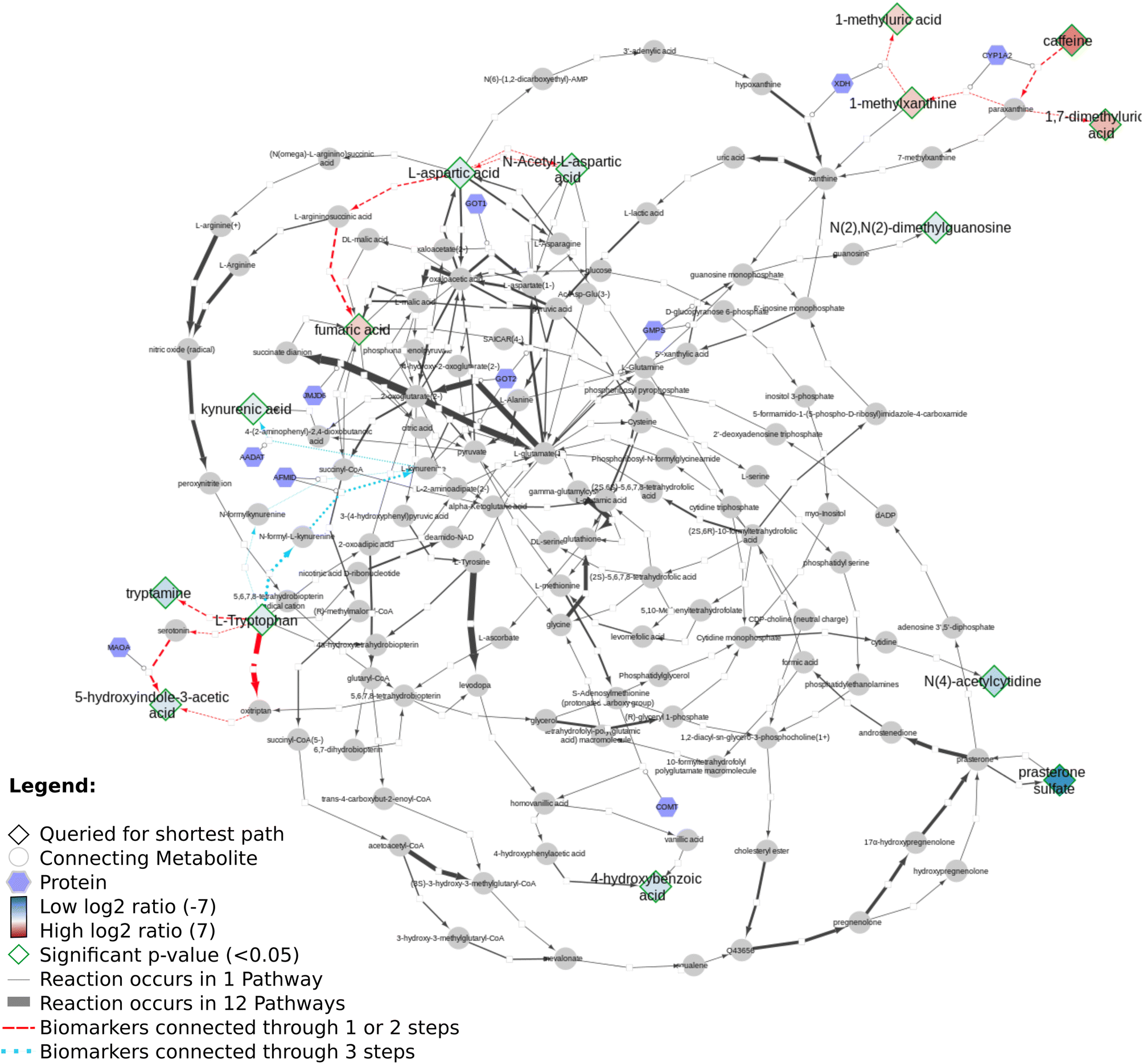
by <a href="https://scholar.google.com/citations?user=Le-4tuQAAAAJ&amp;hl">Denise Slenter</a>: “Discovering life’s directed metabolic (sub)paths to
interpret human biochemical markers using the DSMN tool” (doi:<a href="https://doi.org/10.1039/D3DD00069A">10.1039/D3DD00069A</a>).
This paper explains how various open science resources (<a href="https://www.wikidata.org/">Wikidata</a>,
<a href="https://reactome.org/">Reactome</a>, <a href="https://www.wikipathways.org/">WikiPathways</a>) are used to visualize
the biological story of the data from two metabolomics experiments archived in MetaboLights.</p>

<p>Using <a href="https://neo4j.com/">Neo4J</a> and <a href="https://cytoscape.org/">Cytoscape</a> she visualizes the data onto a network created with
RDF, <a href="https://en.wikipedia.org/wiki/SPARQL">SPARQL</a> from the above resources:</p>

<p><img src="/assets/images/d3dd00069a-f12_hi-res.png" alt="" /></p>

<p>The whole approach uses open science, making the work very reproducible. This is essential, as our knowledge
about metabolic processes continues to grow, if not only for the human lipids, but also from molecular
imaging technologies. Moreover, a lot of biological detail is yet to be encoded on pathway databases,
such as cellular location of proteins and metabolites, which proteins are expressed in which tissue, or
the kinetics of metabolic reactions. All knowledge that can be pulled it via knowledge graphs becomes
immediately available by using this <a href="https://en.wikipedia.org/wiki/FAIR_data">FAIR</a> approach.</p>

<p>One last note, the reader may notice a focus on the shortest path. Of course, the biological relevant
path may not be the “shortest” path. But from a network analysis perspective that question is purely
academic. Neo4J, like other tools, support finding all paths. But validation which paths (the shorter
or any of the longer) is biologically most relevant first depends on actually more biological
knowledge to become FAIR. After this, it is just push button.</p>]]></content><author><name>Egon Willighagen</name></author><category term="wikipathways" /><category term="doi:10.1039/D3DD00069A" /><category term="metabolomics" /><summary type="html"><![CDATA[I am still catching up with a lot of work, and found out I actually had forgotten to blog about this cool article by Denise Slenter: “Discovering life’s directed metabolic (sub)paths to interpret human biochemical markers using the DSMN tool” (doi:10.1039/D3DD00069A). This paper explains how various open science resources (Wikidata, Reactome, WikiPathways) are used to visualize the biological story of the data from two metabolomics experiments archived in MetaboLights.]]></summary><media:thumbnail xmlns:media="http://search.yahoo.com/mrss/" url="https://chem-bla-ics.linkedchemistry.info/assets/images/d3dd00069a-f12_hi-res.png" /><media:content medium="image" url="https://chem-bla-ics.linkedchemistry.info/assets/images/d3dd00069a-f12_hi-res.png" xmlns:media="http://search.yahoo.com/mrss/" /></entry><entry><title type="html">Paper: “Extending inherited metabolic disorder diagnostics with biomarker interaction visualizations”</title><link href="https://chem-bla-ics.linkedchemistry.info/2023/05/12/paper-extending-inherited-metabolic.html" rel="alternate" type="text/html" title="Paper: “Extending inherited metabolic disorder diagnostics with biomarker interaction visualizations”" /><published>2023-05-12T00:00:00+00:00</published><updated>2023-05-12T00:00:00+00:00</updated><id>https://chem-bla-ics.linkedchemistry.info/2023/05/12/paper-extending-inherited-metabolic</id><content type="html" xml:base="https://chem-bla-ics.linkedchemistry.info/2023/05/12/paper-extending-inherited-metabolic.html"><![CDATA[<p>When I joined the BiGCaT research group in 2012 I was particularly interested in the open science approach of WikiPathways.
As a chemist by training and researcher in cheminformatics, metabolites and their metabolic reactions took my particular
interest. I am happy that I have been able to fund Denise’s research project. And thanks Denise for this very exciting research.
I know it’s just a first step, and far more translational steps are needed, but I for one am very exciting to bridge molecular
info to clinical outcomes.</p>

<p>In this study, Denise explored how we can take advantage from molecular pathway databases to link biomarker information:
<em>“Our framework integrates literature and expert knowledge into machine-readable pathway models, including relevant urine
biomarkers and their interactions. The clinical data of 16 previously diagnosed patients with various pyrimidine and urea
cycle disorders were visualized on the top 3 relevant pathways. Two expert laboratory scientists evaluated the resulting
visualizations to derive a diagnosis”</em> (doi:<a href="https://doi.org/10.1186/s13023-023-02683-9">10.1186/s13023-023-02683-9</a>).</p>

<p>Figure 4 shows how such a visualization of those biomarker interactions can look like:</p>

<p><img src="/assets/images/13023_2023_2683_Fig4_HTML.png" alt="" /></p>

<p>And I am hugely proud of the open science approach, <a href="https://bigcat-um.github.io/IMD-PUPY/">from GitHub repo</a>, open source
R code, SPARQL queries. Thank you, Denise! And thanks to <a href="https://cris.maastrichtuniversity.nl/en/persons/laura-steinbusch">Dr Laura Steinbusch</a>
for this nice collaboration! Further acks in the article.</p>]]></content><author><name>Egon Willighagen</name></author><category term="metabolomics" /><category term="rdf" /><category term="sparql" /><category term="wikipathways" /><category term="doi:10.1186/S13023-023-02683-9" /><summary type="html"><![CDATA[When I joined the BiGCaT research group in 2012 I was particularly interested in the open science approach of WikiPathways. As a chemist by training and researcher in cheminformatics, metabolites and their metabolic reactions took my particular interest. I am happy that I have been able to fund Denise’s research project. And thanks Denise for this very exciting research. I know it’s just a first step, and far more translational steps are needed, but I for one am very exciting to bridge molecular info to clinical outcomes.]]></summary><media:thumbnail xmlns:media="http://search.yahoo.com/mrss/" url="https://chem-bla-ics.linkedchemistry.info/assets/images/13023_2023_2683_Fig4_HTML.png" /><media:content medium="image" url="https://chem-bla-ics.linkedchemistry.info/assets/images/13023_2023_2683_Fig4_HTML.png" xmlns:media="http://search.yahoo.com/mrss/" /></entry><entry><title type="html">Biology, ACPs, lipids, cheminformatics, and Dagstuhl</title><link href="https://chem-bla-ics.linkedchemistry.info/2022/08/01/biology-acps-lipids-cheminformatics-and.html" rel="alternate" type="text/html" title="Biology, ACPs, lipids, cheminformatics, and Dagstuhl" /><published>2022-08-01T00:00:00+00:00</published><updated>2022-08-01T00:00:00+00:00</updated><id>https://chem-bla-ics.linkedchemistry.info/2022/08/01/biology-acps-lipids-cheminformatics-and</id><content type="html" xml:base="https://chem-bla-ics.linkedchemistry.info/2022/08/01/biology-acps-lipids-cheminformatics-and.html"><![CDATA[<p>Already 3 months ago I visited <a href="https://www.dagstuhl.de/">Dagstuhl</a> for the second time. The weather was much better than in the January right before
the start of the pandemic. The first I attended the Computational Metabolomics meeting, with the focus From Cheminformatics to Machine Learning, one
of the things we concerned ourselves with was how to do computation with compound classes (see
<a href="https://drops.dagstuhl.de/opus/volltexte/2020/12403/pdf/dagrep_v010_i001_p144_20051.pdf">Section 3.6</a> and
<a href="https://egonw.github.io/cdk-cxsmiles/">this online book</a>). We know how to handle
SMILES and we know how to the substructure searching with SMARTS, but what if you have compound classes or lipid classes? Biology is a greasy business.</p>

<p>From a <a href="https://wikipathways.org/">WikiPathways</a> there is additional complexity, with modified proteins involved in lipid metabolism, the acyl-carrier
proteins. They look like this, and the R group is a protein:</p>

<p><img src="/assets/images/Screenshot_20220801_180944.png" alt="" /></p>

<p>We have quite a few of them in WikiPathway and they also show up in <a href="https://www.ebi.ac.uk/chebi/searchId.do?chebiId=CHEBI:5697">ChEBI</a> (and likely
Reactome), <a href="https://www.lipidmaps.org/databases/lmsd/LMFA07060040?LMID=LMFA07060040">LIPID MAPS</a>, and
<a href="https://www.kegg.jp/entry/C05764">KEGG</a>.</p>

<p>During this years Dagstuhl we used up one session to continue working on it (report pending). Part of the results is that
<a href="https://www.wikidata.org/">Wikidata</a> (see doi:<a href="https://doi.org/10.7554/eLife.52614">10.7554/eLife.52614</a> and
doi:<a href="https://doi.org/10.7554/eLife.70780">10.7554/eLife.70780</a>) now has <a href="https://www.wikidata.org/wiki/Property:P10718">a property for CXSMILES</a>.
CDK 2.0 (doi:<a href="https://doi.org/10.1186/s13321-017-0220-4">10.1186/s13321-017-0220-4</a>) already supported CXSMILES and the above image is actually created with
<a href="https://github.com/cdk/depict">CDK Depict</a> (thx to John!).</p>

<p>So, that means I can now start adding all those ACPs to Wikidata :) Here’s <a href="https://www.wikidata.org/wiki/Q113377202">hexadecanoyl-[acp]</a>
(or this <a href="https://scholia.toolforge.org/chemical-class/Q113377202">Scholia page</a>):</p>

<p><img src="/assets/images/Screenshot_20220801_182345.png" alt="" /></p>]]></content><author><name>Egon Willighagen</name></author><category term="cdk" /><category term="chebi" /><category term="dagstuhl" /><category term="epilipidnet" /><category term="kegg" /><category term="wikipathways" /><category term="lipidmaps" /><category term="metabolomics" /><category term="smiles" /><category term="wikidata" /><category term="doi:10.7554/ELIFE.52614" /><category term="doi:10.7554/ELIFE.70780" /><category term="doi:10.1186/S13321-017-0220-4" /><category term="cxsmiles" /><summary type="html"><![CDATA[Already 3 months ago I visited Dagstuhl for the second time. The weather was much better than in the January right before the start of the pandemic. The first I attended the Computational Metabolomics meeting, with the focus From Cheminformatics to Machine Learning, one of the things we concerned ourselves with was how to do computation with compound classes (see Section 3.6 and this online book). We know how to handle SMILES and we know how to the substructure searching with SMARTS, but what if you have compound classes or lipid classes? Biology is a greasy business.]]></summary></entry><entry><title type="html">MetWare presentation at Metabolomics Workshop</title><link href="https://chem-bla-ics.linkedchemistry.info/2009/01/27/metware-presenation-at-metabolomics.html" rel="alternate" type="text/html" title="MetWare presentation at Metabolomics Workshop" /><published>2009-01-27T00:00:00+00:00</published><updated>2009-01-27T00:00:00+00:00</updated><id>https://chem-bla-ics.linkedchemistry.info/2009/01/27/metware-presenation-at-metabolomics</id><content type="html" xml:base="https://chem-bla-ics.linkedchemistry.info/2009/01/27/metware-presenation-at-metabolomics.html"><![CDATA[<p>I gave <a href="https://doi.org/10.5281/zenodo.3366041">this</a> 10 minute presentation on
<a href="https://sourceforge.net/projects/metware/">MetWare <i class="fa-solid fa-recycle fa-xs"></i></a> this afternoon at the
<a href="http://www.elixir-europe.org/page.php?page=metabolomics_workshop">International Metabolomics Workshop <i class="fa-solid fa-link-slash fa-xs"></i></a>:</p>

<p><a href="https://doi.org/10.5281/zenodo.3366041"><img src="/assets/images/metware_uppsala_2009.png" alt="" /></a></p>]]></content><author><name>Egon Willighagen</name></author><category term="metware" /><category term="metabolomics" /><category term="doi:10.5281/ZENODO.3366041" /><summary type="html"><![CDATA[I gave this 10 minute presentation on MetWare this afternoon at the International Metabolomics Workshop :]]></summary><media:thumbnail xmlns:media="http://search.yahoo.com/mrss/" url="https://chem-bla-ics.linkedchemistry.info/assets/images/metware_uppsala_2009.png" /><media:content medium="image" url="https://chem-bla-ics.linkedchemistry.info/assets/images/metware_uppsala_2009.png" xmlns:media="http://search.yahoo.com/mrss/" /></entry><entry><title type="html">MetWare screenshot: spectrum support #2</title><link href="https://chem-bla-ics.linkedchemistry.info/2008/08/21/metware-screenshot-spectrum-support-2.html" rel="alternate" type="text/html" title="MetWare screenshot: spectrum support #2" /><published>2008-08-21T00:00:00+00:00</published><updated>2008-08-21T00:00:00+00:00</updated><id>https://chem-bla-ics.linkedchemistry.info/2008/08/21/metware-screenshot-spectrum-support-2</id><content type="html" xml:base="https://chem-bla-ics.linkedchemistry.info/2008/08/21/metware-screenshot-spectrum-support-2.html"><![CDATA[<p>As <a href="https://chem-bla-ics.linkedchemistry.info/2008/08/20/metware-screenshot-spectrum-support.html">promised yesterday <i class="fa-solid fa-recycle fa-xs"></i></a>, here’s the pretty
visualization of the mass spectrum, using JavaScript from the <a href="http://www.ebi.ac.uk/pride/#soft">PRIDE project</a>:</p>

<p><img src="/assets/images/msGUI.png" alt="" /></p>

<p>Note the manual adding of peaks at 10 and 100 m/z to get the real peaks somewhere in the middle instead of on the left and right border of the graph.</p>

<p>Meanwhile, the search page is now autogenerated too, and the types of searches allowed (min, max in the picture) again depends on the
XML Scheme data type defined in the <a href="http://metware.svn.sourceforge.net/viewvc/metware/BigMet/trunk/src/main/onto/metware.skos?content-type=text%2Fxml&amp;revision=HEAD">MetWare SKOS</a>:</p>

<p><img src="/assets/images/mwSearch.png" alt="" /></p>]]></content><author><name>Egon Willighagen</name></author><category term="metware" /><category term="metabolomics" /><category term="xml" /><category term="skos" /><summary type="html"><![CDATA[As promised yesterday , here’s the pretty visualization of the mass spectrum, using JavaScript from the PRIDE project:]]></summary><media:thumbnail xmlns:media="http://search.yahoo.com/mrss/" url="https://chem-bla-ics.linkedchemistry.info/assets/images/msGUI.png" /><media:content medium="image" url="https://chem-bla-ics.linkedchemistry.info/assets/images/msGUI.png" xmlns:media="http://search.yahoo.com/mrss/" /></entry><entry><title type="html">Online, multiplayer metabolomics game!</title><link href="https://chem-bla-ics.linkedchemistry.info/2008/08/01/online-multiplayer-metabolomics-game.html" rel="alternate" type="text/html" title="Online, multiplayer metabolomics game!" /><published>2008-08-01T00:00:00+00:00</published><updated>2008-08-01T00:00:00+00:00</updated><id>https://chem-bla-ics.linkedchemistry.info/2008/08/01/online-multiplayer-metabolomics-game</id><content type="html" xml:base="https://chem-bla-ics.linkedchemistry.info/2008/08/01/online-multiplayer-metabolomics-game.html"><![CDATA[<p>I was just organizing my <a href="http://delicious.com/egonw/toread">toread</a>s, when I found this link: <a href="http://www.metabolaspel.nl/">metabolaspel.nl</a>,
an online, multiplayer metabolomics game! It’s in Dutch, but I guess anyone will get the idea :) Two teams, each may have two players, fight
each other in sugar-fat conversion, by tuning the metabolism parameters:</p>

<p><img src="/assets/images/mbgame.png" alt="" /></p>

<p>The game board should look familiar:</p>

<p><img src="/assets/images/mbgame2.png" alt="" /></p>

<p>I finally found a worthy follow up for <a href="http://en.wikipedia.org/wiki/Civilization_(computer_game)">Civilization</a> :)</p>]]></content><author><name>Egon Willighagen</name></author><category term="metabolomics" /><summary type="html"><![CDATA[I was just organizing my toreads, when I found this link: metabolaspel.nl, an online, multiplayer metabolomics game! It’s in Dutch, but I guess anyone will get the idea :) Two teams, each may have two players, fight each other in sugar-fat conversion, by tuning the metabolism parameters:]]></summary><media:thumbnail xmlns:media="http://search.yahoo.com/mrss/" url="https://chem-bla-ics.linkedchemistry.info/assets/images/mbgame2.png" /><media:content medium="image" url="https://chem-bla-ics.linkedchemistry.info/assets/images/mbgame2.png" xmlns:media="http://search.yahoo.com/mrss/" /></entry><entry><title type="html">Metabolomics needs you</title><link href="https://chem-bla-ics.linkedchemistry.info/2008/07/15/metabolomics-needs-you.html" rel="alternate" type="text/html" title="Metabolomics needs you" /><published>2008-07-15T00:00:00+00:00</published><updated>2008-07-15T00:00:00+00:00</updated><id>https://chem-bla-ics.linkedchemistry.info/2008/07/15/metabolomics-needs-you</id><content type="html" xml:base="https://chem-bla-ics.linkedchemistry.info/2008/07/15/metabolomics-needs-you.html"><![CDATA[<p>Over on <a href="http://metabolomicsineu.blogspot.com/">Metabolomics In Europe</a> I posted a ad for an
<a href="http://metabolomicsineu.blogspot.com/2008/07/researcher-bioinformatics-for.html">open metabolomics position in our group</a>.
Go check it out!</p>]]></content><author><name>Egon Willighagen</name></author><category term="metabolomics" /><summary type="html"><![CDATA[Over on Metabolomics In Europe I posted a ad for an open metabolomics position in our group. Go check it out!]]></summary></entry><entry><title type="html">Moving to Sweden: Improving CDK support in Bioclipse</title><link href="https://chem-bla-ics.linkedchemistry.info/2008/07/04/moving-to-sweden-improving-cdk-support.html" rel="alternate" type="text/html" title="Moving to Sweden: Improving CDK support in Bioclipse" /><published>2008-07-04T00:00:00+00:00</published><updated>2008-07-04T00:00:00+00:00</updated><id>https://chem-bla-ics.linkedchemistry.info/2008/07/04/moving-to-sweden-improving-cdk-support</id><content type="html" xml:base="https://chem-bla-ics.linkedchemistry.info/2008/07/04/moving-to-sweden-improving-cdk-support.html"><![CDATA[<p><span style="width: 30%; display: block; margin-left: auto; margin-right: auto; float: right">
<img src="/blog//assets/images/nmc.png" />
</span>
This autumn I will end my current post-doc position at <a href="http://www.pri.wur.nl/">Plant Research International</a> in the
<a href="http://www.ab.wur.nl/">Applied Bioinformatics</a> group and at <a href="http://www.biometris.nl/">Biometris</a> (both part of
<a href="http://www.wur.nl/">Wageningen University</a>) funded by the <a href="http://www.metabolomicscentre.nl/">Netherlands Metabolomics Center</a>
(lot’s of vacancies), where I had a good time, and collaborated in several projects within the NMC with much pleasure.</p>

<p>However, personal circumstances strengthened an older wish of me and my family to seek the adventure of living abroad,
and a vacancy was available in the <a href="http://www.farmbio.uu.se/researchgroup.php?fg=1">group of Prof. Wikberg</a>.
So, we are moving to <a href="http://en.wikipedia.org/wiki/Sweden">Sweden</a>. There, I will extend my research on effectively combining
chemoinformatics (sometimes misspelled as <em>cheminformatics</em> ;) and chemometrics, as I did in my PhD, which fits well with the
development of <a href="https://chem-bla-ics.linkedchemistry.info/2006/10/11/are-chemogenomics-and.html">proteochemotrics <i class="fa-solid fa-recycle fa-xs"></i></a> methodology and
<a href="http://www.bioclipse.net/">Bioclipse</a> as platform to transform scientific hypotheses into data queries.</p>]]></content><author><name>Egon Willighagen</name></author><category term="career" /><category term="metabolomics" /><category term="cdk" /><summary type="html"><![CDATA[This autumn I will end my current post-doc position at Plant Research International in the Applied Bioinformatics group and at Biometris (both part of Wageningen University) funded by the Netherlands Metabolomics Center (lot’s of vacancies), where I had a good time, and collaborated in several projects within the NMC with much pleasure.]]></summary><media:thumbnail xmlns:media="http://search.yahoo.com/mrss/" url="https://chem-bla-ics.linkedchemistry.info/blog//assets/images/nmc.png" /><media:content medium="image" url="https://chem-bla-ics.linkedchemistry.info/blog//assets/images/nmc.png" xmlns:media="http://search.yahoo.com/mrss/" /></entry><entry><title type="html">Recovering full mass spectra from GC-MS data #2</title><link href="https://chem-bla-ics.linkedchemistry.info/2008/06/05/recovering-full-mass-spectra-from-gc-ms_05.html" rel="alternate" type="text/html" title="Recovering full mass spectra from GC-MS data #2" /><published>2008-06-05T00:00:00+00:00</published><updated>2008-06-05T00:00:00+00:00</updated><id>https://chem-bla-ics.linkedchemistry.info/2008/06/05/recovering-full-mass-spectra-from-gc-ms_05</id><content type="html" xml:base="https://chem-bla-ics.linkedchemistry.info/2008/06/05/recovering-full-mass-spectra-from-gc-ms_05.html"><![CDATA[<p>Steffen reminded me over email that the particular machine only has a 1 dalton accuracy, and that the 150ppm
parameter setting is somewhat inappropriate. As <a href="https://chem-bla-ics.linkedchemistry.info/2008/06/04/recovering-full-mass-spectra-from-gc-ms.html">seen yesterday <i class="fa-solid fa-recycle fa-xs"></i></a>,
it works fine for larger peaks, but fails for low intensity peaks. So, I reran the <code class="language-plaintext highlighter-rouge">centWave</code> peak detection with 750, 1000 and 1250 ppm,
and that indeed make <a href="http://masspec.scripps.edu/xcms/xcms.php">XCMS</a> recover many more metabolites, and, also important, with more
extracted ion chromatograms per metabolite, yielding a more accurate mass spectrum. At the same time, I notice that profiles are not
as clean as before, but that’s where the peak fitting with (Modified) Gaussians come into play.</p>

<p>The original 150ppm results:</p>

<p><img src="/assets/images/ionChromPlot4.png" alt="" /></p>

<p>The 750ppm results:</p>

<p><img src="/assets/images/map5.png" alt="" /></p>

<p>And for 1000ppm (1250ppm did not further improve):</p>

<p><img src="/assets/images/map6.png" alt="" /></p>]]></content><author><name>Egon Willighagen</name></author><category term="metabolomics" /><category term="rstats" /><summary type="html"><![CDATA[Steffen reminded me over email that the particular machine only has a 1 dalton accuracy, and that the 150ppm parameter setting is somewhat inappropriate. As seen yesterday , it works fine for larger peaks, but fails for low intensity peaks. So, I reran the centWave peak detection with 750, 1000 and 1250 ppm, and that indeed make XCMS recover many more metabolites, and, also important, with more extracted ion chromatograms per metabolite, yielding a more accurate mass spectrum. At the same time, I notice that profiles are not as clean as before, but that’s where the peak fitting with (Modified) Gaussians come into play.]]></summary><media:thumbnail xmlns:media="http://search.yahoo.com/mrss/" url="https://chem-bla-ics.linkedchemistry.info/assets/images/map6.png" /><media:content medium="image" url="https://chem-bla-ics.linkedchemistry.info/assets/images/map6.png" xmlns:media="http://search.yahoo.com/mrss/" /></entry></feed>