<?xml version="1.0" encoding="utf-8"?><feed xmlns="http://www.w3.org/2005/Atom" ><generator uri="https://jekyllrb.com/" version="4.3.4">Jekyll</generator><link href="https://chem-bla-ics.linkedchemistry.info/feed/by_tag/mastodon.xml" rel="self" type="application/atom+xml" /><link href="https://chem-bla-ics.linkedchemistry.info/" rel="alternate" type="text/html" /><updated>2026-06-07T16:43:55+00:00</updated><id>https://chem-bla-ics.linkedchemistry.info/feed/by_tag/mastodon.xml</id><title type="html">chem-bla-ics</title><subtitle>Chemblaics (pronounced chem-bla-ics) is the science that uses open science and computers to solve problems in chemistry, biochemistry and related fields.</subtitle><author><name>Egon Willighagen</name></author><entry><title type="html">SWAT4HCLS 2026</title><link href="https://chem-bla-ics.linkedchemistry.info/2026/04/04/swat4hcls-2026.html" rel="alternate" type="text/html" title="SWAT4HCLS 2026" /><published>2026-04-04T16:54:00+00:00</published><updated>2026-04-04T16:54:00+00:00</updated><id>https://chem-bla-ics.linkedchemistry.info/2026/04/04/swat4hcls-2026</id><content type="html" xml:base="https://chem-bla-ics.linkedchemistry.info/2026/04/04/swat4hcls-2026.html"><![CDATA[<p>A bit over a week ago, <a href="https://www.swat4ls.org/workshops/amsterdam2026/">SWAT4HCLS 2026</a> took place, with the matching
<a href="https://www.swat4ls.org/workshops/amsterdam2026/swat4hcls-biohackathon-2026/">biohackathon</a> on Thursday (see
<a href="https://chem-bla-ics.linkedchemistry.info/2026/03/22/swat4hcls-2026-amsterdam-this-week.html">this post</a>.
I attempted a bit of live coverage on mastodon: <a href="https://social.edu.nl/@egonw/116285060969709401">day 1</a> and
<a href="https://social.edu.nl/@egonw/116289579219485790">day 2</a>. But it seems the semantic web community interested
in SWAT4HCLS has not found the fediverse yet. So, make sure to check
<a href="https://www.swat4ls.org/workshops/amsterdam2026/programme/accepted-submissions/">this full list of abstracts</a>.</p>

<p>The meeting consisted of <a href="https://www.swat4ls.org/workshops/amsterdam2026/programme/keynotes/">four keynotes</a>, each
one was quite interesting. Cornet gave a nice historic perspective of the venue and of the semantic web field,
which is a great way to welcome the participants to your institute. The talk also touches on the main theme
of the meeting: clinical data. It is a long standing (and important) research field, but progress is slow.
Cornet <a href="https://social.edu.nl/@egonw/116283216644714695">comments</a> along the lines that <em>we have been talking
about reasoning over patient data for more than twenty years, but we still have not solve it</em>.</p>

<p>The problem is really not only privacy, but simple also lack of a common language. As
<a href="https://qlever.scholia.wiki/orcid/0000-0003-3248-7899">Sabine Österle</a> explains
about sharing health/patient data in Switzerland, across 26 kantons and legislations and 4 national languages.
Another issue is more technical, running SPARQL across hospitals involves more than just aligning ontologies,
but also requires (too much) fiddling with SPARQL queries.</p>

<p>There was plenty of other content too, however. For example, I was pleasantly
<a href="https://social.edu.nl/@egonw/116284409447761902">surprised</a> by the
<a href="https://www.swat4ls.org/workshops/amsterdam2026/programme/accepted-submissions/#RDF4RiskAssessment_Toolkit_A_Toolkit_for_Converting_Tabular_Research_Data_to_FAIR_RDF_for_Risk_Assessment_and_Life_Sciences">RDF4RiskAssessment</a>
work, the <a href="https://www.swat4ls.org/workshops/amsterdam2026/programme/accepted-submissions/#RO-Crates_for_BioImaging">RO-Crates for BioImaging</a>,
and <a href="https://www.swat4ls.org/workshops/amsterdam2026/programme/accepted-submissions/#FDPcrawleR_A_Lightweight_R_Framework_for_Auditing_FAIR_Data_Points_and_FAIR_Virtual_Platforms">FDPcrawleR</a>.
All these projects have direct links to research ongoing in <a href="https://www.maastrichtuniversity.nl/research/translational-genomics">our TGX team</a>.</p>

<p><a href="https://qlever.scholia.wiki/orcid/0000-0003-1213-6776">Hanna Bast</a> gave the second keynote of the first day, about <a href="https://qlever.dev/">QLever</a>
(doi:<a href="https://doi.org/10.1145/3132847.3132921">10.1145/3132847.3132921</a>). She talked about some of the recent improvements,
something we really <a href="https://chem-bla-ics.linkedchemistry.info/2026/02/28/rescuing-scholia-3-we-did-it.html">needed for Scholia</a>.
She showed a technical approach to make federated queries faster, tho it currently only works between endpoints
that both run QLever. One thing I am looking forward to, is playing with the notion of
<a href="https://docs.qlever.dev/materialized-views/?h=materialize">materialized views</a>, but the biohackathon
was too short to get around to that during the Thursday.</p>

<p>The second day kicked off with a keynote by <a href="https://qlever.scholia.wiki/orcid/0000-0002-3469-4923">Janna Hastings</a>,
whose work I greatly admire. I was not disappointed today, and she showed the
<a href="https://www.bciontology.org/">Behaviour Change Intervention Ontology</a> and <a href="https://chebifier.hastingslab.org/">Chebifier</a>
(doi:<a href="https://doi.org/10.1039/D3DD00238A">10.1039/D3DD00238A</a>).</p>

<p>The last talk I want to mention in the blog is by two researcher working with Michel Dumontier. They
<a href="https://www.swat4ls.org/workshops/amsterdam2026/programme/accepted-submissions/#Embedding-based_Deduplication_of_Knowledge_Graphs_using_Graph_Neural_Networks">presented</a>
a study about deduplication in/of knowledge graphs. This is something I want to read in more detail.</p>]]></content><author><name>Egon Willighagen</name></author><category term="swat4ls" /><category term="mastodon" /><category term="justdoi:10.1039/D3DD00238A" /><category term="justdoi:10.1145/3132847.3132921" /><summary type="html"><![CDATA[A bit over a week ago, SWAT4HCLS 2026 took place, with the matching biohackathon on Thursday (see this post. I attempted a bit of live coverage on mastodon: day 1 and day 2. But it seems the semantic web community interested in SWAT4HCLS has not found the fediverse yet. So, make sure to check this full list of abstracts.]]></summary></entry><entry><title type="html">Open Infrastructures #2: the SURF Fediverse</title><link href="https://chem-bla-ics.linkedchemistry.info/2026/02/08/open-infrastructures.html" rel="alternate" type="text/html" title="Open Infrastructures #2: the SURF Fediverse" /><published>2026-02-08T00:00:00+00:00</published><updated>2026-02-08T00:00:00+00:00</updated><id>https://chem-bla-ics.linkedchemistry.info/2026/02/08/open-infrastructures</id><content type="html" xml:base="https://chem-bla-ics.linkedchemistry.info/2026/02/08/open-infrastructures.html"><![CDATA[<p>When I first started writing this post, I started writing up why scientific communication is important, but because I started
explaining what needs improving, and what are underlying causes why change is not happening, it got dark pretty quickly. So,
I deleted that essay again. Instead, let’s just enjoy the awesome and long list of solutions we have for scientific discourse.
Readers of my blog can find many posts in the past 20 years about the diversification.
One thing I will say before I move one, is a reply to the argument that journal-based peer review is essential to the
quality of research: if the quality of your research is dependent on your peers, then please rethink why you are doing research.</p>

<p>Now, about the <a href="https://en.wikipedia.org/wiki/Fediverse">fediverse</a>…</p>

<h2 id="mastodon-service-by-surf">Mastodon (service by SURF)</h2>

<p><a href="https://en.wikipedia.org/wiki/Mastodon_(social_network)">Mastodon</a> is one of the more well-known corners of the fediverse,
and I <a href="https://chem-bla-ics.linkedchemistry.info/tag/mastodon">blogged about it before</a>.
It is intrinsically open, while it has extensive options to make things more private. It is like Twitter but then without the
central control. It is unlike Slack, <a href="https://en.wikipedia.org/wiki/Zulip">Zulip</a>, and LinkedIn which has clear walls around communities.
It also is unlike past efforts like Google Wave and <a href="https://chem-bla-ics.linkedchemistry.info/tag/friendfeed">FriendFeed</a>
which created much more structured discourse.</p>

<p>But I enjoy Mastodon. It has all the good science, the friendly, helpful people, and I have many options to block people,
fediverse servers, and even individual keywords (you can remove anything “PFAS”, for example, something hard in the real world).
But you also have linear timeline, with just content of the people you follow.</p>

<p>And, with the <a href="http://surf.nl/">SURF</a> <a href="https://social.edu.nl/">social.edu.nl</a> server, every researcher from a SURF-linked
research insitute can get an account there via <a href="https://www.surf.nl/en/services/identity-access-management/surfconext">SURFconext</a>
(the Mastodon solution may need to be activited by your institute first; if so, ask your institute ICT to enable it).
The list of accounts on this SURF Mastodon server shows <a href="https://social.edu.nl/directory?order=active">a veried list of people and organisations</a>,
but you can also check this list of <a href="https://communities.surf.nl/publieke-waarden/artikel/80-ways-to-follow-research-science-and-education-on-mastodon">80 Ways to follow Research, Science and Education on Mastodon</a>.
Or <a href="https://chem-bla-ics.linkedchemistry.info/2022/11/21/finding-mastodon-accounts-with-wikidata.html">this list of Wikidata queries</a>.</p>

<p>I think every organization that communicates their research should have at least one open world communication channel,
and if they then like to keep their wall-garden LinkedIn account too, that is fine. But societal impact for just a select group
of people feels a bit awkward to me.</p>

<h2 id="peertube-service-by-surf">PeerTube (service by SURF)</h2>

<p>But SURF operates a second fediverse server, one using the <a href="https://en.wikipedia.org/wiki/PeerTube">PeerTube</a> software, also
extended with the SURFconext interoperability. PeerTube is a platform to share videos, like YouTube.
Just before the winter holiday, I got the opportunity to create two project accounts on SURF’s <a href="https://video.edu.nl/">video.edu.nl</a>,
one for the <a href="https://vhp4safety.nl/">VHP4Safety</a> project and one for the <a href="https://tdcc.nl/projects/tdcc-nes-projects/fair4chemnl-accelerating-the-adoption-of-universal-data-standards-in-chemistry/">FAIR4ChemNL</a>
project.</p>

<p>The cool thing actually is that SURFconext has group accounts via <a href="https://servicedesk.surf.nl/wiki/spaces/IAM/pages/92668196/SURFconext+Invite+EN">SURFconext Invite</a>
(it was earlier called <em>SURFconext Teams</em>), so these two PeerTube channels are operated by two or more
people from the project, and the two videos that are now available, have not actually been uploaded by me.</p>

<p>But I am very excited we now have channels to share our video communication, <a href="https://video.edu.nl/a/vhp4safety/videos">here for VHP4Safety</a>:</p>

<p><img src="/assets/images/peertube_vhp4safety.png" alt="" /></p>

<p>And <a href="https://video.edu.nl/a/fair4chemnl/videos">here for FAIR4ChemNL</a>:</p>

<p><img src="/assets/images/peertube_fair4chemnl.png" alt="" /></p>

<!-- Communication infrastructure behind the world wide web has been open infrastructure for a long time, including email, the web itself,
and internet relay chat. Early commercial alternatives, like Compuserve and AOL, created walled gardens using unique information, quite like
Netflix, HBO, and AppleTV do now. While these disappeared, the commercial need for walls is deep rooted in the Western culture.
And the walled gardens won in the end. The do for streaming, for searching, and increasingly for communication. The latter, of course,
is causing a lot of social problems, by controlling who can say what to whom. And being operated by huge interantional companies, the
often operate outside law. Even the European Commissions cannot keep them within legal limits.

It is essential to realize this affects the research community hard. The publishing industry is largely a walled garden: it was
before open access and with APC-that-come-with-30-percent-profit as the norm the walls have not really dropped. If you prefer to
talk about the peer review walls, the walls exist just as well: who can do peer review (is allowed inside the wall), who decides
which peer reviewers are important (who gets thrown outside the wall), and why post-publication peer review is not a thing
(only thing inside the wall matter). The walls, unfortunately, are often based on good looks (like journal impact factor,
the label "American" or "Society") and discussions about quality are mostly pushed outside the wall.

Yet, communication is a central activity in doing research, and open communication channels are to me an essential part
of that. If the discussion of good science is limited to those in power, this can only harm science. Of course, retractions are
rare, fraud even more, and any correlation with anything cannot happen inside the walls (until it does).
Unfortunately, until we can untangle the notion of peer review from prestige, power, and money, it will not easily change. -->]]></content><author><name>Egon Willighagen</name></author><category term="mastodon" /><category term="peertube" /><category term="vhp4safety" /><category term="fair4chemnl" /><summary type="html"><![CDATA[When I first started writing this post, I started writing up why scientific communication is important, but because I started explaining what needs improving, and what are underlying causes why change is not happening, it got dark pretty quickly. So, I deleted that essay again. Instead, let’s just enjoy the awesome and long list of solutions we have for scientific discourse. Readers of my blog can find many posts in the past 20 years about the diversification. One thing I will say before I move one, is a reply to the argument that journal-based peer review is essential to the quality of research: if the quality of your research is dependent on your peers, then please rethink why you are doing research.]]></summary><media:thumbnail xmlns:media="http://search.yahoo.com/mrss/" url="https://chem-bla-ics.linkedchemistry.info/assets/images/peertube_fair4chemnl.png" /><media:content medium="image" url="https://chem-bla-ics.linkedchemistry.info/assets/images/peertube_fair4chemnl.png" xmlns:media="http://search.yahoo.com/mrss/" /></entry><entry><title type="html">Integrating comments via the Fediverse</title><link href="https://chem-bla-ics.linkedchemistry.info/2025/08/13/integrating-comments-via-the-fediverse.html" rel="alternate" type="text/html" title="Integrating comments via the Fediverse" /><published>2025-08-13T00:00:00+00:00</published><updated>2025-08-13T00:00:00+00:00</updated><id>https://chem-bla-ics.linkedchemistry.info/2025/08/13/integrating-comments-via-the-fediverse</id><content type="html" xml:base="https://chem-bla-ics.linkedchemistry.info/2025/08/13/integrating-comments-via-the-fediverse.html"><![CDATA[<p>My <a href="https://chem-bla-ics.linkedchemistry.info/2023/07/27/archiving-and-updating-my-blog.html">old blog</a>
had (has) comments via the Blogger.com platform, but I did not have anything for the new blog. A couple of options
are used, like Disqus and <a href="https://skerdiberberi.com/blog/utterances">comments via GitHub</a>. However, these both
have the downside of a <a href="https://en.wikipedia.org/wiki/Vendor_lock-in">vendor lock-in</a> and the whole point of moving
my blog was to break out from such lock-ins.</p>

<p>Almost half a year ago I read <a href="https://tzovar.as/commenting/">this post</a> by <a href="https://tzovar.as/about/">Bastian</a>
about, well, <em>integrating comments via the Fediverse</em>. He explains a solution worked out in 2021 by
<a href="https://fossacademic.tech/2021/12/16/CommentsTest.html">Robert W. Gehl</a>. I liked this idea and had the blog
post bookmarked for some time. But I did not get around working it <a href="https://github.com/egonw/blog2/commit/006b41822b46a935d159ca276cfab3a6a3b00e40">out until Monday</a>.
I had to do some <a href="https://github.com/egonw/blog2/commit/cc4f81db22d69d928352ee06ecad889286ae27bf">CSS fixing</a>
after that, but I can now have fediverse-powered comments in my blog by adding a bit of YAML, like this:</p>

<div class="language-yaml highlighter-rouge"><div class="highlight"><pre class="highlight"><code><span class="na">comments</span><span class="pi">:</span>
  <span class="na">host</span><span class="pi">:</span> <span class="s">social.edu.nl</span>
  <span class="na">username</span><span class="pi">:</span> <span class="s">egonw</span>
  <span class="na">id</span><span class="pi">:</span> <span class="m">115009169485329450</span>
</code></pre></div></div>

<p>I have annotated a few posts now, and will have some curation to do. But when I have made such a link,
the this is what it will look like by default:</p>

<p><img src="/assets/images/fedicomments1.png" alt="" /></p>

<p>After clicking the button (I want to style that a bit better), it shows the fediverse reactions:</p>

<p><img src="/assets/images/fedicomments2.png" alt="" /></p>

<p>There are some things that I like to improve. For example, clicking the <em>reply</em>, <em>boost</em>, or <em>like</em>
buttons doesn’t do anything yet. But there is code around that will show a popup box to redirect you
to your home fediserver. Let’s see how this evolves.</p>]]></content><author><name>Egon Willighagen</name></author><category term="blog" /><category term="cito:usesMethodIn:10.59350/pr6zx-10397" /><category term="mastodon" /><summary type="html"><![CDATA[My old blog had (has) comments via the Blogger.com platform, but I did not have anything for the new blog. A couple of options are used, like Disqus and comments via GitHub. However, these both have the downside of a vendor lock-in and the whole point of moving my blog was to break out from such lock-ins.]]></summary><media:thumbnail xmlns:media="http://search.yahoo.com/mrss/" url="https://chem-bla-ics.linkedchemistry.info/assets/images/fedicomments2.png" /><media:content medium="image" url="https://chem-bla-ics.linkedchemistry.info/assets/images/fedicomments2.png" xmlns:media="http://search.yahoo.com/mrss/" /></entry><entry><title type="html">Mastodon, RSS, BlueSky</title><link href="https://chem-bla-ics.linkedchemistry.info/2024/11/10/mastodon-bridge-to-bluesky.html" rel="alternate" type="text/html" title="Mastodon, RSS, BlueSky" /><published>2024-11-10T00:00:00+00:00</published><updated>2024-11-10T00:00:00+00:00</updated><id>https://chem-bla-ics.linkedchemistry.info/2024/11/10/mastodon-bridge-to-bluesky</id><content type="html" xml:base="https://chem-bla-ics.linkedchemistry.info/2024/11/10/mastodon-bridge-to-bluesky.html"><![CDATA[<p><img style="float: right;" src="/assets/images/bluesky.png" width="200" />
The x-odus continues and there is a wave of researchers moving from X to another walled-garden called <a href="https://en.wikipedia.org/wiki/Bluesky">Bluesky</a>.
This is good and bad. First, it is good that people are leaving X (imho) and it is good that they move to a platform that supports
open standards, the <a href="https://en.wikipedia.org/wiki/AT_Protocol">AT Protocol</a>. But I am less sure, about moving to another closed source
platform. I prefer <a href="https://chem-bla-ics.linkedchemistry.info/tag/mastodon">Mastodon</a>. You can follow Mastodon accounts with their
<a href="https://chem-bla-ics.linkedchemistry.info/tag/rss">RSS</a> feeds and that gives BlueSky users the ability to follow me on social media.
This is important to me. I have a LinkedIn account too, but you can only follow me there if you have an account there too. To me,
that does not align with the Open Science ideals.</p>

<p>But while you can follow me Mastodon accounts <a href="https://social.edu.nl/@egonw.rss">with</a> <a href="https://mastodon.social/@egonw.rss">RSS</a>
(or just by checking the <a href="https://social.edu.nl/@egonw">two</a> <a href="https://mastodon.social/@egonw">webpages</a>, this is a read-only access. That is,
you cannot reply. For that, you still need an Mastodon (or Fediverse) account too.</p>

<p>But then there is <a href="https://fed.brid.gy/docs">Bridgy Fed</a>. It <em>“is a decentralized social network bridge. It connects the fediverse,
the web, and Bluesky”</em>. I learned about this recently, and it seems to do what it promises. Using the AT Protocol, it allows me
to follow and reply to BlueSky users (if they have enabled the bridge), and BlueSky users can interact with me.</p>

<p>So, if you have BlueSky and want to follow one or both of my Mastodon accounts, check out:</p>

<ul>
  <li><a href="https://bsky.app/profile/egonw.social.edu.nl.ap.brid.gy">@egonw.social.edu.nl.ap.brid.gy</a> (focused on my research)</li>
  <li><a href="https://bsky.app/profile/egonw.mastodon.social.ap.brid.gy">@egonw.mastodon.social.ap.brid.gy</a> (more general open science)</li>
</ul>

<p>But only if they enabled the bridge too, I can follow them back.</p>]]></content><author><name>Egon Willighagen</name></author><category term="mastodon" /><summary type="html"><![CDATA[The x-odus continues and there is a wave of researchers moving from X to another walled-garden called Bluesky. This is good and bad. First, it is good that people are leaving X (imho) and it is good that they move to a platform that supports open standards, the AT Protocol. But I am less sure, about moving to another closed source platform. I prefer Mastodon. You can follow Mastodon accounts with their RSS feeds and that gives BlueSky users the ability to follow me on social media. This is important to me. I have a LinkedIn account too, but you can only follow me there if you have an account there too. To me, that does not align with the Open Science ideals.]]></summary><media:thumbnail xmlns:media="http://search.yahoo.com/mrss/" url="https://chem-bla-ics.linkedchemistry.info/assets/images/bluesky.png" /><media:content medium="image" url="https://chem-bla-ics.linkedchemistry.info/assets/images/bluesky.png" xmlns:media="http://search.yahoo.com/mrss/" /></entry><entry><title type="html">Universities and open infrastructures</title><link href="https://chem-bla-ics.linkedchemistry.info/2023/07/07/universities-and-open-infrastructures.html" rel="alternate" type="text/html" title="Universities and open infrastructures" /><published>2023-07-07T00:00:00+00:00</published><updated>2023-07-07T00:00:00+00:00</updated><id>https://chem-bla-ics.linkedchemistry.info/2023/07/07/universities-and-open-infrastructures</id><content type="html" xml:base="https://chem-bla-ics.linkedchemistry.info/2023/07/07/universities-and-open-infrastructures.html"><![CDATA[<p>The role of a university is manifold. Being a place where people can find knowledge and the track record how that knowledge was reached is
often seen as part of that. Over the past decades universities outsources this role, for example to publishers. This is seeing a lot of
discussion and I am happy to see that the <a href="https://www.universiteitenvannederland.nl/">Dutch Universities</a> are
<a href="/2023/07/06/journal-rankings.html">taking back control</a> <a href="https://www.openaire.eu/next-narcis-dutch-research-portal-on-openaire">fast now</a>.
For example, <a href="https://mastodon.social/@Radboud_uni">Radboud University</a> (&gt;1k followers) already joined the Fediverse (Mastodon etc), making
them independent from non-EU law and commercial interests. Scientific journals, Nobel Prize winners, etc
<a href="2022-11-21-finding-mastodon-accounts-with-wikidata.markdown">already joined too  <i class="fa-solid fa-recycle fa-xs"></i></a>, btw.</p>

<p><a href="https://netzpolitik.org/2023/a-call-to-action-universities-of-the-world-into-the-fediverse/">This effort</a> is calling for more universities
to go into the direction of open infrastructures. I am looking forward to seeing all Dutch Universities post news on Mastodon, post videos
on PeerTube, etc.</p>

<p>Would it not be awesome if the Fediverse would become the new multidimensional knowledge dissemination and peer review system we have all
been waiting for?</p>

<p><strong>Update</strong>: universities with a Mastodon listed in Wikidata on the world map: <a href="https://w.wiki/6zR3">https://w.wiki/6zR3</a></p>]]></content><author><name>Egon Willighagen</name></author><category term="openscience" /><category term="mastodon" /><summary type="html"><![CDATA[The role of a university is manifold. Being a place where people can find knowledge and the track record how that knowledge was reached is often seen as part of that. Over the past decades universities outsources this role, for example to publishers. This is seeing a lot of discussion and I am happy to see that the Dutch Universities are taking back control fast now. For example, Radboud University (&gt;1k followers) already joined the Fediverse (Mastodon etc), making them independent from non-EU law and commercial interests. Scientific journals, Nobel Prize winners, etc already joined too , btw.]]></summary></entry><entry><title type="html">Twitter exits FAIR and is no longer a dissemination solution</title><link href="https://chem-bla-ics.linkedchemistry.info/2023/07/01/twitter-exits-fair-and-is-no-longer.html" rel="alternate" type="text/html" title="Twitter exits FAIR and is no longer a dissemination solution" /><published>2023-07-01T00:00:00+00:00</published><updated>2023-07-01T00:00:00+00:00</updated><id>https://chem-bla-ics.linkedchemistry.info/2023/07/01/twitter-exits-fair-and-is-no-longer</id><content type="html" xml:base="https://chem-bla-ics.linkedchemistry.info/2023/07/01/twitter-exits-fair-and-is-no-longer.html"><![CDATA[<p>And just like that, without a warning, Twitter changed policies again, and you now need a Twitter account and be logged in to see public tweets:
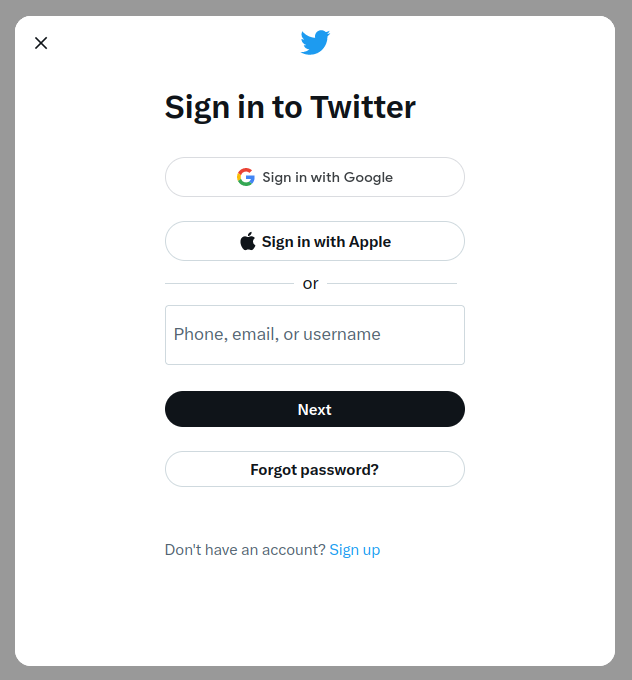
<a href="https://www.theverge.com/2023/6/30/23779764/twitter-blocks-unregistered-users-account-tweets">Twitter has started blocking unregistered users</a>
(The Verge). Though I learned it first via Mastodon, of course.</p>

<p>For example, this is what happens when you go to <a href="http://twitter.com/wikipathways">twitter.com/wikipathways</a>:</p>

<p><img src="/assets/images/twitter_login.png" alt="Screenshot of the Twitter login page." /></p>

<p>Fortunately, <a href="https://wikipathways.org/">WikiPathways</a> does have a <a href="https://fosstodon.org/@wikipathways">Mastodon account</a>,
that anyone can see without having a Mastodon account. You can even follow WikiPathways’s account with
<a href="https://fosstodon.org/@wikipathways.rss">its RSS feed</a>. Dissemination should not be paywalled.</p>

<p>Maybe Musk has been talking to Elsevier and Springer Nature.</p>

<p>Tip: <a href="https://chem-bla-ics.linkedchemistry.info/2022/11/21/finding-mastodon-accounts-with-wikidata.html">Finding Mastodon accounts with Wikidata (a few SPARQL queries) <i class="fa-solid fa-recycle fa-xs"></i></a></p>

<p><strong>Update</strong>: <a href="https://tweakers.net/nieuws/211364/musk-blokkeren-van-niet-ingelogde-gebruikers-op-twitter-is-tijdelijke-maatregel.html">Musk</a> said this
was a temporary measure. The problem was scraping of content, you know, the content we openly share on Twitter. Maybe they could have done this
with APIs. Oh wait, they closed those behind a very expensive paywall.</p>

<p><strong>Update 2</strong>: Another rumor is that the forgot to make a deal with a cloud provider and suddenly were left with a fraction of the computing power.</p>

<p><strong>Update 3</strong>: The access has been restored, so you can start scraping/archiving all interesting tweets again.</p>]]></content><author><name>Egon Willighagen</name></author><category term="twitter" /><category term="mastodon" /><category term="wikipathways" /><summary type="html"><![CDATA[And just like that, without a warning, Twitter changed policies again, and you now need a Twitter account and be logged in to see public tweets: Twitter has started blocking unregistered users (The Verge). Though I learned it first via Mastodon, of course.]]></summary></entry><entry><title type="html">Finding Mastodon accounts with Wikidata (a few SPARQL queries)</title><link href="https://chem-bla-ics.linkedchemistry.info/2022/11/21/finding-mastodon-accounts-with-wikidata.html" rel="alternate" type="text/html" title="Finding Mastodon accounts with Wikidata (a few SPARQL queries)" /><published>2022-11-21T00:00:00+00:00</published><updated>2022-11-21T00:00:00+00:00</updated><id>https://chem-bla-ics.linkedchemistry.info/2022/11/21/finding-mastodon-accounts-with-wikidata</id><content type="html" xml:base="https://chem-bla-ics.linkedchemistry.info/2022/11/21/finding-mastodon-accounts-with-wikidata.html"><![CDATA[<p>There are multiple initiatives to support the migration from Twitter to Mastodon (see also
<a href="2022-11-12-stwittermastodong.markdown">this blog post <i class="fa-solid fa-recycle fa-xs"></i></a>). But
<a href="https://wikidata.org/">Wikidata</a>
should not be forgotten here which has been tracking Mastodon accounts of things in their database:</p>

<p><img src="/assets/images/Screenshot_20221121_075015.png" alt="Screenshot of a Wikidata query showing the growth in number of Mastodon accounts listed in Wikidata." /></p>

<p>So, here are some <a href="https://query.wikidata.org/">Wikidata SPARQL</a> queries to see the uptake:</p>

<ul>
  <li><a href="https://w.wiki/5$3w">Universities with Mastodon</a></li>
  <li><a href="https://w.wiki/5$42">All Mastodon accounts in Wikidata</a> (or <a href="https://w.wiki/5$4S">subset with also a Twitter account</a>)</li>
  <li><a href="https://w.wiki/6zFm">Nobel Prize winners with Mastodon</a></li>
  <li><a href="https://w.wiki/5$4V">Academic journals with Mastodon</a></li>
  <li><a href="https://w.wiki/5$4a">People with Mastodon that published in a PLOS journal</a> (you can pick another publisher)</li>
  <li><a href="https://w.wiki/5$4e">Find your co-authors with your ORCID</a> (just replace my ORCID with yours)</li>
</ul>

<p>If you find yourself missing, back in April I <a href="https://web.archive.org/web/20220428130716/https://threadreaderapp.com/thread/1519193166188007424.html">tweeted <i class="fa-solid fa-box-archive fa-xs"></i></a> (sorry)
how you can find yourself and others in Wikidata and how to add your or their Mastodon account.</p>]]></content><author><name>Egon Willighagen</name></author><category term="mastodon" /><category term="sparql" /><category term="wikidata" /><category term="rdf" /><category term="orcid" /><summary type="html"><![CDATA[There are multiple initiatives to support the migration from Twitter to Mastodon (see also this blog post ). But Wikidata should not be forgotten here which has been tracking Mastodon accounts of things in their database:]]></summary><media:thumbnail xmlns:media="http://search.yahoo.com/mrss/" url="https://chem-bla-ics.linkedchemistry.info/assets/images/Screenshot_20221121_075015.png" /><media:content medium="image" url="https://chem-bla-ics.linkedchemistry.info/assets/images/Screenshot_20221121_075015.png" xmlns:media="http://search.yahoo.com/mrss/" /></entry><entry><title type="html">s/Twitter/Mastodon/g</title><link href="https://chem-bla-ics.linkedchemistry.info/2022/11/12/stwittermastodong.html" rel="alternate" type="text/html" title="s/Twitter/Mastodon/g" /><published>2022-11-12T00:00:00+00:00</published><updated>2022-11-12T00:00:00+00:00</updated><id>https://chem-bla-ics.linkedchemistry.info/2022/11/12/stwittermastodong</id><content type="html" xml:base="https://chem-bla-ics.linkedchemistry.info/2022/11/12/stwittermastodong.html"><![CDATA[<p><img src="/assets/images/Mastodon_logotype_(simple)_new_hue.svg.png" style="width: 30%; display: block; margin-left: auto; margin-right: auto; float: right" alt="Mastodon logo. AGPL source: WikiCommons" />
Yeah, it has been hard to miss it (see e.g. <a href="https://www.nature.com/articles/d41586-022-03668-7">Should I join Mastodon? A scientists’ guide to Twitter’s rival</a>).
Twitter is experiencing some turbulence and <a href="https://joinmastodon.org/">Mastodon</a> has become a very attractive, open source,
community-driven, inclusive alternative. It’s been <a href="https://scholia.toolforge.org/topic/Q27986619">around since 2016</a> and there
is some <a href="https://scholia.toolforge.org/topic/Q27986619">research literature about it</a> already. I got
<a href="https://chem-bla-ics.blogspot.com/2018/09/mastodon-somewhere-between-twitter-and.html">my account in 2018</a>, but did
not start actively using it until earlier this year.</p>

<p>It’s a fascinating platform: federated, community driven, and open source. Oh, and it uses an open standard:
<a href="https://en.wikipedia.org/wiki/ActivityPub">ActivityPub</a>. I have still a lot to learn, but there are some reasons why Mastodon
is better and some reasons why it is worse than Twitter.</p>

<p>First, how can you follow me:</p>

<ul>
  <li>main scholarly account: <a href="https://social.edu.nl/@egonw">https://social.edu.nl/@egonw</a></li>
  <li>politics, foss, hobby account: <a href="https://mastodon.social/@egonw">https://mastodon.social/@egonw</a></li>
</ul>

<p><strong>Better</strong></p>

<p>Well, this is personal, of course, but the following points makes Mastodon for me a better platform:</p>

<ul>
  <li>distributed, open standard
    <ul>
      <li>e.g. no more tweeting of new Zotero entries (soon I hope), just follow my Zotero account</li>
    </ul>
  </li>
  <li>community standards
    <ul>
      <li>you can pick; if you don’t like the terms of your current server (read: service provider), just move to another server</li>
      <li>images must have alternate descriptions on many servers</li>
    </ul>
  </li>
  <li>edit button with version control</li>
  <li>content warnings</li>
  <li>ability to hide anything with #caturday (or any other word)</li>
  <li>detailed annotation of privacy (public, unlisted, etc; no encryption, tho)</li>
</ul>

<p><strong>Worse</strong></p>

<p>Maybe this category can better be called opportunities. After all, it’s the community that defines how it will evolve, just like Twitter did (which did not originally have hashtags, retweets). One big elephant in the scientific social media world wright now is the uncertainty about searching and indexing: will it be useful as (post-publication) platform? will we be able to use if for conference tweeting?</p>

<p>Another aspect is that in some countries mobile internet is deeply coupled with big companies. Think coupling of access with free whatsapp.</p>

<p>Finally: growing pains. The platform is growing fast, and right now it can be hard to find a server that accepts new accounts.</p>

<p><strong>Tips?</strong></p>

<p>Sure. Start with <a href="https://fedi.tips/">https://fedi.tips/</a>. Have fun! And I love to hear what your tips are :)</p>

<p>Image from <a href="https://commons.wikimedia.org/wiki/File:Mastodon_logotype_(simple)_new_hue.svg">WikiCommons</a>.</p>]]></content><author><name>Egon Willighagen</name></author><category term="mastodon" /><category term="twitter" /><category term="justdoi:10.1038/d41586-022-03668-7" /><summary type="html"><![CDATA[Yeah, it has been hard to miss it (see e.g. Should I join Mastodon? A scientists’ guide to Twitter’s rival). Twitter is experiencing some turbulence and Mastodon has become a very attractive, open source, community-driven, inclusive alternative. It’s been around since 2016 and there is some research literature about it already. I got my account in 2018, but did not start actively using it until earlier this year.]]></summary><media:thumbnail xmlns:media="http://search.yahoo.com/mrss/" url="https://chem-bla-ics.linkedchemistry.info/assets/images/Mastodon_logotype_(simple)_new_hue.svg.png" /><media:content medium="image" url="https://chem-bla-ics.linkedchemistry.info/assets/images/Mastodon_logotype_(simple)_new_hue.svg.png" xmlns:media="http://search.yahoo.com/mrss/" /></entry></feed>