<?xml version="1.0" encoding="utf-8"?><feed xmlns="http://www.w3.org/2005/Atom" ><generator uri="https://jekyllrb.com/" version="4.3.4">Jekyll</generator><link href="https://chem-bla-ics.linkedchemistry.info/feed/by_tag/google.xml" rel="self" type="application/atom+xml" /><link href="https://chem-bla-ics.linkedchemistry.info/" rel="alternate" type="text/html" /><updated>2026-04-19T09:50:36+00:00</updated><id>https://chem-bla-ics.linkedchemistry.info/feed/by_tag/google.xml</id><title type="html">chem-bla-ics</title><subtitle>Chemblaics (pronounced chem-bla-ics) is the science that uses open science and computers to solve problems in chemistry, biochemistry and related fields.</subtitle><author><name>Egon Willighagen</name></author><entry><title type="html">CiTO annotations with Zotero 8 and Google Docs</title><link href="https://chem-bla-ics.linkedchemistry.info/2026/04/15/cito-annotations-with-zotero-8-and-google-docs.html" rel="alternate" type="text/html" title="CiTO annotations with Zotero 8 and Google Docs" /><published>2026-04-15T00:00:00+00:00</published><updated>2026-04-15T00:00:00+00:00</updated><id>https://chem-bla-ics.linkedchemistry.info/2026/04/15/cito-annotations-with-zotero-8-and-google-docs</id><content type="html" xml:base="https://chem-bla-ics.linkedchemistry.info/2026/04/15/cito-annotations-with-zotero-8-and-google-docs.html"><![CDATA[<p>This is a bit of work I did already in March, but with the <a href="https://www.zotero.org/blog/zotero-9/">Zotero 9 release</a> I was reminded
that I wanted to blog this. Ideally, it will trigger some further discussion and maybe a future Zotero/Google Docs version supports
bibliography-level annotations too.</p>

<p>Still, <a href="https://www.zotero.org/blog/zotero-8/">Zotero</a> 8 brought in <em>prefix</em> and <em>suffix</em> support, and I was wondering if this could
be used for CiTO citation intent annotations. And it can. This was the result, and make of it what you want:</p>

<p><img src="/assets/images/zotero_notes.png" alt="" /></p>]]></content><author><name>Egon Willighagen</name></author><category term="cito" /><category term="zotero" /><category term="google" /><summary type="html"><![CDATA[This is a bit of work I did already in March, but with the Zotero 9 release I was reminded that I wanted to blog this. Ideally, it will trigger some further discussion and maybe a future Zotero/Google Docs version supports bibliography-level annotations too.]]></summary><media:thumbnail xmlns:media="http://search.yahoo.com/mrss/" url="https://chem-bla-ics.linkedchemistry.info/assets/images/zotero_notes.png" /><media:content medium="image" url="https://chem-bla-ics.linkedchemistry.info/assets/images/zotero_notes.png" xmlns:media="http://search.yahoo.com/mrss/" /></entry><entry><title type="html">Also new this week: “Google Dataset Search”</title><link href="https://chem-bla-ics.linkedchemistry.info/2018/09/08/also-new-this-week-google-dataset-search.html" rel="alternate" type="text/html" title="Also new this week: “Google Dataset Search”" /><published>2018-09-08T00:00:00+00:00</published><updated>2018-09-08T00:00:00+00:00</updated><id>https://chem-bla-ics.linkedchemistry.info/2018/09/08/also-new-this-week-google-dataset-search</id><content type="html" xml:base="https://chem-bla-ics.linkedchemistry.info/2018/09/08/also-new-this-week-google-dataset-search.html"><![CDATA[<p>There was a lot of Open Science news this week. The <a href="https://www.blog.google/products/search/making-it-easier-discover-datasets/">announcement</a>
of the <a href="https://toolbox.google.com/datasetsearch">Google Dataset Search</a> was one of them:</p>

<p><img src="/assets/images/google_dataset_search.png" alt="" /></p>

<p>Of course, I first tried searching for “<a href="https://toolbox.google.com/datasetsearch/search?query=RDF%20chemistry&amp;docid=hiQ14TdWzjx%2FQ37gAAAAAA%3D%3D">RDF chemistry</a>”
which shows some of my data sets (and a lot more):</p>

<p><img src="/assets/images/google_dataset_search2.png" alt="" /></p>

<p>It picks up data from many sources, such as <a href="https://figshare.com/">Figshare</a> in this image. That means it also works
(well, sort of, as <a href="https://twitter.com/baoilleach/status/1037986030266318848">Noel O’Boyle noticed</a>) for
supplementary information from the <a href="https://jcheminf.biomedcentral.com/">Journal of Cheminformatics</a>.</p>

<p>It picks up metadata in several ways, among which <a href="http://schemas.org/">schemas.org</a>. So, next week we’ll see if
we can get <a href="http://enanomapper.net/">eNanoMapper</a> extended to spit compatible JSON-LD for its data sets, called “bundles”.</p>

<h2 id="integrated-with-google-scholar">Integrated with Google Scholar?</h2>

<p>While the URL for the search engine does not suggest the service is more than a 20% project, we can
hope it will stay around like Google Scholar has been. But I do hope they will further integrate it
with Scholar. For example, in the above figure, it did pick up that I am the author of that data set
(well, repurposed from an effort of <a href="https://twitter.com/rapodaca">Rich Apodaca</a>), it did not figure
out that I am also on Scholar.</p>

<p>So, these data sets do not show up in your Google Scholar profile yet, but they <strong><em>must</em></strong>. Time will
tell where this data search engine is going. There are many interesting features, and given the amount
of online attention, they won’t stop development just yet, and I expect to discover more and better
features in the next months. Give it a spin!</p>]]></content><author><name>Egon Willighagen</name></author><category term="data" /><category term="google" /><summary type="html"><![CDATA[There was a lot of Open Science news this week. The announcement of the Google Dataset Search was one of them:]]></summary><media:thumbnail xmlns:media="http://search.yahoo.com/mrss/" url="https://chem-bla-ics.linkedchemistry.info/assets/images/google_dataset_search2.png" /><media:content medium="image" url="https://chem-bla-ics.linkedchemistry.info/assets/images/google_dataset_search2.png" xmlns:media="http://search.yahoo.com/mrss/" /></entry><entry><title type="html">My Google Scholar Citations profile arrived</title><link href="https://chem-bla-ics.linkedchemistry.info/2011/08/02/my-google-scholar-citations-profile.html" rel="alternate" type="text/html" title="My Google Scholar Citations profile arrived" /><published>2011-08-02T00:00:00+00:00</published><updated>2011-08-02T00:00:00+00:00</updated><id>https://chem-bla-ics.linkedchemistry.info/2011/08/02/my-google-scholar-citations-profile</id><content type="html" xml:base="https://chem-bla-ics.linkedchemistry.info/2011/08/02/my-google-scholar-citations-profile.html"><![CDATA[<p><a href="http://en.wikipedia.org/wiki/Web_of_Science">Web of Science</a> is my de facto standard for citation statistics (I need these for
<a href="http://vr.se/">VR</a> grant applications), and defines the lower limit of citations (it is pretty clean, but I do have to ping them now
and then to fix something). The public front-end of it is <a href="http://www.researcherid.com/rid/C-6136-2008">Researcher ID</a>. There is an
<a href="http://academic.research.microsoft.com/Author/2893110/egon-l-willighagen">Microsoft initiative</a>, which looks clean but doesn’t work
on Linux for the nicer things, but the coverage of journals is pretty bad in my field, giving a biased (downwards)
<a href="http://en.wikipedia.org/wiki/H-index">H-index</a>. And
<a href="http://web.archive.org/web/20110815142119/http://www.citeulike.org/user/egonw">CiteULike <i class="fa-solid fa-box-archive fa-xs"></i></a>
and <a href="http://www.mendeley.com/profiles/egon-willighagen/">Mendeley</a> focus more on your publications than on citations (though the former
has <a href="http://opencitations.wordpress.com/2010/10/21/use-of-cito-in-citeulike/">great CiTO support</a>!).</p>

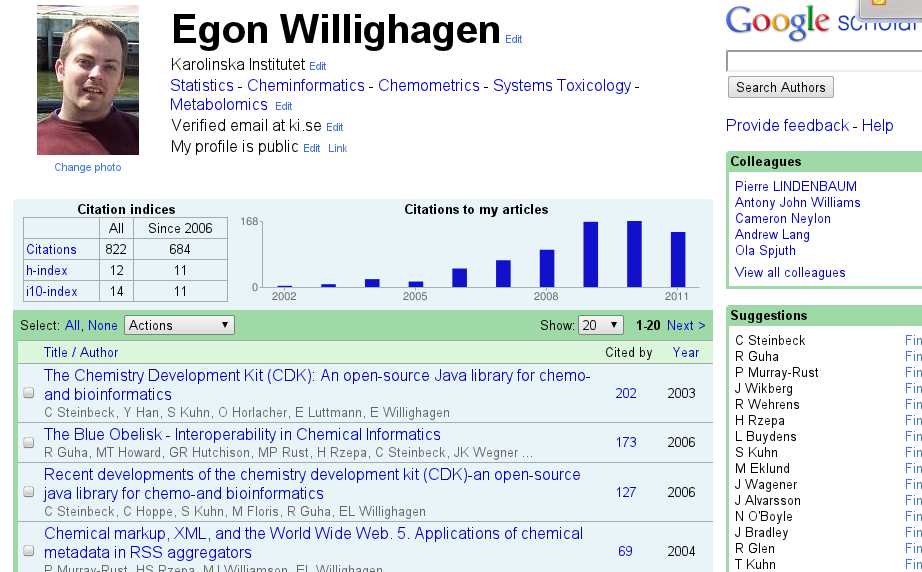
<p>Then <a href="http://googlescholar.blogspot.com/2011/07/google-scholar-citations.html">Google Scholar Citations</a> (GSC) shows up. While it
does not look as pretty as competing products, it compensates that with a wide coverage of literature (for example, it supports the
<a href="http://jcheminf.com/">JChemInf</a>, which Web-of-Science currently does not; and I happen to publish a lot in that journal recently),
books, and reports, while keeping false positives fairly low. Thus, it provides an upper limit of my citations statistics, but one
I am pretty happy confident about. And my H-index is quite comparable anyway. This is what
<a href="http://scholar.google.com/citations?user=u8SjMZ0AAAAJ">my profile</a> looks like:</p>

<p><img src="/assets/images/gsc.png" alt="" /></p>

<p>So, these statistics have two purposes to me: 1. grant applications, and 2. I like to know what people based theirs on my research. (Well,
OK, 3. it helps me understand why I work so hard on too many things.)</p>

<p>Now the question is, will GSC take off. Will it replace <a href="http://orcid.org/">ORCID</a>? Will they join ORCID? Will GSC get a good API?
Who will write the first <a href="http://www.biomedcentral.com/1471-2105/8/487">userscript</a> to make the GUI fancier? Will GSC support CiTO?
Will GSC start using microformats or RDFa? What mashups can we expect between bibliographic databases? Will new entries automatically
be posted to Google+? Will it have a button to autocreate a blog post when a paper gets cited 100, 500, or a 1000 times? Will GSC
support <a href="http://friendfeed.com/search?q=%23altmetrics">#altmetrics</a>?</p>]]></content><author><name>Egon Willighagen</name></author><category term="google" /><category term="citeulike" /><category term="doi:10.1186/1471-2105-8-487" /><summary type="html"><![CDATA[Web of Science is my de facto standard for citation statistics (I need these for VR grant applications), and defines the lower limit of citations (it is pretty clean, but I do have to ping them now and then to fix something). The public front-end of it is Researcher ID. There is an Microsoft initiative, which looks clean but doesn’t work on Linux for the nicer things, but the coverage of journals is pretty bad in my field, giving a biased (downwards) H-index. And CiteULike and Mendeley focus more on your publications than on citations (though the former has great CiTO support!).]]></summary><media:thumbnail xmlns:media="http://search.yahoo.com/mrss/" url="https://chem-bla-ics.linkedchemistry.info/assets/images/gsc.png" /><media:content medium="image" url="https://chem-bla-ics.linkedchemistry.info/assets/images/gsc.png" xmlns:media="http://search.yahoo.com/mrss/" /></entry><entry><title type="html">Google Translation in Gmail in action</title><link href="https://chem-bla-ics.linkedchemistry.info/2010/02/03/google-translation-in-gmail-in-action.html" rel="alternate" type="text/html" title="Google Translation in Gmail in action" /><published>2010-02-03T00:10:00+00:00</published><updated>2010-02-03T00:10:00+00:00</updated><id>https://chem-bla-ics.linkedchemistry.info/2010/02/03/google-translation-in-gmail-in-action</id><content type="html" xml:base="https://chem-bla-ics.linkedchemistry.info/2010/02/03/google-translation-in-gmail-in-action.html"><![CDATA[<p> </p>

<p><img src="/assets/images/gmailTranslate1.png" alt="" /></p>]]></content><author><name>Egon Willighagen</name></author><category term="google" /><summary type="html"><![CDATA[ ]]></summary><media:thumbnail xmlns:media="http://search.yahoo.com/mrss/" url="https://chem-bla-ics.linkedchemistry.info/assets/images/gmailTranslate1.png" /><media:content medium="image" url="https://chem-bla-ics.linkedchemistry.info/assets/images/gmailTranslate1.png" xmlns:media="http://search.yahoo.com/mrss/" /></entry><entry><title type="html">Google Wave Invite: but you need to work on the CDK and the CDKitty robot</title><link href="https://chem-bla-ics.linkedchemistry.info/2009/10/01/google-wave-invite-but-you-need-to-work.html" rel="alternate" type="text/html" title="Google Wave Invite: but you need to work on the CDK and the CDKitty robot" /><published>2009-10-01T00:10:00+00:00</published><updated>2009-10-01T00:10:00+00:00</updated><id>https://chem-bla-ics.linkedchemistry.info/2009/10/01/google-wave-invite-but-you-need-to-work</id><content type="html" xml:base="https://chem-bla-ics.linkedchemistry.info/2009/10/01/google-wave-invite-but-you-need-to-work.html"><![CDATA[<p>I just posted to below email to the cdk-user mailing list. Next Monday, I’ll decide.</p>

<blockquote>
  <p>Hi all,</p>

  <p>unless you have not read any news in the last two days, you will have
seen that Google is rolling out a second batch of <a href="http://en.wikipedia.org/wiki/Google_Wave">Google Wave</a>
accounts… I have one invite for someone who wants to co-develop the
CDKitty robot, which adds <a href="http://cdk.sf.net/">CDK</a>-based functionality to Google Wave…</p>

  <p>The code is at: <a href="https://github.com/egonw/cdkitty">https://github.com/egonw/cdkitty</a></p>

  <p>If you are interested in the account, please email me offline with:</p>

  <ul>
    <li>how you think you can contribute to the robot</li>
    <li>why you want to do that</li>
    <li>how much time you will have for it</li>
  </ul>

  <p>The position is open to anyway, and consider your email an application
to the position :) (and, if you are a student, we could even try to
arrange <a href="http://www.uu.se/">Uppsala University</a> credit points, if you can work 20 weeks
full time on it).</p>

  <p>Egon
```</p>
</blockquote>

<p>BTW, existing Google Wave users can invite the robot by adding <em>chemdevelkit@appspot.com</em>.</p>]]></content><author><name>Egon Willighagen</name></author><category term="google" /><category term="wave" /><category term="cdk" /><summary type="html"><![CDATA[I just posted to below email to the cdk-user mailing list. Next Monday, I’ll decide.]]></summary></entry><entry><title type="html">Google Wave robot for CDK functionality</title><link href="https://chem-bla-ics.linkedchemistry.info/2009/09/02/google-wave-robot-for-cdk-functionality.html" rel="alternate" type="text/html" title="Google Wave robot for CDK functionality" /><published>2009-09-02T00:00:00+00:00</published><updated>2009-09-02T00:00:00+00:00</updated><id>https://chem-bla-ics.linkedchemistry.info/2009/09/02/google-wave-robot-for-cdk-functionality</id><content type="html" xml:base="https://chem-bla-ics.linkedchemistry.info/2009/09/02/google-wave-robot-for-cdk-functionality.html"><![CDATA[<p>I was really happy to hear early last week that I was invited to take part in the <a href="https://chem-bla-ics.linkedchemistry.info/2009/08/17/social-web-does-not-wait-for-bioclipse.html">Google Wave <i class="fa-solid fa-recycle fa-xs"></i></a> beta,
and received my account details this Monday, while at attending (and <a href="http://chem-bla-ics.blogspot.com/2009/09/open-knowledge-reproducibility-in.html">speaking at</a>) the GDCh
Wissenschaftsforum Chemie 2009. Yesterday was a travel day, and while working on course material for the <a href="http://www.pharmbio.org/">Pharmaceutical Bioinformatics</a> course that
uses <a href="http://www.bioclipse.net/">Bioclipse</a>, I set up an Eclipse environment for development of a wave robot. <a href="http://code.google.com/apis/wave/extensions/robots/java-tutorial.html">Documentation</a>
was very clear, and deployment on <a href="http://www.appspot.com/">Appspot</a> one click on the appropriate button. Great work from the people from Google! It was all so easy, I could not
resist pushing things a bit further, and looked carefully at other robots, like <a href="http://www.chemspider.com/blog/chemspidey-rides-the-wave-courtesy-of-cameron-neylon.html">ChemSpidey</a>
by <a href="http://blog.openwetware.org/scienceintheopen/2009/08/27/writing-a-wave-robot-some-thoughts-on-good-practice-for-research-robots/">Cameron</a> and
<a href="http://blogs.nature.com/wp/nascent/2009/07/igor_a_google_wave_robot_to_ma.html">Igor</a> by <a href="http://www.ghastlyfop.com/blog/">Euan</a>, to see how text replacement is done,
and wrote my first functional robot, <em>CDKitty (<strong>chemdevelkit@appspot.com</strong>)</em>:</p>

<p><img src="/assets/images/cdkitty.png" alt="" /></p>

<p>It seems that it is a policy that wave robot names end with <code class="language-plaintext highlighter-rouge">-y</code>, so CDKitty sounded somewhat appropriate. Anyways, the robot is not overly functional yet, but it has
a <em>profile</em> (which took some extra googling) and one function <strong><em>mwOf</em></strong>. Add the robot to your wave and prefix a molecular formula with <code class="language-plaintext highlighter-rouge">mwOf:</code>,
and CDKitty will calculate the molecular formula on the fly. Clearly, this opens up a whole new application world for the <a href="http://cdk.sf.net/">CDK</a>,
and you can leave feature requests at the <a href="http://github.com/egonw/CDKitty/issues">issue tracker</a> of the <a href="http://github.com/egonw/CDKitty">project home at GitHub</a>.
Patches are most welcome too! :)</p>

<p>BTW, it seems I messed up the regular expression, which seems not to be including the last digit (filed as <a href="http://github.com/egonw/CDKitty/issues/#issue/1">issue 1</a>).</p>

<p>Almost forgot to add that: many thanx to <a href="http://blog.openwetware.org/scienceintheopen/">Cameron</a> for the insightful discussions we had over applecider,
Weisse and German dinner on Monday evening!</p>]]></content><author><name>Egon Willighagen</name></author><category term="cdk" /><category term="cheminf" /><category term="google" /><category term="wave" /><summary type="html"><![CDATA[I was really happy to hear early last week that I was invited to take part in the Google Wave beta, and received my account details this Monday, while at attending (and speaking at) the GDCh Wissenschaftsforum Chemie 2009. Yesterday was a travel day, and while working on course material for the Pharmaceutical Bioinformatics course that uses Bioclipse, I set up an Eclipse environment for development of a wave robot. Documentation was very clear, and deployment on Appspot one click on the appropriate button. Great work from the people from Google! It was all so easy, I could not resist pushing things a bit further, and looked carefully at other robots, like ChemSpidey by Cameron and Igor by Euan, to see how text replacement is done, and wrote my first functional robot, CDKitty (chemdevelkit@appspot.com):]]></summary><media:thumbnail xmlns:media="http://search.yahoo.com/mrss/" url="https://chem-bla-ics.linkedchemistry.info/assets/images/cdkitty.png" /><media:content medium="image" url="https://chem-bla-ics.linkedchemistry.info/assets/images/cdkitty.png" xmlns:media="http://search.yahoo.com/mrss/" /></entry><entry><title type="html">The Social Web does not wait for Bioclipse… here comes Google Wave</title><link href="https://chem-bla-ics.linkedchemistry.info/2009/08/17/social-web-does-not-wait-for-bioclipse.html" rel="alternate" type="text/html" title="The Social Web does not wait for Bioclipse… here comes Google Wave" /><published>2009-08-17T00:00:00+00:00</published><updated>2009-08-17T00:00:00+00:00</updated><id>https://chem-bla-ics.linkedchemistry.info/2009/08/17/social-web-does-not-wait-for-bioclipse</id><content type="html" xml:base="https://chem-bla-ics.linkedchemistry.info/2009/08/17/social-web-does-not-wait-for-bioclipse.html"><![CDATA[<p><a href="https://wave.google.com/">Google Wave</a> is going to change the web. It’s the end of Google Docs, and likely many other services. It’s
going to be Open Source and being a Wave Provider will not be restricted to Google. This will be enough to make this a success. If
you haven’t watched the full video demo yet, please have a look yourself:</p>

<object width="560" height="340"><param name="movie" value="https://www.youtube.com/v/v_UyVmITiYQ&amp;hl=en&amp;fs=1&amp;" />
  <param name="allowFullScreen" value="true" /><param name="allowscriptaccess" value="always" />
  <embed src="https://www.youtube.com/v/v_UyVmITiYQ&amp;hl=en&amp;fs=1&amp;" type="application/x-shockwave-flash" allowscriptaccess="always" allowfullscreen="true" width="560" height="340" wmode="opaque" />
</object>

<p>I left some thoughts and notes on FriendFeed, but they got lost.</p>]]></content><author><name>Egon Willighagen</name></author><category term="google" /><category term="wave" /><summary type="html"><![CDATA[Google Wave is going to change the web. It’s the end of Google Docs, and likely many other services. It’s going to be Open Source and being a Wave Provider will not be restricted to Google. This will be enough to make this a success. If you haven’t watched the full video demo yet, please have a look yourself:]]></summary></entry><entry><title type="html">RDF for chemistry</title><link href="https://chem-bla-ics.linkedchemistry.info/2009/02/25/rdf-for-chemistry.html" rel="alternate" type="text/html" title="RDF for chemistry" /><published>2009-02-25T00:00:00+00:00</published><updated>2009-02-25T00:00:00+00:00</updated><id>https://chem-bla-ics.linkedchemistry.info/2009/02/25/rdf-for-chemistry</id><content type="html" xml:base="https://chem-bla-ics.linkedchemistry.info/2009/02/25/rdf-for-chemistry.html"><![CDATA[<p><a href="http://www.iscb.org/cms_addon/conferences/cshals2009/io-informatics-news.php">C-SHALS 2009</a> (<em>Conference on Semantics in Healthcare and Life Sciences</em>)
has just started, and has coverage in a <a href="http://cshals.blogspot.com/">blog</a> and in a <a href="http://friendfeed.com/rooms/cshals-2009">FriendFeed room</a>. It
nicely coincides with Rich’ blog on <a href="https://doi.org/10.59350/a2w3n-cvb94">What the Heck is the Semantic Web? <i class="fa-solid fa-recycle fa-xs"></i></a>,
and the RDF work I have recently done on <a href="https://chem-bla-ics.linkedchemistry.info/2009/02/17/dbpedia-enters-rdfopenmoleculesnet.html">rdf.openmolecules.net <i class="fa-solid fa-recycle fa-xs"></i></a>
and <a href="https://chem-bla-ics.linkedchemistry.info/2009/02/22/solubility-data-in-bioclipse-2-handling.html">Bioclipse <i class="fa-solid fa-recycle fa-xs"></i></a>. (Oh, do I wish I could have attended that
conference.)</p>

<p>Anyway, I was proudly surprised to see <a href="http://chem-bla-ics.blogspot.com/search?q=sechemtic">sechemtic</a> show up in the
<a href="http://cambridgesemantics.com/2008/09/sem-web-introduction/">Semantic Web technologies: Introduction and Survey</a> tutorial by Lee Feigenbaum of
<a href="http://cambridgesemantics.com/">Cambridge Semantics</a>:</p>

<p><img src="/assets/images/sechemticCSHALS.png" alt="" /></p>

<p><strong>Use?</strong> Rich was asking what could be done with RDF for chemistry… here is a <a href="http://semantically-challenged.blogspot.com/2008/11/cool-uris-for-molecules.html">nice mashup by Phil Ashworth</a>:
<a href="http://homepage.ntlworld.com/philnjo/phil/chemdemo/chemdemo1.html">a Google Map</a> showing the locations where certain chemical can be bought:</p>

<p><img src="/assets/images/googleChemMashup.png" alt="" /></p>]]></content><author><name>Egon Willighagen</name></author><category term="google" /><category term="chemistry" /><category term="rdf" /><category term="semweb" /><category term="justdoi:10.59350/a2w3n-cvb94" /><summary type="html"><![CDATA[C-SHALS 2009 (Conference on Semantics in Healthcare and Life Sciences) has just started, and has coverage in a blog and in a FriendFeed room. It nicely coincides with Rich’ blog on What the Heck is the Semantic Web? , and the RDF work I have recently done on rdf.openmolecules.net and Bioclipse . (Oh, do I wish I could have attended that conference.)]]></summary><media:thumbnail xmlns:media="http://search.yahoo.com/mrss/" url="https://chem-bla-ics.linkedchemistry.info/assets/images/sechemticCSHALS.png" /><media:content medium="image" url="https://chem-bla-ics.linkedchemistry.info/assets/images/sechemticCSHALS.png" xmlns:media="http://search.yahoo.com/mrss/" /></entry><entry><title type="html">Blogger Degrading…</title><link href="https://chem-bla-ics.linkedchemistry.info/2009/02/12/blogger-degrading.html" rel="alternate" type="text/html" title="Blogger Degrading…" /><published>2009-02-12T00:00:00+00:00</published><updated>2009-02-12T00:00:00+00:00</updated><id>https://chem-bla-ics.linkedchemistry.info/2009/02/12/blogger-degrading</id><content type="html" xml:base="https://chem-bla-ics.linkedchemistry.info/2009/02/12/blogger-degrading.html"><![CDATA[<p>Did others notice this too? The <a href="http://www.blogger.com/">blogger.com</a> <em>Links to this post</em> functionality seems seriously broken…
once a rather useful feature, it has now degradated to a useless state:</p>

<p><img src="/assets/images/bloggerDegrading.png" alt="" /></p>

<p>I’m quite sure a post of <a href="http://phylogenomics.blogspot.com/2008/10/mccain-palin-going-after-fruit-flies.html">last October</a> cannot
link to the <a href="http://usefulchem.blogspot.com/2009/02/substructure-searching-on-ons.html">Substructure searching on ONS solubility data</a>
item Jean-Claude posted today.</p>]]></content><author><name>Egon Willighagen</name></author><category term="blog" /><category term="google" /><summary type="html"><![CDATA[Did others notice this too? The blogger.com Links to this post functionality seems seriously broken… once a rather useful feature, it has now degradated to a useless state:]]></summary><media:thumbnail xmlns:media="http://search.yahoo.com/mrss/" url="https://chem-bla-ics.linkedchemistry.info/assets/images/bloggerDegrading.png" /><media:content medium="image" url="https://chem-bla-ics.linkedchemistry.info/assets/images/bloggerDegrading.png" xmlns:media="http://search.yahoo.com/mrss/" /></entry><entry><title type="html">Mapping Peoples Interest: Google Insight Search</title><link href="https://chem-bla-ics.linkedchemistry.info/2008/08/06/mapping-peoples-interest-google-insight.html" rel="alternate" type="text/html" title="Mapping Peoples Interest: Google Insight Search" /><published>2008-08-06T00:00:00+00:00</published><updated>2008-08-06T00:00:00+00:00</updated><id>https://chem-bla-ics.linkedchemistry.info/2008/08/06/mapping-peoples-interest-google-insight</id><content type="html" xml:base="https://chem-bla-ics.linkedchemistry.info/2008/08/06/mapping-peoples-interest-google-insight.html"><![CDATA[<p><a href="https://google.com/">Google</a> has a new service: <a href="http://www.google.com/insights/search/">Google Insight Search</a>, and I was wondering if
it could tell me to use <em>chemoinformatics or cheminformatics</em>… No, it can’t. In both there is a declining interest (only chemoinformatics
shown):</p>

<p><img src="/assets/images/chemoinf.trend.png" alt="" /></p>

<p>More interesting is that the interest in chemoinformatics only comes from India:</p>

<p><img src="/assets/images/chemoinf.map.png" alt="" /></p>

<p>This tool holds for both flavors too.</p>]]></content><author><name>Egon Willighagen</name></author><category term="google" /><category term="cheminf" /><summary type="html"><![CDATA[Google has a new service: Google Insight Search, and I was wondering if it could tell me to use chemoinformatics or cheminformatics… No, it can’t. In both there is a declining interest (only chemoinformatics shown):]]></summary><media:thumbnail xmlns:media="http://search.yahoo.com/mrss/" url="https://chem-bla-ics.linkedchemistry.info/assets/images/chemoinf.map.png" /><media:content medium="image" url="https://chem-bla-ics.linkedchemistry.info/assets/images/chemoinf.map.png" xmlns:media="http://search.yahoo.com/mrss/" /></entry></feed>