<?xml version="1.0" encoding="utf-8"?><feed xmlns="http://www.w3.org/2005/Atom" ><generator uri="https://jekyllrb.com/" version="4.3.4">Jekyll</generator><link href="https://chem-bla-ics.linkedchemistry.info/feed/by_tag/fair4chemnl.xml" rel="self" type="application/atom+xml" /><link href="https://chem-bla-ics.linkedchemistry.info/" rel="alternate" type="text/html" /><updated>2026-10-07T12:46:55+00:00</updated><id>https://chem-bla-ics.linkedchemistry.info/feed/by_tag/fair4chemnl.xml</id><title type="html">chem-bla-ics</title><subtitle>Chemblaics (pronounced chem-bla-ics) is the science that uses open science and computers to solve problems in chemistry, biochemistry and related fields.</subtitle><author><name>Egon Willighagen</name></author><entry><title type="html">FAIR Implementation Profiles: Chemistry</title><link href="https://chem-bla-ics.linkedchemistry.info/2026/05/05/fair-implementation-profiles.html" rel="alternate" type="text/html" title="FAIR Implementation Profiles: Chemistry" /><published>2026-05-05T00:00:00+00:00</published><updated>2026-05-05T00:00:00+00:00</updated><id>https://chem-bla-ics.linkedchemistry.info/2026/05/05/fair-implementation-profiles</id><content type="html" xml:base="https://chem-bla-ics.linkedchemistry.info/2026/05/05/fair-implementation-profiles.html"><![CDATA[<p>I have had this on my todo list for way too long: writing about <a href="https://www.go-fair.org/how-to-go-fair/fair-implementation-profile/">FAIR Implementation Profiles</a>,
or FIPs for short (see also doi:<a href="https://doi.org/10.1007/978-3-030-65847-2_13">10.1007/978-3-030-65847-2_13</a>):</p>

<blockquote>
  <p>The FIP is a collection of FAIR implementation choices made by a community of practice for each of the FAIR Principles.</p>
</blockquote>

<p>In the early GO FAIR days, people referred to the <em>challenges and choices</em>. FIPs are a formal approach to report the choices.
The days of the <em>implementation networks</em>, like the Chemistry Implementation Network (doi:<a href="https://doi.org/10.1162/dint_a_00035">10.1162/dint_a_00035</a>),
or the AdvancedNano network (doi:<a href="https://doi.org/10.1016/j.impact.2024.100513">10.1016/j.impact.2024.100513</a>). For the first,
we absolutely agreed on the InChI, for example, but we never wrote that down as a FIP. But even without FIPs, the
idea was that communities could learn from each other, could converge. This is where the term
<a href="https://www.go-fair.org/today/fair-matrix/">FAIR Convergence Matrix</a> comes from. (I had forgotten I was actually
part of the matching Working Group. If only I had dedicated funding for it at the time.)</p>

<p>Now, I had on my wishlist to write up a list over FIPs around chemistry. This is relevant for the
<a href="https://video.edu.nl/w/pjf5vFFU287AGfYA2SXpE5">FAIR4ChemNL</a> project, but obviously beyond that. And while we did
a lot of FAIRification work in, particularly, the nanosafety cluster projects (eNanoMapper, NanoCommons, NanoSolveIT,
RiskGONE, and SbD4Nano), a lot of this never was formalized as FIPs. Second, various relevant standards have been
proposed in chemistry, for <a href="https://doi.org/10.1186/s13321-021-00520-4">chemical compounds</a> and
<a href="https://doi.org/10.1021/acsenvironau.5c00314">transformation products</a>, among plenty of other things.
But during the first <a href="https://elixir-europe.org/communities/toxicology">ELIXIR Toxicology Community</a>
workshop in Utrecht, we had FIPs on the agenda too (see <a href="https://doi.org/10.37044/osf.io/un2rw">this report</a>).</p>

<h2 id="fips-in-chemistry">FIPs in Chemistry</h2>

<p>But while I had already several browser tabs open for months, I never could find the courage to start making the list. Silly.
Therefore, this list should be considered a start. I don’t think it is exhaustive. I know there is an index somewhere,
but I cannot find back that browser tab. Additions are most welcome: I will update this post (thanks to git and Rogue Scholar).
In brackets I list (a selection of) the FAIR enabling resources mentioned in that FIP.</p>

<ul>
  <li><a href="https://fip-wizard.ds-wizard.org/wizard/projects/2f1c0e80-3c9d-4967-9dc6-fd05fac96269/metrics">Adverse Outcome Pathways FIP</a> (DOI, AOP Wiki ID)</li>
  <li><a href="https://docs.google.com/spreadsheets/d/1yNEYzJRbx10RkuqJmLcO7RPOq-nrimUKQLQW6uWzfho/edit?gid=127295437#gid=127295437">Toxicogenomics</a> (ISA-Tab, BioStudies, ArrayExpress)</li>
  <li><a href="https://fip-wizard.ds-wizard.org/wizard/projects/b0d84171-4556-46ed-9ace-c1c58db38092">WorldFAIR WP04 NANOMATERIALS FIP01</a> (DOI, ORCID, UUID, ROR, InChI, DataCite, QMRF, RDF/JSON-LD, OWL; doi<a href="https://doi.org/10.5281/zenodo.7378109">10.5281/zenodo.7378109</a>)</li>
</ul>

<p>Is that all? No, I do not think so, but this is all I can easily find (ironically). Well, I guess you now see why I have had a so much trouble starting to write down this post…
Someone will surely give me some pointers…</p>

<h2 id="ackknowledgments">Ackknowledgments</h2>

<p>I also like to thank all the people involved in these FIPs. I strongly encourage you to look up all the people who
wrote them down. I also like to thank the INTOXICOM workshop FIP experts Iseult Lynch and Gerhard Burger for
sharing their knowledge.</p>

<p>Finally, I recommend checking out the <a href="https://fip.fair-wizard.com/">FIP Wizard</a>.</p>]]></content><author><name>Egon Willighagen</name></author><category term="fair" /><category term="doi:10.1162/dint_a_00035" /><category term="doi:10.1016/J.IMPACT.2024.100513" /><category term="cito:citesAsPotentialSolution:10.1186/s13321-021-00520-4" /><category term="cito:citesAsPotentialSolution:10.1021/acsenvironau.5c00314" /><category term="doi:10.37044/OSF.IO/UN2RW" /><category term="cito:citesForInformation:10.1007/978-3-030-65847-2_13" /><category term="justdoi:10.5281/zenodo.7378109" /><category term="fair4chemnl" /><summary type="html"><![CDATA[I have had this on my todo list for way too long: writing about FAIR Implementation Profiles, or FIPs for short (see also doi:10.1007/978-3-030-65847-2_13):]]></summary></entry><entry><title type="html">The TDCC NES Col-Lab Retreat</title><link href="https://chem-bla-ics.linkedchemistry.info/2026/02/21/the-tdcc-nes-col-lab-retreat.html" rel="alternate" type="text/html" title="The TDCC NES Col-Lab Retreat" /><published>2026-02-21T00:00:00+00:00</published><updated>2026-02-21T00:00:00+00:00</updated><id>https://chem-bla-ics.linkedchemistry.info/2026/02/21/the-tdcc-nes-col-lab-retreat</id><content type="html" xml:base="https://chem-bla-ics.linkedchemistry.info/2026/02/21/the-tdcc-nes-col-lab-retreat.html"><![CDATA[<p>Last autumn two TDCC projects started, <em>FAIR4ChemNL</em> (<a href="https://chem-bla-ics.linkedchemistry.info/2026/02/08/open-infrastructures.html">with the PeerTube channel</a>
and doi:<a href="https://doi.org/10.61686/XVYQV45374">10.61686/XVYQV45374</a>) and <em>FAIRify for metabolomics data</em>
(doi:<a href="https://doi.org/10.61686/CSGIP04334">10.61686/CSGIP04334</a>). But I haven’t written much on either yet and what the role is our research group in these projects.</p>

<p>Let’s start with what the TDCC actually are: they are <a href="https://tdcc.nl/">Thematic Digital Competence Centres</a>:</p>

<blockquote>
  <p>The Thematic Digital Competence Centres (TDCCs) are network-based initiatives set up by NWO and the Dutch academic
community to broker investments into research data management projects. The three TDCCs are national and discipline
based, with one pillar each for the Social Sciences &amp; Humanities (SSH), Natural and Engineering Sciences (NES) and
Life Sciences &amp; Health (LSH). The networks will help formulate and facilitate projects designed to promote the adoption
of open data, software and research practices, alongside the development of the necessary expertise.</p>
</blockquote>

<p>So, where initiatives like <a href="https://www.go-fair.org/">GO FAIR</a> had centers of competencies (the implementation networks),
they did not have funding for them. This was a main reason why the <em>Chemistry Implementation Network</em> (ChIN,
doi:<a href="https://doi.org/10.1162/dint_a_00035">10.1162/dint_a_00035</a>) did not take off.
The TDCCs do not provide a lot of money, but enough to support disseminating expertise and promote some key ideas.</p>

<p>The idea is that combined with other efforts, it strengthens the level of FAIR in the Dutch research community.
I have to say, this is much needed, as the level of FAIR data in journal publications is so much to wish for,
and still mostly absent.</p>

<p>The FAIR4ChemNL project already had a networking activity during the writing of the proposal, the workshop already
back in 2024 that I <a href="https://chem-bla-ics.linkedchemistry.info/2024/06/10/two-meetings.html">blogged about earlier</a>
(see also <a href="https://doi.org/10.5281/zenodo.15050550">this report</a>).
The FAIRify project is coordinated by the group that was key in the <em>Netherlands Metabolomics Center</em> (NMC), now the
<a href="https://metabolomicscentre.nl/">BeneLux Metabolomics Center</a>. During a postdoc at the NMC during my Wageningen
days, we already did a lot of FAIR competency building with <a href="https://chem-bla-ics.linkedchemistry.info/tag/metware">the MetWare project</a>.</p>

<h2 id="the-col-lab-retreat">The Col-Lab Retreat</h2>

<p>The <a href="https://tdcc.nl/about-tddc/nes/">TDCC-NES</a> organized a networking event in August last year,
the 2025 <a href="https://nescollab.nl/">TDCC-NES Col-Lab Retreat</a>. I am late with
reporting on it, but there simply was too much project management that took priority. The meeting was in the
wonderful Dutch town Schoorl, and the location is great for collaborative meetings. I had been there a year
earlier for an Open Science Retreat and was happy to go back.</p>

<p>During the unconference-style meeting <a href="https://tdcc.nl/creating-space-for-our-community-the-story-of-our-nes-col-lab-retreat/">various topics were discussed</a>
in breakout groups, and because of the two TDCC projects, I was particularly interested in the <em>Metadata and interoperability</em>
topic. Partly because this is how we can make eletronic lab notebooks automatically push metadata to
registries (and <a href="https://www.linkedin.com/in/rory-macneil-68a80011/">Rory Macneil</a> was also in Schoorl,
of <a href="https://www.researchspace.com/">RSpace/ResearchSpace</a> which already integrated with various open
platforms), and partly because I wanted to continue explore <a href="https://chem-bla-ics.linkedchemistry.info/tag/nanopub">nanopublications</a>
with <a href="https://fediscience.org/@rupdecat">Christian Meesters</a>, which could be the envelope to distribute
the metadata. For the last, I was looking at the Java library for nanopublications
(see <a href="https://github.com/Nanopublication/nanopub-java/pull/52">this PR</a>.</p>

<p>The idea that ELNs automatically share metadata about experiments is something that is attractive.
It would require no involvement from the researcher, would be fully automatic, and drive interest
(users, peer reviewers) to experiments and experimental data. Something that is still absurdly hard
is to do a search for experiments that measured the melting point of some chemical. How
awesome would it be if ELNs would automatically register chemicals from the experiment in,
for example, <a href="https://pubchem.ncbi.nlm.nih.gov/">PubChem</a>.</p>

<p>We had the idea of applying for a Lorentz Workshop, but the earliest deadline was too early, but
maybe it is time to pick up that idea again. Interoperability standards already exist, like
the aforementioned nanopubs, but also <a href="https://www.researchobject.org/ro-crate/">RO-Crates</a> that are also studied by Jente Houweling
in the VHP4Safety project (see <a href="https://platform.vhp4safety.nl/data">this Data tab</a> for a preview).</p>]]></content><author><name>Egon Willighagen</name></author><category term="fair" /><category term="doi:10.1162/DINT_A_00035" /><category term="chemistry" /><category term="metabolomics" /><category term="fair4chemnl" /><category term="fairify" /><category term="cito:citesAsEvidence:10.5281/ZENODO.15050550" /><category term="nanopub" /><category term="crate" /><category term="pubchem" /><summary type="html"><![CDATA[Last autumn two TDCC projects started, FAIR4ChemNL (with the PeerTube channel and doi:10.61686/XVYQV45374) and FAIRify for metabolomics data (doi:10.61686/CSGIP04334). But I haven’t written much on either yet and what the role is our research group in these projects.]]></summary></entry><entry><title type="html">Open Infrastructures #2: the SURF Fediverse</title><link href="https://chem-bla-ics.linkedchemistry.info/2026/02/08/open-infrastructures.html" rel="alternate" type="text/html" title="Open Infrastructures #2: the SURF Fediverse" /><published>2026-02-08T00:00:00+00:00</published><updated>2026-02-08T00:00:00+00:00</updated><id>https://chem-bla-ics.linkedchemistry.info/2026/02/08/open-infrastructures</id><content type="html" xml:base="https://chem-bla-ics.linkedchemistry.info/2026/02/08/open-infrastructures.html"><![CDATA[<p>When I first started writing this post, I started writing up why scientific communication is important, but because I started
explaining what needs improving, and what are underlying causes why change is not happening, it got dark pretty quickly. So,
I deleted that essay again. Instead, let’s just enjoy the awesome and long list of solutions we have for scientific discourse.
Readers of my blog can find many posts in the past 20 years about the diversification.
One thing I will say before I move one, is a reply to the argument that journal-based peer review is essential to the
quality of research: if the quality of your research is dependent on your peers, then please rethink why you are doing research.</p>

<p>Now, about the <a href="https://en.wikipedia.org/wiki/Fediverse">fediverse</a>…</p>

<h2 id="mastodon-service-by-surf">Mastodon (service by SURF)</h2>

<p><a href="https://en.wikipedia.org/wiki/Mastodon_(social_network)">Mastodon</a> is one of the more well-known corners of the fediverse,
and I <a href="https://chem-bla-ics.linkedchemistry.info/tag/mastodon">blogged about it before</a>.
It is intrinsically open, while it has extensive options to make things more private. It is like Twitter but then without the
central control. It is unlike Slack, <a href="https://en.wikipedia.org/wiki/Zulip">Zulip</a>, and LinkedIn which has clear walls around communities.
It also is unlike past efforts like Google Wave and <a href="https://chem-bla-ics.linkedchemistry.info/tag/friendfeed">FriendFeed</a>
which created much more structured discourse.</p>

<p>But I enjoy Mastodon. It has all the good science, the friendly, helpful people, and I have many options to block people,
fediverse servers, and even individual keywords (you can remove anything “PFAS”, for example, something hard in the real world).
But you also have linear timeline, with just content of the people you follow.</p>

<p>And, with the <a href="http://surf.nl/">SURF</a> <a href="https://social.edu.nl/">social.edu.nl</a> server, every researcher from a SURF-linked
research insitute can get an account there via <a href="https://www.surf.nl/en/services/identity-access-management/surfconext">SURFconext</a>
(the Mastodon solution may need to be activited by your institute first; if so, ask your institute ICT to enable it).
The list of accounts on this SURF Mastodon server shows <a href="https://social.edu.nl/directory?order=active">a veried list of people and organisations</a>,
but you can also check this list of <a href="https://communities.surf.nl/publieke-waarden/artikel/80-ways-to-follow-research-science-and-education-on-mastodon">80 Ways to follow Research, Science and Education on Mastodon</a>.
Or <a href="https://chem-bla-ics.linkedchemistry.info/2022/11/21/finding-mastodon-accounts-with-wikidata.html">this list of Wikidata queries</a>.</p>

<p>I think every organization that communicates their research should have at least one open world communication channel,
and if they then like to keep their wall-garden LinkedIn account too, that is fine. But societal impact for just a select group
of people feels a bit awkward to me.</p>

<h2 id="peertube-service-by-surf">PeerTube (service by SURF)</h2>

<p>But SURF operates a second fediverse server, one using the <a href="https://en.wikipedia.org/wiki/PeerTube">PeerTube</a> software, also
extended with the SURFconext interoperability. PeerTube is a platform to share videos, like YouTube.
Just before the winter holiday, I got the opportunity to create two project accounts on SURF’s <a href="https://video.edu.nl/">video.edu.nl</a>,
one for the <a href="https://vhp4safety.nl/">VHP4Safety</a> project and one for the <a href="https://tdcc.nl/projects/tdcc-nes-projects/fair4chemnl-accelerating-the-adoption-of-universal-data-standards-in-chemistry/">FAIR4ChemNL</a>
project.</p>

<p>The cool thing actually is that SURFconext has group accounts via <a href="https://servicedesk.surf.nl/wiki/spaces/IAM/pages/92668196/SURFconext+Invite+EN">SURFconext Invite</a>
(it was earlier called <em>SURFconext Teams</em>), so these two PeerTube channels are operated by two or more
people from the project, and the two videos that are now available, have not actually been uploaded by me.</p>

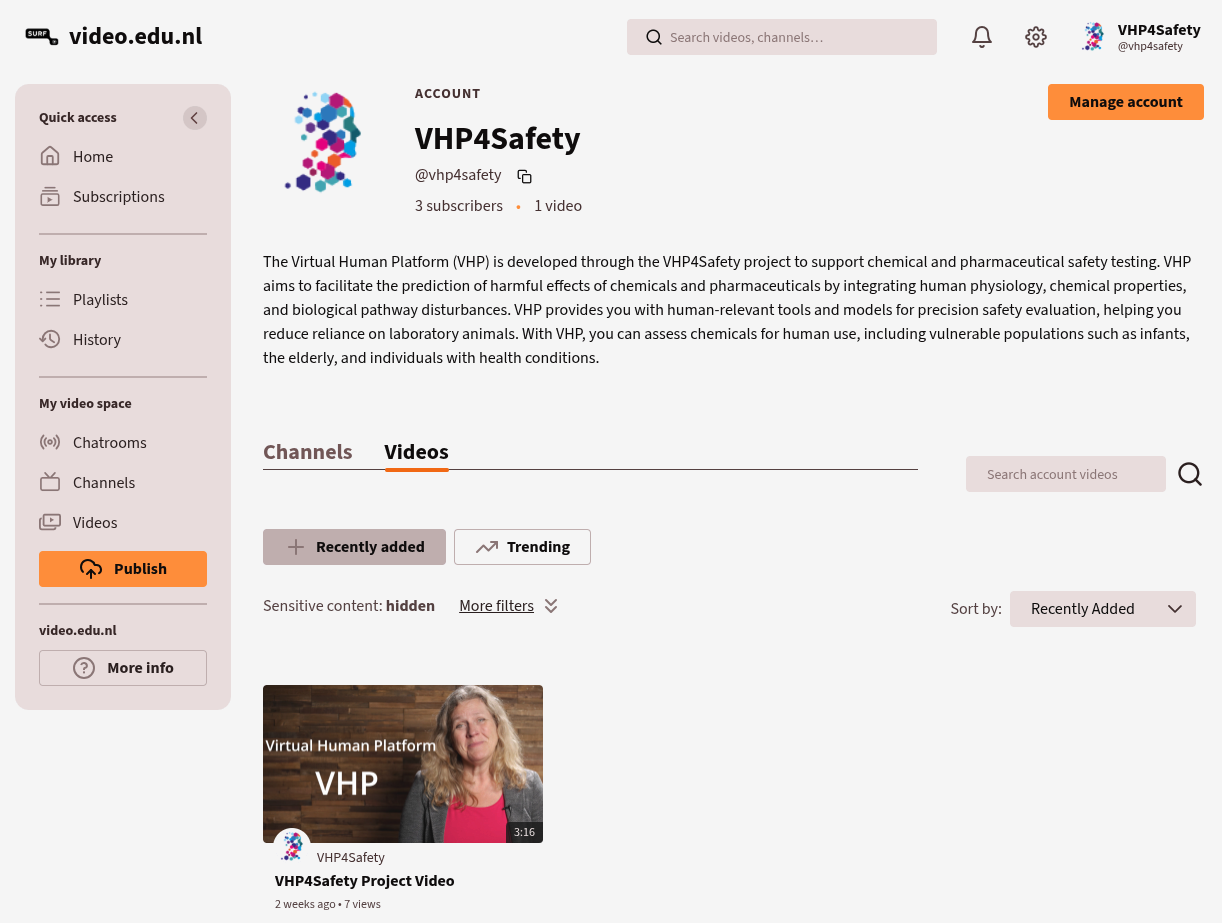
<p>But I am very excited we now have channels to share our video communication, <a href="https://video.edu.nl/a/vhp4safety/videos">here for VHP4Safety</a>:</p>

<p><img src="/assets/images/peertube_vhp4safety.png" alt="" /></p>

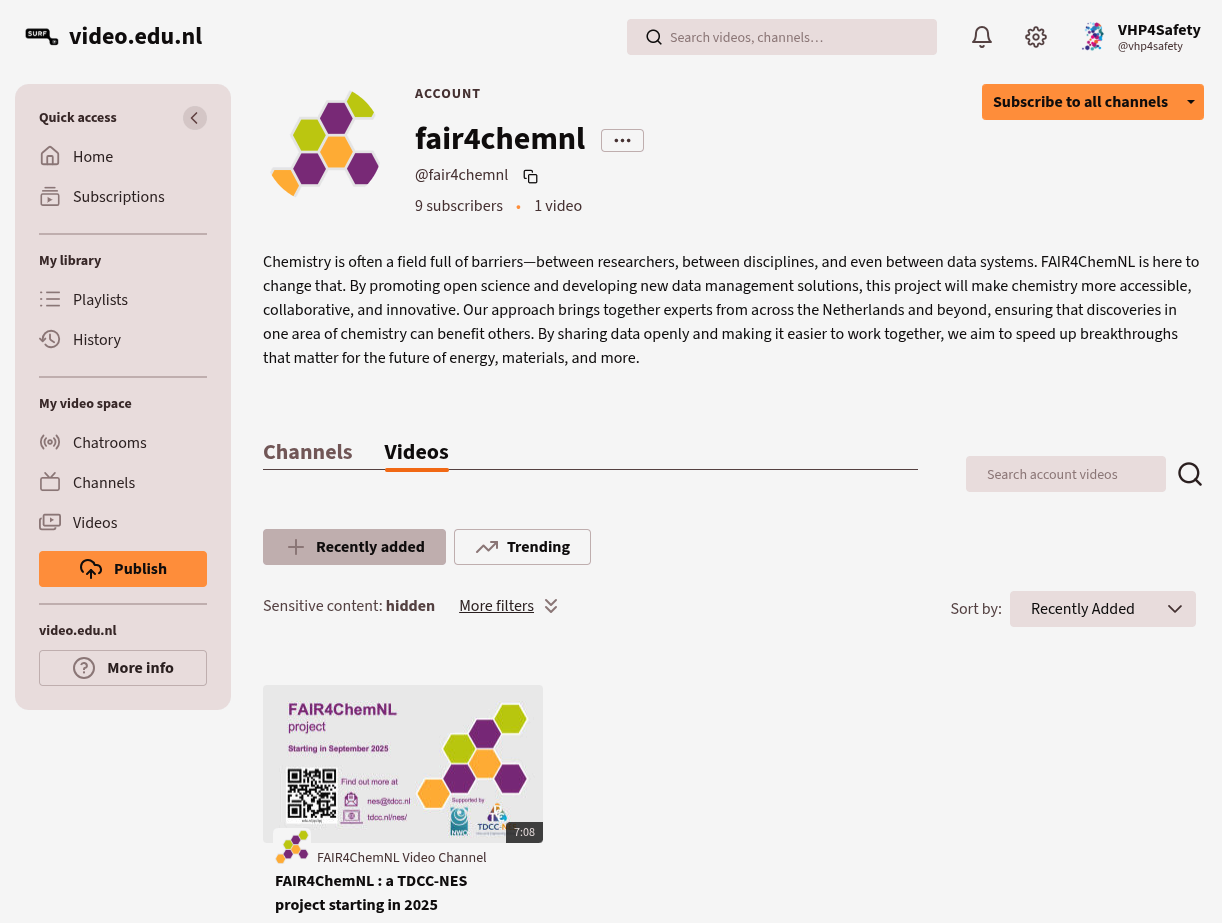
<p>And <a href="https://video.edu.nl/a/fair4chemnl/videos">here for FAIR4ChemNL</a>:</p>

<p><img src="/assets/images/peertube_fair4chemnl.png" alt="" /></p>

<!-- Communication infrastructure behind the world wide web has been open infrastructure for a long time, including email, the web itself,
and internet relay chat. Early commercial alternatives, like Compuserve and AOL, created walled gardens using unique information, quite like
Netflix, HBO, and AppleTV do now. While these disappeared, the commercial need for walls is deep rooted in the Western culture.
And the walled gardens won in the end. The do for streaming, for searching, and increasingly for communication. The latter, of course,
is causing a lot of social problems, by controlling who can say what to whom. And being operated by huge interantional companies, the
often operate outside law. Even the European Commissions cannot keep them within legal limits.

It is essential to realize this affects the research community hard. The publishing industry is largely a walled garden: it was
before open access and with APC-that-come-with-30-percent-profit as the norm the walls have not really dropped. If you prefer to
talk about the peer review walls, the walls exist just as well: who can do peer review (is allowed inside the wall), who decides
which peer reviewers are important (who gets thrown outside the wall), and why post-publication peer review is not a thing
(only thing inside the wall matter). The walls, unfortunately, are often based on good looks (like journal impact factor,
the label "American" or "Society") and discussions about quality are mostly pushed outside the wall.

Yet, communication is a central activity in doing research, and open communication channels are to me an essential part
of that. If the discussion of good science is limited to those in power, this can only harm science. Of course, retractions are
rare, fraud even more, and any correlation with anything cannot happen inside the walls (until it does).
Unfortunately, until we can untangle the notion of peer review from prestige, power, and money, it will not easily change. -->]]></content><author><name>Egon Willighagen</name></author><category term="mastodon" /><category term="peertube" /><category term="vhp4safety" /><category term="fair4chemnl" /><summary type="html"><![CDATA[When I first started writing this post, I started writing up why scientific communication is important, but because I started explaining what needs improving, and what are underlying causes why change is not happening, it got dark pretty quickly. So, I deleted that essay again. Instead, let’s just enjoy the awesome and long list of solutions we have for scientific discourse. Readers of my blog can find many posts in the past 20 years about the diversification. One thing I will say before I move one, is a reply to the argument that journal-based peer review is essential to the quality of research: if the quality of your research is dependent on your peers, then please rethink why you are doing research.]]></summary><media:thumbnail xmlns:media="http://search.yahoo.com/mrss/" url="https://chem-bla-ics.linkedchemistry.info/assets/images/peertube_fair4chemnl.png" /><media:content medium="image" url="https://chem-bla-ics.linkedchemistry.info/assets/images/peertube_fair4chemnl.png" xmlns:media="http://search.yahoo.com/mrss/" /></entry><entry><title type="html">Two meetings: ELIXIR Toxicology and FAIR4ChemNL</title><link href="https://chem-bla-ics.linkedchemistry.info/2024/06/10/two-meetings.html" rel="alternate" type="text/html" title="Two meetings: ELIXIR Toxicology and FAIR4ChemNL" /><published>2024-06-10T00:00:00+00:00</published><updated>2024-06-10T00:00:00+00:00</updated><id>https://chem-bla-ics.linkedchemistry.info/2024/06/10/two-meetings</id><content type="html" xml:base="https://chem-bla-ics.linkedchemistry.info/2024/06/10/two-meetings.html"><![CDATA[<p>Noting that in the coming week I am not attending the <a href="https://elixir-europe.org/events/elixir-all-hands-2024">ELIXIR All Hands in Uppsala</a>.
Having lived in (and around) Uppsala for more than three years, I am disappointed and with the first stories from colleagues coming
in even more. But it has been a way too busy year, I have much to finish up, and I need to take care of myself too. I am not 32 anymore.</p>

<p>But in the past two weeks I did attend two workshops. The first was a <a href="https://www.aanmelder.nl/intoxicom2024firstworkshop">workshop</a> by the
<a href="https://elixir-europe.org/communities/toxicology">ELIXIR Toxicology Community</a>, which was held in Utrecht/NL. The programme was around
FAIR and included two really nice hands-on sessions where we developed drafts for <a href="https://faircookbook.elixir-europe.org/">FAIR Cookbook</a>
recipes (see also doi:<a href="https://doi.org/10.1038/s41597-023-02166-3">10.1038/s41597-023-02166-3</a>) and for
<a href="https://www.go-fair.org/how-to-go-fair/fair-implementation-profile/">FAIR Implementation Profiles</a>
(doi:<a href="https://doi.org/10.1007/978-3-030-65847-2_13">10.1007/978-3-030-65847-2_13</a>). We will write up a
<a href="https://biohackrxiv.org/discover">BioHackrXiv</a> report.</p>

<p>The second workshop was last week, the <a href="https://tdcc.nl/evenementen/fair4chemnl-workshop/">FAIR4ChemNL workshop</a>, which was also held
in Utrecht/NL. The topic was FAIR in chemistry, and we discussed various aspects. There was a significant participant group from the
German NFDI4Cat project (“Cat” is short for (chemical) catalysis), which recently published a nice analysis of several ontologies
(doi:<a href="https://doi.org/10.1186/s13321-024-00807-2">10.1186/s13321-024-00807-2</a>). And there was also a lot of mention of RDF and SPARQL.</p>

<p>I think it is time for a new special issue around semantic web technologies.</p>]]></content><author><name>Egon Willighagen</name></author><category term="elixir" /><category term="fair" /><category term="chemistry" /><category term="doi:10.1038/S41597-023-02166-3" /><category term="justdoi:10.1007/978-3-030-65847-2_13" /><category term="justdoi:10.1186/S13321-024-00807-2" /><category term="rdf" /><category term="sparql" /><category term="fair4chemnl" /><summary type="html"><![CDATA[Noting that in the coming week I am not attending the ELIXIR All Hands in Uppsala. Having lived in (and around) Uppsala for more than three years, I am disappointed and with the first stories from colleagues coming in even more. But it has been a way too busy year, I have much to finish up, and I need to take care of myself too. I am not 32 anymore.]]></summary></entry></feed>