<?xml version="1.0" encoding="utf-8"?><feed xmlns="http://www.w3.org/2005/Atom" ><generator uri="https://jekyllrb.com/" version="4.3.4">Jekyll</generator><link href="https://chem-bla-ics.linkedchemistry.info/feed/by_tag/elixir.xml" rel="self" type="application/atom+xml" /><link href="https://chem-bla-ics.linkedchemistry.info/" rel="alternate" type="text/html" /><updated>2026-11-01T15:22:34+00:00</updated><id>https://chem-bla-ics.linkedchemistry.info/feed/by_tag/elixir.xml</id><title type="html">chem-bla-ics</title><subtitle>Chemblaics (pronounced chem-bla-ics) is the science that uses open science and computers to solve problems in chemistry, biochemistry and related fields.</subtitle><author><name>Egon Willighagen</name></author><entry><title type="html">The launch of the Virtual Human Platform</title><link href="https://chem-bla-ics.linkedchemistry.info/2026/06/06/the-launch-of-the-virtual-human-platform.html" rel="alternate" type="text/html" title="The launch of the Virtual Human Platform" /><published>2026-06-06T00:00:00+00:00</published><updated>2026-06-06T00:00:00+00:00</updated><id>https://chem-bla-ics.linkedchemistry.info/2026/06/06/the-launch-of-the-virtual-human-platform</id><content type="html" xml:base="https://chem-bla-ics.linkedchemistry.info/2026/06/06/the-launch-of-the-virtual-human-platform.html"><![CDATA[<p><img src="/assets/images/vhp_platform.png" style="width: 30%; display: block; margin-left: auto; margin-right: auto; float: right" alt="Screenshot of the Virtual Human Platform website, showing a logo, three section panels (Case Studies, Tools, Methods, Data), and a short description. The page is just the top part and includes several menus at the top." />
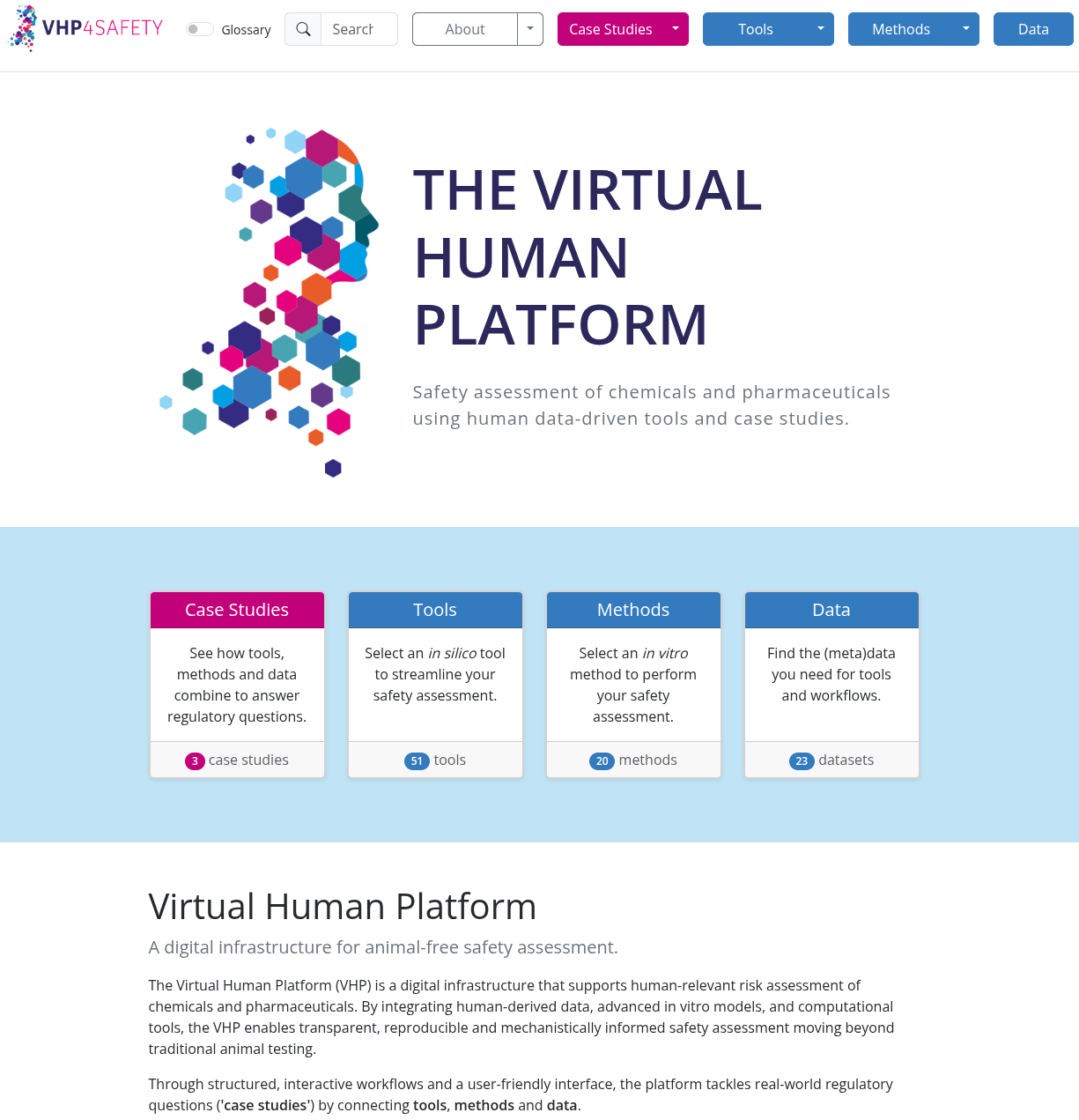
Nine days ago, the <a href="https://vhp4safety.nl/">VHP4Safety</a> project
(see <a href="https://chem-bla-ics.linkedchemistry.info/tag/vhp4safety">these posts</a>)
held a launch event in Utrecht for the
<a href="https://platform.vhp4safety.nl/">Virtual Human Platform</a> (VHP), a key result of the
<a href="https://www.nwo.nl/en/researchprogrammes/dutch-research-agenda-nwa">Dutch Research Agenda</a> (NWA,
from the Dutch <em>Nationale Wetenschapsagenda</em>). Despite the name, the NWA is just one part
of the NWO funding mechanisms, but like the <a href="https://www.openscience.nl/en/about-us">NWO Open Science programme</a>
it is funding with a specific purpose. And the purpose of the NWA is to answer
research and societal questions that the Dutch people together defined and a public
consultation (many years ago). VHP4Safety is answering to one of those questions.</p>

<h2 id="co-creation">Co-creation</h2>

<p>The project is still running another few months, but the <a href="https://www.sciencrew.com/c/9347/a/335652577?title=Launch_of_the_Virtual_Human_Platform">launch last week</a>
gives us the opportunity to include feedback from the stakeholders from the Dutch
society, many of which have been involved in the project via designathons and
hackathons (see doi:<a href="https://doi.org/10.14573/altex.2407211">10.14573/altex.2407211</a>).</p>

<p>The VHP4Safety platform is a co-creation created by most of the people working
on the VHP4Safety grant. Some people focused on innovation and education (RL3),
others on the regulatory questions (RL2), and some on the development of the
platform (RL1). The research line 1 (RL1) included a work package on the
technological development, work package 1.1, and that was led by Maastricht
University (Ozan and me) and the Applied University of Utrecht (Dr. Marc Teunis).
This project would not be together without the leadership by
Prof. dr. ir. Juliette Legler, Dr. Cyrille Krul, and Prof. dr. Anne Kienhuis
 (see <a href="https://video.edu.nl/w/rvUKc7J4E4HEt2TEbJEQt9">this video</a>).</p>

<h2 id="not-just-technology">Not just technology</h2>

<p>I have to give a huge shout out to Ozan whom had the daunting task
to set up something like OpenRiskNet (doi:<a href="https://doi.org/10.1016/j.toxlet.2018.06.617">10.1016/j.toxlet.2018.06.617</a>),
a project with at least twice as much
funding for operating and documenting just the technical platform, but also
help other partners getting their work on the platform. Also shout outs to 
Luc who in our group first explored how to translate the OpenRiskNet platform
to VHP4Safety with <a href="https://en.wikipedia.org/wiki/Kubernetes">kubernetes</a> from
which we concluded that that was not an option for us. And to Sean in our group
who introduced us to <a href="https://www.geeksforgeeks.org/devops/introduction-to-docker-swarm-mode/">Docker Swarm</a>.</p>

<p>But that is just one aspect of the technological layers. The design outlined
in the original proposal is based on earlier projects, including OpenRiskNet,
eNanoMapper, OpenRiskNet, Open PHACTS, NanoCommons, SbD4Nano and many others.
It is based on open standards developed and/or adopted by
<a href="https://elixir-europe.org/">ELIXIR Europe</a> projects and many other organisations.</p>

<p>And then we have not even covered the content on the platform.</p>

<h2 id="a-virtual-human">A virtual human</h2>

<p>Building full virtual human is an ambition. Many <a href="https://en.wikipedia.org/wiki/Digital_twin">digital twins</a>
capture just one part of human biology. For safety assessment we need many models,
data from experiments, and knowledge bases. And we need a clear narrative that
describes how those isolated solutions are integrated so that regulatory questions
can be answered. That co-created combination is the launched <em>virtual human platform</em>.</p>

<p>Underlying the VHP is a good bit of open science, though it also integrated 
proprietary solutions, currently needed to be able to replace animal testing.
And our modular co-creation resulted in <a href="https://github.com/VHP4Safety">many separate git repositories</a>.
This allows distributed development models and all contributors to take ownership
of the development of their contributions. Marc and Frank introduced a agile computing
approach that we adopted to guide the development of the full platform.</p>

<p>There is so much to write up about the platform (and we will), but for now I want
to highlight a few essential git repositories underlying the 1.0 version of the
platform we launched last week (along with the number of contributors in the past two years):</p>

<ul>
  <li><a href="https://github.com/VHP4Safety/virtual-human-platform">virtual-human-platform</a> (<a href="https://github.com/VHP4Safety/virtual-human-platform/graphs/contributors?from=6%2F1%2F2024">10 contributors</a>): software that provide the platform UX</li>
  <li><a href="https://github.com/VHP4Safety/cloud">cloud</a> (<a href="https://github.com/VHP4Safety/cloud/graphs/contributors?from=6%2F1%2F2024">11 contributors</a>): collects the meta data about (computational) services</li>
  <li><a href="https://github.com/VHP4Safety/ui-casestudy-config">ui-casestudy-config</a> (<a href="https://github.com/VHP4Safety/ui-casestudy-config/graphs/contributors?from=5%2F31%2F2025">7 contributors</a>): collects the details of the narratives of the case studies</li>
</ul>

<p>This includes <a href="https://github.com/aniekdewinter">Aniek</a>, <a href="https://github.com/FW94">Fabian</a>,
<a href="https://github.com/iaortega">Isaac</a>, <a href="https://github.com/senseibelbi">Ivo</a>,
<a href="https://github.com/jmillanacosta">Javier</a>, <a href="https://github.com/johannehouweling">Jente</a>,
<a href="https://github.com/LindeSchoenmaker">Linde</a>, <a href="https://github.com/marvinm2">Marvin</a>,
<a href="https://github.com/mirthhe">Myrthe</a>, <a href="https://github.com/saadlodhi0916">Saad</a>,
<a href="https://github.com/ShakiraPortfolio">Shakira</a>, and <a href="https://github.com/youphendriks">Youp</a>,
in addition to the earlier named <a href="https://github.com/ozancinar">Ozan</a> and
<a href="https://github.com/Maddocent">Marc</a>.</p>

<p>This excludes the many contributions via the designathons and hackathons that are
behind many of the commits to these repositories. And this also excludes the
many <a href="https://github.com/VHP4Safety/">other source code repositories</a> for tools
and services developed and made available on this VHP, with even more researchers.</p>

<p>Very much aware of all the work that is still ahead of us, I am happy with the
important milestone of this release. Thank you to
<a href="https://github.com/orgs/VHP4Safety/people">everyone who contributed to this co-creation</a>,
all the <a href="https://www.sciencrew.com/c/9319/a/329042452?title=VHP4Safety_Partners">involved institutes</a>,
NWO for <a href="https://www.nwo.nl/en/projects/nwa129219272">the funding</a>, and the Dutch
public for the important NWA question.</p>

<p>The project delivered!</p>]]></content><author><name>Egon Willighagen</name></author><category term="vhp4safety" /><category term="bioschemas" /><category term="openscience" /><category term="elixir" /><category term="doi:10.14573/ALTEX.2407211" /><category term="justdoi:10.1016/j.toxlet.2018.06.617" /><summary type="html"><![CDATA[Nine days ago, the VHP4Safety project (see these posts) held a launch event in Utrecht for the Virtual Human Platform (VHP), a key result of the Dutch Research Agenda (NWA, from the Dutch Nationale Wetenschapsagenda). Despite the name, the NWA is just one part of the NWO funding mechanisms, but like the NWO Open Science programme it is funding with a specific purpose. And the purpose of the NWA is to answer research and societal questions that the Dutch people together defined and a public consultation (many years ago). VHP4Safety is answering to one of those questions.]]></summary><media:thumbnail xmlns:media="http://search.yahoo.com/mrss/" url="https://chem-bla-ics.linkedchemistry.info/assets/images/vhp_platform.png" /><media:content medium="image" url="https://chem-bla-ics.linkedchemistry.info/assets/images/vhp_platform.png" xmlns:media="http://search.yahoo.com/mrss/" /></entry><entry><title type="html">INTOXICOM Workshop #4: Training Materials for Toxicology</title><link href="https://chem-bla-ics.linkedchemistry.info/2025/05/12/intoxicom-training-material-collection.html" rel="alternate" type="text/html" title="INTOXICOM Workshop #4: Training Materials for Toxicology" /><published>2025-05-12T00:00:00+00:00</published><updated>2025-05-12T00:00:00+00:00</updated><id>https://chem-bla-ics.linkedchemistry.info/2025/05/12/intoxicom-training-material-collection</id><content type="html" xml:base="https://chem-bla-ics.linkedchemistry.info/2025/05/12/intoxicom-training-material-collection.html"><![CDATA[<p>INTOXICOM is an ELIXIR Toxicoloy Community (doi:<a href="https://doi.org/10.12688/f1000research.74502.2">10.12688/f1000research.74502.2</a>)
implementation study, organizing five workshops, each
one with a different topic. The first three workshops were in Utrecht
(doi:<a href="https://doi.org/10.37044/osf.io/un2rw">10.37044/osf.io/un2rw</a>), Basel, and Uppsala.
The <a href="https://www.aanmelder.nl/intoxicom-ws-2/wiki/1152037/wp-4-features-ws-4">fourth workshop</a>
has the theme <em>training material</em> and will be held in Birmingham (thanks
<a href="https://www.linkedin.com/in/iseult-lynch-b5856910/">Iseult</a>!). And one aspect of that is to make
existing training material from toxicology projects indexed and therefore more FAIR.</p>

<p>Last week we had a telcon, and I promised to make an overview of some open educational resources
that I have (co-)developed over the years. It started during the eNanoMapper project, where
our Project Technical Adviser was Dr. <a href="https://orcid.org/0000-0003-1461-0988">Cedric Notredame</a>.
He commented on us using Word documents for training materials, and that was for me a cue to
<a href="https://github.com/enanomapper/tutorials/commit/5ca03a94a3bd3b60dbb6e080f05cb9faca7eaf69">start using</a>
GitHub Pages instead. We later reused this for NanoCommons, and by then GitHub Pages had
become common and the foundation for other online material for toxicology projects.</p>

<p>Here follows an overview of tutorials I contributed to. Some are already registered
with TeSS, but I am sure I will learn a lot of new tricks, and particularly about the
learning paths.</p>

<p>Hope to see you there! Register <a href="https://www.aanmelder.nl/intoxicom-ws-2/wiki/1152037/wp-4-features-ws-4">here</a>.</p>

<h2 id="enanomapper">eNanoMapper</h2>

<ul>
  <li><a href="https://enanomapper.github.io/tutorials/BrowseOntology/Tutorial%20browsing%20eNM%20ontology.html">Browsing the eNanoMapper ontology with BioPortal, AberOWL and Protégé</a></li>
  <li><a href="https://enanomapper.github.io/tutorials/Entering_and_analysing_nano_safety_data/readme.html">Entering and analysing nano safety data</a></li>
  <li><a href="https://enanomapper.github.io/tutorials/Added%20ontology%20terms/README.html">Adding ontology terms</a></li>
  <li><a href="https://enanomapper.github.io/tutorials/Pathway_analysis/Pathway%20analysis.html">How to use the Pathway module of ArrayAnalysis.org for pathway analysis of microarray data</a></li>
  <li><a href="https://enanomapper.github.io/tutorials/Pathway/readme.html">How to make a pathway</a></li>
</ul>

<p>By other eNanoMapper partners:</p>

<ul>
  <li><a href="https://enanomapper.github.io/tutorials/Omics%20descriptors%20calculation/Omics%20descriptors%20calculation%20R%20package.html">Omics descriptors calculation</a> (by Georgia Tsiliki and Haralambos Sarimveis)</li>
</ul>

<h2 id="nanocommons">NanoCommons</h2>

<ul>
  <li><a href="https://nanocommons.github.io/tutorials/enteringData/">Adding nanomaterial data</a></li>
  <li><a href="https://nanocommons.github.io/user-handbook/FAIRification/ten-simple-actions/">Ten simple actions to make NSC Research Output more Findable</a></li>
</ul>

<p>By group members:</p>

<ul>
  <li><a href="https://nanocommons.github.io/tutorials/eNanoMapper/">Adding new term to the eNanoMapper ontology</a> (by Laurent Winckers)</li>
  <li><a href="https://nanocommons.github.io/user-handbook/">NanoCommons User Guidance Handbook</a> (by Thomas Exner, with contributions by many)</li>
</ul>

<h2 id="fairplus">FAIRplus</h2>

<p>I add this one as well, as this below recipes were developed for the eTox use case.</p>

<ul>
  <li><a href="https://w3id.org/faircookbook/FCB007">InChI and SMILES identifiers for chemical structures</a></li>
  <li><a href="https://w3id.org/faircookbook/FCB080">Creating InChIKeys for IUPAC names</a></li>
</ul>

<h2 id="vhp4safety">VHP4Safety</h2>

<ul>
  <li><a href="https://docs.vhp4safety.nl/en/latest/tutorials/cheminfo/intro.html">Information about chemicals</a></li>
</ul>

<p>Many more are listed on the <a href="https://docs.vhp4safety.nl/e">VHP4Safety Docs</a> website.</p>]]></content><author><name>Egon Willighagen</name></author><category term="enanomapper" /><category term="nanocommons" /><category term="elixir" /><category term="cito:citesAsRecommendedReading:10.12688/f1000research.74502.2" /><category term="cito:citesAsRecommendedReading:10.37044/osf.io/un2rw" /><summary type="html"><![CDATA[INTOXICOM is an ELIXIR Toxicoloy Community (doi:10.12688/f1000research.74502.2) implementation study, organizing five workshops, each one with a different topic. The first three workshops were in Utrecht (doi:10.37044/osf.io/un2rw), Basel, and Uppsala. The fourth workshop has the theme training material and will be held in Birmingham (thanks Iseult!). And one aspect of that is to make existing training material from toxicology projects indexed and therefore more FAIR.]]></summary></entry><entry><title type="html">New preprint: “BioHackEU24 report: ORCID and ROR identifiers in BioHackrXiv reports”</title><link href="https://chem-bla-ics.linkedchemistry.info/2025/03/23/orcid-and-ror.html" rel="alternate" type="text/html" title="New preprint: “BioHackEU24 report: ORCID and ROR identifiers in BioHackrXiv reports”" /><published>2025-03-23T00:00:00+00:00</published><updated>2025-03-23T00:00:00+00:00</updated><id>https://chem-bla-ics.linkedchemistry.info/2025/03/23/orcid-and-ror</id><content type="html" xml:base="https://chem-bla-ics.linkedchemistry.info/2025/03/23/orcid-and-ror.html"><![CDATA[<p>While this was not the primary hack project during the <a href="https://biohackathon-europe.org/">ELIXIR BioHackathon Europe</a>
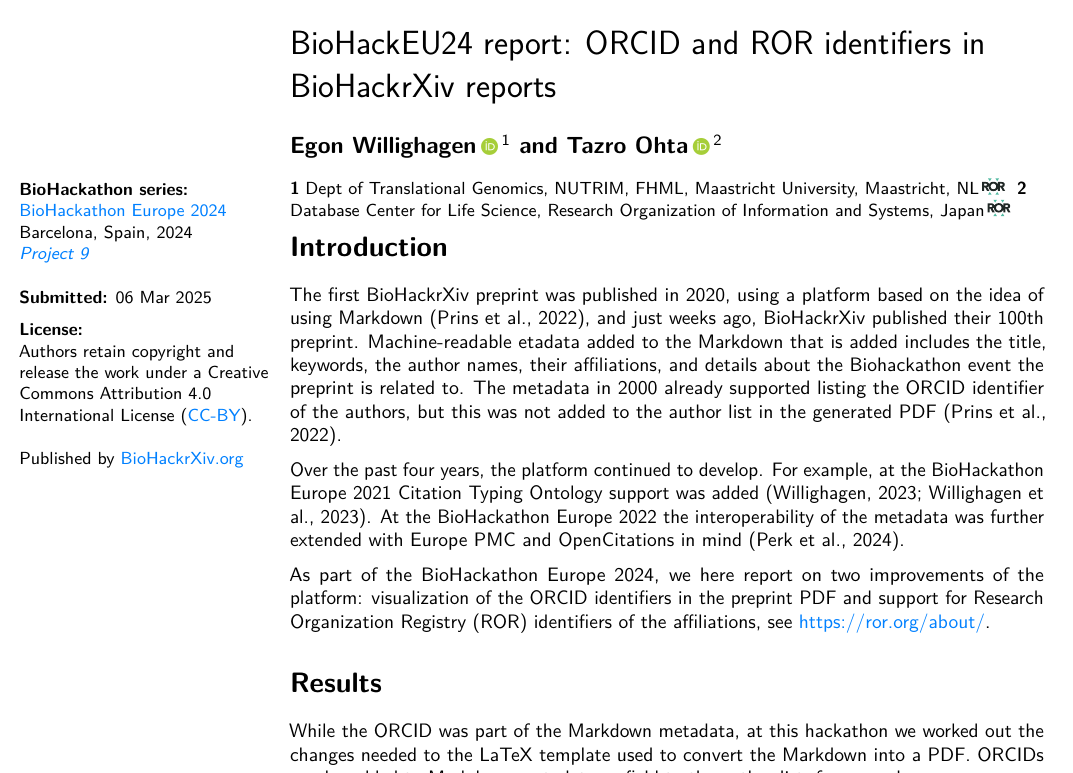
last autumn, but I really like BioHackrXiv and I got the question if I could have a look at getting
the ORCID logo in generated PDF. The ORCID was already in the YAML metadata of report markdown,
so it sounded easy. Well, it was a big more complicated, but all the nicer to now have the project
report online (doi:<a href="https://doi.org/10.37044/osf.io/p9u42_v1">10.37044/osf.io/p9u42_v1</a>). And once the ORCID was working,
adding the <a href="https://ror.org/">Research Organisation Registry</a> ID was not much harder. Cool to see both used
in other <a href="https://osf.io/preprints/biohackrxiv/discover?sort=-dateCreated">recent BioHackrXiv reports</a>!</p>

<p><img src="/assets/images/biohackrxiv_orcid_ror.png" alt="" /></p>]]></content><author><name>Egon Willighagen</name></author><category term="elixir" /><category term="biohackrxiv" /><category term="cito:describes:10.37044/osf.io/p9u42_v1" /><summary type="html"><![CDATA[While this was not the primary hack project during the ELIXIR BioHackathon Europe last autumn, but I really like BioHackrXiv and I got the question if I could have a look at getting the ORCID logo in generated PDF. The ORCID was already in the YAML metadata of report markdown, so it sounded easy. Well, it was a big more complicated, but all the nicer to now have the project report online (doi:10.37044/osf.io/p9u42_v1). And once the ORCID was working, adding the Research Organisation Registry ID was not much harder. Cool to see both used in other recent BioHackrXiv reports!]]></summary><media:thumbnail xmlns:media="http://search.yahoo.com/mrss/" url="https://chem-bla-ics.linkedchemistry.info/assets/images/biohackrxiv_orcid_ror.png" /><media:content medium="image" url="https://chem-bla-ics.linkedchemistry.info/assets/images/biohackrxiv_orcid_ror.png" xmlns:media="http://search.yahoo.com/mrss/" /></entry><entry><title type="html">Two meetings: ELIXIR Toxicology and FAIR4ChemNL</title><link href="https://chem-bla-ics.linkedchemistry.info/2024/06/10/two-meetings.html" rel="alternate" type="text/html" title="Two meetings: ELIXIR Toxicology and FAIR4ChemNL" /><published>2024-06-10T00:00:00+00:00</published><updated>2024-06-10T00:00:00+00:00</updated><id>https://chem-bla-ics.linkedchemistry.info/2024/06/10/two-meetings</id><content type="html" xml:base="https://chem-bla-ics.linkedchemistry.info/2024/06/10/two-meetings.html"><![CDATA[<p>Noting that in the coming week I am not attending the <a href="https://elixir-europe.org/events/elixir-all-hands-2024">ELIXIR All Hands in Uppsala</a>.
Having lived in (and around) Uppsala for more than three years, I am disappointed and with the first stories from colleagues coming
in even more. But it has been a way too busy year, I have much to finish up, and I need to take care of myself too. I am not 32 anymore.</p>

<p>But in the past two weeks I did attend two workshops. The first was a <a href="https://www.aanmelder.nl/intoxicom2024firstworkshop">workshop</a> by the
<a href="https://elixir-europe.org/communities/toxicology">ELIXIR Toxicology Community</a>, which was held in Utrecht/NL. The programme was around
FAIR and included two really nice hands-on sessions where we developed drafts for <a href="https://faircookbook.elixir-europe.org/">FAIR Cookbook</a>
recipes (see also doi:<a href="https://doi.org/10.1038/s41597-023-02166-3">10.1038/s41597-023-02166-3</a>) and for
<a href="https://www.go-fair.org/how-to-go-fair/fair-implementation-profile/">FAIR Implementation Profiles</a>
(doi:<a href="https://doi.org/10.1007/978-3-030-65847-2_13">10.1007/978-3-030-65847-2_13</a>). We will write up a
<a href="https://biohackrxiv.org/discover">BioHackrXiv</a> report.</p>

<p>The second workshop was last week, the <a href="https://tdcc.nl/evenementen/fair4chemnl-workshop/">FAIR4ChemNL workshop</a>, which was also held
in Utrecht/NL. The topic was FAIR in chemistry, and we discussed various aspects. There was a significant participant group from the
German NFDI4Cat project (“Cat” is short for (chemical) catalysis), which recently published a nice analysis of several ontologies
(doi:<a href="https://doi.org/10.1186/s13321-024-00807-2">10.1186/s13321-024-00807-2</a>). And there was also a lot of mention of RDF and SPARQL.</p>

<p>I think it is time for a new special issue around semantic web technologies.</p>]]></content><author><name>Egon Willighagen</name></author><category term="elixir" /><category term="fair" /><category term="chemistry" /><category term="doi:10.1038/S41597-023-02166-3" /><category term="justdoi:10.1007/978-3-030-65847-2_13" /><category term="justdoi:10.1186/S13321-024-00807-2" /><category term="rdf" /><category term="sparql" /><category term="fair4chemnl" /><summary type="html"><![CDATA[Noting that in the coming week I am not attending the ELIXIR All Hands in Uppsala. Having lived in (and around) Uppsala for more than three years, I am disappointed and with the first stories from colleagues coming in even more. But it has been a way too busy year, I have much to finish up, and I need to take care of myself too. I am not 32 anymore.]]></summary></entry><entry><title type="html">Community activity #2: FAIRsharing</title><link href="https://chem-bla-ics.linkedchemistry.info/2023/06/11/community-activity-2-fairsharing.html" rel="alternate" type="text/html" title="Community activity #2: FAIRsharing" /><published>2023-06-11T00:00:00+00:00</published><updated>2023-06-11T00:00:00+00:00</updated><id>https://chem-bla-ics.linkedchemistry.info/2023/06/11/community-activity-2-fairsharing</id><content type="html" xml:base="https://chem-bla-ics.linkedchemistry.info/2023/06/11/community-activity-2-fairsharing.html"><![CDATA[<p>Some years ago we started the <a href="https://elixir-europe.org/communities/toxicology">ELIXIR Toxicology Community</a>. It has been an interesting journey,
partly covered in <a href="https://f1000research.com/articles/10-1129/v1">this whitepaper</a>). We started with interaction we had in several projects already,
but particularly the potential. I see this. This series of posts is a number of things toxicology projects can do to benefit from ELIXIR solutions
(“<a href="https://elixir-europe.org/services">services</a>”). The posts have been sent first to the ELIXIR Toxicology Community mailing list (please join!).</p>

<h3 id="history">History</h3>

<p>In this post, let’s look at <a href="https://fairsharing.org/">FAIRsharing</a>. It is “A curated, informative and educational resource on data and metadata standards,
inter-related to databases and data policies” [0,1].</p>

<p>The ELIXIR Toxicology Community (we) maintains the toxicology corner of this database and members of our community have been adding toxicology-related
databases, relevant standards. On the side of the policies we are falling a bit short:
<a href="https://fairsharing.org/Toxicology">fairsharing.org/Toxicology</a>.</p>

<h3 id="why-adopt-fairsharing">Why adopt FAIRsharing</h3>

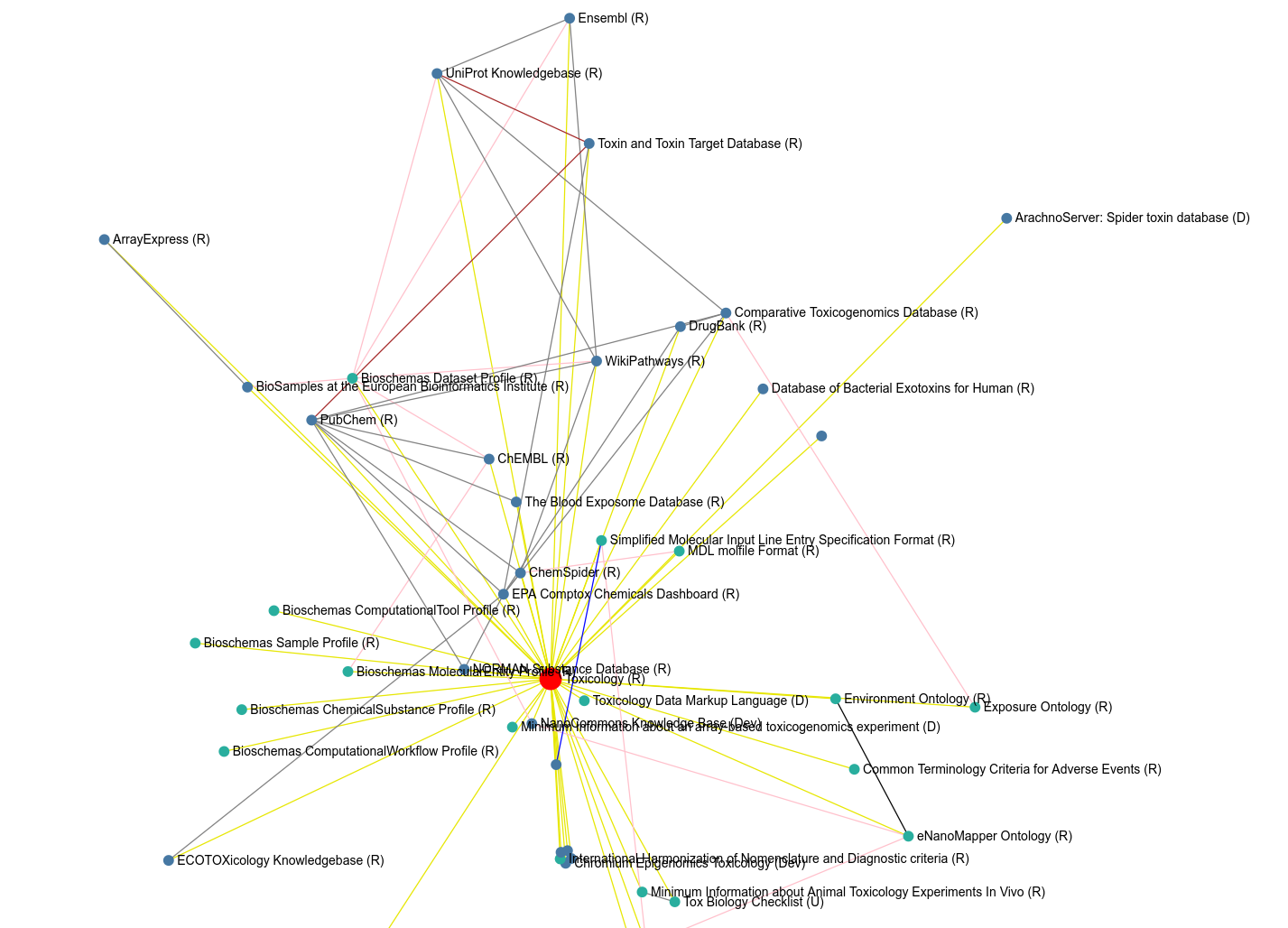
<p>FAIRsharing is one place where metadata can be shared about your databases. It helps make your resources and research more FAIR and explains people
how your work relates to other work (<a href="https://fairsharing.org/graph/3496">fairsharing.org/graph/3496</a>):</p>

<p><img src="/assets/images/fairsharing_toxicology.png" alt="Screenshot of the 'collects' graph of the FAIRsharing Toxicology Community." /></p>

<h3 id="what-you-can-do">What you can do</h3>

<p>Get an account (with your ORCID or GitHub account) and add resources important to your research, your projects, your work generally. Particularly,
(data) policies and standards you are expected to comply with are useful. Also, links between various resources. For example, if some (project)
database complies with an important policy or standards, this is worth seeing show up.</p>

<p>Alternatively, join the ELIXIR Toxicology Community <a href="https://doi.org/10.1162/dint_r_00024">mailing list</a> and post the missing resource there,
or use our issue tracker at <a href="https://github.com/elixir-europe/toxicology-community/issues/">github.com/elixir-europe/toxicology-community/issues/</a>.</p>

<p>Let’s make toxicology more <a href="https://doi.org/10.1162/dint_r_00024">FAIR</a>.</p>

<p>0.<a href="https://www.nature.com/articles/s41587-019-0080-8">https://www.nature.com/articles/s41587-019-0080-8</a>
1.<a href="https://scholia.toolforge.org/work/Q64084285">https://scholia.toolforge.org/work/Q64084285</a></p>]]></content><author><name>Egon Willighagen</name></author><category term="elixir" /><category term="fair" /><category term="toxicology" /><category term="doi:10.12688/f1000research.74502.1" /><category term="justdoi:10.1038/s41587-019-0080-8" /><category term="doi:10.1162/dint_r_00024" /><summary type="html"><![CDATA[Some years ago we started the ELIXIR Toxicology Community. It has been an interesting journey, partly covered in this whitepaper). We started with interaction we had in several projects already, but particularly the potential. I see this. This series of posts is a number of things toxicology projects can do to benefit from ELIXIR solutions (“services”). The posts have been sent first to the ELIXIR Toxicology Community mailing list (please join!).]]></summary><media:thumbnail xmlns:media="http://search.yahoo.com/mrss/" url="https://chem-bla-ics.linkedchemistry.info/assets/images/fairsharing_toxicology.png" /><media:content medium="image" url="https://chem-bla-ics.linkedchemistry.info/assets/images/fairsharing_toxicology.png" xmlns:media="http://search.yahoo.com/mrss/" /></entry></feed>