<?xml version="1.0" encoding="utf-8"?><feed xmlns="http://www.w3.org/2005/Atom" ><generator uri="https://jekyllrb.com/" version="4.3.4">Jekyll</generator><link href="https://chem-bla-ics.linkedchemistry.info/feed/by_tag/crystal.xml" rel="self" type="application/atom+xml" /><link href="https://chem-bla-ics.linkedchemistry.info/" rel="alternate" type="text/html" /><updated>2026-08-14T05:35:03+00:00</updated><id>https://chem-bla-ics.linkedchemistry.info/feed/by_tag/crystal.xml</id><title type="html">chem-bla-ics</title><subtitle>Chemblaics (pronounced chem-bla-ics) is the science that uses open science and computers to solve problems in chemistry, biochemistry and related fields.</subtitle><author><name>Egon Willighagen</name></author><entry><title type="html">All CrystalEye data available as PDDL</title><link href="https://chem-bla-ics.linkedchemistry.info/2010/06/21/all-crystaleye-data-available-as-pddl.html" rel="alternate" type="text/html" title="All CrystalEye data available as PDDL" /><published>2010-06-21T00:00:00+00:00</published><updated>2010-06-21T00:00:00+00:00</updated><id>https://chem-bla-ics.linkedchemistry.info/2010/06/21/all-crystaleye-data-available-as-pddl</id><content type="html" xml:base="https://chem-bla-ics.linkedchemistry.info/2010/06/21/all-crystaleye-data-available-as-pddl.html"><![CDATA[<p>I do not think I have seen this earlier, but I do not visit the homepage regularly. But congratulations to the
<a href="http://wwmm.ch.cam.ac.uk/crystaleye/">CrystalEye</a> team for releasing the data explicitly as
<a href="http://www.opendatacommons.org/licenses/pddl/1-0/">PDDL</a>! I cannot stress enough how useful it is if you add
a statement like this to your <em>public domain</em> data. Well done!</p>

<p><img src="/assets/images/crystalEyeOpen.png" alt="" /></p>]]></content><author><name>Egon Willighagen</name></author><category term="crystal" /><category term="opendata" /><summary type="html"><![CDATA[I do not think I have seen this earlier, but I do not visit the homepage regularly. But congratulations to the CrystalEye team for releasing the data explicitly as PDDL! I cannot stress enough how useful it is if you add a statement like this to your public domain data. Well done!]]></summary><media:thumbnail xmlns:media="http://search.yahoo.com/mrss/" url="https://chem-bla-ics.linkedchemistry.info/assets/images/crystalEyeOpen.png" /><media:content medium="image" url="https://chem-bla-ics.linkedchemistry.info/assets/images/crystalEyeOpen.png" xmlns:media="http://search.yahoo.com/mrss/" /></entry><entry><title type="html">Dutch contribution to the Crystallography Open Database at risk?</title><link href="https://chem-bla-ics.linkedchemistry.info/2010/02/24/dutch-contribution-to-crystallography.html" rel="alternate" type="text/html" title="Dutch contribution to the Crystallography Open Database at risk?" /><published>2010-02-24T00:00:00+00:00</published><updated>2010-02-24T00:00:00+00:00</updated><id>https://chem-bla-ics.linkedchemistry.info/2010/02/24/dutch-contribution-to-crystallography</id><content type="html" xml:base="https://chem-bla-ics.linkedchemistry.info/2010/02/24/dutch-contribution-to-crystallography.html"><![CDATA[<p>The Dutch company <a href="http://www.panalytical.com/">PANalytical</a> has made their <a href="http://www.panalytical.com/index.cfm?pargetinit=1&amp;menuinit=1&amp;pid=1324">HighScore software</a>
available (some details in this <a href="http://www.crystallography.net/archives/2010/PANalytical/README.txt">README</a>) for use in the
<a href="http://www.crystallography.net/">Crystallography Open Database</a>.</p>

<p><a href="http://www.icdd.com/">ICDD</a> is rumored not to be amused by the contribution of the HighScore-based search functionality, and
rumored to be claiming breach of intellectual property. I have not seen either any ICDD patents nor the HighScore implementation,
but clearly there is a conflict of interest.</p>

<p>BTW, <a href="https://chem-bla-ics.linkedchemistry.info/2010/02/19/open-data-panton-principles.html">Panton Principle <i class="fa-solid fa-recycle fa-xs"></i></a> endorsers may be
interesting in signing the <a href="http://www.crystallography.net/petition/">petition for Open Data in crystallograph</a> too.</p>]]></content><author><name>Egon Willighagen</name></author><category term="crystal" /><category term="cod" /><summary type="html"><![CDATA[The Dutch company PANalytical has made their HighScore software available (some details in this README) for use in the Crystallography Open Database.]]></summary></entry><entry><title type="html">Simple, Open Bug Track System: social bookmarking</title><link href="https://chem-bla-ics.linkedchemistry.info/2008/02/06/simple-open-bug-track-system-social.html" rel="alternate" type="text/html" title="Simple, Open Bug Track System: social bookmarking" /><published>2008-02-06T00:00:00+00:00</published><updated>2008-02-06T00:00:00+00:00</updated><id>https://chem-bla-ics.linkedchemistry.info/2008/02/06/simple-open-bug-track-system-social</id><content type="html" xml:base="https://chem-bla-ics.linkedchemistry.info/2008/02/06/simple-open-bug-track-system-social.html"><![CDATA[<p><a href="http://wwmm.ch.cam.ac.uk/blogs/downing/">Jim</a> replied to the <a href="http://chem-bla-ics.blogspot.com/2008/01/why-chemistry-rich-rss-feeds-matter.html#c9123182507496435262">request by Anthony in my blog</a> <!-- keep link -->
for a bug track system for <a href="http://wwmm.ch.cam.ac.uk/crystaleye/">CrystalEye</a> (in beta), after a discussion on the CIF
processing pipeline (see [here] <i class="fa-solid fa-recycle fa-xs"></i>(https://chem-bla-ics.linkedchemistry.info/2008/01/30/why-chemistry-rich-rss-feeds-matter.html),
<a href="http://wwmm.ch.cam.ac.uk/blogs/murrayrust/?p=943">here</a>, <a href="http://www.chemspider.com/blog/why-we-cant-publish-scraped-crystaleye-data-yetand-science-commons-declare-a-protocol-for-implementing-open-access-data.html">here</a>
and <a href="http://wwmm.ch.cam.ac.uk/blogs/murrayrust/?p=946">here</a>).</p>

<p>Instead of setting up a BTS at <a href="http://www.sf.net/">SourceForge</a>, locally with <a href="http://www.bugzilla.org/">Bugzilla</a>, or at
<a href="http://www.launchpad.net/">LaunchPad</a>, he <a href="http://wwmm.ch.cam.ac.uk/blogs/downing/?p=171">suggested to use</a>
<a href="http://www.connotea.org/">Connotea</a>:</p>

<blockquote>
  <p>To report a problem in CrystalEye, simply bookmark an example of the problem with the tag “crystaleyeproblem”, using the
Description field to describe the problem. All the problems will appear on the tag feed.</p>

  <p>When we fix the problem we’ll add the tag “crystaleyefixed” to the same bookmark. If you subscribe to this feed, you’ll
know to remove the crystaleyeproblem tag.</p>

  <p>In the fullness of time, we’re planning to use connotea tags to annotate structures where full processing hasn’t been
possible (uncalculatable bond orders, charges etc).</p>
</blockquote>

<p>Now, Connotea is advertised as a <em>[f]ree online reference management for all researchers, clinicians and scientists</em>,
and I have never really been happy with any HTML page ending up in the system, I would counter the suggestion by using social
bookmarking websites for any HTML page (not just publications), such as <a href="http://del.icio.us/">Del.icio.us</a>
(see <a href="http://del.icio.us/search/?fr=del_icio_us&amp;p=crystaleye&amp;type=all">their list of CrystalEye bookmarks</a>).</p>

<p>Anyway, it does not really matter, and Connotea has an open API to query the database. This will allow Jim to write a simple
userscript to enhance each CrystalEye page with a list of bug reports. That will allow every CrystalEye visitor to see what
others are commenting on it. In that respect, many other things can be envisioned… Getting comments on the paper behind the
crystal structure from <a href="http://cb.openmolecules.net/">Chemical blogspace</a> and <a href="http://www.postgenomic.com/">Postgenomic</a>,
…</p>]]></content><author><name>Egon Willighagen</name></author><category term="crystal" /><summary type="html"><![CDATA[Jim replied to the request by Anthony in my blog for a bug track system for CrystalEye (in beta), after a discussion on the CIF processing pipeline (see [here] (https://chem-bla-ics.linkedchemistry.info/2008/01/30/why-chemistry-rich-rss-feeds-matter.html), here, here and here).]]></summary></entry><entry><title type="html">Evidence of Aromaticity</title><link href="https://chem-bla-ics.linkedchemistry.info/2007/11/06/evidence-of-aromaticity.html" rel="alternate" type="text/html" title="Evidence of Aromaticity" /><published>2007-11-06T00:00:00+00:00</published><updated>2007-11-06T00:00:00+00:00</updated><id>https://chem-bla-ics.linkedchemistry.info/2007/11/06/evidence-of-aromaticity</id><content type="html" xml:base="https://chem-bla-ics.linkedchemistry.info/2007/11/06/evidence-of-aromaticity.html"><![CDATA[<p>I have been working on a new atom type perception engine for the <a href="http://cdk.sf.net/">CDK</a>, after having decided that
<a href="https://chem-bla-ics.linkedchemistry.info/2007/07/01/atom-typing-in-cdk.html">the existing atom type lists <i class="fa-solid fa-recycle fa-xs"></i></a> where not sufficient for
the algorithms we have in the CDK. The <a href="http://cdk.svn.sourceforge.net/viewvc/*checkout*/cdk/trunk/cdk/src/org/openscience/cdk/config/data/cdk_atomtypes.xml?revision=9288">new list</a>
is growing in size, and basically contains four properties (besides element and formal charge):</p>

<ol>
  <li>number of bounded neighbors</li>
  <li>number of pi bonds (or double bond equivalents)</li>
  <li>number of lone pairs</li>
  <li>hybridization state</li>
</ol>

<p>This seems to be a minimal and accurate set to cover a rather good deal of chemoinformatics. I have yet to make the mappings
of the new atom type list with existing lists for force fields, and radicals are missing too. However, the following
algorithms in the CDK seem to translate rather well:</p>

<ul>
  <li>hydrogen adding</li>
  <li>aromaticity detection (Hückel rules)</li>
</ul>

<p>I still have to rework the double bond perception.</p>

<h2 id="aromaticity">Aromaticity</h2>

<p>Now, aromaticity is a fuzzy concept, and there is no general agreement on what it is. Some say it is smelly compounds, others
say ring systems which apply to the Hückel rule. Based on the new atom type list, I have rewritten the Hückel aromaticity
detector and it applies these rules:</p>

<ul>
  <li>only single rings and two fused non-spiro rings</li>
  <li>4n+2 electrons</li>
  <li>no ring atoms with double points not in the ring too</li>
</ul>

<p>This approach differs in two ways from the old code: it no longer tries to test all ring systems, which required to use
the <a href="http://cheminfo.informatics.indiana.edu/~rguha/code/java/nightly/api/org/openscience/cdk/ringsearch/AllRingsFinder.html">CDK AllRingsFinder algorithm</a>
which combinatorial generates all possible ring systems. The new code only considers ring systems with up to two single
rings. Aromaticity beyond that is even less well defined than aromaticity in general.</p>

<p>The other difference is that the ring system must not have ring atoms which have a double bond which is not part of the
ring too. The classical example is benzoquinone (InChI=1/C6H4O2/c7-5-1-2-6(8)4-3-5/h1-4H) which is not aromatic, even
though it conforms the 4n+2 rule (image from <a href="http://pubchem.ncbi.nlm.nih.gov/">PubChem</a>):</p>

<p><img src="/assets/images/cid4650.png" alt="" /></p>

<h2 id="evidence-of-aromaticity">Evidence of Aromaticity</h2>

<p>The final rule, of course, is what nature tells us what is aromatic and what is not. There are many other details to
aromaticity than I just covered. For example, take azulene (InChI=1/C10H8/c1-2-5-9-7-4-8-10(9)6-3-1/h1-8H). All
atoms are aromatic, but not all bonds (also <a href="https://pubchem.ncbi.nlm.nih.gov/compound/9231">PubChem</a>):</p>

<p><img src="/assets/images/cid9231.png" alt="" /></p>

<p>These things are complex, but the rise of <a href="http://en.wikipedia.org/wiki/Open_Data">Open Data</a> helps us out, as well
as increasing computing power. <a href="http://wwmm.ch.cam.ac.uk/blogs/murrayrust/">Peter</a> has been running two rather
projects which may help us out: <a href="http://wwmm.ch.cam.ac.uk/crystaleye/">CrystalEye</a> (Nick: no blog?) and
<a href="https://blogs.ch.cam.ac.uk/pmr/2007/11/02/open-nmr-update-and-requests-for-input/">OpenNMR <i class="fa-solid fa-recycle fa-xs"></i></a>.</p>

<p>NMR shifts will give us experimental backup on our notion of aromaticity, and so do bond lengths. I
<a href="https://blogs.ch.cam.ac.uk/pmr/2007/11/02/open-nmr-update-and-requests-for-input/#comment-1139">asked Peter about this <i class="fa-solid fa-recycle fa-xs"></i></a>, and whether OpenNMR
predicted shifts could indeed confirm aromaticity of compounds, and <a href="https://blogs.ch.cam.ac.uk/pmr/2007/11/05/open-nmr-how-good-is-the-prediction/">he replied <i class="fa-solid fa-recycle fa-xs"></i></a>
and showed that the predicted spectra could be used to distinguish between C-C and C=C bonds.</p>

<p>I commented the following (which was in moderation at the time of writing), and that gets us to experimental
evidence for aromaticity:</p>

<blockquote>
  <p>Thanx for the elaborate answer. What I had in mind was the question whether NMR shift predictions can be
used to tell me if a certain ring system is aromatic or not, and in case of fused rings, which atoms and
which bonds are aromatic and which not. I’m sure the prediction error for 1H NMR shifts is well below 2ppm,
and more in the order of 0.2ppm.</p>
</blockquote>

<blockquote>
  <p>But maybe I should be asking, can I use CrystalEye to decide if ring systems are “aromatic”, and in case
of two rings fused together (non-spiro), which atoms and bonds are aromatic and which not. Aromaticity is
a fuzzy concept, with various definitions. I would be interesting in linking what the expert considers
‘aromatic’ (or SMILES, or the CDK, or …) with what the QM chemistry (via bond lengths or NMR shift
predictions) and crystal structures (via bond lengths) has to teach us. The null hypothesis being that
the bonds are not delocalized (bond length) and that no ring current is found (NMR shifts, 1H in particular).</p>
</blockquote>

<blockquote>
  <p>Regarding those bond lengths, ‘aromatic’ bonds show a bond length in between that of single and double bonds
(e.g. see <a href="http://www.chem.swin.edu.au/modules/mod2/bondlen.html">this random pick</a>). The CrystalEye data
does not reflect that really, and only <a href="http://wwmm.ch.cam.ac.uk/crystaleye/bondlengths/C-C-after-protocol.svg">a trimodal histograms</a>
shows up. Indeed, the C#C peak is <em>very</em> low, around 1.2A :) Apparently, the triple C#C bond order is
underrepresented in nowadays crystallography.</p>
</blockquote>

<blockquote>
  <p>Maybe aromatic C:C bonds are underrepresented too, or can the absence of a peak around 1.40A be explained
otherwise? I would at least have expected a shoulder or deviation in peak shape of the peak at 1.37A.</p>
</blockquote>

<p>This is what the histogram looks like (for archival reasons):</p>

<p><img src="/assets/images/trimodalCC.png" alt="" /></p>]]></content><author><name>Egon Willighagen</name></author><category term="cdk" /><category term="inchikey:CUFNKYGDVFVPHO-UHFFFAOYSA-N" /><category term="inchikey:AZQWKYJCGOJGHM-UHFFFAOYSA-N" /><category term="aromaticity" /><category term="crystal" /><summary type="html"><![CDATA[I have been working on a new atom type perception engine for the CDK, after having decided that the existing atom type lists where not sufficient for the algorithms we have in the CDK. The new list is growing in size, and basically contains four properties (besides element and formal charge):]]></summary><media:thumbnail xmlns:media="http://search.yahoo.com/mrss/" url="https://chem-bla-ics.linkedchemistry.info/assets/images/trimodalCC.png" /><media:content medium="image" url="https://chem-bla-ics.linkedchemistry.info/assets/images/trimodalCC.png" xmlns:media="http://search.yahoo.com/mrss/" /></entry><entry><title type="html">Automatic Classification of thousands of Crystal Structures</title><link href="https://chem-bla-ics.linkedchemistry.info/2007/08/24/automatic-classification-of-thousands.html" rel="alternate" type="text/html" title="Automatic Classification of thousands of Crystal Structures" /><published>2007-08-24T00:00:00+00:00</published><updated>2007-08-24T00:00:00+00:00</updated><id>https://chem-bla-ics.linkedchemistry.info/2007/08/24/automatic-classification-of-thousands</id><content type="html" xml:base="https://chem-bla-ics.linkedchemistry.info/2007/08/24/automatic-classification-of-thousands.html"><![CDATA[<p>Clustering and classification of crystal structures is hot. Parkin hit the <a href="http://www.rsc.org/Publishing/Journals/CE/article.asp?doi=b710869a">front cover</a>
of <a href="http://www.rsc.org/Publishing/Journals/ce/">CrystEngComm</a> with a story on <em>Comparing entire crystal structures: structural genetic fingerprinting</em>
(DOI:<a href="https://doi.org/10.1039/b704177b">10.1039/b704177b</a>). Now, the story itself, while rather interesting and well written, has three major flaws:</p>

<ol>
  <li>the data set it way too small</li>
  <li>the proposed proof-of-concept is not novel at all</li>
  <li>they do not cite me</li>
</ol>

<p>Well, the latter sounds a bit boohoo, and it is :) (BTW, I do like this paper.)</p>

<p>They propose the work as proof-of-concept, but use a very artificial data set of only 12 crystal structures (<a href="http://en.wikipedia.org/wiki/Benzene">benzene</a>
and eleven <a href="http://en.wikipedia.org/wiki/Polycyclic_aromatic_hydrocarbon">polycyclic aromatic hydrocarbons</a>, like
<a href="http://en.wikipedia.org/wiki/Naphthalene">naphtalene</a>, <a href="http://en.wikipedia.org/wiki/Anthracene">anthracene</a>,
<a href="http://en.wikipedia.org/wiki/Phenanthrene">phenanthrene</a>, <a href="http://en.wikipedia.org/wiki/Triphenylene">triphenylene</a>,
<a href="https://en.wikipedia.org/wiki/Pyrene">pyrene</a>, <a href="https://en.wikipedia.org/wiki/Perylene">perylene</a>, and <a href="https://en.wikipedia.org/wiki/Coronene">coronene</a>).
While such a small set does make a nice example where you can still list all similarities (<code class="language-plaintext highlighter-rouge">0.5*N*(N-1)</code>), it is really too artificial.</p>

<p>Now, you may wonder if I am in the position to criticize this shortcoming, but I think I am. As part of my PhD
work, I analyzed this problem myself, and published two years ago the paper <em>Method for the computational comparison
of crystal structures</em> (DOI:<a href="https://doi.org/10.1107/S0108768104028344">10.1107/S0108768104028344</a>). Apparently,
Parkin was not aware of this publication and did not cite it. I should have went to a crystallography conference
with a poster, and advertise my work more. In this paper, I analyzed a data set with 48 crystal structures, manually
validated by visual inspection, resulting in having to compare 1128! crystal structure pairs. Took me two full weeks
behind a Silicon Graphics. Yes, I really understand why they took only 12 structures :)</p>

<p>However, there is more prior art. While my approach was based on a new radial distibution function-based whole
crystal structure descriptor, my supervisor (<a href="http://www.cac.science.ru.nl/people/rwehrens/index.html">Ron</a>) used
the more common powder diffraction pattern and showed in <em>Representing Structural Databases in a Self-Organising Map</em>
(DOI:<a href="https://doi.org/10.1107/S0108768105020331">10.1107/S0108768105020331</a>) it to be a good enough descriptor for
clustering of thousands of crystal structures using a <a href="http://en.wikipedia.org/wiki/Self-organizing_map">self-organizing map</a>
(SOM).</p>

<p>Last week, my second paper in crystallography appeared: <em>Supervised Self-Organizing Maps in Crystal Property and
Structure Prediction</em> (DOI:<a href="https://doi.org/10.1021/cg060872y">10.1021/cg060872y</a>). In this paper, we show how
supervised SOMs (see DOI:<a href="https://doi.org/10.1016/j.chemolab.2006.02.003">10.1016/j.chemolab.2006.02.003</a>) can be
used for supervised classification and even for property prediction. Note that these supervised SOMs are <em>truly</em>
supervised, unlike many earlier modifications of the unsupervised SOMs: the training is supervised.</p>

<p>Finally, another advantage of this last work: the code is open source. The code for the unsupervised SOMs is available as
<a href="http://r-project.org/">R</a> package: <a href="http://cran.r-project.org/src/contrib/Descriptions/kohonen.html">kohonen</a>; and for
powder diffraction patterns: <a href="http://cran.r-project.org/src/contrib/Descriptions/wccsom.html">wccsom</a>. Details can be found in
<a href="http://cran.r-project.org/doc/Rnews/Rnews_2006-3.pdf">this R News issue</a>. The first package is not actually limited to
crystal structures, and can be used for any clustering problem. However, the articles mentioned here make use of simulated
diffraction patters, and I am not sure there are open source tools to generate those.</p>

<p>BTW, I would still be interested in teaming up with <a href="http://wwmm.ch.cam.ac.uk/crystaleye/index.html">CrystalEye</a> in
one way or another, and couple these data analysis methods to live streams of new crystal structures. Nick, let me
know if you are interesting in idea exchange.</p>

<p>Getting back to Parkin’s paper, I do like the work. Hirshfield surfaces are an interesting tool to visualize packing
characteristics, and using them to describe a crystal structure sounds like an interesting idea indeed. I just hope
that the method properly scales.</p>]]></content><author><name>Egon Willighagen</name></author><category term="crystal" /><category term="justdoi:10.1039/b704177b" /><category term="inchikey:UHOVQNZJYSORNB-UHFFFAOYSA-N" /><category term="inchikey:UFWIBTONFRDIAS-UHFFFAOYSA-N" /><category term="inchikey:MWPLVEDNUUSJAV-UHFFFAOYSA-N" /><category term="inchikey:YNPNZTXNASCQKK-UHFFFAOYSA-N" /><category term="inchikey:SLGBZMMZGDRARJ-UHFFFAOYSA-N" /><category term="inchikey:BBEAQIROQSPTKN-UHFFFAOYSA-N" /><category term="inchikey:CSHWQDPOILHKBI-UHFFFAOYSA-N" /><category term="inchikey:VPUGDVKSAQVFFS-UHFFFAOYSA-N" /><category term="doi:10.1107/S0108768104028344" /><category term="justdoi:10.1107/S0108768105020331" /><category term="doi:10.1021/CG060872Y" /><category term="justdoi:10.1016/j.chemolab.2006.02.003" /><summary type="html"><![CDATA[Clustering and classification of crystal structures is hot. Parkin hit the front cover of CrystEngComm with a story on Comparing entire crystal structures: structural genetic fingerprinting (DOI:10.1039/b704177b). Now, the story itself, while rather interesting and well written, has three major flaws:]]></summary></entry><entry><title type="html">Uncertainty in NMR based 3D protein models</title><link href="https://chem-bla-ics.linkedchemistry.info/2006/04/02/uncertainty-in-nmr-based-3d-protein.html" rel="alternate" type="text/html" title="Uncertainty in NMR based 3D protein models" /><published>2006-04-02T00:00:00+00:00</published><updated>2006-04-02T00:00:00+00:00</updated><id>https://chem-bla-ics.linkedchemistry.info/2006/04/02/uncertainty-in-nmr-based-3d-protein</id><content type="html" xml:base="https://chem-bla-ics.linkedchemistry.info/2006/04/02/uncertainty-in-nmr-based-3d-protein.html"><![CDATA[<p>While I was working on implementing proper author-given chain IDs in <a href="http://www.pdb.org/">PDB</a> structures for
<a href="http://www.jmol.org/">Jmol</a>’s mmCIF reader today, I thought it was interesting to mention the recent article
<em>Traditional Biomolecular Structure Determination by NMR Spectroscopy Allows for Major Errors by Nabuurs</em>
(DOI:<a href="http://dx.doi.org/10.1371/journal.pcbi.0020009">10.1371/journal.pcbi.0020009</a>, open access), working at the
<a href="http://www.cmbi.ru.nl/">CMBI</a>, two floors away from my former working location at the
<a href="https://www.ru.nl/">Radboud University Nijmegen</a>.</p>

<p>Nabuurs discusses in this article the uncertainties that come with NMR derived 3D molecular structures of proteins.
These studies do not give factual data on atomic coordinates, but generally give facts about interatomic distances.
Solving the 3D geometry is then an optimization problem where the task is to find the 3D geometry that best
reproduces the factual interatomic distances.</p>

<p>Now, this optimization has many closeby, i.e. in terms of matching the experimental data, minima, corresponding,
possibly, to quite different structures.</p>

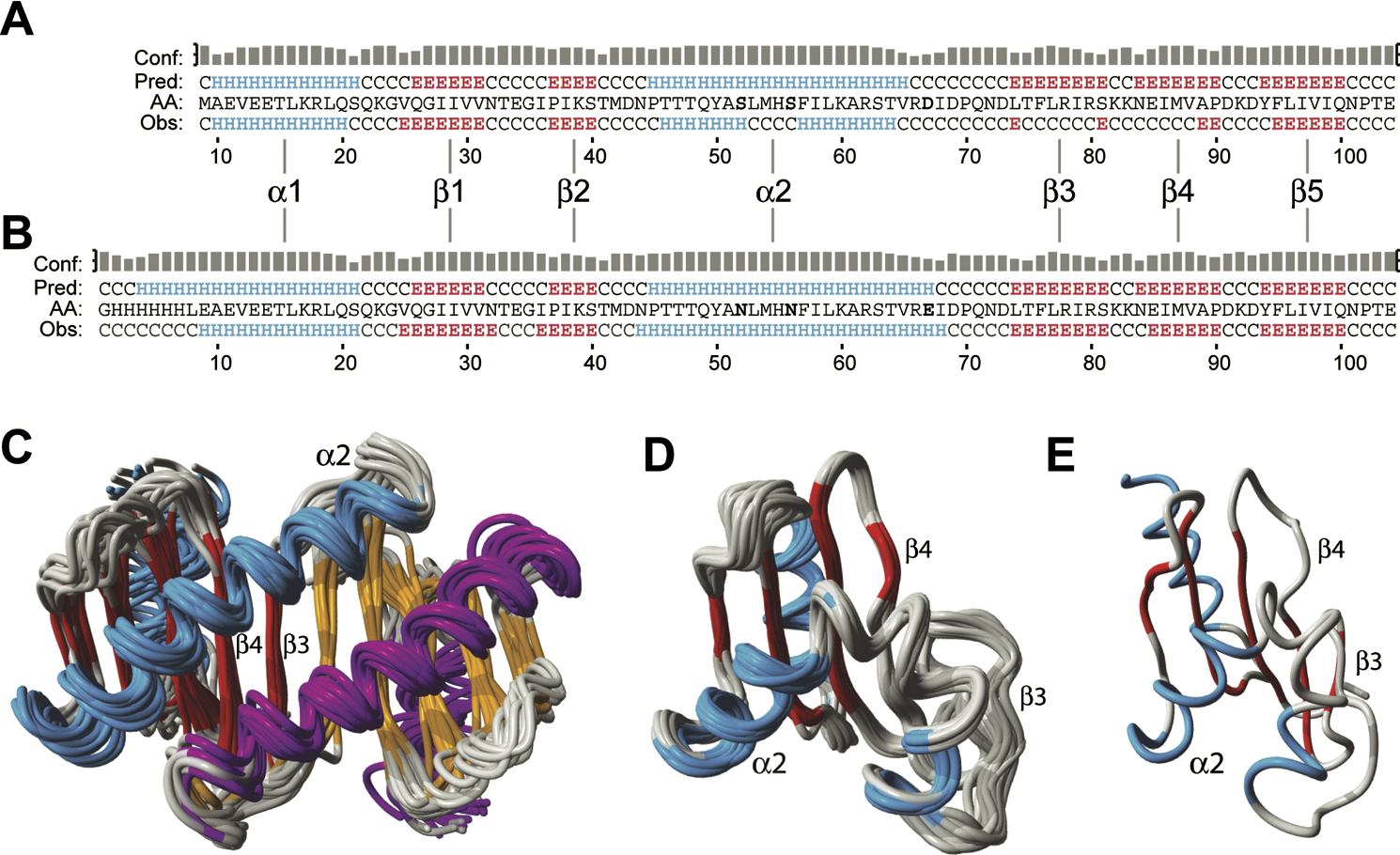
<p>This is nicely demonstrated in the article, by comparing the folds of <a href="http://www.pdb.org/pdb/explore.do?structureId=1Y4O">1Y4O</a>
and <a href="http://www.pdb.org/pdb/explore.do?structureId=1TGQ">1TGQ</a>, as shown in the figure below
(<a href="http://www.plos.org/oa/index.html">CCAL</a> license):</p>

<p><img src="/assets/images/pcbi.0020009.g001.png" alt="Figure 1 from the article: Sequence and Structure Ensembles of Two DLC2A Structures." /></p>

<p>It is interesting to note that 1TGQ got replaced by <a href="http://www.pdb.org/pdb/explore.do?structureId=2B95">2B95</a> about the same
time the article by Nabuurs was published, which shows a 3D model that is homologous with that of 1Y4O, and different from
that in the Nabuurs article.</p>]]></content><author><name>Egon Willighagen</name></author><category term="pdb" /><category term="crystal" /><category term="pdb" /><category term="cif" /><category term="justdoi:10.1371/JOURNAL.PCBI.0020009" /><summary type="html"><![CDATA[While I was working on implementing proper author-given chain IDs in PDB structures for Jmol’s mmCIF reader today, I thought it was interesting to mention the recent article Traditional Biomolecular Structure Determination by NMR Spectroscopy Allows for Major Errors by Nabuurs (DOI:10.1371/journal.pcbi.0020009, open access), working at the CMBI, two floors away from my former working location at the Radboud University Nijmegen.]]></summary></entry><entry><title type="html">Going to the German Chemoinformatics Conference</title><link href="https://chem-bla-ics.linkedchemistry.info/2005/11/11/going-to-german-chemoinformatics.html" rel="alternate" type="text/html" title="Going to the German Chemoinformatics Conference" /><published>2005-11-11T00:00:00+00:00</published><updated>2005-11-11T00:00:00+00:00</updated><id>https://chem-bla-ics.linkedchemistry.info/2005/11/11/going-to-german-chemoinformatics</id><content type="html" xml:base="https://chem-bla-ics.linkedchemistry.info/2005/11/11/going-to-german-chemoinformatics.html"><![CDATA[<p>This sunday starts the first <a href="https://web.archive.org/web/20051215010113/https://www.cic-workshop.de/">German Chemoinformatics Conference <i class="fa-solid fa-box-archive fa-xs"></i></a> in
<a href="http://www.goslar.de/">Goslar</a>. It’s an interesting <a href="https://web.archive.org/web/20060206222231/http://scholle.oc.uni-kiel.de/users/cic/tagungen/workshop05/programm.html">programme <i class="fa-solid fa-box-archive fa-xs"></i></a>, with
presentations on the InChI, PubChem, 25 years of chemoinformatics, the chemical semantic web, and much more.</p>

<p>Among these presentations is mine, on comparing crystal structures
(<a href="https://web.archive.org/web/20050410111504/http://www.cac.science.ru.nl/research/publications/PDFs/willighagen2005.pdf">PDF <i class="fa-solid fa-box-archive fa-xs"></i></a>)
and deducing cell parameters. But I’m having a poster on QSAR too.</p>

<p>I’ll arrive on saturday afternoon in Goslar, so leave a message at the conference hotel if you want to meet up, and talk about my work, or yours, or
the CDK, KDE, JChemPaint, Jmol, kfile_chemical, Kat/Chemistry, <a href="http://www.blueobelisk.org/">BlueObelisk</a>, Eclipse, R, or whatever else…
I plan to have a modest german meal and one or two beers in the evening.</p>

<p>BTW, after Belém (Lissabon), Sintra, Boppard, Kinderdijk, Hoorn and Cologne, it’s the 7th
<a href="http://whc.unesco.org/">UNESCO world heritage</a> site I’m visiting in just 14 months! Can’t we just have conferences in Hawaii and sorts, like
they do in other fields?? Oh, wait, we do: EuroQSAR is on a cruise boat.</p>]]></content><author><name>Egon Willighagen</name></author><category term="cheminf" /><category term="crystal" /><category term="doi:10.1107/S0108768104028344" /><category term="career" /><summary type="html"><![CDATA[This sunday starts the first German Chemoinformatics Conference in Goslar. It’s an interesting programme , with presentations on the InChI, PubChem, 25 years of chemoinformatics, the chemical semantic web, and much more.]]></summary></entry></feed>