<?xml version="1.0" encoding="utf-8"?><feed xmlns="http://www.w3.org/2005/Atom" ><generator uri="https://jekyllrb.com/" version="4.3.4">Jekyll</generator><link href="https://chem-bla-ics.linkedchemistry.info/feed/by_tag/conference.xml" rel="self" type="application/atom+xml" /><link href="https://chem-bla-ics.linkedchemistry.info/" rel="alternate" type="text/html" /><updated>2026-03-08T13:54:44+00:00</updated><id>https://chem-bla-ics.linkedchemistry.info/feed/by_tag/conference.xml</id><title type="html">chem-bla-ics</title><subtitle>Chemblaics (pronounced chem-bla-ics) is the science that uses open science and computers to solve problems in chemistry, biochemistry and related fields.</subtitle><author><name>Egon Willighagen</name></author><entry><title type="html">American Chemical Society Fall 2023 meeting</title><link href="https://chem-bla-ics.linkedchemistry.info/2023/09/09/ACSFall2023.html" rel="alternate" type="text/html" title="American Chemical Society Fall 2023 meeting" /><published>2023-09-09T00:00:00+00:00</published><updated>2023-09-09T00:00:00+00:00</updated><id>https://chem-bla-ics.linkedchemistry.info/2023/09/09/ACSFall2023</id><content type="html" xml:base="https://chem-bla-ics.linkedchemistry.info/2023/09/09/ACSFall2023.html"><![CDATA[<p>About four weeks ago the <a href="https://www.acs.org/meetings/acs-meetings/fall-2023.html">Fall 2023 American Chemical Society</a>
meeting (<a href="https://mastodon.social/tags/ACSFall2023">#ACSFall2023</a>).
I have attended a few ACS meetings in person and even organized a <a href="https://egonw.github.io/acsrdf2010/">symposium at the 2010 ACS meeting</a>
in Boston. This time too, I did not participate in person, tho visiting San Francisco again would have been nice. I gave
<a href="https://mastodon.social/@egonw@social.edu.nl/110882509829434765">two</a> <a href="https://mastodon.social/@egonw@social.edu.nl/110883271752255923">presentations</a>
(slides doi:<a href="https://doi.org/10.5281/zenodo.8255394">10.5281/zenodo.8255394</a>), but have not uploaded my slides of the first presentation to Zenodo yet.</p>

<p>The theme of the meeting was data, and this resulted in a wealth of presentations with cheminformatics. What is striking
here is that a lot of work has not changed so much in 20 years, except for the scale. What I missed here was the large open
data sets, but generally the level of open science was heartwarming! So many preprints mentions, GitHub repositories, and Zenodo
deposits. The Blue Obelisk was truly ahead of its time, but it is a delight to see the field of chemistry catch up.
I can now say a lot of about peer review, and why the field is not benefitting from all the experience that exists in the field
because people publish in the wrong journals, but that is for another time.</p>

<p>I attended multiple sessions, which is a bit of a challenge, doing this remotely from Central European Summer Time (CEST).
Of course, the Sunday started with the <a href="https://acs.digitellinc.com/sessions/574129/view">Chemical informatics (R)evolution: Towards Democratization and Open Science</a>
session, where I had my first talk, and later that day the <a href="https://acs.digitellinc.com/sessions/573932/view">Enhance your Data - Smart Ways to Metadata and Knowledge Graphs</a> session,
where I gave a second talk, about <a href="https://bioschemas.org/">Bioschemas</a>’ <code class="language-plaintext highlighter-rouge">ChemicalSubstance</code> and <code class="language-plaintext highlighter-rouge">MolecularEntity</code>. Sadly, I
had to leave that meeting early because it was getting too late.</p>

<p>There were so many interesting sessions, I could not attend everything. I also have to go back to all
<a href="https://mastodon.social/tags/ACSFall2023">my notes</a> and isolate things I want to follow up on, prominently open datasets.</p>

<p>More later.</p>]]></content><author><name>Egon Willighagen</name></author><category term="acs" /><category term="scholia" /><category term="wikidata" /><category term="justdoi:10.5281/zenodo.8255394" /><category term="acsfall2023" /><category term="conference" /><summary type="html"><![CDATA[About four weeks ago the Fall 2023 American Chemical Society meeting (#ACSFall2023). I have attended a few ACS meetings in person and even organized a symposium at the 2010 ACS meeting in Boston. This time too, I did not participate in person, tho visiting San Francisco again would have been nice. I gave two presentations (slides doi:10.5281/zenodo.8255394), but have not uploaded my slides of the first presentation to Zenodo yet.]]></summary></entry><entry><title type="html">Oxford… #2</title><link href="https://chem-bla-ics.linkedchemistry.info/2010/08/06/oxford-2.html" rel="alternate" type="text/html" title="Oxford… #2" /><published>2010-08-06T00:00:00+00:00</published><updated>2010-08-06T00:00:00+00:00</updated><id>https://chem-bla-ics.linkedchemistry.info/2010/08/06/oxford-2</id><content type="html" xml:base="https://chem-bla-ics.linkedchemistry.info/2010/08/06/oxford-2.html"><![CDATA[<p>The <a href="/2010/08/01/oxford.html">Predictive Toxicology <i class="fa-solid fa-recycle fa-xs"></i></a> meeting is over. It was a great meeting, by any standard.
Very much recommended, and many thanx to Barry for the organization! The meeting was a true workshop, with a mix of presentations and getting
work done. I participated in a group that looked at mutagenicity of potential anti-malaria drugs from the datasets of GSK and Novartis recently
release as Open Data. We used various tools to predict properties, and plan to make all our results freely available soon. Otherwise, it was
also great to meet Nina again (with whom I <a href="https://chem-bla-ics.blogspot.com/2010/08/using-bioclipse-to-upload-data-to.html">talked about OpenTox</a>),
and to meet other CDK users, including Patrik (<a href="https://web.archive.org/web/20100918124243/https://www.farma.ku.dk/smartcyp/">SMARTCyp <i class="fa-solid fa-box-archive fa-xs"></i></a>,
doi:<a href="https://doi.org/10.1021/ml100016x">10.1021/ml100016x</a>) and David (<a href="http://inkspotscience.com/">Inkspot</a>).</p>

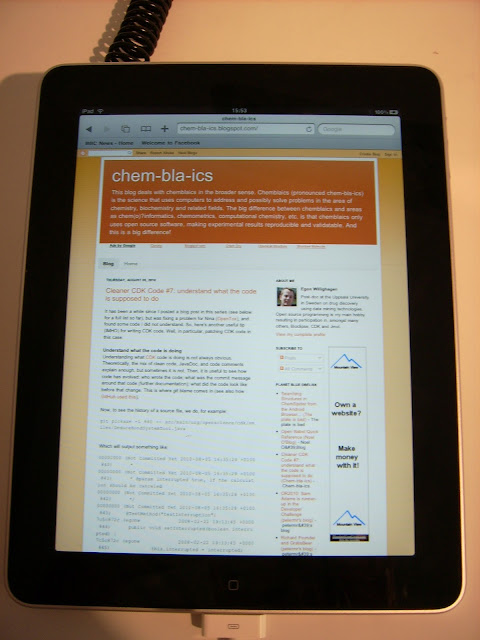
<p>In the afternoon I walked around a bit more in Oxford, did some more shopping… and visited the Apple shop and played with an iPad. It’s
indeed a great piece of hardware. Looking forward to the first Android versions :)</p>

<p><img src="/assets/images/DSCI0107.JPG" alt="" /></p>]]></content><author><name>Egon Willighagen</name></author><category term="cdk" /><category term="oxford" /><category term="oxfordadmet2010" /><category term="justdoi:10.1021/ml100016x" /><category term="conference" /><summary type="html"><![CDATA[The Predictive Toxicology meeting is over. It was a great meeting, by any standard. Very much recommended, and many thanx to Barry for the organization! The meeting was a true workshop, with a mix of presentations and getting work done. I participated in a group that looked at mutagenicity of potential anti-malaria drugs from the datasets of GSK and Novartis recently release as Open Data. We used various tools to predict properties, and plan to make all our results freely available soon. Otherwise, it was also great to meet Nina again (with whom I talked about OpenTox), and to meet other CDK users, including Patrik (SMARTCyp , doi:10.1021/ml100016x) and David (Inkspot).]]></summary></entry><entry><title type="html">Oxford…</title><link href="https://chem-bla-ics.linkedchemistry.info/2010/08/01/oxford.html" rel="alternate" type="text/html" title="Oxford…" /><published>2010-08-01T00:00:00+00:00</published><updated>2010-08-01T00:00:00+00:00</updated><id>https://chem-bla-ics.linkedchemistry.info/2010/08/01/oxford</id><content type="html" xml:base="https://chem-bla-ics.linkedchemistry.info/2010/08/01/oxford.html"><![CDATA[<p>Yesterday I arrived in <a href="http://en.wikipedia.org/wiki/Oxford">Oxford</a>, after a 3.5 hour bus transfer from
<a href="http://en.wikipedia.org/wiki/London_Stansted_Airport">London Stansted</a>. Long, boring ride (though I might have seen a few
<a href="https://web.archive.org/web/20100728051221/http://www.rspb.org.uk/wildlife/birdguide/name/r/redkite/index.aspx">red kites <i class="fa-solid fa-box-archive fa-xs"></i></a>, but seeing that they were near extinct, I am
wondering what other large bird of prey has strong split tail like a swallow). Showed once more that the UK infrastructure has
hardly changed since the 19th century. Enjoying an undergraduate room at one of the colleges. Pretty basic, but makes me feel
more like a human than a tourist. Yes!, undergraduate students are human too! One of the advantages is you get an excellent
internet connection :)</p>

<p>Anyways, going to the <a href="https://web.archive.org/web/20111001000000*/http://echeminfo.com/comty_oxfordadmet10">Predictive Toxicology <i class="fa-solid fa-box-archive fa-xs"></i></a> workshop, thanx to the bursary award I received from
<a href="https://web.archive.org/web/20110207193345/http://echeminfo.com/">echeminfo <i class="fa-solid fa-box-archive fa-xs"></i></a>
(see <a href="http://chem-bla-ics.blogspot.com/2010/03/oxford-august-2010-echeminfo-predictive.html">Oxford, August 2010: eCheminfo Predictive ADME &amp; Toxicology 2010 Workshop</a>).</p>

<p>This afternoon I walked around a bit, watching all the old buildings. But I guess being here without anyone to share it with,
and that it looks just like <a href="http://en.wikipedia.org/wiki/Cambridge">Cambridge</a>, makes me not-so-much impressed. Moreover, it’s too
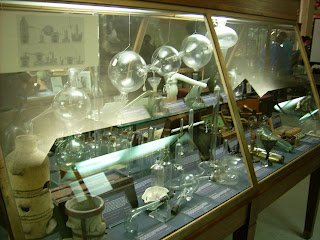
busy with tourists and people randomly wearing Oxford University sweatshirts. Small and nice was the
<a href="http://www.mhs.ox.ac.uk/">Museum of the History of Science</a>, with some nice chemical pieces, like this one:</p>

<p><img src="/assets/images/DSCI0089.JPG" alt="" /></p>

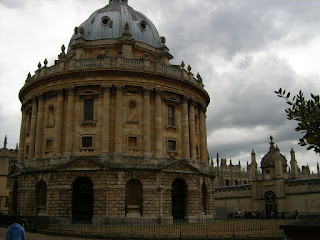
<p>Buildings like the <a href="http://en.wikipedia.org/wiki/Radcliffe_Camera">Radcliffe Camera</a> are nice on the outside, but closed.
Seems I have to become a fellow first. This is what it looked like today:</p>

<p><img src="/assets/images/DSCI0094.JPG" alt="" /></p>

<p>Quite interesting too was the Oxford University Press shop. I’m a sucker for books. Apparently, you can just write a book
and publish it. For example, an extensive list of <a href="http://ukcatalogue.oup.com/category/academic/series/general/opr.do">dictionaries on about anything</a>…
and since I have been writing several book chapters right now, perhaps this is actually an interesting route…</p>

<p>But the question is, of course, how long will we keep reading books… they’re the
<a href="https://blogs.ch.cam.ac.uk/pmr/2008/04/29/why-pdf-is-a-hamburger/">hamburgers <i class="fa-solid fa-recycle fa-xs"></i></a> of educational material… Kindle and alikes will soon drop in
price, and cost some €30 euro. But e-book prices will have to drop too, and I still do not get why an e-book is more expensive than a paperback…
(see <a href="http://chem-bla-ics.blogspot.com/2010/07/amazon-kindle-edition-is-more-expensive.html">Amazon, the Kindle edition is more expensive than the paperback??</a>).
But then again… they are rich, and I am not.</p>

<p>There was some recent talk about the fact that no one can be Open to the full. You either do Open Data or Open Source, and
make a living from the rest. That’s where I nicely show I know bullocks of economics. I do
<a href="http://bodr.sf.net/">BODR</a>, <a href="http://cdk.sf.net/">CDK</a>, … all Open, all for free.</p>

<p>OK. That’s a plus for Oxford… it makes you think about things. Perhaps there is something to
<a href="http://en.wikipedia.org/wiki/Morphic_field#Morphogenetic_field">morphogenetic</a> fields…</p>]]></content><author><name>Egon Willighagen</name></author><category term="oxford" /><category term="oxfordadmet2010" /><category term="publishing" /><category term="science" /><category term="toxicology" /><category term="conference" /><summary type="html"><![CDATA[Yesterday I arrived in Oxford, after a 3.5 hour bus transfer from London Stansted. Long, boring ride (though I might have seen a few red kites , but seeing that they were near extinct, I am wondering what other large bird of prey has strong split tail like a swallow). Showed once more that the UK infrastructure has hardly changed since the 19th century. Enjoying an undergraduate room at one of the colleges. Pretty basic, but makes me feel more like a human than a tourist. Yes!, undergraduate students are human too! One of the advantages is you get an excellent internet connection :)]]></summary></entry><entry><title type="html">German Conference on Chemoinformatics 2006: Day 3</title><link href="https://chem-bla-ics.linkedchemistry.info/2006/11/14/german-conference-on-chemoinformatics_14.html" rel="alternate" type="text/html" title="German Conference on Chemoinformatics 2006: Day 3" /><published>2006-11-14T00:00:00+00:00</published><updated>2006-11-14T00:00:00+00:00</updated><id>https://chem-bla-ics.linkedchemistry.info/2006/11/14/german-conference-on-chemoinformatics_14</id><content type="html" xml:base="https://chem-bla-ics.linkedchemistry.info/2006/11/14/german-conference-on-chemoinformatics_14.html"><![CDATA[<p>Just some short quites note about the third day (see <a href="https://chem-bla-ics.linkedchemistry.info/2006/11/13/german-conference-on-chemoinformatics.html">day 1 and 2 <i class="fa-solid fa-recycle fa-xs"></i></a>).
Today’s program of the <a href="http://scholle.oc.uni-kiel.de/users/cic/tagungen/workshop06/index.html">German Conference on Chemoinformatics</a>
started with a presentation by Rzepa about his work on a semantic wiki (DOI:<a href="https://doi.org/10.1021/ci060139e">10.1021/ci060139e</a>),
which might be <a href="http://www.ch.ic.ac.uk/wiki/">online here</a>. (He recorded a podcast, but I have not seen it online yet.) I wish I could
see the sources of those wiki pages, to see how that system integrates RDF, but at least <a href="http://www.jmol.org/">Jmol</a> is running fine.
The presentation by Couch showed the status of the <a href="http://www.materialsgrid.org/">Materials Grid project</a>, and how a guy called AgentX
does all the hard work. Ihlenfeldt updated us about the status of <a href="http://pubchem.ncbi.nlm.nih.gov/">PubChem</a>, and mostly on what they
had to do to keep the system from dying from its own success, for example using something called minimol. Googling does not seem to
help, as that points to a number of things, but not any PubChem webpage. I am still waiting for a European organization to set up a mirror.</p>

<p>After the coffee break, Kuhn showed a coarse grained force field, approximating molecules by hacking them up in fragment of 3-10 heavy atoms.
I guess, a bit like some small molecules force fields do for methyls. Fragments within a molecule are tied together by springs, and intra-
and intermolecular force field parameters by running MD runs on fragment pairs. Varnek argued that QSPR for melting point prediction has
reached a fundamental limited, with an RMSE of around 30 to 40 degrees Celsius, which makes it quite unreasonable to decide whether a
compound with a predicted melting point of 40 degrees is solid or fluid at room temperature.</p>

<p>You have to forgive me for not reporting on the afternoon session; I was tied up talking with people at our booth, talking about the CDK,
Taverna, Bioclipse, Jmol, other opensource chemoinformatics tools, and chemoinformatics in general. Very nice, but exhausting. I might
advise the organization to set up a blog aggregator next year, though I am not sure whether there are others blogging about this conference.</p>]]></content><author><name>Egon Willighagen</name></author><category term="cheminf" /><category term="conference" /><category term="justdoi:10.1021/ci060139e" /><category term="semweb" /><summary type="html"><![CDATA[Just some short quites note about the third day (see day 1 and 2 ). Today’s program of the German Conference on Chemoinformatics started with a presentation by Rzepa about his work on a semantic wiki (DOI:10.1021/ci060139e), which might be online here. (He recorded a podcast, but I have not seen it online yet.) I wish I could see the sources of those wiki pages, to see how that system integrates RDF, but at least Jmol is running fine. The presentation by Couch showed the status of the Materials Grid project, and how a guy called AgentX does all the hard work. Ihlenfeldt updated us about the status of PubChem, and mostly on what they had to do to keep the system from dying from its own success, for example using something called minimol. Googling does not seem to help, as that points to a number of things, but not any PubChem webpage. I am still waiting for a European organization to set up a mirror.]]></summary></entry><entry><title type="html">German Conference on Chemoinformatics 2006: Day 1 and 2</title><link href="https://chem-bla-ics.linkedchemistry.info/2006/11/13/german-conference-on-chemoinformatics.html" rel="alternate" type="text/html" title="German Conference on Chemoinformatics 2006: Day 1 and 2" /><published>2006-11-13T00:00:00+00:00</published><updated>2006-11-13T00:00:00+00:00</updated><id>https://chem-bla-ics.linkedchemistry.info/2006/11/13/german-conference-on-chemoinformatics</id><content type="html" xml:base="https://chem-bla-ics.linkedchemistry.info/2006/11/13/german-conference-on-chemoinformatics.html"><![CDATA[<p>The <a href="http://scholle.oc.uni-kiel.de/users/cic/tagungen/workshop06/index.html">2nd German Conference on Chemoinformatics</a>
started yesterday, with two chemoinformatics tutorials: one on industrial chemoinformatics (I saw this presentation
before… not sure when), with a good overview on integrating different information sources; the second one was about
opensource chemoinformatics by <a href="http://wiki.cubic.uni-koeln.de/blog/index.php">Christoph Steinbeck</a> (being involved
in opensource chemoinformatics for almost 10 years now!), which included a <a href="http://www.bioclipse.net/">Bioclipse</a>
demo (by me) and a demo by Thomas Kuhn on the <a href="http://cdk.sf.net/">CDK</a> based chemoinformatics plugin to
<a href="http://taverna.sf.net/">Taverna</a>. Other opensource projects of the <a href="http://www.blueobelisk.org/">Blue Obelisk</a>
movement were mentioned and a few outside it too.</p>

<p>The conference is in honor of the life work by <a href="http://www2.chemie.uni-erlangen.de/">Prof. Gasteiger</a>, who gave an
overview of chemoinformatics in his group, Germany and Europe. He stressed the need of education in chemoinformatics,
like in <a href="http://wiki.cubic.uni-koeln.de/blog/pivot/entry.php?id=12">Obernai</a>. He also highlighted that we, today,
are still solving the same problem as 30 years ago. Which is true, which is why this channel is called
<a href="https://chem-bla-ics.linkedchemistry.info/">Chem-bla-ics <i class="fa-solid fa-recycle fa-xs"></i></a>, trying to solve that problem. When asked if opensource chemoinformatics
form the start would have addressed this, he replied that he requires people to cooperatively do research with his
group; opensource clearly cannot enforce that.</p>

<h1 id="day-2">Day 2</h1>

<p>Todays program had a number of interesting presentations (I, unfortunately, missed the first presentation, so
have to visit that group soon now, to make up for that.) <a href="http://www.dq.fct.unl.pt/staff/jas/introduction.htm">Prof. Aires-de-Sousa</a>
showed his work on MOLMAP for mapping metabolic networks (<a href="http://www.genome.jp/kegg/">KEGG</a> really, see my
<a href="https://chem-bla-ics.linkedchemistry.info/2006/04/04/mining-kegg-pathway-database-with-self.html">earlier blog <i class="fa-solid fa-recycle fa-xs"></i></a>), and showed,
just as proof of principle, classification of organisms based on this.</p>

<p>J. Weisser talked about docking, still an obligatory topic. This work really showed two new approaches: the use
of QM partial charges (the example showed an improvement in RMSD of a factor 10, not very statistical, but
promising indeed); the second was the fact that water does not like to be in tight spots, because of reduced
possibilities for hydrogen bonding. A concept common in understand supramolecular phenomenon, but I have not
seen this applied to docking before. But I am no expert in that field. M. Wagner showed work on using KEGG
data to estimate likely metabolites, and the use in reducing effects of metabolic degradation. T. Schroeter
introduced me to <a href="http://www.gaussianprocess.org/">gaussian processes</a>, a new data modeling method. Quite
embarrassing to get introduced to such, as being specialized in modeling methods for chemical problems.</p>

<p>The poster session was, as normally, really exhausting, talking to a lot of people. Having a booth at the exhibition
on opensource chemoinformatics added a nice twist to this. I therefore skipped the FIZ-award winner lectures, so I
hope someone else will blog about those.</p>

<p>One last note: <a href="http://www.sun.com/software/opensource/java/">Sun started releasing their Java platform under the GPL license</a>.
<a href="http://wwmm.ch.cam.ac.uk/blogs/downing/">Jim</a>, seems that they <a href="https://chem-bla-ics.linkedchemistry.info/2006/10/25/being-good-opensource-user.html">proved me wrong <i class="fa-solid fa-recycle fa-xs"></i></a>.
The class library is still not GPL, but is expected to become licensed such somewhere in the first half of next year.</p>]]></content><author><name>Egon Willighagen</name></author><category term="cheminf" /><category term="conference" /><category term="openscience" /><category term="bioclipse" /><category term="cdk" /><category term="taverna" /><category term="java" /><summary type="html"><![CDATA[The 2nd German Conference on Chemoinformatics started yesterday, with two chemoinformatics tutorials: one on industrial chemoinformatics (I saw this presentation before… not sure when), with a good overview on integrating different information sources; the second one was about opensource chemoinformatics by Christoph Steinbeck (being involved in opensource chemoinformatics for almost 10 years now!), which included a Bioclipse demo (by me) and a demo by Thomas Kuhn on the CDK based chemoinformatics plugin to Taverna. Other opensource projects of the Blue Obelisk movement were mentioned and a few outside it too.]]></summary></entry><entry><title type="html">Bioclipse Workshop: short but productive</title><link href="https://chem-bla-ics.linkedchemistry.info/2006/11/03/bioclipse-workshop-short-but.html" rel="alternate" type="text/html" title="Bioclipse Workshop: short but productive" /><published>2006-11-03T00:00:00+00:00</published><updated>2006-11-03T00:00:00+00:00</updated><id>https://chem-bla-ics.linkedchemistry.info/2006/11/03/bioclipse-workshop-short-but</id><content type="html" xml:base="https://chem-bla-ics.linkedchemistry.info/2006/11/03/bioclipse-workshop-short-but.html"><![CDATA[<p>The <a href="http://www.bioclipse.net/">Bioclipse</a> <a href="http://wiki.bioclipse.net/index.php?title=Bioclipse_Workshop_Oct/Nov_2006">Workshop</a>
has ended and, for just three days, turned out <a href="http://wiki.bioclipse.net/index.php?title=Outcome_of_the_Bioclipse_autumn_workshop_2006">quite productive</a>.
We have first bits of scripting support for JavaScript using <a href="http://www.mozilla.org/rhino/">Rhino</a>. At this moment the
scripting plugin needs to explicit depend on plugins to be able to access their classpath, but we plan to solve that.
An example script:</p>

<div class="language-javascript highlighter-rouge"><div class="highlight"><pre class="highlight"><code><span class="c1">// to have short identifiers</span>
<span class="nb">Array</span> <span class="o">=</span> <span class="nb">Packages</span><span class="p">.</span><span class="nx">java</span><span class="p">.</span><span class="nx">lang</span><span class="p">.</span><span class="nx">reflect</span><span class="p">.</span><span class="nb">Array</span><span class="p">;</span>
<span class="nb">String</span> <span class="o">=</span> <span class="nb">Packages</span><span class="p">.</span><span class="nx">java</span><span class="p">.</span><span class="nx">lang</span><span class="p">.</span><span class="nb">String</span><span class="p">;</span>
<span class="nx">msgBox</span> <span class="o">=</span> <span class="nb">Packages</span><span class="p">.</span><span class="nx">net</span><span class="p">.</span><span class="nx">bioclipse</span><span class="p">.</span><span class="nx">plugins</span><span class="p">.</span><span class="nx">bc_rhino</span><span class="p">.</span><span class="nx">ShowBcMsgBox</span><span class="p">;</span>
<span class="nx">DbfetchServiceServiceLocator</span> <span class="o">=</span>
  <span class="nb">Packages</span><span class="p">.</span><span class="nx">uk</span><span class="p">.</span><span class="nx">ac</span><span class="p">.</span><span class="nx">ebi</span><span class="p">.</span><span class="nx">www</span><span class="p">.</span><span class="nx">ws</span><span class="p">.</span><span class="nx">services</span><span class="p">.</span><span class="nx">urn</span><span class="p">.</span><span class="nx">Dbfetch</span><span class="p">.</span><span class="nx">DbfetchServiceServiceLocator</span><span class="p">;</span>

<span class="c1">// get data</span>
<span class="nx">service</span> <span class="o">=</span> <span class="k">new</span> <span class="nc">DbfetchServiceServiceLocator</span><span class="p">();</span>
<span class="nx">strarray</span> <span class="o">=</span> <span class="nx">service</span><span class="p">.</span><span class="nf">getUrnDbfetch</span><span class="p">().</span><span class="nf">fetchData</span><span class="p">(</span><span class="dl">"</span><span class="s2">refseq:NM_210721</span><span class="dl">"</span><span class="p">,</span> <span class="dl">"</span><span class="s2">refseq</span><span class="dl">"</span><span class="p">,</span> <span class="dl">"</span><span class="s2">raw</span><span class="dl">"</span><span class="p">);</span>

<span class="c1">// make readable</span>
<span class="nx">str</span> <span class="o">=</span> <span class="k">new</span> <span class="nc">String</span><span class="p">();</span>
<span class="k">for </span><span class="p">(</span><span class="nx">i</span> <span class="o">=</span> <span class="mi">0</span><span class="p">;</span> <span class="nx">i</span> <span class="o">&lt;</span> <span class="nb">Array</span><span class="p">.</span><span class="nf">getLength</span><span class="p">(</span><span class="nx">strarray</span><span class="p">);</span> <span class="nx">i</span><span class="o">++</span><span class="p">)</span> <span class="p">{</span>
  <span class="k">if </span><span class="p">(</span><span class="nx">i</span> <span class="o">!=</span> <span class="mi">0</span><span class="p">)</span>
  <span class="nx">str</span> <span class="o">=</span> <span class="nx">str</span> <span class="o">+</span> <span class="p">(</span><span class="dl">"</span><span class="se">\n</span><span class="dl">"</span><span class="p">);</span>
  <span class="nx">str</span> <span class="o">=</span> <span class="nx">str</span> <span class="o">+</span> <span class="nx">strarray</span><span class="p">[</span><span class="nx">i</span><span class="p">];</span>
<span class="p">}</span>

<span class="c1">// show</span>
<span class="nx">msgBox</span><span class="p">.</span><span class="nc">ShowStatic</span><span class="p">(</span><span class="nx">str</span><span class="p">);</span>
</code></pre></div></div>

<p>It’s just a short example that uses webservice technology in Bioclipse to fetch a sequence.</p>

<h1 id="qsar-support">QSAR support</h1>

<p>QSAR support is getting along too, with a new DescriptorProvider extension point in <a href="http://svn.sourceforge.net/viewvc/bioclipse/trunk/">trunk/</a>
and work is progressing on a wizard that allows selecting descriptors and a CDK backend. The output of the wizard is a matrix resource, for
which we already have a rich editor. A <a href="http://www-ra.informatik.uni-tuebingen.de/software/joelib/">JOELib</a> plugin has been suggested,
as it has a good deal of QSAR descriptors too; <a href="http://miningdrugs.blogspot.com/">Jörg</a>, interested in doing a tiny bit of Bioclipse hacking?</p>

<p>A full proceedings is available <a href="http://wiki.bioclipse.net/index.php?title=Outcome_of_the_Bioclipse_autumn_workshop_2006">online</a>.</p>]]></content><author><name>Egon Willighagen</name></author><category term="bioclipse" /><category term="qsar" /><category term="javascript" /><category term="conference" /><summary type="html"><![CDATA[The Bioclipse Workshop has ended and, for just three days, turned out quite productive. We have first bits of scripting support for JavaScript using Rhino. At this moment the scripting plugin needs to explicit depend on plugins to be able to access their classpath, but we plan to solve that. An example script:]]></summary></entry><entry><title type="html">The Bioclipse Workshop is in progress</title><link href="https://chem-bla-ics.linkedchemistry.info/2006/11/01/bioclipse-workshop-is-in-progress.html" rel="alternate" type="text/html" title="The Bioclipse Workshop is in progress" /><published>2006-11-01T00:00:00+00:00</published><updated>2006-11-01T00:00:00+00:00</updated><id>https://chem-bla-ics.linkedchemistry.info/2006/11/01/bioclipse-workshop-is-in-progress</id><content type="html" xml:base="https://chem-bla-ics.linkedchemistry.info/2006/11/01/bioclipse-workshop-is-in-progress.html"><![CDATA[<p>The <a href="http://www.bioclipse.net/">Bioclipse</a> <a href="http://wiki.bioclipse.net/index.php?title=Bioclipse_Workshop_Oct/Nov_2006">Workshop</a>
is in progress, and <a href="http://bioclipse.blogspot.com/">Ola</a> is now leading a discussion about future releases and functionality.
Proceedings are <a href="http://wiki.bioclipse.net/index.php?title=Outcome_of_the_Bioclipse_autumn_workshop_2006">live updated</a>,
and presentation sheets will be available shortly.</p>]]></content><author><name>Egon Willighagen</name></author><category term="bioclipse" /><category term="conference" /><summary type="html"><![CDATA[The Bioclipse Workshop is in progress, and Ola is now leading a discussion about future releases and functionality. Proceedings are live updated, and presentation sheets will be available shortly.]]></summary></entry><entry><title type="html">CDK Bug Squash Party - Day 5</title><link href="https://chem-bla-ics.linkedchemistry.info/2006/09/24/cdk-bug-squash-party-day-5.html" rel="alternate" type="text/html" title="CDK Bug Squash Party - Day 5" /><published>2006-09-24T00:00:00+00:00</published><updated>2006-09-24T00:00:00+00:00</updated><id>https://chem-bla-ics.linkedchemistry.info/2006/09/24/cdk-bug-squash-party-day-5</id><content type="html" xml:base="https://chem-bla-ics.linkedchemistry.info/2006/09/24/cdk-bug-squash-party-day-5.html"><![CDATA[<p>Day 5 was formally the last day (see also the summaries of <a href="https://chem-bla-ics.linkedchemistry.info/2006/09/18/cdk-bug-squash-party-day-1.html">day 1 <i class="fa-solid fa-recycle fa-xs"></i></a>,
<a href="https://chem-bla-ics.linkedchemistry.info/2006/09/20/cdk-bug-squash-party-day-2.html">day 2 <i class="fa-solid fa-recycle fa-xs"></i></a> and
<a href="https://chem-bla-ics.linkedchemistry.info/2006/09/22/cdk-bug-squash-party-day-3-and-4.html">day 3/4 <i class="fa-solid fa-recycle fa-xs"></i></a>) of the
<a href="http://cdk.sf.net/">Chemistry Development Kit</a> <a href="http://wiki.cubic.uni-koeln.de/cdkwiki/doku.php?id=bsp200609">Bug Squash Party</a> (BSP).
Miguel uploaded the last bits of his CDK <a href="http://cheminfo.informatics.indiana.edu/~rguha/code/java/nightly/api/org/openscience/cdk/protein/data/PDBPolymer.html">PDBPolymer</a>
to CML to CDK PDBPolymer roundtripping functionality (closing a bug and a feature request in one go). Have not tested this first hand yet,
but looking forward to playing with this bit of code. Kai continued to work on the more difficult bits of the
<a href="http://wiki.cubic.uni-koeln.de/cdkwiki/doku.php?id=refactoringkernelclasses">code refactoring</a>, resulting in fewer though more
comprehensive commits. Stefan fixed another bug in JChemPaint; the rendering of implicit hydrogens.</p>

<p>About the last, the <a href="http://cheminfo.informatics.indiana.edu/~rguha/code/java/nightly/api/org/openscience/cdk/renderer/Renderer2D.html">Renderer2D</a>
needs a serious overhaul. That is, a complete rewrite in proper Java2D, which can use affine transformations for zooming, scaling and fixing the
coordinate system. The current code is ancient and predates Java2D. <a href="https://doi.org/10.59350/qxc8d-c1w35">Rich’ code</a>
might be a good starting point. I would love to do this rewrite, but lack the resources… anyone in need of some open source fame?</p>

<p>I worked on atom typing, which is yet largely untested, and often integrated with other bits of code. Yesterday I uploaded
<a href="http://svn.sourceforge.net/viewvc/cdk/trunk/cdk/src/org/openscience/cdk/atomtype/">some first patches</a> which I wrote on the train ride
back to the Netherlands.</p>

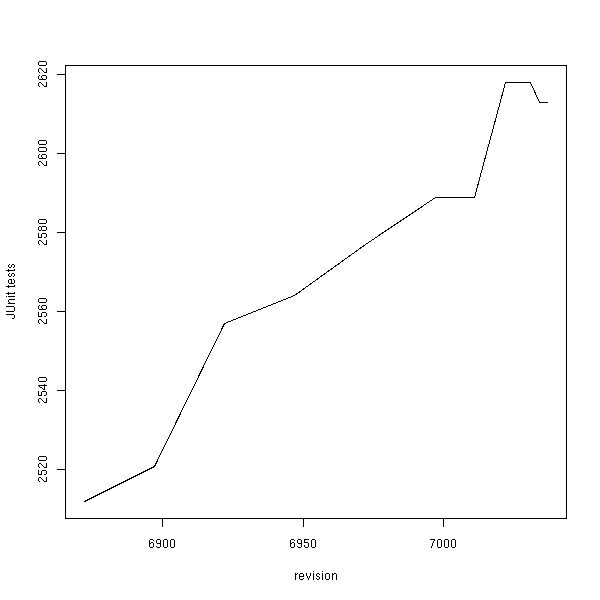
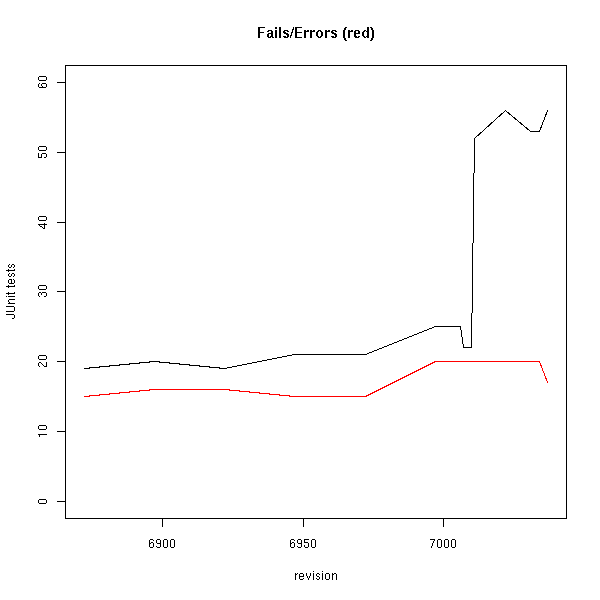
<p>Now, what can be concluded from this BSP? The participant count was below what I had hoped for, but those who did worked hard (and
with pleasure I hope :) The total number of JUnit test has increased:</p>

<p><img src="/assets/images/junit_tests.png" alt="" /></p>

<p>And so has the number of failing tests:</p>

<p><img src="/assets/images/fails_tests.png" alt="" /></p>

<p>These plots were made with <a href="http://www.r-project.org/">R</a> from data created with two custom scripts both found in
<a href="http://svn.sourceforge.net/viewvc/cdk/trunk/cdk/tools/">cdk/tools</a>: makeBugCountPlot.pl and extractBugCountPlotData.bsh.
Note that <a href="http://cheminfo.informatics.indiana.edu/~rguha/code/java/nightly/junitsummary.html">96.86% of the tests do not fail</a>!</p>

<p>The bump in failing tests seems to be due to <a href="http://svn.sourceforge.net/viewvc/cdk/trunk/cdk/src/org/openscience/cdk/smiles/SmilesParser.java?r1=7009&amp;r2=7011">commit 7010-7011</a>,
which has to do with SMILES parsing. Yes, the bond order resolving is still not solved. I don’t seem to get Todd’s patch for this working,
but not giving up either. The bump is so large, because quite some JUnit tests use the SmilesParser as a quick tool to get a configured
connection table. However, these tests should be replaced by explicit CDK models, which is easy done with the
<a href="http://cheminfo.informatics.indiana.edu/~rguha/code/java/nightly/api/org/openscience/cdk/io/CDKSourceCodeWriter.html">CDKSourceCodeWriter</a>.
I’ll blog about how to use that soon.</p>]]></content><author><name>Egon Willighagen</name></author><category term="cdk" /><category term="bsp" /><category term="junit" /><category term="conference" /><category term="cito:citesAsPotentialSolution:10.59350/qxc8d-c1w35" /><summary type="html"><![CDATA[Day 5 was formally the last day (see also the summaries of day 1 , day 2 and day 3/4 ) of the Chemistry Development Kit Bug Squash Party (BSP). Miguel uploaded the last bits of his CDK PDBPolymer to CML to CDK PDBPolymer roundtripping functionality (closing a bug and a feature request in one go). Have not tested this first hand yet, but looking forward to playing with this bit of code. Kai continued to work on the more difficult bits of the code refactoring, resulting in fewer though more comprehensive commits. Stefan fixed another bug in JChemPaint; the rendering of implicit hydrogens.]]></summary><media:thumbnail xmlns:media="http://search.yahoo.com/mrss/" url="https://chem-bla-ics.linkedchemistry.info/assets/images/junit_tests.png" /><media:content medium="image" url="https://chem-bla-ics.linkedchemistry.info/assets/images/junit_tests.png" xmlns:media="http://search.yahoo.com/mrss/" /></entry><entry><title type="html">CDK Bug Squash Party - Day 3 and 4</title><link href="https://chem-bla-ics.linkedchemistry.info/2006/09/22/cdk-bug-squash-party-day-3-and-4.html" rel="alternate" type="text/html" title="CDK Bug Squash Party - Day 3 and 4" /><published>2006-09-22T00:00:00+00:00</published><updated>2006-09-22T00:00:00+00:00</updated><id>https://chem-bla-ics.linkedchemistry.info/2006/09/22/cdk-bug-squash-party-day-3-and-4</id><content type="html" xml:base="https://chem-bla-ics.linkedchemistry.info/2006/09/22/cdk-bug-squash-party-day-3-and-4.html"><![CDATA[<p>Because I was struggling hard with <a href="http://sourceforge.net/mailarchive/forum.php?thread_id=30594266&amp;forum_id=2178">default values for cdk.interfaces fields</a>,
I did not have time to write up the <a href="http://wiki.cubic.uni-koeln.de/cdkwiki/doku.php?id=bsp200609">Bug Squash Party</a> report for day 3 (see also
<a href="https://chem-bla-ics.linkedchemistry.info/2006/09/18/cdk-bug-squash-party-day-1.html">day 1 <i class="fa-solid fa-recycle fa-xs"></i></a> and
<a href="https://chem-bla-ics.linkedchemistry.info/2006/09/20/cdk-bug-squash-party-day-2.html">day 2 <i class="fa-solid fa-recycle fa-xs"></i></a>).
But here it is.</p>

<h1 id="day-3">Day 3</h1>

<p>Kai worked hard on getting the <code class="language-plaintext highlighter-rouge">cdk.interfaces</code> API cleaned up, as <a href="http://wiki.cubic.uni-koeln.de/cdkwiki/doku.php?id=refactoringkernelclasses">agreed upon earlier</a>.
Christian added a test for the <a href="http://cheminfo.informatics.indiana.edu/~rguha/code/java/nightly/api/org/openscience/cdk/geometry/GeometryTools.html">RMSD calculator</a>
(see <code class="language-plaintext highlighter-rouge">getAllAtomRMSD()</code>), and cleaned up his code a bit. Stefan continued his bug-squashing on JChemPaint and fixed another one or two bugs.</p>

<p>Rajarshi uploaded a patch to set undefined atomic properties, like partial and formal charges and the implicit hydrogen count, to <code class="language-plaintext highlighter-rouge">UNSET</code> by default.
However, this broke the CDK at many places, as apparently many class methods assume the default to be zero. After discussing the issue at the CUBIC,
it turned out that this was sort of the intended, though undocumented, behavior: use the <a href="http://java.sun.com/docs/books/tutorial/java/nutsandbolts/datatypes.html">default Java values</a>.</p>

<p>And I added missing <code class="language-plaintext highlighter-rouge">clone()</code> methods, closing one bug on SourceForge, added files for Eclipse to know how to build the CDK with Ant (thanx
to Nico for similar files for <a href="http://www.jmol.org/">Jmol</a>), and got CDK compiled again against <a href="http://www.classpath.org/">Classpath</a>.</p>

<h1 id="day-4">Day 4</h1>

<p>Miguel uploaded his first patched for support saving <a href="http://cheminfo.informatics.indiana.edu/~rguha/code/java/nightly/api/org/openscience/cdk/protein/data/PDBPolymer.html">PDBPolymer</a>
data structures into and restoring them again from CML, addressing an <a href="https://sourceforge.net/tracker/index.php?func=detail&amp;aid=1085912&amp;group_id=20024&amp;atid=120024">almost two-year-old bug</a>.
He created new cdk.interfaces for them, to address module dependencies, but a large set of JUnit tests are <a href="http://cheminfo.informatics.indiana.edu/~rguha/code/java/nightly/test/result-data.html">yet missing</a>.</p>

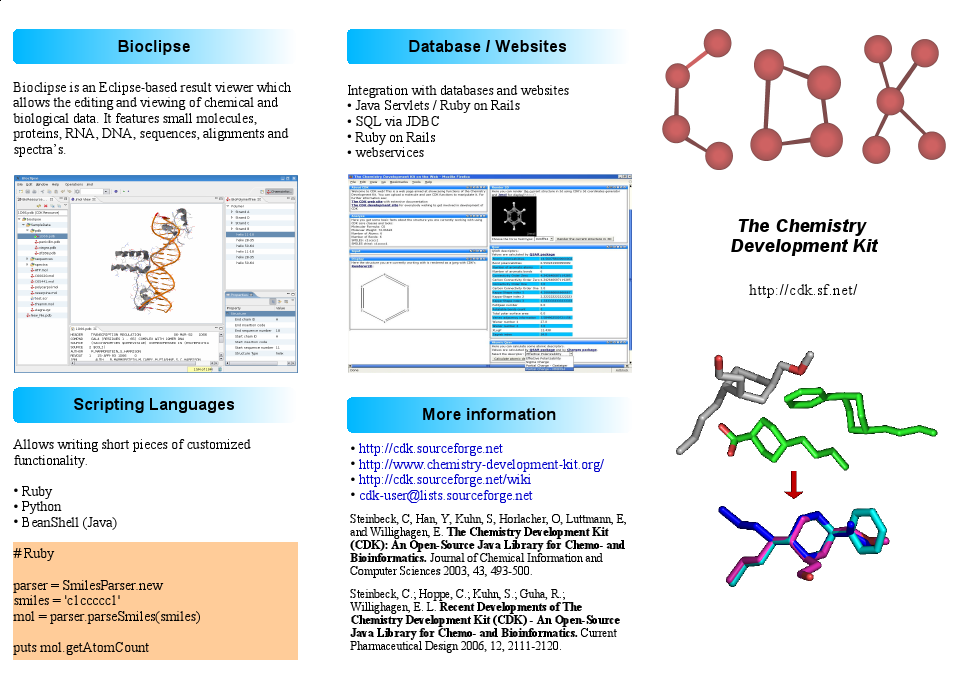
<p>Kai continued his cdk.interfaces refactoring, working on the more involved changes. Stefan, Tobias, and me worked on a poster and three three-fold
flyers for our CDK booth at <a href="http://www.inf.uni-konstanz.de/complife06/">CompLife2006</a>, so have not been very productive in bug squashing.
But we are happy with the result. Below is a screenshot on one side of the main CDK folder:</p>

<p><img src="/assets/images/flyerScreeny.png" alt="" /></p>

<p>With <a href="http://cheminfo.informatics.indiana.edu/~rguha/code/java/nightly/junitsummary.html">77 failing JUnit test</a>, and still a too large number of
<a href="http://sourceforge.net/tracker/?atid=120024&amp;group_id=20024&amp;func=browse">open bugs on SourceForge</a>, there is plenty of things to do today.</p>]]></content><author><name>Egon Willighagen</name></author><category term="cdk" /><category term="bsp" /><category term="java" /><category term="pdb" /><category term="conference" /><summary type="html"><![CDATA[Because I was struggling hard with default values for cdk.interfaces fields, I did not have time to write up the Bug Squash Party report for day 3 (see also day 1 and day 2 ). But here it is.]]></summary><media:thumbnail xmlns:media="http://search.yahoo.com/mrss/" url="https://chem-bla-ics.linkedchemistry.info/assets/images/flyerScreeny.png" /><media:content medium="image" url="https://chem-bla-ics.linkedchemistry.info/assets/images/flyerScreeny.png" xmlns:media="http://search.yahoo.com/mrss/" /></entry><entry><title type="html">CDK Bug Squash Party - Day 2</title><link href="https://chem-bla-ics.linkedchemistry.info/2006/09/20/cdk-bug-squash-party-day-2.html" rel="alternate" type="text/html" title="CDK Bug Squash Party - Day 2" /><published>2006-09-20T00:00:00+00:00</published><updated>2006-09-20T00:00:00+00:00</updated><id>https://chem-bla-ics.linkedchemistry.info/2006/09/20/cdk-bug-squash-party-day-2</id><content type="html" xml:base="https://chem-bla-ics.linkedchemistry.info/2006/09/20/cdk-bug-squash-party-day-2.html"><![CDATA[<p>Like <a href="https://chem-bla-ics.linkedchemistry.info/2006/09/18/cdk-bug-squash-party-day-1.html">yesterday <i class="fa-solid fa-recycle fa-xs"></i></a> I will give short overview of things done at the
<a href="http://cdk.sf.net/">Chemistry Development Kit</a> <a href="http://wiki.cubic.uni-koeln.de/cdkwiki/doku.php?id=bsp200609">Bug Squash Party</a> (BSP).
I think Stefan was the only to fix and close a bug report yesterday. Rajarshi added the
<a href="http://cheminfo.informatics.indiana.edu/~rguha/code/java/nightly/api/org/openscience/cdk/qsar/descriptors/molecular/MDEDescriptor.html">MDE descriptor</a>
(yes, during a BSP new code might be commited too ;)</p>

<p>More interestingly, discussion on the <a href="http://sourceforge.net/mailarchive/forum.php?forum_id=2178">developers mailing list</a> on the
patch by Todd Martin of the <a href="http://www.epa.gov/">EPA</a> to address deducing bond orders in
SMILES parsing (the major source of current open bugs!). A problem seems to be when his tool should be called in the SmilesParser class.</p>

<p>More details on the proceedings can be found on the <a href="http://wiki.cubic.uni-koeln.de/cdkwiki/doku.php?id=bsp200609">BSP wiki page</a>.</p>]]></content><author><name>Egon Willighagen</name></author><category term="cdk" /><category term="bsp" /><category term="conference" /><summary type="html"><![CDATA[Like yesterday I will give short overview of things done at the Chemistry Development Kit Bug Squash Party (BSP). I think Stefan was the only to fix and close a bug report yesterday. Rajarshi added the MDE descriptor (yes, during a BSP new code might be commited too ;)]]></summary></entry></feed>