<?xml version="1.0" encoding="utf-8"?><feed xmlns="http://www.w3.org/2005/Atom" ><generator uri="https://jekyllrb.com/" version="4.3.4">Jekyll</generator><link href="https://chem-bla-ics.linkedchemistry.info/feed/by_tag/citeulike.xml" rel="self" type="application/atom+xml" /><link href="https://chem-bla-ics.linkedchemistry.info/" rel="alternate" type="text/html" /><updated>2026-05-17T12:12:40+00:00</updated><id>https://chem-bla-ics.linkedchemistry.info/feed/by_tag/citeulike.xml</id><title type="html">chem-bla-ics</title><subtitle>Chemblaics (pronounced chem-bla-ics) is the science that uses open science and computers to solve problems in chemistry, biochemistry and related fields.</subtitle><author><name>Egon Willighagen</name></author><entry><title type="html">History of the term Open Science #1: the early days</title><link href="https://chem-bla-ics.linkedchemistry.info/2019/04/07/history-of-term-open-science-1-early.html" rel="alternate" type="text/html" title="History of the term Open Science #1: the early days" /><published>2019-04-07T00:00:00+00:00</published><updated>2019-04-07T00:00:00+00:00</updated><id>https://chem-bla-ics.linkedchemistry.info/2019/04/07/history-of-term-open-science-1-early</id><content type="html" xml:base="https://chem-bla-ics.linkedchemistry.info/2019/04/07/history-of-term-open-science-1-early.html"><![CDATA[<p><span style="width: 40%; display: block; margin-left: auto; margin-right: auto; float: right">
<img src="/assets/images/Screenshot_20190407_144507.png" /> <br />
Screenshot of the <i><a href="http://www.citeulike.org/group/20496">Open Science History</a></i> group on CiteULike.
</span></p>

<p>Open Science has been around for some time. Before Copyright became a thing, knowledge dissemination was mostly limited by
how easy you could get knowledge from one place to another. The introduction of Copyright changed this. No longer the question was
<strong><em>how to get people to know the new knowledge to how to get people to pay for new knowledge</em></strong>. One misconception, for example,
is that publishing is a free market. Yes, you can argue that you can publish anywhere you like (theoretically, at least, but
reality says otherwise), but the monopoly is in getting access: for every new fact (and republishing the same fact is a faux
pas), there is exactly one provider of that fact.</p>

<p>Slowly this is changing, but only slowly. What this really needs, is open licenses, just like open source licenses. Licenses that
allow fixing typos, allow resharing with your students, etc.</p>

<p>But contrary to what has been prevalent in the <a href="https://tools.wmflabs.org/scholia/topic/Q56458321">Plan S</a> discussion, these
ideas are not new. And people have been trying Open Science for more than two decades already.</p>

<p>I have been trying to dig up the oldest references (ongoing effort) of the term Open Science (in the current meaning), and
had <a href="https://web.archive.org/web/20190404104652/http://www.citeulike.org/group/20496">a CiteULike group for that</a>.
But CiteULike is shutting down, so I will blog the references I found, and add some context.</p>

<p>A first article to mention is this 1998 article that mentions Open Science: <em><a href="https://www.jstor.org/stable/116885">Common Agency Contracting and the Emergence of
“Open Science” Institutions</a> The American Economic Review, Vol. 88, No. 2. (May 1998),
pp. 15-21 by Paul A. David</em>. Worth reading, but does require reading some of the cited literature.</p>

<p>The follow two magazine articles took the term Open Science to a wider public, and in reply to a conference held at
Brookhaven National Laboratory:</p>

<ul>
  <li><a href="https://www.chronicle.com/article/the-open-source-movement/3254">The ‘Open-Source Movement’ Turns Its Eye to Science</a> <em>The Chronicle of Higher Education</em> (5 November 1999) by Vincent Kiernan</li>
  <li><a href="http://www.drdobbs.com/a-natural-home-for-open-source/184411210">A Natural Home for Open Source</a> 1999 <em>Dr. Dobb’s The World of Software Development</em> (1 October 1999)</li>
  <li><a href="http://www.linuxjournal.com/article/3739">Open Source/Open Science</a> 1999 <em>Linux Journal</em> (1 February 2000) by Stephen Adler</li>
</ul>

<p>I would also like to note that the <a href="http://openscience.org/">openscience.org</a> website by
<a href="https://tools.wmflabs.org/scholia/author/Q20900795">Dan Gezelter</a> went online in the late nineties already, which I have
used in various of my source code projects, and, of course, also has been used by the
<a href="https://cdk.github.io/">Chemistry Development Kit</a> from the start.</p>]]></content><author><name>Egon Willighagen</name></author><category term="citeulike" /><category term="opensource" /><category term="openscience" /><summary type="html"><![CDATA[Screenshot of the Open Science History group on CiteULike.]]></summary><media:thumbnail xmlns:media="http://search.yahoo.com/mrss/" url="https://chem-bla-ics.linkedchemistry.info/assets/images/Screenshot_20190407_144507.png" /><media:content medium="image" url="https://chem-bla-ics.linkedchemistry.info/assets/images/Screenshot_20190407_144507.png" xmlns:media="http://search.yahoo.com/mrss/" /></entry><entry><title type="html">CiteULike adds a HTML widget to embed citations</title><link href="https://chem-bla-ics.linkedchemistry.info/2013/02/06/citeulike-adds-html-widget-to-embed.html" rel="alternate" type="text/html" title="CiteULike adds a HTML widget to embed citations" /><published>2013-02-06T00:00:00+00:00</published><updated>2013-02-06T00:00:00+00:00</updated><id>https://chem-bla-ics.linkedchemistry.info/2013/02/06/citeulike-adds-html-widget-to-embed</id><content type="html" xml:base="https://chem-bla-ics.linkedchemistry.info/2013/02/06/citeulike-adds-html-widget-to-embed.html"><![CDATA[<div class="cul_citation" id="cul_citation_11962023">
<a href="https://web.archive.org/web/20170317105559/http://www.citeulike.org/user/egonw/article/11962023"><img class="cul_citation_icon" src="/assets/images/cul_icon.gif" /></a>&nbsp;<span class="cul_citation_text">Spjuth,&nbsp;O.; Carlsson,&nbsp;L.; Alvarsson,&nbsp;J.; Georgiev,&nbsp;V.; Willighagen,&nbsp;E.; Eklund,&nbsp;M.&nbsp;<i>Current Topics in Medicinal Chemistry</i>&nbsp;<b>2012,</b>&nbsp;<i>12,</i>&nbsp;1980-1986.</span><br />
<br /></div>

<p>Yeah, that looks like <a href="https://web.archive.org/web/20170424163633/https://citeulike.org/groupforum/2919/?highlight=40978#msg_40978">what I asked for <i class="fa-solid fa-box-archive fa-xs"></i></a> :) Thanx, and well done!</p>]]></content><author><name>Egon Willighagen</name></author><category term="citeulike" /><category term="doi:10.2174/156802612804910287" /><summary type="html"><![CDATA[&nbsp;Spjuth,&nbsp;O.; Carlsson,&nbsp;L.; Alvarsson,&nbsp;J.; Georgiev,&nbsp;V.; Willighagen,&nbsp;E.; Eklund,&nbsp;M.&nbsp;Current Topics in Medicinal Chemistry&nbsp;2012,&nbsp;12,&nbsp;1980-1986.]]></summary></entry><entry><title type="html">CiTO / CiteULike: publishing innovation</title><link href="https://chem-bla-ics.linkedchemistry.info/2012/02/23/cito-citeulike-publishing-innovation.html" rel="alternate" type="text/html" title="CiTO / CiteULike: publishing innovation" /><published>2012-02-23T00:00:00+00:00</published><updated>2012-02-23T00:00:00+00:00</updated><id>https://chem-bla-ics.linkedchemistry.info/2012/02/23/cito-citeulike-publishing-innovation</id><content type="html" xml:base="https://chem-bla-ics.linkedchemistry.info/2012/02/23/cito-citeulike-publishing-innovation.html"><![CDATA[<p>Readers of my blog know I have been using the Citation Typing Ontology, CiTO (doi:<a href="http://dx.doi.org/10.1186/2041-1480-1-S1-S6">10.1186/2041-1480-1-S1-S6</a>).
I allows me to see <a href="http://chem-bla-ics.blogspot.com/2010/02/citing-chemistry-development-kit.html">how the CDK</a> is
<a href="https://chem-bla-ics.linkedchemistry.info/2010/10/31/citeulike-cito-use-case-1-wordles.html">cited and used <i class="fa-solid fa-recycle fa-xs"></i></a>. CiteULike is currently adding more CiTO more functionality,
which they <a href="https://chem-bla-ics.linkedchemistry.info/2010/09/17/list-of-things-i-miss-in-citeulike.html">started <i class="fa-solid fa-recycle fa-xs"></i></a> doing almost one and a half years ago.</p>

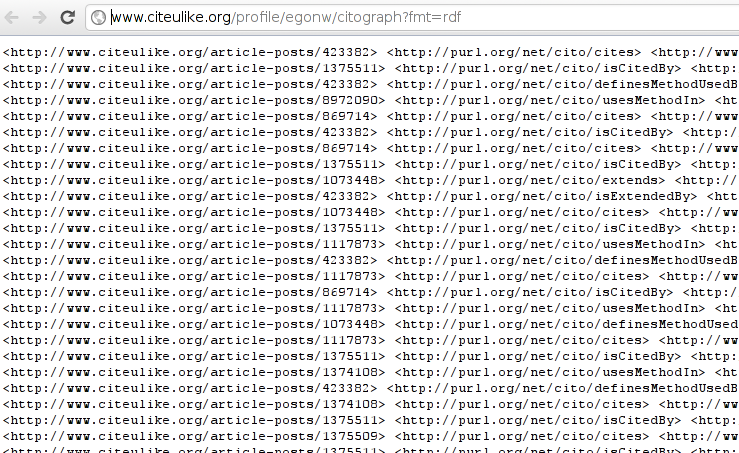
<p>One of the things, is that the CiTO data added via a certain account, can be downloaded as triples:</p>

<p><img src="/assets/images/culcito2.png" alt="" /></p>

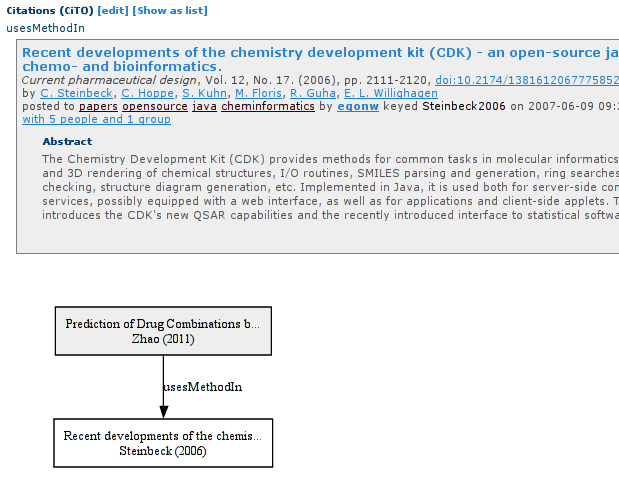
<p>The second is that they are improving the graphics of how it is visualized. E.g. they added an ‘Expand’ link, which I found when they
<a href="https://twitter.com/#!/citeulike/status/172446830666321921">tweeted</a> they had hidden drag-n-drop, which I haven’t found yet, though.
Clicking that action, will show you the following:</p>

<p><img src="/assets/images/culcito.png" alt="" /></p>

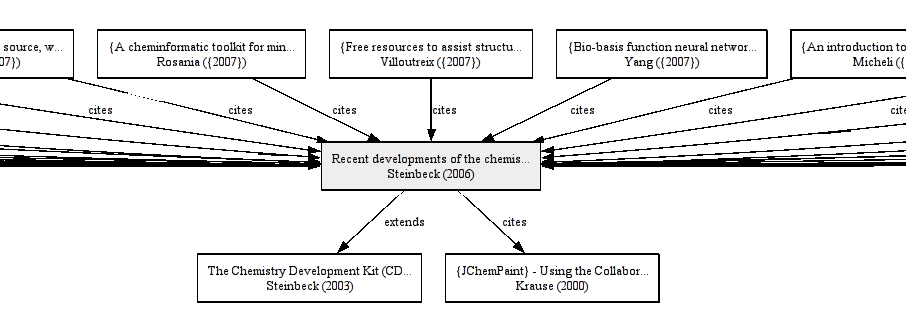
<p>Because CiteULike takes advantage of the <a href="http://www.w3.org/TR/owl-ref/#InverseFunctionalProperty-def">inverse function</a> of the CiTO predictates,
they show up with the cited paper too, which is less suitable for the top-down flow graphics:</p>

<p><img src="/assets/images/culcito1.png" alt="" /></p>

<p>To make this advertorial a bit balanced, not all <a href="https://chem-bla-ics.linkedchemistry.info/2010/09/17/list-of-things-i-miss-in-citeulike.html">my wishes <i class="fa-solid fa-recycle fa-xs"></i></a> have been
implemented yet, and the next up from my perspective should be Linked Data. There is some Linked Data embedded as RDFa, but the latter is not turning out
to be the killer I had hoped, and regular RDF entry points should be used.</p>

<p>Each CiteULike entry (post) should get a unique <a href="http://en.wikipedia.org/wiki/Internationalized_Resource_Identifier">IRI</a> (or
<a href="http://en.wikipedia.org/wiki/Uniform_resource_identifier">URI</a>) and opening that link should give RDF about that post
(<a href="http://www.citeulike.org/groupforum/2191">wish #10</a>). That’s is <a href="http://en.wikipedia.org/wiki/Dereferenceable_Uniform_Resource_Identifier">dereferencibility</a>.
The RDF can be, for example, in <a href="http://bibliontology.com/">BIBO</a> but there are many alternatives, and I have not been keeping up with which is the best
(please leave a comment, if you have an opinion on that).</p>

<p>But I like where this is going! Thanx, CiteIReallyLikeThis!</p>]]></content><author><name>Egon Willighagen</name></author><category term="citeulike" /><category term="cito" /><category term="justdoi:10.1186/2041-1480-1-S1-S6" /><category term="rdf" /><summary type="html"><![CDATA[Readers of my blog know I have been using the Citation Typing Ontology, CiTO (doi:10.1186/2041-1480-1-S1-S6). I allows me to see how the CDK is cited and used . CiteULike is currently adding more CiTO more functionality, which they started doing almost one and a half years ago.]]></summary><media:thumbnail xmlns:media="http://search.yahoo.com/mrss/" url="https://chem-bla-ics.linkedchemistry.info/assets/images/culcito1.png" /><media:content medium="image" url="https://chem-bla-ics.linkedchemistry.info/assets/images/culcito1.png" xmlns:media="http://search.yahoo.com/mrss/" /></entry><entry><title type="html">My Google Scholar Citations profile arrived</title><link href="https://chem-bla-ics.linkedchemistry.info/2011/08/02/my-google-scholar-citations-profile.html" rel="alternate" type="text/html" title="My Google Scholar Citations profile arrived" /><published>2011-08-02T00:00:00+00:00</published><updated>2011-08-02T00:00:00+00:00</updated><id>https://chem-bla-ics.linkedchemistry.info/2011/08/02/my-google-scholar-citations-profile</id><content type="html" xml:base="https://chem-bla-ics.linkedchemistry.info/2011/08/02/my-google-scholar-citations-profile.html"><![CDATA[<p><a href="http://en.wikipedia.org/wiki/Web_of_Science">Web of Science</a> is my de facto standard for citation statistics (I need these for
<a href="http://vr.se/">VR</a> grant applications), and defines the lower limit of citations (it is pretty clean, but I do have to ping them now
and then to fix something). The public front-end of it is <a href="http://www.researcherid.com/rid/C-6136-2008">Researcher ID</a>. There is an
<a href="http://academic.research.microsoft.com/Author/2893110/egon-l-willighagen">Microsoft initiative</a>, which looks clean but doesn’t work
on Linux for the nicer things, but the coverage of journals is pretty bad in my field, giving a biased (downwards)
<a href="http://en.wikipedia.org/wiki/H-index">H-index</a>. And
<a href="http://web.archive.org/web/20110815142119/http://www.citeulike.org/user/egonw">CiteULike <i class="fa-solid fa-box-archive fa-xs"></i></a>
and <a href="http://www.mendeley.com/profiles/egon-willighagen/">Mendeley</a> focus more on your publications than on citations (though the former
has <a href="http://opencitations.wordpress.com/2010/10/21/use-of-cito-in-citeulike/">great CiTO support</a>!).</p>

<p>Then <a href="http://googlescholar.blogspot.com/2011/07/google-scholar-citations.html">Google Scholar Citations</a> (GSC) shows up. While it
does not look as pretty as competing products, it compensates that with a wide coverage of literature (for example, it supports the
<a href="http://jcheminf.com/">JChemInf</a>, which Web-of-Science currently does not; and I happen to publish a lot in that journal recently),
books, and reports, while keeping false positives fairly low. Thus, it provides an upper limit of my citations statistics, but one
I am pretty happy confident about. And my H-index is quite comparable anyway. This is what
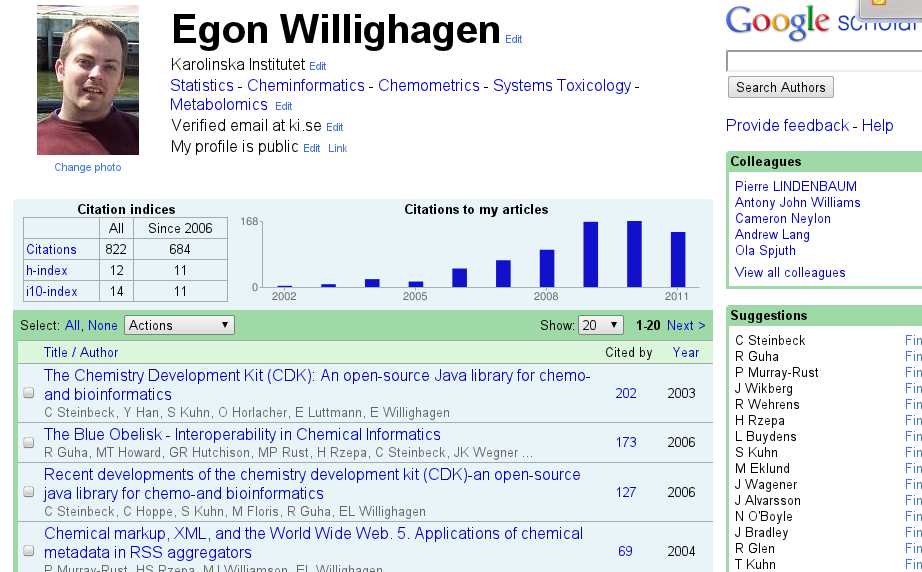
<a href="http://scholar.google.com/citations?user=u8SjMZ0AAAAJ">my profile</a> looks like:</p>

<p><img src="/assets/images/gsc.png" alt="" /></p>

<p>So, these statistics have two purposes to me: 1. grant applications, and 2. I like to know what people based theirs on my research. (Well,
OK, 3. it helps me understand why I work so hard on too many things.)</p>

<p>Now the question is, will GSC take off. Will it replace <a href="http://orcid.org/">ORCID</a>? Will they join ORCID? Will GSC get a good API?
Who will write the first <a href="http://www.biomedcentral.com/1471-2105/8/487">userscript</a> to make the GUI fancier? Will GSC support CiTO?
Will GSC start using microformats or RDFa? What mashups can we expect between bibliographic databases? Will new entries automatically
be posted to Google+? Will it have a button to autocreate a blog post when a paper gets cited 100, 500, or a 1000 times? Will GSC
support <a href="http://friendfeed.com/search?q=%23altmetrics">#altmetrics</a>?</p>]]></content><author><name>Egon Willighagen</name></author><category term="google" /><category term="citeulike" /><category term="doi:10.1186/1471-2105-8-487" /><summary type="html"><![CDATA[Web of Science is my de facto standard for citation statistics (I need these for VR grant applications), and defines the lower limit of citations (it is pretty clean, but I do have to ping them now and then to fix something). The public front-end of it is Researcher ID. There is an Microsoft initiative, which looks clean but doesn’t work on Linux for the nicer things, but the coverage of journals is pretty bad in my field, giving a biased (downwards) H-index. And CiteULike and Mendeley focus more on your publications than on citations (though the former has great CiTO support!).]]></summary><media:thumbnail xmlns:media="http://search.yahoo.com/mrss/" url="https://chem-bla-ics.linkedchemistry.info/assets/images/gsc.png" /><media:content medium="image" url="https://chem-bla-ics.linkedchemistry.info/assets/images/gsc.png" xmlns:media="http://search.yahoo.com/mrss/" /></entry><entry><title type="html">CiteULike CiTO Use Case #1: Wordles</title><link href="https://chem-bla-ics.linkedchemistry.info/2010/10/31/citeulike-cito-use-case-1-wordles.html" rel="alternate" type="text/html" title="CiteULike CiTO Use Case #1: Wordles" /><published>2010-10-31T00:00:00+00:00</published><updated>2010-10-31T00:00:00+00:00</updated><id>https://chem-bla-ics.linkedchemistry.info/2010/10/31/citeulike-cito-use-case-1-wordles</id><content type="html" xml:base="https://chem-bla-ics.linkedchemistry.info/2010/10/31/citeulike-cito-use-case-1-wordles.html"><![CDATA[<p>Last month I reported a <a href="https://chem-bla-ics.linkedchemistry.info/2010/09/17/list-of-things-i-miss-in-citeulike.html">few things I missed <i class="fa-solid fa-recycle fa-xs"></i></a>
in <a href="http://www.citeulike.org/">CiteULike</a>. One of them was support for CiTO (see
doi:<a href="https://doi.org/10.1186/2041-1480-1-S1-S6">10.1186/2041-1480-1-S1-S6</a>), a great Citation Typing Ontology.</p>

<p>I promised the CiTO author, <a href="http://www.zoo.ox.ac.uk/staff/academics/shotton_dm.htm">David</a>, my use cases, but have been horribly
busy in the past few weeks with my new position, wrapping up my past position, and thinking on my position after Cambridge. But finally, here it is. Based on source code I
<a href="http://github.com/egonw/groovy-citeulike">wrote and released earlier</a>, the first use case I represent is the
<a href="http://www.wordle.net/">Wordle</a> one, which I <a href="http://chem-bla-ics.blogspot.com/2010/02/wordle-of-titles-of-20-most-recent.html">showed with manual work in February</a>.</p>

<p>Now that all the data is semantically marked up in CiteULike, I can easily extract all paper titles (or whatever is available in CiteULike) for all papers that cite the first
<a href="http://cdk.sf.net/">CDK</a> paper (doi:<a href="http://dx.doi.org/10.1021/ci025584y">10.1021/ci025584y</a>). Using the JSON interface, I have
<a href="http://github.com/egonw/groovy-citeulike/blob/master/cul2wordleInput.groovy">this Groovy script</a> to extract all titles:</p>

<div class="language-groovy highlighter-rouge"><div class="highlight"><pre class="highlight"><code><span class="kn">import</span> <span class="nn">groovyx.net.http.HTTPBuilder</span>
<span class="kn">import</span> <span class="nn">groovyx.net.http.Method</span>
<span class="kn">import</span> <span class="nn">static</span> <span class="n">groovyx</span><span class="o">.</span><span class="na">net</span><span class="o">.</span><span class="na">http</span><span class="o">.</span><span class="na">ContentType</span><span class="o">.</span><span class="na">JSON</span>

<span class="n">culUrl</span> <span class="o">=</span> <span class="s2">"http://www.citeulike.org/"</span><span class="o">;</span>

<span class="n">citotags</span> <span class="o">=</span> <span class="o">[</span>
  <span class="s2">"cito--cites"</span><span class="o">,</span>
  <span class="s2">"cito--usesMethodIn"</span><span class="o">,</span>
  <span class="s2">"cito--discusses"</span><span class="o">,</span>
  <span class="s2">"cito--extends"</span>
<span class="c1">// there are more, but these are all</span>
<span class="c1">// I use right now</span>
<span class="o">]</span>

<span class="n">papers</span> <span class="o">=</span> <span class="o">[</span>
  <span class="s2">"1073448"</span><span class="o">,</span>
  <span class="s2">"423382"</span>
<span class="o">]</span>

<span class="n">http</span> <span class="o">=</span> <span class="k">new</span> <span class="n">HTTPBuilder</span><span class="o">(</span><span class="n">culUrl</span><span class="o">)</span>

<span class="n">papers</span><span class="o">.</span><span class="na">each</span> <span class="o">{</span> <span class="n">paper</span> <span class="o">-&gt;</span>
  <span class="n">println</span> <span class="s2">"# Processing $paper..."</span>
  <span class="n">citotags</span><span class="o">.</span><span class="na">each</span> <span class="o">{</span> <span class="n">tag</span> <span class="o">-&gt;</span>
    <span class="n">citation</span> <span class="o">=</span> <span class="s2">"$tag--$paper"</span><span class="o">.</span><span class="na">toLowerCase</span><span class="o">()</span>
    <span class="n">http</span><span class="o">.</span><span class="na">request</span><span class="o">(</span><span class="n">Method</span><span class="o">.</span><span class="na">valueOf</span><span class="o">(</span><span class="s2">"GET"</span><span class="o">),</span> <span class="n">JSON</span><span class="o">)</span> <span class="o">{</span>
      <span class="n">uri</span><span class="o">.</span><span class="na">path</span> <span class="o">=</span> <span class="s2">"/json/user/egonw/tag/$citation"</span>

      <span class="n">response</span><span class="o">.</span><span class="na">success</span> <span class="o">=</span> <span class="o">{</span> <span class="n">resp</span><span class="o">,</span><span class="n">json</span> <span class="o">-&gt;</span>
        <span class="n">json</span><span class="o">.</span><span class="na">each</span> <span class="o">{</span> <span class="n">article</span> <span class="o">-&gt;</span>
          <span class="n">tripleCount</span> <span class="o">=</span> <span class="mi">0</span><span class="o">;</span>
          <span class="n">article</span><span class="o">.</span><span class="na">tags</span><span class="o">.</span><span class="na">each</span> <span class="o">{</span> <span class="n">artTag</span> <span class="o">-&gt;</span>
            <span class="k">if</span> <span class="o">(</span><span class="n">artTag</span><span class="o">.</span><span class="na">startsWith</span><span class="o">(</span><span class="n">tag</span><span class="o">))</span> <span class="n">tripleCount</span><span class="o">++</span>
          <span class="o">}</span>
          <span class="k">if</span> <span class="o">(</span><span class="n">tripleCount</span> <span class="o">&gt;</span> <span class="mi">0</span><span class="o">)</span> <span class="o">{</span>
            <span class="n">title</span> <span class="o">=</span> <span class="n">article</span><span class="o">.</span><span class="na">title</span>
            <span class="n">title</span> <span class="o">=</span> <span class="n">title</span><span class="o">.</span><span class="na">replaceAll</span><span class="o">(</span><span class="s2">"\\{"</span><span class="o">,</span><span class="s2">""</span><span class="o">)</span>
            <span class="n">title</span> <span class="o">=</span> <span class="n">title</span><span class="o">.</span><span class="na">replaceAll</span><span class="o">(</span><span class="s2">"\\}"</span><span class="o">,</span><span class="s2">""</span><span class="o">)</span>
            <span class="n">println</span> <span class="s2">"$title"</span>
          <span class="o">}</span>
        <span class="o">}</span>
      <span class="o">}</span>
    <span class="o">}</span>
  <span class="o">}</span>
<span class="o">}</span>
</code></pre></div></div>

<p>The output is two blocks which I can easily copy/paste into Wordle. Now, I think I heard one can actually download the java code, so I am tempted to integrate it later,
but for now copy/paste will do fine, after the data handling is mostly automated: with a few lines extra I can make such visualizations for any paper
I annotated in CiteULike with CiTO.</p>

<p><strong>The CDK I paper</strong></p>

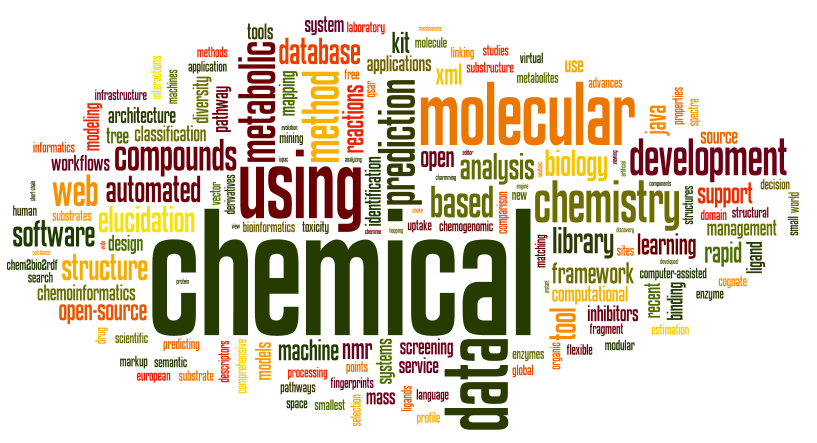
<p><img src="/assets/images/wordleCDK1.png" alt="" /></p>

<p><strong>The CDK II paper</strong></p>

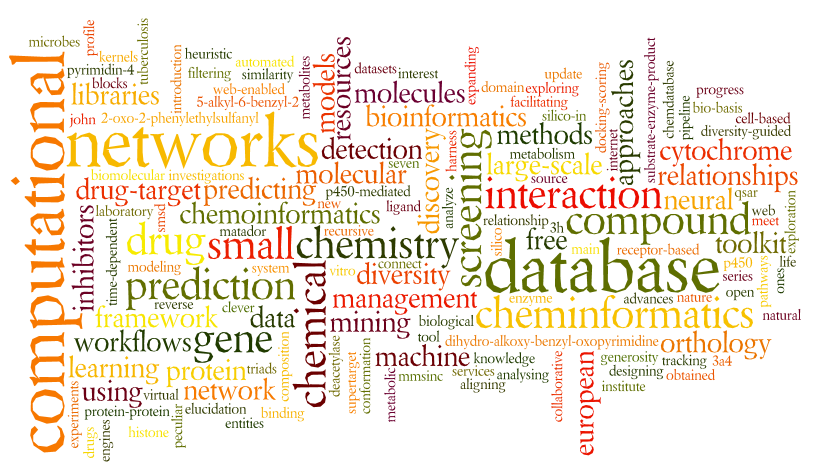
<p><img src="/assets/images/wordleCDK2.png" alt="" /></p>

<p>Interesting differences… more statistics will soon follow. See <a href="https://chem-bla-ics.linkedchemistry.info/2010/02/22/further-statistics-on-papers-citing-cdk.html">Further statistics on the papers citing the CDK <i class="fa-solid fa-recycle fa-xs"></i></a>
for the kind of analyses I have in mind.</p>]]></content><author><name>Egon Willighagen</name></author><category term="justdoi:10.1186/2041-1480-1-S1-S6" /><category term="cito" /><category term="citeulike" /><category term="cdk" /><category term="wordle" /><category term="doi:10.1021/CI025584Y" /><summary type="html"><![CDATA[Last month I reported a few things I missed in CiteULike. One of them was support for CiTO (see doi:10.1186/2041-1480-1-S1-S6), a great Citation Typing Ontology.]]></summary></entry><entry><title type="html">A list of things I miss in CiteULike</title><link href="https://chem-bla-ics.linkedchemistry.info/2010/09/17/list-of-things-i-miss-in-citeulike.html" rel="alternate" type="text/html" title="A list of things I miss in CiteULike" /><published>2010-09-17T00:00:00+00:00</published><updated>2010-09-17T00:00:00+00:00</updated><id>https://chem-bla-ics.linkedchemistry.info/2010/09/17/list-of-things-i-miss-in-citeulike</id><content type="html" xml:base="https://chem-bla-ics.linkedchemistry.info/2010/09/17/list-of-things-i-miss-in-citeulike.html"><![CDATA[<p>AJCann posted a blog today about what <a href="http://scienceoftheinvisible.blogspot.com/2010/09/long-list-of-things-i-dont-like-about.html">he doesn’t like about Mendeley</a>.
Abhishek replied that he does not like people complain about one tool, instead of pointing out a good alternative.
<a href="http://www.mendeley.com/">Mendeley</a> has two alternatives, <a href="http://www.zotero.org/">Zotero</a> and <a href="http://www.citeulike.org/">CiteULike</a> (there is also
<a href="http://connotea.org/">Connotea</a>, but got behind in evolution).</p>

<p>Agreeing with <a href="http://twitter.com/citeulike">@citeulike</a> and <a href="http://twitter.com/abhishektiwari">@abhishektiwari</a>, as a service provider
any bad news is good news too: they provide opportunities to improve. So, as encouraged to do so, I reported my long list of things I miss in CiteULike:</p>

<ul>
  <li>@citeulike ok, one more. wish #18: get readermeter.org to also support citeulike</li>
  <li>@citeulike wish #17: allow people linking between papers in their libs using CiTO to annotate how they cite papers, see http://ur.ly/lBUO</li>
  <li>@citeulike wish #16: I think I saw images from some papers, right? how about doing that for #biomedcentral journals too?</li>
  <li>@citeulike wish #15: at the same http://ur.ly/lIGn page, the tag cloud should reflect tag use with font sizing</li>
  <li>@citeulike wish #14: upon ‘post url’, the first page with extraced information should allow marking as ‘I am author’ (cannot find that)</li>
  <li>@citeulike (new) wish #12: clicking an account name should get me to a public portal, rather than just his paper list</li>
  <li>@citeulike good point, wish #13: be more strong on requiring people to tag papers… and use article keywords as default tags</li>
  <li>@citeulike wish #11: remove ‘no-tag’ from tag clouds</li>
  <li>@citeulike wish #10: support #RDF export with BIBO and/or PRISM</li>
  <li>@citeulike wish #9: use #foaf for the RDFa for account pages, and to mark up friends</li>
  <li>@citeulike wish #8: and more generally, make #citeulike part of the #linkeddata network (provide an #rdf API)</li>
  <li>@citeulike wish #7: start using RDFa, e.g. with the PRISM ontology</li>
  <li>@citeulike wish #6: on an article page (like http://ur.ly/lvWk) summarize the network that bookmarked that article, not just the acc names</li>
  <li>@citeulike wish #5: don’t show the ‘copy’ button for papers that are already in my archive (really a bug)</li>
  <li>@citeulike indeed, but don’t or do it right… wish #4: allow people to have that link automatically point to an external blog</li>
  <li>@citeulike wish #3: provide summaries of lists, like article count per journal and article count per year</li>
  <li>@citeulike well, I’ll use the blog functoinality to summarize… wish #2: do not try to be a blogging platform</li>
  <li>@citeulike (new) wish #1: put automatically focus on text field after clicking search and select all text for easy deletion</li>
</ul>

<p>The reports are now also available in the <a href="http://www.citeulike.org/groupfunc/3124/forums">fora of CiteULike</a>.</p>]]></content><author><name>Egon Willighagen</name></author><category term="cito" /><category term="citeulike" /><summary type="html"><![CDATA[AJCann posted a blog today about what he doesn’t like about Mendeley. Abhishek replied that he does not like people complain about one tool, instead of pointing out a good alternative. Mendeley has two alternatives, Zotero and CiteULike (there is also Connotea, but got behind in evolution).]]></summary></entry><entry><title type="html">Scientific Literature: searching, ranking, storage</title><link href="https://chem-bla-ics.linkedchemistry.info/2007/06/08/scientific-literature-searching-ranking.html" rel="alternate" type="text/html" title="Scientific Literature: searching, ranking, storage" /><published>2007-06-08T00:00:00+00:00</published><updated>2007-06-08T00:00:00+00:00</updated><id>https://chem-bla-ics.linkedchemistry.info/2007/06/08/scientific-literature-searching-ranking</id><content type="html" xml:base="https://chem-bla-ics.linkedchemistry.info/2007/06/08/scientific-literature-searching-ranking.html"><![CDATA[<p>Dealing with scientific literature has been one important theme in <a href="http://wiki.cubic.uni-koeln.de/cb/">Chemical blogspace</a>.
For example, ranking articles and how to store your personal PDF archive has been topics of discussion. In this blog I will
summarize bits of the discussion, and my personal view on things.</p>

<h2 id="searching">Searching</h2>

<p>Searching literature is traditionally done in systems like Chemical Abstracts and Web-of-Science. The open nature of a
growing number of repositories (e.g. the Dutch <a href="http://www.darenet.nl/en/page/language.view/search.page">DARE</a>) and
indexing facilities like <a href="http://www.ncbi.nlm.nih.gov/sites/entrez?db=pubmed">PubMed</a> make these proprietary tools
obsolete.</p>

<p>It is incorrect to assume that these payed services are the only trustworthy sources. Even WoS fails to make the all
links between entries in the database. For example, I am aware of two missing citations to articles I have written,
even though both the cited and the citing article is available in the system. One of the citing articles was in the
<a href="http://www3.interscience.wiley.com/cgi-bin/jhome/26737?CRETRY=1&amp;SRETRY=0">Angewandte Chemie</a>!</p>

<p>Additionally, some search services, like <a href="http://scholar.google.com/">Google Scholar</a>, have the advantage that they
find copies and close variants of articles in proprietary articles on home pages and in open repositories. Today,
I learned about <a href="http://en.scientificcommons.org/">Scientific Commons</a> which indexes and links to a staggering
1.5M publications, using, among others, PubMed and university repositories. Where possible it makes direct links
to PDF versions of the article.</p>

<h2 id="ranking">Ranking</h2>

<p><a href="http://www.chemicalforums.com/index.php?topic=17653.msg67580#msg67580">Mitch set up</a> <a href="http://chemrank.com/">ChemRank</a>,
to which <a href="https://blogs.ch.cam.ac.uk/pmr/2007/05/30/ranking-chemistry-and-blogosphere-metrics/">Peter <i class="fa-solid fa-recycle fa-xs"></i></a>, the <a href="http://www.thechemblog.com/?p=552">ChemBlog</a>
and <a href="https://chem-bla-ics.linkedchemistry.info/2007/05/30/chemrank-ranking-scientific-literature.html">I replied <i class="fa-solid fa-recycle fa-xs"></i></a>. Afterwards,
I learned that other services are available too, that allow, in addition to setting up an online personal literature
database, voting and commenting on articles.</p>

<p>Apparently, <a href="http://www.citeulike.org/">CiteULike</a> (CUL) supports this too. In contrast to ChemRank, CUL requires
a login, which I personally see as an advantage, because I can browse literature bookmarked by other accounts I trust.
There is also <a href="http://www.connotea.org/">Connotea</a> but I never liked that site that much (e.g. is allows bookmarking
any web page); <a href="https://doi.org/10.59350/6zgf4-2wb06">Rich has his comments too <i class="fa-solid fa-recycle fa-xs"></i></a>.
I would also like to mention <a href="http://www.biowizard.com/">BioWizard</a> which is based on the PubMed content, which actually
covers a good deal of chemistry literature nowadays too.</p>

<h2 id="local-storage">Local Storage</h2>

<p>These above mentioned systems can be used as alternative to offline bibliographic database systems, like EndNote and
<a href="http://jabref.sf.net/">JabRef</a>. The latter is my favorite, being based on BibTeX which I use for my LaTeX based
publications, and is opensource and contains <a href="http://www.ohloh.net/accounts/2934/contributions/557">a few patches</a>
from yours truly. Jungfreudlich wondered <a href="http://www.jungfreudlich.de/2007/05/20/how-are-your-paper-files-organized/">how people organized their PDF archive</a>
and <a href="http://www.jungfreudlich.de/2007/05/20/how-are-your-paper-files-organized/#comment-3199">I commented how I do it</a>:</p>

<ul>
  <li>a directory hierarchy based on journal name and year</li>
  <li>file names that include last name of the first author and year</li>
  <li>JabRef for the bibiographic database</li>
  <li><a href="http://strigi.sf.net/">Strigi</a> for full text search</li>
</ul>

<p><a href="http://miningdrugs.blogspot.com/2007/05/literature-management.html">Jörg</a> and
<a href="http://www.thepowerofgoo.net/2007/05/20/organizing-pdfs-papers/">the power of goo</a> replied too.</p>

<h2 id="mashups">Mashups</h2>

<p>I have accounts on several online tools now (with some duplication which I don’t like), and I have no idea which of
the options will stay around. Time will learn. Good news is that the open characters of many of these allow making
mashups, and generally integrate tools. For example, JabRef allows downloading citations from PubMed, and Noel
<a href="http://baoilleach.blogspot.com/2007/05/supporting-information-available-as.html">suggested to use Greasemonkey scripts to link to the supplementary information for his articles</a>,
instead of using the mechanisms journals have. I can see the advantage of this, as, for example,
<a href="https://blogs.ch.cam.ac.uk/pmr/2007/05/09/access-to-and-re-use-of-open-data-in-chemistry-impressions/">Wiley takes full copyright of the data in SI material <i class="fa-solid fa-recycle fa-xs"></i></a>,
while Noel’s mechanism would keep the data open.</p>

<p>For now, however, I would very much like to see a meta service where I can query rankings and comment for
articles using any or all of the above tools.</p>]]></content><author><name>Egon Willighagen</name></author><category term="citeulike" /><category term="publishing" /><category term="chemistry" /><category term="justdoi:10.59350/6zgf4-2wb06" /><category term="connotea" /><summary type="html"><![CDATA[Dealing with scientific literature has been one important theme in Chemical blogspace. For example, ranking articles and how to store your personal PDF archive has been topics of discussion. In this blog I will summarize bits of the discussion, and my personal view on things.]]></summary></entry></feed>