<?xml version="1.0" encoding="utf-8"?><feed xmlns="http://www.w3.org/2005/Atom" ><generator uri="https://jekyllrb.com/" version="4.3.4">Jekyll</generator><link href="https://chem-bla-ics.linkedchemistry.info/feed/by_tag/cdk.xml" rel="self" type="application/atom+xml" /><link href="https://chem-bla-ics.linkedchemistry.info/" rel="alternate" type="text/html" /><updated>2026-07-18T13:36:15+00:00</updated><id>https://chem-bla-ics.linkedchemistry.info/feed/by_tag/cdk.xml</id><title type="html">chem-bla-ics</title><subtitle>Chemblaics (pronounced chem-bla-ics) is the science that uses open science and computers to solve problems in chemistry, biochemistry and related fields.</subtitle><author><name>Egon Willighagen</name></author><entry><title type="html">CDK 2.12</title><link href="https://chem-bla-ics.linkedchemistry.info/2026/03/08/cdk-2.12.html" rel="alternate" type="text/html" title="CDK 2.12" /><published>2026-03-08T00:00:00+00:00</published><updated>2026-03-08T00:00:00+00:00</updated><id>https://chem-bla-ics.linkedchemistry.info/2026/03/08/cdk-2.12</id><content type="html" xml:base="https://chem-bla-ics.linkedchemistry.info/2026/03/08/cdk-2.12.html"><![CDATA[<p><a href="https://github.com/cdk/cdk/releases/tag/cdk-2.12">Version 2.12</a> of the <a href="https://cdk.github.io/">Chemistry Development Kit</a> has been released.
It is the last release with contributions by <a href="https://www.nwo.nl/en/projects/osf232097">our NWO Open Science grant</a>.
This release adds some nice new APIs:</p>

<ul>
  <li>harmonize hydrogens to various states: depiction, stereo, minimal, and unsafe (useful for depictions)</li>
  <li>generate wedge bonds based on coordinates and stereochemistry</li>
  <li>more Markush / RGroup support</li>
  <li>atropisomers via CXSMILES</li>
  <li>sugar extraction</li>
</ul>

<p>I also update the following libraries/tools to use CDK 2.12:</p>

<ul>
  <li><a href="https://github.com/enanomapper/nanojava/releases/tag/nanojava-2.0.6">NanoJava 2.16</a></li>
  <li><a href="https://github.com/egonw/bacting/releases/tag/bacting-1.0.10">Bacting 1.0.10</a> (and the Python pyBacting will follow asap)</li>
</ul>]]></content><author><name>Egon Willighagen</name></author><category term="cdk" /><category term="openscience" /><category term="justdoi:10.5281/zenodo.18850648" /><summary type="html"><![CDATA[Version 2.12 of the Chemistry Development Kit has been released. It is the last release with contributions by our NWO Open Science grant. This release adds some nice new APIs:]]></summary></entry><entry><title type="html">Open Infrastructures #1: Research Software Directory</title><link href="https://chem-bla-ics.linkedchemistry.info/2025/12/29/open-infrastructures.html" rel="alternate" type="text/html" title="Open Infrastructures #1: Research Software Directory" /><published>2025-12-29T00:00:00+00:00</published><updated>2025-12-29T00:00:00+00:00</updated><id>https://chem-bla-ics.linkedchemistry.info/2025/12/29/open-infrastructures</id><content type="html" xml:base="https://chem-bla-ics.linkedchemistry.info/2025/12/29/open-infrastructures.html"><![CDATA[<blockquote>
  <p>Research software is an integral part of scientific investigations.</p>
</blockquote>

<p>This is what Struck wrote in 2018 in a contribution to the 2018 IEEE 14th International Conference on e-Science (e-Science)
(doi:<a href="https://doi.org/10.1109/eScience.2018.00016">10.1109/eScience.2018.00016</a>). I very much agree with this,
and the notion is gaining ground in the academic community. Their paper <em>“identifies challenges, risks and new opportunities
in research software publication and discovery”</em>.</p>

<p>At the same conference, Spaaks <em>et al.</em> presented a lightning talk about the
<a href="https://research-software-directory.org/software/rsd-ng">Research Software Directory</a> (RSD),
<em>“a content management system for research software, which promotes the visibility, reuse, and impact of research software”</em>
(doi:<a href="https://doi.org/10.1109/eScience.2018.00013">10.1109/eScience.2018.00013</a>).</p>

<p>I wonder who spoke first at the meeting.</p>

<p>Anyway, I learned about RSD a while ago already and have been using it for some of our
group’s research software. We don’t have a collection for our group, but you will find them
under the <a href="https://research-software-directory.org/organisations/maastricht-university">Maastricht University organisation page</a>.</p>

<p>And as sketched by Struck and implemented by Spaaks <em>et al.</em>, RSD gives rich context
to the research software. It can track the activity on the project (for GitHub, GitLab,
<a href="https://github.com/research-software-directory/RSD-as-a-service/issues/1605">Codeberg</a> etc),
track citations to key literature, and can have links to distributions where the software is published
(like Debian, CRAN, <a href="https://github.com/research-software-directory/RSD-as-a-service/issues/1606">Bioconductor</a>, etc).</p>

<p>This is what it looks like for the <a href="https://research-software-directory.org/software/cdk">Chemistry Development Kit</a>:</p>

<p><img src="/assets/images/rsd.png" alt="" /></p>

<p>I like initiatives like this, as they help the community work out open standards to exchange
metadata, and encourage other projects by reusing their APIs.</p>]]></content><author><name>Egon Willighagen</name></author><category term="justdoi:10.1109/eScience.2018.00016" /><category term="justdoi:10.1109/eScience.2018.00013" /><category term="cdk" /><category term="openscience" /><summary type="html"><![CDATA[Research software is an integral part of scientific investigations.]]></summary><media:thumbnail xmlns:media="http://search.yahoo.com/mrss/" url="https://chem-bla-ics.linkedchemistry.info/assets/images/rsd.png" /><media:content medium="image" url="https://chem-bla-ics.linkedchemistry.info/assets/images/rsd.png" xmlns:media="http://search.yahoo.com/mrss/" /></entry><entry><title type="html">25 years of the Chemistry Development Kit</title><link href="https://chem-bla-ics.linkedchemistry.info/2025/09/28/25-years-of-the-chemistry-development-kit.html" rel="alternate" type="text/html" title="25 years of the Chemistry Development Kit" /><published>2025-09-28T00:00:00+00:00</published><updated>2025-09-28T00:00:00+00:00</updated><id>https://chem-bla-ics.linkedchemistry.info/2025/09/28/25-years-of-the-chemistry-development-kit</id><content type="html" xml:base="https://chem-bla-ics.linkedchemistry.info/2025/09/28/25-years-of-the-chemistry-development-kit.html"><![CDATA[<p>Twenty five years ago the <a href="https://cdk.github.io/">Chemistry Development Kit</a> (CDK) was founded. The Chemistry and Internet (<a href="https://www.google.com/search?q=ChemInt2000">ChemInt2000</a>)
had just ended (it ran from 23 to 26 September) and my friend and I had taken the Amtrak night train from Washington to South Bend. At that time there
were two leading Java applets for chemistry, <a href="https://jchempaint.github.io/">JChemPaint</a> and <a href="http://jmol.org/">Jmol</a>. I had hacked Chemical Markup
Language support into both of them, and <a href="https://chemistry.nd.edu/people/dan-gezelter/">Dan Gezelter</a> (Jmol and <a href="https://openscience.org/">openscience.org</a>),
<a href="http://www.steinbeck-molecular.de/steinblog/">Christoph Steinbeck</a> (JChemPaint), and me took the opportunity of being in North America
to discuss if we could use a common code base. Chris’ <em>compchem</em> had done something similar. Peter Murray-Rust, who had also attended ChemInt2000
like me and Chris did not attend.</p>

<p>I do not remember exactly, but I guess we must have met on the 28th and 29th? Maybe already on Wednesday. During this meeting we discussed a common
data model (yes, Jmol used the CDK data model at some point) and somewhere during the meeting we wrote down a name for the project. There was the
Java Development Kit, so this could be the Chemistry Development Kit. The name stuck.</p>

<p>A quick post like this cannot do credit to the history of the CDK, nor of everyone involved in the past or still is. You can browse some of the history
of the CDK in <a href="https://chem-bla-ics.linkedchemistry.info/tag/cdk">my blog</a> and in <a href="http://www.steinbeck-molecular.de/steinblog/index.php/category/chemistry-development-kit/">Chris’ blog</a>.
It has been an amazing journey and with a small grant just behind us (with  Alyanne de Haan, René van der Ploeg, and Marc Teunis from Hogeschool Utrecht),
and all the awesome things ongoing (new JChemPaint, various extensions, upgraded downstream tools), the CDK is alive and kicking.</p>

<p>A huge congrats and thanks to everyone (and every company and organization) who contributed code to the CDK with this huge milestone. There are a few people
that I want to particularly thank (see the AUTHORS file for all names): Chris, who in the late nineties made a difference with open source in chemistry,
Dan, for Jmol and hosting this memorable meeting at Notre Dame University, Rajarshi Guha, who operated <em>CDK Nightly</em> for many years, well before Travis
and Google Actions, Stefan, Miguel, Gilleain, and Christian, for many years of contributions to the CDK, and John Mayfield, the current
CDK release manager.</p>]]></content><author><name>Egon Willighagen</name></author><category term="cdk" /><category term="jchempaint" /><category term="jmol" /><category term="openscience" /><category term="chemistry" /><summary type="html"><![CDATA[Twenty five years ago the Chemistry Development Kit (CDK) was founded. The Chemistry and Internet (ChemInt2000) had just ended (it ran from 23 to 26 September) and my friend and I had taken the Amtrak night train from Washington to South Bend. At that time there were two leading Java applets for chemistry, JChemPaint and Jmol. I had hacked Chemical Markup Language support into both of them, and Dan Gezelter (Jmol and openscience.org), Christoph Steinbeck (JChemPaint), and me took the opportunity of being in North America to discuss if we could use a common code base. Chris’ compchem had done something similar. Peter Murray-Rust, who had also attended ChemInt2000 like me and Chris did not attend.]]></summary></entry><entry><title type="html">cdk2024 #6: wrapping up already</title><link href="https://chem-bla-ics.linkedchemistry.info/2025/03/30/cdk2024-4.html" rel="alternate" type="text/html" title="cdk2024 #6: wrapping up already" /><published>2025-03-30T00:00:00+00:00</published><updated>2025-03-30T00:00:00+00:00</updated><id>https://chem-bla-ics.linkedchemistry.info/2025/03/30/cdk2024-4</id><content type="html" xml:base="https://chem-bla-ics.linkedchemistry.info/2025/03/30/cdk2024-4.html"><![CDATA[<p>Tomorrow is already the last day of the <a href="https://www.nwo.nl/en/researchprogrammes/open-science/open-science-fund">NWO Open Science</a> grant
for the <a href="https://cdk.github.io/">Chemistry Development Kit</a>. We are wrapping up, but I am happy we have a few weeks more
to finish up the reporting. We held a user group meeting earlier this month (btw, check out the <a href="https://doi.org/10.5281/zenodo.15058009">slides by Jonas</a>),
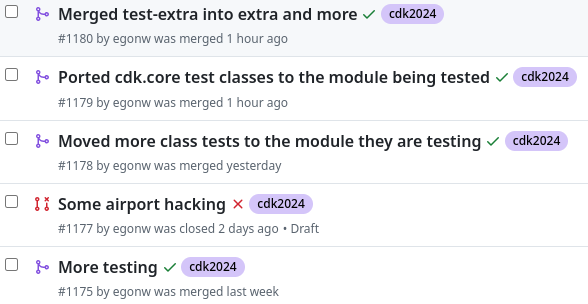
and I did a <a href="https://github.com/cdk/cdk/pull/1175">few</a> <a href="https://github.com/cdk/cdk/pull/1178">more</a>
<a href="https://github.com/cdk/cdk/pull/1179">JUnit</a> <a href="https://github.com/cdk/cdk/pull/1180">testing</a> updates last week:</p>

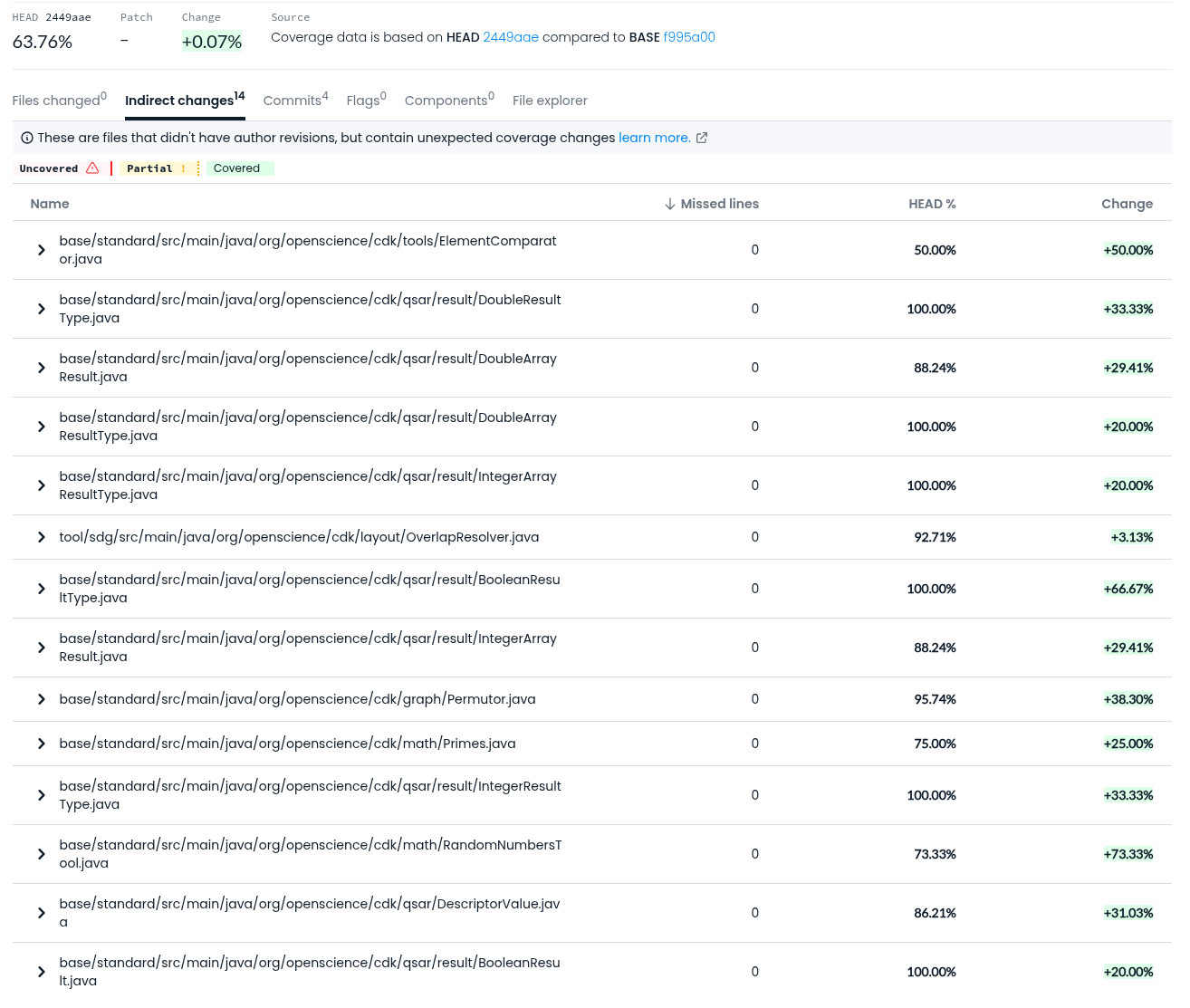
<p><img src="/assets/images/cdk2024_junit.png" alt="" /></p>

<p>Actually, you see <a href="https://github.com/cdk/cdk/pull/1177">one pull request</a> here that I closed. I accidentally included a
circular dependency. Some core CDK functionality is hard to test with an implementation of the data model, but if that
implementation depends on the module you are testing, that won’t work (not in Maven anyway). But the good bits got included
in the next pull request. One of the goals was to improve the code covered by the tests.</p>

<p>This <em>coverage testing</em> has an imporant code maintenance purpose: it visualizes whih code is not checked. Sometimes
code is not tested that under normal conditions should have been (a bug) and sometimes it is handling a rare situation
which you want tested too, to make sure that rare case does not get covered by the common code. Thus, the percentage
code covered by tests should be as high as is reasonable. The pull requests therefore aim to raise that percentage,
such as for this pull request:</p>

<p><img src="/assets/images/cdk2024_coverage.png" alt="" /></p>

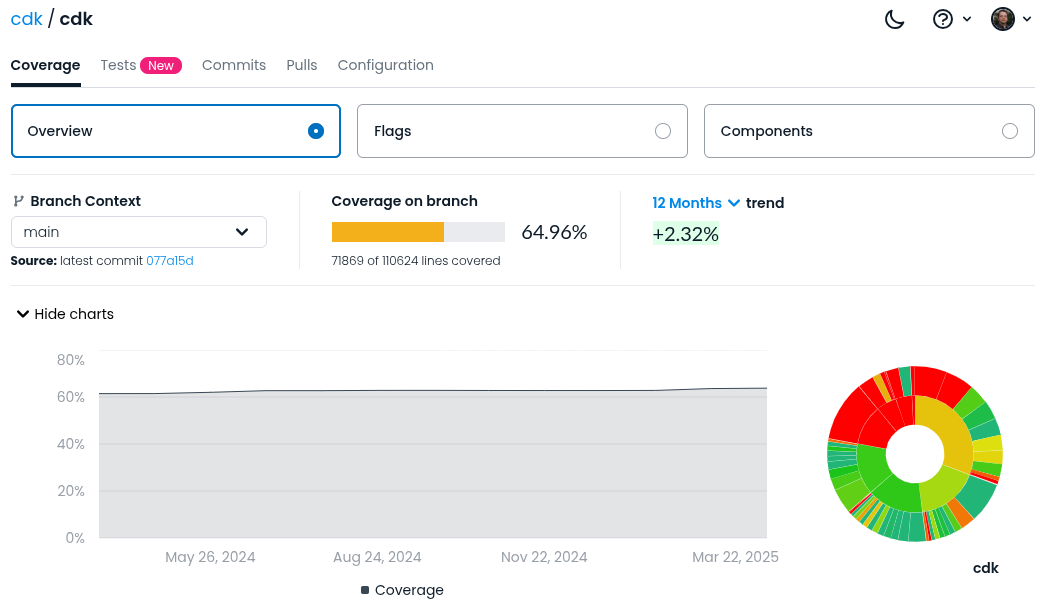
<p>Indeed, over the past 12 months, the coverage did improve, perhaps not as much as we liked, with 2.32 percent point
to 64.96 percent:</p>

<p><img src="/assets/images/cdk2024_coverage2.png" alt="" /></p>

<p>The CDK started routinely using unit testing somewhere in the zeroes, with home made continous integration
<a href="https://chem-bla-ics.linkedchemistry.info/2006/05/01/nightly-cdk-builds-now-available.html">as early as 2006</a>,
shared with the development community every night, thanks to Rajarshi Guha’s effort. We had our
<a href="https://chem-bla-ics.linkedchemistry.info/2006/11/28/code-coverage-making-sure-your-code-is.html">first code coverage results in the same year</a>.
And at some point we had sufficient coverage that it gave us the opportunity to routinely check
<a href="https://chem-bla-ics.linkedchemistry.info/2007/11/07/comparing-junit-test-results-between.html">the impact of a patch</a>.
Of course, this is exactly what many open source projects do with GitHub Actions nowadays.</p>

<p>Unfortunately, we also found that many of the CDK-using tools we worked on in this grant to get updated to
use a (more) recent CDK version do not have such solutions in place. That left us in several cases quite
in the dark. More about that soon!</p>]]></content><author><name>Egon Willighagen</name></author><category term="cdk2024" /><category term="cdk" /><category term="junit" /><category term="cito:citesAsRecommendedReading:10.5281/zenodo.15058009" /><summary type="html"><![CDATA[Tomorrow is already the last day of the NWO Open Science grant for the Chemistry Development Kit. We are wrapping up, but I am happy we have a few weeks more to finish up the reporting. We held a user group meeting earlier this month (btw, check out the slides by Jonas), and I did a few more JUnit testing updates last week:]]></summary><media:thumbnail xmlns:media="http://search.yahoo.com/mrss/" url="https://chem-bla-ics.linkedchemistry.info/assets/images/cdk2024_junit.png" /><media:content medium="image" url="https://chem-bla-ics.linkedchemistry.info/assets/images/cdk2024_junit.png" xmlns:media="http://search.yahoo.com/mrss/" /></entry><entry><title type="html">cdk2024 #5: Chemistry Development Kit User Group Meeting - Day 2</title><link href="https://chem-bla-ics.linkedchemistry.info/2025/03/16/CDK-UGM-2.html" rel="alternate" type="text/html" title="cdk2024 #5: Chemistry Development Kit User Group Meeting - Day 2" /><published>2025-03-16T00:00:00+00:00</published><updated>2025-03-16T00:00:00+00:00</updated><id>https://chem-bla-ics.linkedchemistry.info/2025/03/16/CDK-UGM-2</id><content type="html" xml:base="https://chem-bla-ics.linkedchemistry.info/2025/03/16/CDK-UGM-2.html"><![CDATA[<p>Where <a href="https://chem-bla-ics.linkedchemistry.info/2025/03/11/CDK-UGM.html">the first workshop day</a> had several
talks about new and old features of the <a href="https://cdk.github.io/">Chemistry Development Kit</a> (CDK), the second day
was a hackathon day. We hacked and we talked. The coding was not mostly only the CDK repository itself,
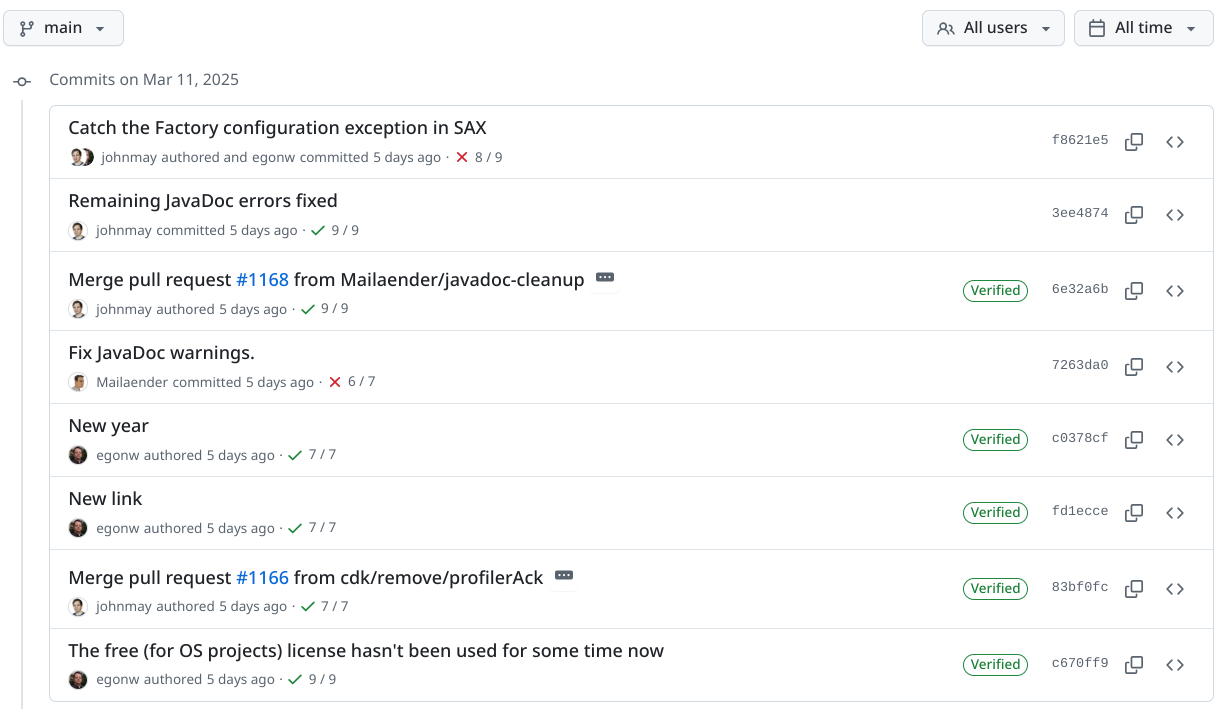
but <a href="https://github.com/cdk/cdk/commits/main/?since=2025-03-10&amp;until=2025-03-11">some things happened there</a> too:</p>

<p><img src="/assets/images/cdk_hackathon.png" alt="" /></p>

<p>Some pointers:</p>

<ul>
  <li>we worked on the <a href="http://cdk.github.io/cdkbook/">Groovy Cheminformatics with the Chemistry Development Kit</a> book
    <ul>
      <li>move the repository to the GitHub organisation</li>
      <li>improved the build system</li>
    </ul>
  </li>
  <li>it was explored how the CDK can generate SMILES for glycans</li>
  <li>continued work on updated tools using the CDK, e.g. <a href="https://apps.cytoscape.org/apps/chemviz2">ChemViz2</a></li>
  <li>code clean up, e.g. on <a href="https://github.com/cdk/cdk/commit/7263da00a86d97f965995bf7e706eadb95b90aa9">JavaDoc</a>
and <a href="https://github.com/cdk/cdk/commit/f8621e5fc02cfc73f52272b9dcc9354a4b0bc35d">the XML parsing</a></li>
  <li>a <a href="https://github.com/JChemPaint/jchempaint/releases/tag/3.4b">JChemPaint release, based on CDK 2.10</a>,
with a <a href="https://flathub.org/apps/io.github.jchempaint.JChemPaint">flatpak for easy install on many Linux distributions</a></li>
</ul>

<p>We further had discussions about a possible change of the license (what it would involve) and OSGi support.
The problem there is that Java packages can only exist in one OSGi bundle, and this is currently not the
discuss. We discussed that the current modules were partially setup to clean up dependencies, and generally
modularize the CDK (e.g. each module could have a separate person responsible). We now want to propose
a larger <code class="language-plaintext highlighter-rouge">core</code> module which covers the common cheminformatics functionality. A final discussion point
I want to mention is that there are serious hints that we may have the Chemistry Development Kit
as JavaScript in the browser soon!</p>

<p>I like to thank every one who joined the workshop, particularly those that travelled to Maastricht
from the UK, Germany, and Bulgaria. Also thanks to the six participants online who joined on the
first day!</p>]]></content><author><name>Egon Willighagen</name></author><category term="cdk" /><category term="openscience" /><category term="cdk2024" /><summary type="html"><![CDATA[Where the first workshop day had several talks about new and old features of the Chemistry Development Kit (CDK), the second day was a hackathon day. We hacked and we talked. The coding was not mostly only the CDK repository itself, but some things happened there too:]]></summary><media:thumbnail xmlns:media="http://search.yahoo.com/mrss/" url="https://chem-bla-ics.linkedchemistry.info/assets/images/cdk_hackathon.png" /><media:content medium="image" url="https://chem-bla-ics.linkedchemistry.info/assets/images/cdk_hackathon.png" xmlns:media="http://search.yahoo.com/mrss/" /></entry><entry><title type="html">cdk2024 #4: Chemistry Development Kit User Group Meeting - Day 1</title><link href="https://chem-bla-ics.linkedchemistry.info/2025/03/11/CDK-UGM.html" rel="alternate" type="text/html" title="cdk2024 #4: Chemistry Development Kit User Group Meeting - Day 1" /><published>2025-03-11T00:00:00+00:00</published><updated>2025-03-11T00:00:00+00:00</updated><id>https://chem-bla-ics.linkedchemistry.info/2025/03/11/CDK-UGM</id><content type="html" xml:base="https://chem-bla-ics.linkedchemistry.info/2025/03/11/CDK-UGM.html"><![CDATA[<p>As part of our <a href="https://www.nwo.nl/en/">Dutch Research Council</a> (NWO) <a href="https://www.nwo.nl/en/projects/osf232097">Open Science grant</a>,
we organized a <a href="https://cdk.github.io/nwo-openscience-2024/">Chemistry Development Kit User Group Meeting</a>
(<a href="https://hashtags-hub.toolforge.org/CDK25UGM">#CDK25UGM</a>), of which yesterday was the “conference” day, and today a hackathon.</p>

<p>I opened the session with a few slides welcoming everyone at Maastricht University (and our
<a href="https://chem-bla-ics.linkedchemistry.info/2025/01/27/translational-genomics.html">Dept of Translational Genomics</a>,
and explaining the NWO grant.
<a href="https://orcid.org/0000-0001-7730-2646">John Mayfield</a> (<a href="https://www.nextmovesoftware.com/">NextMove</a>) spoke about
“What’s New” in the Chemistry Development Kit 2.10, e.g. explaining more about the new (much faster) <code class="language-plaintext highlighter-rouge">AtomContainer</code>,
SMIRKS, and more.</p>

<p>After lunch, <a href="https://orcid.org/0000-0003-1554-6666">Jonas Schaub</a> (<a href="https://www.uni-jena.de/en/">Friedrich Schiller University Jena</a>)
showed various projects where the CDK is used, titled  “Scaffolds, Functional Groups, Aglycones: Algorithmic Substructure Identification with CDK”
(see doi:<a href="https://doi.org/10.1186/s13321-023-00762-4">10.1186/s13321-023-00762-4</a>, doi:<a href="https://doi.org/10.1186/s13321-022-00656-x">10.1186/s13321-022-00656-x</a>,
and doi:<a href="https://doi.org/10.1186/s13321-020-00467-y">10.1186/s13321-020-00467-y</a>).
Lyudvika Radeva (<a href="https://www.ideaconsult.net/">Ideaconsult Ltd</a>, <a href="https://uni-plovdiv.bg/en/">University of Plovdiv</a>) showed
what SYBYL Line Notation (SLN) is and how this is implemented in Ambit (see doi:<a href="https://doi.org/10.1002/minf.202100027">10.1002/minf.202100027</a>).
<a href="https://orcid.org/0000-0002-4354-4353">Sonja Herres-Pawlis</a> (<a href="https://www.rwth-aachen.de/">RWTH Aachen University</a>)
updated us with “News from the InChI: making the InChI FAIR and including inorganics”, e.g. showing how
they worked out how the InChI is going to handle organometalics, where the bonds and the stereochemistry
as aspects that were not handled by the current InChI.</p>

<p>After the afternoon coffee break, <a href="https://orcid.org/0000-0003-3662-2621">Zhixu Ni</a> (<a href="https://fedorovalab.net/team/zhixu-ni/">TU Dresden</a>)
showed his work on lipid maps characterization and identification. We previously met a few times
at EpiLipidNET COST action meetings, and it was great to see his continued research on representation
of lipids and lipid classes in hit “A Fuzzy Solution for Lipid Structures Using CXSMILES”.</p>

<p>Finally, <a href="https://www.linkedin.com/in/matthiasmailaender/">Matthias Mailänder</a> (<a href="https://www.lablicate.com/">Lablicate GmbH</a>)
gave a “Live demo of where <a href="https://github.com/OpenChrom">OpenChrom</a> uses the CDK”, and
<a href="https://research.rug.nl/en/persons/yajie-ding">Yajie Ding</a> (University of Groningen) told her about her
glycoscience research. There, cheminformatics can also greatly help and the CDK may provide
them with solutions.</p>

<p>This really doesn’t do justice to all the discussions, examples, use cases, etc. But it gives you
an idea. We had 11 people in the room, and were joined online by an additional 6 people.</p>]]></content><author><name>Egon Willighagen</name></author><category term="cdk" /><category term="openscience" /><category term="justdoi:10.1002/minf.202100027" /><category term="justdoi:10.1186/s13321-022-00656-x" /><category term="justdoi:10.1186/s13321-023-00762-4" /><category term="justdoi:10.1186/s13321-020-00467-y" /><category term="cdk2024" /><summary type="html"><![CDATA[As part of our Dutch Research Council (NWO) Open Science grant, we organized a Chemistry Development Kit User Group Meeting (#CDK25UGM), of which yesterday was the “conference” day, and today a hackathon.]]></summary></entry><entry><title type="html">cdk2024 #3: an unexpected downstream project</title><link href="https://chem-bla-ics.linkedchemistry.info/2024/06/16/cdk2024-3.html" rel="alternate" type="text/html" title="cdk2024 #3: an unexpected downstream project" /><published>2024-06-16T00:00:00+00:00</published><updated>2024-06-16T00:00:00+00:00</updated><id>https://chem-bla-ics.linkedchemistry.info/2024/06/16/cdk2024-3</id><content type="html" xml:base="https://chem-bla-ics.linkedchemistry.info/2024/06/16/cdk2024-3.html"><![CDATA[<p>In <a href="https://chem-bla-ics.linkedchemistry.info/2024/04/07/cdk2024.html">the CDK2024</a>
<a href="https://chem-bla-ics.linkedchemistry.info/2024/05/18/cdk2024-2.html">grant</a> we wrote about
updating various software projects using the <a href="https://cdk.github.io/">Chemistry Development Kit</a>.
We even wrote that “[r]equired API changes will be publicly shared and disseminated with the
Groovy Cheminformatics with the Chemistry Development Kit book (egonw.github.io/cdkbook/)”.
The <em>Groovy Cheminformatics with the Chemistry Development Kit</em> book is a project that has
run since 2009.</p>

<pre><code class="language-git">commit c5cbf9b5dd49baf582afc595c9cbafc714c5199f
Author: Egon Willighagen &lt;egon.willighagen@gmail.com&gt;
Date:   Fri Apr 10 12:34:42 2009 +0200

    Initial copy of the current draft; converted into separate project for easier branching
    for tunes of the book for workshops and sorts
</code></pre>

<p>The original version was in LaTeX and
<a href="https://chem-bla-ics.linkedchemistry.info/2011/02/06/groovy-cheminformatics.html">sold online via Lulu.com <i class="fa-solid fa-recycle fa-xs"></i></a>.
Because all code examples were run (the first public edition had 72 pages with 75 code examples),
like RMarkdown of Jupyter Notebooks by design, I was able to
make <a href="https://chem-bla-ics.blogspot.com/search?q=lulu">many releases</a>.
The big advantage of this was that when <a href="https://en.wikipedia.org/wiki/API">API</a> changes happened,
this would be visible by code not compiling or by output changing.</p>

<p>At some point I open sourced the book (doi:<a href="https://doi.org/10.6084/M9.FIGSHARE.2057790.V1">10.6084/M9.FIGSHARE.2057790.V1</a>)
and then realized that I can <a href="https://github.com/egonw/cdkbook/commit/2630699aa280200188f2ae9ef3f0698964926752">convert the book to Markdown</a>:</p>

<pre><code class="language-git">commit 2630699aa280200188f2ae9ef3f0698964926752
Author: Egon Willighagen &lt;egon.willighagen@gmail.com&gt;
Date:   Mon Dec 24 16:59:14 2018 +0100

    Create chapter3.md
</code></pre>

<p>This is the version available at <a href="https://egonw.github.io/cdkbook/">egonw.github.io/cdkbook/</a>
for some time now. So, now that for SMARTCyp I need to update the visualization, I went book to my book of
code examples (I have a collection of more than 200 examples), but then found that
the chapter on <a href="https://egonw.github.io/cdkbook/depiction">Depiction</a> was missing. I was not
looking forward to this, because I know that
the code examples predate a massive improvement by <a href="https://scholia.toolforge.org/author/Q28796322">John Mayfield</a>
of the rendering stack and I never got around to see if the examples from the book work well enough
with that new API (one is actually updated).</p>

<p>That is when I realized that the <em>Groovy Cheminformatics</em> book actually also is a downstream
project that needs updating. I have been doing this already and it’s fairly smooth so that I did
not think of including it in the grant, other than updating the
<a href="https://egonw.github.io/cdkbook/migration">Migration</a> chapter. I now had enough time
to dive into <a href="https://github.com/cdk/nwo-openscience-2024/issues/30">this project</a>. I need that,
because the goal of the project is also to learn about all the meta science aspects of
project maintenance, roles, communication, etc. Therefore also this blog post: we need a track
record, to collect data.</p>

<p>Anyway, porting <a href="https://egonw.github.io/cdkbook/code/RenderMolecule.code.html">the first script</a> went fairly easy,
but I am now running into a stacktrace:</p>

<div class="language-plaintext highlighter-rouge"><div class="highlight"><pre class="highlight"><code>Processing  RenderSelection.groovyin
doing RenderSelection.out ...
org.codehaus.groovy.control.MultipleCompilationErrorsException: startup failed:
/home/egonw/var/Projects/hub/cdkbook-source/code/RenderSelection.groovy: 39: unable to resolve class ExternalHighlightGenerator
 @ line 39, column 16.
   generators.add(new ExternalHighlightGenerator());
                  ^
org.codehaus.groovy.syntax.SyntaxException: unable to resolve class ExternalHighlightGenerator
 @ line 39, column 16.

</code></pre></div></div>

<p>That brings us to the task of how to find where that class is coming from, which happens
to be something I already <a href="https://github.com/cdk/nwo-openscience-2024/issues/29">had to write up</a>
for up for <code class="language-plaintext highlighter-rouge">RingSearch</code>. Dependency galore.</p>]]></content><author><name>Egon Willighagen</name></author><category term="cdk" /><category term="grant" /><category term="cdk2024" /><category term="doi:10.6084/M9.FIGSHARE.2057790.V1" /><summary type="html"><![CDATA[In the CDK2024 grant we wrote about updating various software projects using the Chemistry Development Kit. We even wrote that “[r]equired API changes will be publicly shared and disseminated with the Groovy Cheminformatics with the Chemistry Development Kit book (egonw.github.io/cdkbook/)”. The Groovy Cheminformatics with the Chemistry Development Kit book is a project that has run since 2009.]]></summary><media:thumbnail xmlns:media="http://search.yahoo.com/mrss/" url="https://chem-bla-ics.linkedchemistry.info/assets/images/cdkDepictChapter.png" /><media:content medium="image" url="https://chem-bla-ics.linkedchemistry.info/assets/images/cdkDepictChapter.png" xmlns:media="http://search.yahoo.com/mrss/" /></entry><entry><title type="html">cdk2024 #2: publishing grant proposals</title><link href="https://chem-bla-ics.linkedchemistry.info/2024/05/18/cdk2024-2.html" rel="alternate" type="text/html" title="cdk2024 #2: publishing grant proposals" /><published>2024-05-18T00:00:00+00:00</published><updated>2024-05-18T00:00:00+00:00</updated><id>https://chem-bla-ics.linkedchemistry.info/2024/05/18/cdk2024-2</id><content type="html" xml:base="https://chem-bla-ics.linkedchemistry.info/2024/05/18/cdk2024-2.html"><![CDATA[<p>Publishing grant proposal is still not very common. The proposal published in Research Ideas and Outcomes)
(doi:<a href="https://doi.org/10.3897/rio.10.e124884">10.3897/rio.10.e124884</a>) for the
<a href="/2024/04/07/cdk2024.html">NWO Open Science grant for the CDK</a> is, however, not the first and hopefully not the last.
Interestingly, it is already cited in (the German) Wikipedia. It is used <a href="https://de.wikipedia.org/wiki/Chemistry_Development_Kit">there</a>
to support a statement which tools use the Chemistry Development Kit.</p>]]></content><author><name>Egon Willighagen</name></author><category term="cdk" /><category term="grant" /><category term="cdk2024" /><category term="doi:10.3897/RIO.10.E124884" /><summary type="html"><![CDATA[Publishing grant proposal is still not very common. The proposal published in Research Ideas and Outcomes) (doi:10.3897/rio.10.e124884) for the NWO Open Science grant for the CDK is, however, not the first and hopefully not the last. Interestingly, it is already cited in (the German) Wikipedia. It is used there to support a statement which tools use the Chemistry Development Kit.]]></summary></entry><entry><title type="html">cdk2024 #1: NWO Open Science grant for the Chemistry Development Kit</title><link href="https://chem-bla-ics.linkedchemistry.info/2024/04/07/cdk2024.html" rel="alternate" type="text/html" title="cdk2024 #1: NWO Open Science grant for the Chemistry Development Kit" /><published>2024-04-07T00:00:00+00:00</published><updated>2024-04-07T00:00:00+00:00</updated><id>https://chem-bla-ics.linkedchemistry.info/2024/04/07/cdk2024</id><content type="html" xml:base="https://chem-bla-ics.linkedchemistry.info/2024/04/07/cdk2024.html"><![CDATA[<p>We recently got awarded our <a href="https://chem-bla-ics.linkedchemistry.info/2022/03/05/bridgedb-nwo-grant-update-1-first-steps.html">second <i class="fa-solid fa-recycle fa-xs"></i></a>
NWO Open Science grant (<a href="https://www.nwo.nl/en/projects/osf232097">OSF23.2.097</a>),
this time for the <a href="https://cdk.github.io/">Chemistry Development Kit</a> (CDK).
“We” here is me and <a href="https://orcid.org/0000-0003-0896-0906">Alyanne de Haan</a>, René van der Ploeg, and
<a href="https://orcid.org/0000-0002-3496-6669">Marc Teunis</a> from Hogeschool Utrecht.
The proposal has been submitted for public dissemination in <a href="https://riojournal.com/">RIO Journal</a>, like
<a href="http://localhost:4000/2022/04/17/bridgedb-nwo-grant-update-2-building-up.html">we did <i class="fa-solid fa-recycle fa-xs"></i></a>
with the first NWO Open Science grant.</p>

<p>The project formally started on April 1 but we had our kick-off meeting in Maastricht on April 4-5.
We were joined by Javier and on the second day by Marvin, and Ozan from our <a href="https://www.maastrichtuniversity.nl/research/bioinformatics">BiGCaT research group</a>
in Maastricht. During this hackathon, I gave a (repeat) <a href="https://zenodo.org/records/6414204">presentation</a>
about the history of the CDK which also included the problem that software using the CDK does not
always use the most recent version.</p>

<p>And that, upgrading tools using the CDK with the latest CDK version, is the main topic of this grant (work package 2, WP2).
The full proposal has the focus list of tools, but most of it is also listed in
<a href="https://github.com/cdk/nwo-openscience-2024/issues">the issue tracker</a> we have set up as project
management tool on GitHub.</p>

<p>Second, we actually hacked together on two first tools, one on our focus list, but the other that was
<a href="https://github.com/cdk/nwo-openscience-2024/issues/22">requested we have a look at too</a>: SMARTCyp.
The latest version uses <a href="https://www.rdkit.org/">RDKit</a> (doi:<a href="https://doi.org/10.1093/bioinformatics/btz037">10.1093/bioinformatics/btz037</a>),
but the original version uses the CDK (doi:<a href="https://doi.org/10.1021/ml100016x">10.1021/ml100016x</a>).</p>

<p>We downloaded the source code of SMARTCyp 2.4.2, started taking <a href="https://github.com/cdk/nwo-openscience-2024/blob/main/monitoring/smartcyp.md">notes</a>,
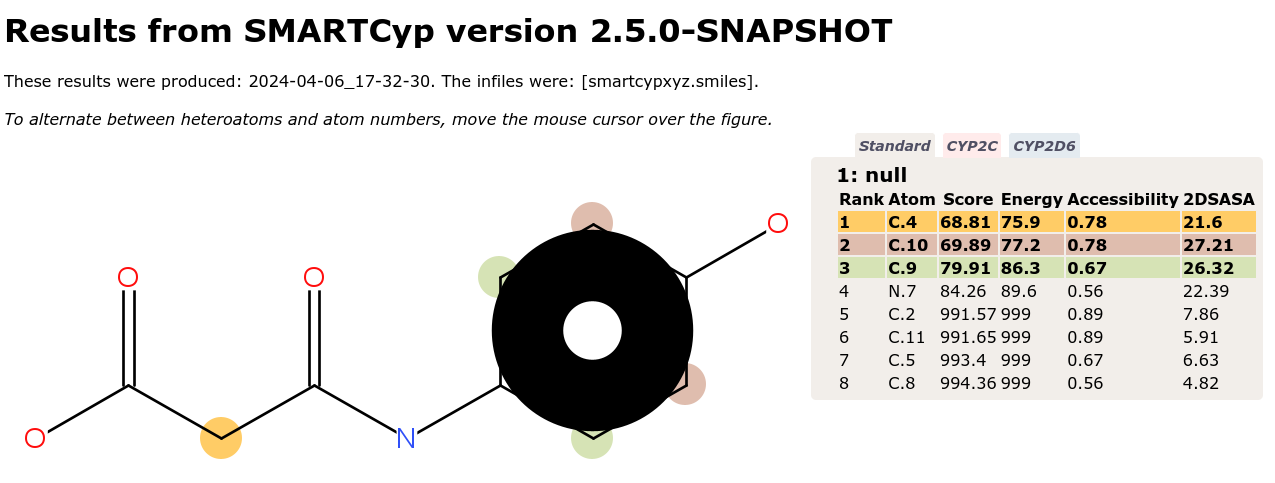
Javier <a href="https://github.com/cdk/smartcyp">started</a> a Maven build environment, updated a lot of code, but we seem quite close to a version that can be tested by
people that have integrated SMARTCyp in other tools. This is based on <a href="https://github.com/cdk/cdk/releases/tag/cdk-2.9">CDK 2.9</a>
and if you ignore the 2D depiction glitch, it looks it was a nice first choice:</p>

<p><img src="/assets/images/smartcyp.png" alt="" /></p>

<p>On a final note, we plan to record carefully our steps, in an open notebook science approach, with
the intention to extract general upgrade steps. For example, we will update the
<a href="https://egonw.github.io/cdkbook/migration.html">Migration</a> section of the
<a href="https://egonw.github.io/cdkbook/">Groovy Cheminformatics with the Chemistry Development Kit</a>.</p>]]></content><author><name>Egon Willighagen</name></author><category term="grant" /><category term="cdk" /><category term="cdk2024" /><category term="justdoi:10.1093/bioinformatics/btz037" /><category term="justdoi:10.1021/ml100016x" /><summary type="html"><![CDATA[We recently got awarded our second NWO Open Science grant (OSF23.2.097), this time for the Chemistry Development Kit (CDK). “We” here is me and Alyanne de Haan, René van der Ploeg, and Marc Teunis from Hogeschool Utrecht. The proposal has been submitted for public dissemination in RIO Journal, like we did with the first NWO Open Science grant.]]></summary><media:thumbnail xmlns:media="http://search.yahoo.com/mrss/" url="https://chem-bla-ics.linkedchemistry.info/assets/images/smartcyp.png" /><media:content medium="image" url="https://chem-bla-ics.linkedchemistry.info/assets/images/smartcyp.png" xmlns:media="http://search.yahoo.com/mrss/" /></entry><entry><title type="html">Wikidata script for SMILES, SMARTS, and CXSMILES depiction</title><link href="https://chem-bla-ics.linkedchemistry.info/2022/11/12/wikidata-script-for-smiles-smarts-and.html" rel="alternate" type="text/html" title="Wikidata script for SMILES, SMARTS, and CXSMILES depiction" /><published>2022-11-12T00:00:00+00:00</published><updated>2022-11-12T00:00:00+00:00</updated><id>https://chem-bla-ics.linkedchemistry.info/2022/11/12/wikidata-script-for-smiles-smarts-and</id><content type="html" xml:base="https://chem-bla-ics.linkedchemistry.info/2022/11/12/wikidata-script-for-smiles-smarts-and.html"><![CDATA[<p>In August I reported about <a href="https://chem-bla-ics.blogspot.com/2022/08/wikidata-now-escapes-smiles-and-cxsmiles.html">2D depiction of (CX)SMILES in Wikidata via linkouts</a>
(<a href="https://chem-bla-ics.blogspot.com/2017/07/wikidata-visualizes-smiles-strings-with.html">going back to 2017</a>). Based on a script by
<a href="https://orcid.org/0000-0001-5916-0947">Magnus Manske</a>, I wrote a <a href="https://www.wikidata.org/wiki/User:Egon_Willighagen/cdkdepict_gadget.js">Wikidata gadget</a>
that uses the same <a href="https://www.simolecule.com/cdkdepict/depict.html">CDK Depict</a>
(<a href="https://cdkdepict.cloud.vhp4safety.nl/">VHP4Safety mirror</a>) to depict the 2D structure in <a href="https://wikidata.org/">Wikidata</a> itself:</p>

<p><img src="/assets/images/Screenshot_20221112_130346.png" alt="Depicting of part of a Wikidata page with 2D structures of a canonical SMILES and matching CXSMILES." /></p>

<p>Note the depiction of the undefined (CIP) stereochemistry on two atoms. Thanks to
<a href="https://orcid.org/0000-0003-0443-9902">Adriano</a> and <a href="https://nextmovesoftware.com/blog/author/john/">John</a> for working that out.</p>

<p>More about CXSMILES in Wikidata in <a href="https://egonw.github.io/cdk-cxsmiles/">this Dagstuhl meeting results write up</a>.</p>]]></content><author><name>Egon Willighagen</name></author><category term="wikidata" /><category term="cdk" /><category term="cxsmiles" /><category term="dagstuhl" /><category term="smiles" /><category term="vhp4safety" /><summary type="html"><![CDATA[In August I reported about 2D depiction of (CX)SMILES in Wikidata via linkouts (going back to 2017). Based on a script by Magnus Manske, I wrote a Wikidata gadget that uses the same CDK Depict (VHP4Safety mirror) to depict the 2D structure in Wikidata itself:]]></summary></entry></feed>