<?xml version="1.0" encoding="utf-8"?><feed xmlns="http://www.w3.org/2005/Atom" ><generator uri="https://jekyllrb.com/" version="4.3.4">Jekyll</generator><link href="https://chem-bla-ics.linkedchemistry.info/feed/by_tag/blog.xml" rel="self" type="application/atom+xml" /><link href="https://chem-bla-ics.linkedchemistry.info/" rel="alternate" type="text/html" /><updated>2026-11-18T10:37:59+00:00</updated><id>https://chem-bla-ics.linkedchemistry.info/feed/by_tag/blog.xml</id><title type="html">chem-bla-ics</title><subtitle>Chemblaics (pronounced chem-bla-ics) is the science that uses open science and computers to solve problems in chemistry, biochemistry and related fields.</subtitle><author><name>Egon Willighagen</name></author><entry><title type="html">Crossref, how do I get old blog post URLs linked to the new DOIs?</title><link href="https://chem-bla-ics.linkedchemistry.info/2026/08/31/crossref-how-do-i-get-old-blog-post-urls-linked-to-the-new-dois.html" rel="alternate" type="text/html" title="Crossref, how do I get old blog post URLs linked to the new DOIs?" /><published>2026-08-31T00:00:00+00:00</published><updated>2026-08-31T00:00:00+00:00</updated><id>https://chem-bla-ics.linkedchemistry.info/2026/08/31/crossref-how-do-i-get-old-blog-post-urls-linked-to-the-new-dois</id><content type="html" xml:base="https://chem-bla-ics.linkedchemistry.info/2026/08/31/crossref-how-do-i-get-old-blog-post-urls-linked-to-the-new-dois.html"><![CDATA[<p>Now that <a href="https://rogue-scholar.org/">Rogue Scholar</a> is getting <a href="https://doi.org/10.53731/zyg15-qv911">serious about citations to blog posts</a>
and <a href="https://chem-bla-ics.linkedchemistry.info/2026/08/23/rogue-scholar-keeps-challenging-the-functionality-of-my-blog.html">how complex this is</a>,
I have been wondering how this works.</p>

<p>I already knew that <a href="https://www.crossref.org/">Crossref</a> tracks citations (see e.g. <a href="https://api.crossref.org/works/10.59787/2413-5488-2025-49-1-83-92">this API call</a>
for a paper where <a href="https://jmol.org/">Jmol</a> is used, doi:<a href="https://doi.org/10.59787/2413-5488-2025-49-1-83-92">10.59787/2413-5488-2025-49-1-83-92</a>),
and I learned that apparently Crossref also does an good job at finding citations when blog post URLs are used instead of the DOIs of the blog posts.</p>

<p>But how does it know? When Rogue Scholar registers a DOI, I assume it passes on the URL to redirect too. But what if the URL changed over time?
For example, I used blogger.com for many years (with satisfaction) and <a href="https://chem-bla-ics.linkedchemistry.info/2023/08/18/last-post-here-freebie-model-online.html">the URLs of the posts have changed</a>!</p>

<p>Crossref, how do I get the old blog post URLs also linked to the DOI?</p>

<p>For example, the doi <a href="https://doi.org/10.59350/65nqr-3w351">10.59350/65nqr-3w351</a> links now to
<a href="https://chem-bla-ics.linkedchemistry.info/2023/08/18/last-post-here-freebie-model-online.html">https://chem-bla-ics.linkedchemistry.info/2023/08/18/last-post-here-freebie-model-online.html</a>
but originally the URL was <a href="https://chem-bla-ics.linkedchemistry.info/2023/08/18/last-post-here-freebie-model-online.html">https://chem-bla-ics.blogspot.com/2023/08/last-post-here-freebie-model-online.html <i class="fa-solid fa-recycle fa-xs"></i></a>.</p>]]></content><author><name>Egon Willighagen</name></author><category term="blog" /><category term="doi" /><category term="justdoi:10.59787/2413-5488-2025-49-1-83-92" /><category term="justdoi:10.53731/zyg15-qv911" /><category term="justdoi:10.59350/65nqr-3w351" /><summary type="html"><![CDATA[Now that Rogue Scholar is getting serious about citations to blog posts and how complex this is, I have been wondering how this works.]]></summary></entry><entry><title type="html">Rogue Scholar keeps challenging the functionality of my blog</title><link href="https://chem-bla-ics.linkedchemistry.info/2026/08/23/rogue-scholar-keeps-challenging-the-functionality-of-my-blog.html" rel="alternate" type="text/html" title="Rogue Scholar keeps challenging the functionality of my blog" /><published>2026-08-23T00:00:00+00:00</published><updated>2026-08-23T00:00:00+00:00</updated><id>https://chem-bla-ics.linkedchemistry.info/2026/08/23/rogue-scholar-keeps-challenging-the-functionality-of-my-blog</id><content type="html" xml:base="https://chem-bla-ics.linkedchemistry.info/2026/08/23/rogue-scholar-keeps-challenging-the-functionality-of-my-blog.html"><![CDATA[<p><a href="https://rogue-scholar.org/">Rogue Scholar</a> continues to offer <a href="https://chem-bla-ics.linkedchemistry.info/2024/07/21/rogue-scholar-and-more.html">awesome features</a>.
It seems the recent move to InvenioRDM (<a href="https://doi.org/10.63517/kshzw-ay335">14.0 was just released</a>) was a good one. It does require rewrites, but make
things more scalable. One thing that did exist in the InvenioRDM-based Rogue Scholar last year was <a href="https://doi.org/10.53731/zyg15-qv911">citations to blog posts</a>.
But even that was <a href="https://doi.org/10.53731/1jbsg-kqm79">redeveloped and relaunched</a> a few days ago. It does not have yet the same amount of citations to
blog posts as before, but <a href="https://rogue-scholar.org/search?q=citations%3A%2A&amp;l=list&amp;p=1&amp;s=10&amp;sort=newest">more than 1200 can be found again</a>.</p>

<p>Platforms are getting more better at precisely capturing how we communicate science. Rogue Scholar is a great example of that, like the
no longer existing <a href="https://chem-bla-ics.linkedchemistry.info/tag/citeulike">CiteULike</a> before. And Rogue Scholar has been challenging
my Markdown-based blog post to support its functionality. For example, I had to <a href="https://chem-bla-ics.linkedchemistry.info/2025/01/19/blog-updates.html">add a JSON Feed</a>,
but also was happy that <a href="https://doi.org/10.53731/1xbh4-mnt50">Rogue Scholar added CiTO Support</a>.</p>

<p>But capturing all citations between things remains an issue. Platforms like Google Scholar and Web of Science do their best, but their
best is not Open or nor FAIR or neither. Generally, it has taken way too long for
<a href="https://doi.org/10.1045/january2015-brase">DataCite</a> and <a href="https://doi.org/10.7717/peerj-cs.86">Software Citations</a> to be picked up.
However, we can <a href="https://chem-bla-ics.linkedchemistry.info/2024/12/30/fair-blog-to-blog-citations.html">take control ourselves</a> when
solutions do not exist.</p>

<p>And because I want journal-to-blog citations are FAIR too, I hacked up another extension of my blog today. I can now add lines like this
to the metadata of blog post:</p>

<div class="language-yaml highlighter-rouge"><div class="highlight"><pre class="highlight"><code><span class="na">cited-in</span><span class="pi">:</span> <span class="s">cito:discusses:10.1186/1471-2105-8-487</span>
</code></pre></div></div>

<p>What is encodes is that the article with doi:<a href="https://doi.org/10.1186/1471-2105-8-487">10.1186/1471-2105-8-487</a> (one of my own)
discusses <a href="https://chem-bla-ics.linkedchemistry.info/2006/12/17/counting-stereoisomers-from-molecular_17.html">one of the posts in my blog</a>.</p>

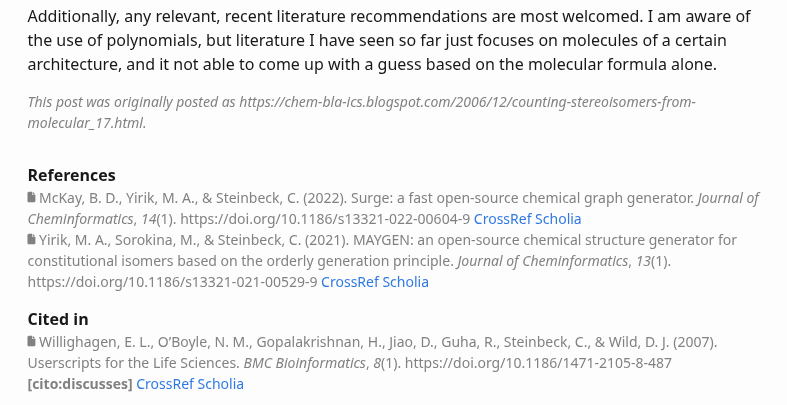
<p>Online, this is rendered with <a href="https://doi.org/10.7717/peerj-cs.214">citation.js</a> like this:</p>

<p><img src="/assets/images/blogs_citedin.png" alt="" /></p>

<p>Here, the <em>References</em> are the things I cite in my blog post, and the <em>Cited in</em> are things citing this blog post.</p>

<h3 id="how-blog-posts-are-cited">How blog posts are cited</h3>

<p>Now, DOIs for blog posts are a new thing: they did not exist when I started blogging. And for the 12 citations I found so far,
they are not using a DOI. I doubt that these citations are easily found in CrossRef or DataCite. Here are two examples, of increasing
complexity. The first one is how many citation styles would do it:</p>

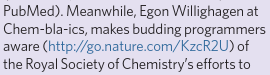
<p><img src="/assets/images/blogs_citing1.png" alt="" /></p>

<p>But they can also look like this:</p>

<p><img src="/assets/images/blogs_citing2.png" alt="" /></p>

<p>And scientific journals sometimes even use URL shorteners and then it may look like this:</p>

<p><img src="/assets/images/blogs_citing3.png" alt="" /></p>

<p>This makes it a challenge for any platform to pick up these citations!</p>

<h3 id="how-about-the-json-feed">How about the JSON Feed</h3>

<p>That leaves me with how I make this information avaiable, a bit towards FAIR, but at least machine readable.
This is done with a <a href="https://egonw.github.io/JSONFeed-extensions/">JSON Feed extension</a> (at the time of writing, I did
not add this proposal yet). My <code class="language-plaintext highlighter-rouge">archive.json</code> feed now contains 12 fragments like this:</p>

<div class="language-json highlighter-rouge"><div class="highlight"><pre class="highlight"><code><span class="nl">"_citations"</span><span class="p">:</span><span class="w"> </span><span class="p">[</span><span class="w">
  </span><span class="p">{</span><span class="w">
    </span><span class="nl">"url"</span><span class="p">:</span><span class="w"> </span><span class="s2">"https://doi.org/10.1038/nchem.2187"</span><span class="p">,</span><span class="w">
    </span><span class="nl">"doi"</span><span class="p">:</span><span class="w"> </span><span class="s2">"10.1038/nchem.2187"</span><span class="p">,</span><span class="w">
    </span><span class="nl">"cito"</span><span class="p">:</span><span class="w"> </span><span class="p">[</span><span class="w">
      </span><span class="s2">"citesForInformation"</span><span class="w">
    </span><span class="p">]</span><span class="w">
  </span><span class="p">}</span><span class="w">
</span><span class="p">]</span><span class="w">
</span></code></pre></div></div>

<p>It matches the structure of the <a href="https://egonw.github.io/JSONFeed-extensions/references.html">_references extension</a>.</p>

<p>Let’s see where this goes :)</p>]]></content><author><name>Egon Willighagen</name></author><category term="cito:citesAsRecommendedReading:10.63517/kshzw-ay335" /><category term="blog" /><category term="cito:citesAsRecommendedReading:10.53731/zyg15-qv911" /><category term="cito" /><category term="cito:citesAsRecommendedReading:10.53731/1jbsg-kqm79" /><category term="cito:citesAsRecommendedReading:10.53731/1xbh4-mnt50" /><category term="mycito:discusses:10.1186/1471-2105-8-487" /><category term="cito:usesMethodIn:10.7717/peerj-cs.214" /><category term="cito:citesAsRecommendedReading:10.7717/peerj-cs.86" /><category term="cito:citesAsRecommendedReading:10.1045/january2015-brase" /><category term="json" /><summary type="html"><![CDATA[Rogue Scholar continues to offer awesome features. It seems the recent move to InvenioRDM (14.0 was just released) was a good one. It does require rewrites, but make things more scalable. One thing that did exist in the InvenioRDM-based Rogue Scholar last year was citations to blog posts. But even that was redeveloped and relaunched a few days ago. It does not have yet the same amount of citations to blog posts as before, but more than 1200 can be found again.]]></summary><media:thumbnail xmlns:media="http://search.yahoo.com/mrss/" url="https://chem-bla-ics.linkedchemistry.info/assets/images/blogs_citedin.png" /><media:content medium="image" url="https://chem-bla-ics.linkedchemistry.info/assets/images/blogs_citedin.png" xmlns:media="http://search.yahoo.com/mrss/" /></entry><entry><title type="html">Chemical blogs history</title><link href="https://chem-bla-ics.linkedchemistry.info/2026/01/17/chemical-blogs-history.html" rel="alternate" type="text/html" title="Chemical blogs history" /><published>2026-01-17T00:00:00+00:00</published><updated>2026-01-17T00:00:00+00:00</updated><id>https://chem-bla-ics.linkedchemistry.info/2026/01/17/chemical-blogs-history</id><content type="html" xml:base="https://chem-bla-ics.linkedchemistry.info/2026/01/17/chemical-blogs-history.html"><![CDATA[<p>Like many awesome internet phenomena, <a href="https://en.wikipedia.org/wiki/Blog">blogging started in the late nineties</a>.
<a href="https://doi.org/10.1038/432933a">Nature</a> <a href="https://doi.org/10.1038/ngeo170">authors</a> <a href="https://doi.org/10.1038/ncb0905-845b">and</a>
<a href="https://doi.org/10.1038/4571058a">editors</a> recognized the effort early. In 2006 there were already
more than 45 million blogs, and at least 50 science blogs made it in the top 50,000 and
<a href="https://doi.org/10.1038/442009a">5 in the top 3,500</a>.</p>

<p>I started blogging in 2005, around the time many others did, among which many chemists.
in 2006 I started a website called <a href="https://chem-bla-ics.linkedchemistry.info/2006/08/25/chemical-blogspace.html">Chemical blogspace</a>
using the <em>Postgenomic.com</em> software. Chemical blogspace extracted which journal articles
were discussed (yeah, there is <a href="https://www.linkedin.com/pulse/how-did-altmetric-come-euan-adie/">a causal relationship with altmetrics</a>!),
and <a href="https://chem-bla-ics.linkedchemistry.info/2006/02/25/hacking-inchi-support-into.html">I added recognition of chemicals</a>,
so that you could <a href="https://chem-bla-ics.linkedchemistry.info/2007/01/04/chemical-blogspace-is-getting-more.html">follow blog posts talking about a specific chemical</a>.
I <a href="https://chem-bla-ics.linkedchemistry.info/2007/10/16/lunch-at-nature-hq-with-euan-joanna-ian.html">visited Euan Adie and others in 2007</a>.
I had to sunset Chemical blogspace several years later, in a time where blogging seems to
be on its return, overtaken by microblogging platforms like Twitter (which died in 2022).</p>

<p>We know now that it didn’t really go away, however. If we look at <a href="https://chem-bla-ics.linkedchemistry.info/2024/07/21/rogue-scholar-and-more.html">Rogue Scholar</a>
we <a href="https://docs.rogue-scholar.org/dashboard">see there is plenty of activity</a>, indeed.
I am very interested in restarting something like Chemical blogspace, based on Rogue Scholar.
The nice things of Chemical blogspace was that it created a virtual community, and in
the end it aggregated and indexed more than 250 chemistry blogs. I would love to see
many of them archived on Rogue Scholar, but the blog authors have to
<a href="https://tally.so/r/nPvNK0">recommend their blog personally here</a>.</p>

<p>You can also just visit many of these blogs to relive the dynamics at the time:</p>

<ul>
  <li><a href="https://chemicalblogspace.blogspot.com/2006/12/new-blogs-1.html">New Blogs #1</a> (2006)</li>
  <li><a href="https://chemicalblogspace.blogspot.com/2007/01/new-blogs-2.html">New Blogs #2</a> (2007)</li>
  <li><a href="https://chemicalblogspace.blogspot.com/2007/02/new-blogs-3.html">New Blogs #3</a></li>
  <li><a href="https://chemicalblogspace.blogspot.com/2007/03/new-blogs-4.html">New Blogs #4</a></li>
  <li><a href="https://chemicalblogspace.blogspot.com/2007/04/new-blogs-5.html">New Blogs #5</a></li>
  <li><a href="https://chemicalblogspace.blogspot.com/2007/05/new-blogs-6.html">New Blogs #6</a></li>
  <li><a href="https://chemicalblogspace.blogspot.com/2007/06/these-are-new-blogs-that-entered.html">New Blogs #7</a></li>
  <li><a href="https://chemicalblogspace.blogspot.com/2007/10/new-blogs-8.html">New Blogs #8</a></li>
  <li><a href="https://chemicalblogspace.blogspot.com/2008/04/new-blogs-9.html">New Blogs #9</a> (2008)</li>
  <li><a href="https://chem-bla-ics.linkedchemistry.info/2009/07/23/new-blogs-10.html">New Blogs #10 <i class="fa-solid fa-recycle fa-xs"></i></a> (2009)</li>
  <li><a href="https://chem-bla-ics.linkedchemistry.info/2009/07/31/new-blogs-11.html">New Blogs #11 <i class="fa-solid fa-recycle fa-xs"></i></a></li>
  <li><a href="https://chemicalblogspace.blogspot.com/2009/11/new-blogs-12.html">New Blogs #12</a></li>
  <li><a href="https://chem-bla-ics.linkedchemistry.info/2010/07/15/cb-new-blogs-13.html">Cb: New Blogs #13</a> (2010)</li>
  <li><a href="https://chem-bla-ics.linkedchemistry.info/2010/10/22/cb-new-blogs-14.html">Cb: New Blogs #14</a></li>
</ul>

<p>A lot has happened since then. There are <a href="https://docs.rogue-scholar.org/dashboard">new platforms</a>.
Blogger and Wordpress are still the bigger platform, but Hugo, Jekyll, and Quarto are modern, open source
alternatives. <a href="https://www.anildash.com/2026/01/09/how-markdown-took-over-the-world/">Markdown may have helped</a>
with the revival of blogging, making it easier than ever.</p>

<p>What is your current favorite chemistry blog? Love to hear from you!</p>]]></content><author><name>Egon Willighagen</name></author><category term="blog" /><category term="nature" /><category term="justdoi:10.1038/4571058a" /><category term="justdoi:10.1038/ngeo170" /><category term="justdoi:10.1038/ncb0905-845b" /><category term="justdoi:10.1038/442009a" /><category term="justdoi:10.1038/432933a" /><summary type="html"><![CDATA[Like many awesome internet phenomena, blogging started in the late nineties. Nature authors and editors recognized the effort early. In 2006 there were already more than 45 million blogs, and at least 50 science blogs made it in the top 50,000 and 5 in the top 3,500.]]></summary></entry><entry><title type="html">20 years of blogging</title><link href="https://chem-bla-ics.linkedchemistry.info/2025/10/15/20-years-of-blogging.html" rel="alternate" type="text/html" title="20 years of blogging" /><published>2025-10-15T00:00:00+00:00</published><updated>2025-10-15T00:00:00+00:00</updated><id>https://chem-bla-ics.linkedchemistry.info/2025/10/15/20-years-of-blogging</id><content type="html" xml:base="https://chem-bla-ics.linkedchemistry.info/2025/10/15/20-years-of-blogging.html"><![CDATA[<p>Today, exactly 20 years ago I <a href="https://chem-bla-ics.linkedchemistry.info/2005/10/15/chem-bla-ics.html">started this blog</a>.
Two years ago I decided to <a href="https://chem-bla-ics.linkedchemistry.info/2023/07/27/archiving-and-updating-my-blog.html">upgrade my blog</a>
to one with version control. A decision I am still very excited about. It allowed me to start innovating my blog again.
As part of this, and following the step <a href="https://larsgw.blogspot.com/">Lars</a> <a href="https://legacy.rogue-scholar.org/blogs/syntaxus_baccata">took ealier</a>,
I registered my blog with <a href="https://rogue-scholar.org/">Rogue Scholar</a> and I started migrating blog posts from
<em>blogger.com</em> to my new location. I completed the years 2005, 2006, 2007, and 2008 now.</p>

<p>I decided to do this manually, which gives me the opportunity to reflect on my 20 years of blogging and 20 years of
research. It has been an utter joy to read about all the open science and all the innovation that happened around
those times, and all the collaborations. For example, the fun of <a href="https://chem-bla-ics.linkedchemistry.info/2006/08/25/chemical-blogspace.html">Postgenomics and Chemical blogspace</a>.
The early semantic web discussions, FOAF, rewrite of JChemPaint, use of the Chemical Markup Language, and so much more.</p>

<p>At the same time, the two years of Rogue Scholar give new opportunities. Starting with DOIs, blog PDFs and ePUBs,
to JSON feeds, grant acknowledgements, and CiTO annotations. It also allows me to update links (e.g. to the blog
of Peter Murray-Rust) and to properly cite other blogs (e.g. that of Rich Apodaca and Henry Rzepa).</p>

<p>I think science blogging is alive and kicking and looking forward to another 20 years of blogging
and another 20 years of science dissemamination innovation!</p>]]></content><author><name>Egon Willighagen</name></author><category term="blog" /><summary type="html"><![CDATA[Today, exactly 20 years ago I started this blog. Two years ago I decided to upgrade my blog to one with version control. A decision I am still very excited about. It allowed me to start innovating my blog again. As part of this, and following the step Lars took ealier, I registered my blog with Rogue Scholar and I started migrating blog posts from blogger.com to my new location. I completed the years 2005, 2006, 2007, and 2008 now.]]></summary></entry><entry><title type="html">Integrating comments via the Fediverse</title><link href="https://chem-bla-ics.linkedchemistry.info/2025/08/13/integrating-comments-via-the-fediverse.html" rel="alternate" type="text/html" title="Integrating comments via the Fediverse" /><published>2025-08-13T00:00:00+00:00</published><updated>2025-08-13T00:00:00+00:00</updated><id>https://chem-bla-ics.linkedchemistry.info/2025/08/13/integrating-comments-via-the-fediverse</id><content type="html" xml:base="https://chem-bla-ics.linkedchemistry.info/2025/08/13/integrating-comments-via-the-fediverse.html"><![CDATA[<p>My <a href="https://chem-bla-ics.linkedchemistry.info/2023/07/27/archiving-and-updating-my-blog.html">old blog</a>
had (has) comments via the Blogger.com platform, but I did not have anything for the new blog. A couple of options
are used, like Disqus and <a href="https://skerdiberberi.com/blog/utterances">comments via GitHub</a>. However, these both
have the downside of a <a href="https://en.wikipedia.org/wiki/Vendor_lock-in">vendor lock-in</a> and the whole point of moving
my blog was to break out from such lock-ins.</p>

<p>Almost half a year ago I read <a href="https://tzovar.as/commenting/">this post</a> by <a href="https://tzovar.as/about/">Bastian</a>
about, well, <em>integrating comments via the Fediverse</em>. He explains a solution worked out in 2021 by
<a href="https://fossacademic.tech/2021/12/16/CommentsTest.html">Robert W. Gehl</a>. I liked this idea and had the blog
post bookmarked for some time. But I did not get around working it <a href="https://github.com/egonw/blog2/commit/006b41822b46a935d159ca276cfab3a6a3b00e40">out until Monday</a>.
I had to do some <a href="https://github.com/egonw/blog2/commit/cc4f81db22d69d928352ee06ecad889286ae27bf">CSS fixing</a>
after that, but I can now have fediverse-powered comments in my blog by adding a bit of YAML, like this:</p>

<div class="language-yaml highlighter-rouge"><div class="highlight"><pre class="highlight"><code><span class="na">comments</span><span class="pi">:</span>
  <span class="na">host</span><span class="pi">:</span> <span class="s">social.edu.nl</span>
  <span class="na">username</span><span class="pi">:</span> <span class="s">egonw</span>
  <span class="na">id</span><span class="pi">:</span> <span class="m">115009169485329450</span>
</code></pre></div></div>

<p>I have annotated a few posts now, and will have some curation to do. But when I have made such a link,
the this is what it will look like by default:</p>

<p><img src="/assets/images/fedicomments1.png" alt="" /></p>

<p>After clicking the button (I want to style that a bit better), it shows the fediverse reactions:</p>

<p><img src="/assets/images/fedicomments2.png" alt="" /></p>

<p>There are some things that I like to improve. For example, clicking the <em>reply</em>, <em>boost</em>, or <em>like</em>
buttons doesn’t do anything yet. But there is code around that will show a popup box to redirect you
to your home fediserver. Let’s see how this evolves.</p>]]></content><author><name>Egon Willighagen</name></author><category term="blog" /><category term="cito:usesMethodIn:10.59350/pr6zx-10397" /><category term="mastodon" /><summary type="html"><![CDATA[My old blog had (has) comments via the Blogger.com platform, but I did not have anything for the new blog. A couple of options are used, like Disqus and comments via GitHub. However, these both have the downside of a vendor lock-in and the whole point of moving my blog was to break out from such lock-ins.]]></summary><media:thumbnail xmlns:media="http://search.yahoo.com/mrss/" url="https://chem-bla-ics.linkedchemistry.info/assets/images/fedicomments2.png" /><media:content medium="image" url="https://chem-bla-ics.linkedchemistry.info/assets/images/fedicomments2.png" xmlns:media="http://search.yahoo.com/mrss/" /></entry><entry><title type="html">Updating links to blogs: Peter Murray-Rust</title><link href="https://chem-bla-ics.linkedchemistry.info/2025/04/13/updating-links-to-blogs-peter-murray-rust.html" rel="alternate" type="text/html" title="Updating links to blogs: Peter Murray-Rust" /><published>2025-04-13T00:00:00+00:00</published><updated>2025-04-13T00:00:00+00:00</updated><id>https://chem-bla-ics.linkedchemistry.info/2025/04/13/updating-links-to-blogs-peter-murray-rust</id><content type="html" xml:base="https://chem-bla-ics.linkedchemistry.info/2025/04/13/updating-links-to-blogs-peter-murray-rust.html"><![CDATA[<p>One reason to <a href="https://chem-bla-ics.linkedchemistry.info/2023/07/27/archiving-and-updating-my-blog.html">move my blog</a>
from Blogger to a git-backed repository is that I can update links but that the version history shows exactly what
change was made. I have been using three icons: when I can find a new URL for the website, I use <i class="fa-solid fa-recycle fa-xs"></i>;
when I cannot find a new URL, but the old URL is in the <a href="https://web.archive.org/">Internet Archive</a>,
I use a <i class="fa-solid fa-box-archive fa-xs"></i>;
finally, if I cannot find anything to replace the broken link, I use <i class="fa-solid fa-link-slash fa-xs"></i>.
For example, the blog of Rich Apodaca is <a href="https://chem-bla-ics.linkedchemistry.info/2024/12/27/archiving_blogs.html">now archived</a>,
and I have been updating the many links to his (still running) blog to use DOI links. That has the added benefit
of <a href="https://chem-bla-ics.linkedchemistry.info/2024/12/30/fair-blog-to-blog-citations.html">making blog-to-blog citations more FAIR</a>.</p>

<p>Now, another blog I link to a lot, is the blog by Peter Murray-Rust, which has run at various URLs, including
<a href="http://wwmm.ch.cam.ac.uk/blogs/murrayrust/">http://wwmm.ch.cam.ac.uk/blogs/murrayrust/</a> and now at
<a href="https://blogs.ch.cam.ac.uk/pmr/">https://blogs.ch.cam.ac.uk/pmr/</a>. My posts on Blogger have a lot of links
to the <code class="language-plaintext highlighter-rouge">wwmm.ch.cam.ac.uk</code> domain, e.g. <code class="language-plaintext highlighter-rouge">http://wwmm.ch.cam.ac.uk/blogs/murrayrust/?p=845</code>. The problem  <!-- keep link -->
with these URLs is that they do not get properly rewritten and all point to a <em>European copyright: Cancel Articles 3, 11 and 13</em>
post from 2018.</p>

<p>But here too, the Internet Archive is helping. It gives me the opportunity to find what <code class="language-plaintext highlighter-rouge">p=845</code> pointed too.
Now, not all blog posts are archived and therefore sometimes need to figure out which posts it was using archived
posts just before or after the post I linked too. Of course, this only works because Peter’s blog is still online
with all posts. First step is to list all pages using the old URL pattern in the archive, e.g. with
<code class="language-plaintext highlighter-rouge">https://web.archive.org/web/*/http://wwmm.ch.cam.ac.uk/blogs/murrayrust/*</code>. <!-- keep link -->
Here, the first <code class="language-plaintext highlighter-rouge">*</code> indicates <code class="language-plaintext highlighter-rouge">any date</code>, while the second <code class="language-plaintext highlighter-rouge">*</code> indicates <code class="language-plaintext highlighter-rouge">any URL that started with the preceding</code>.</p>

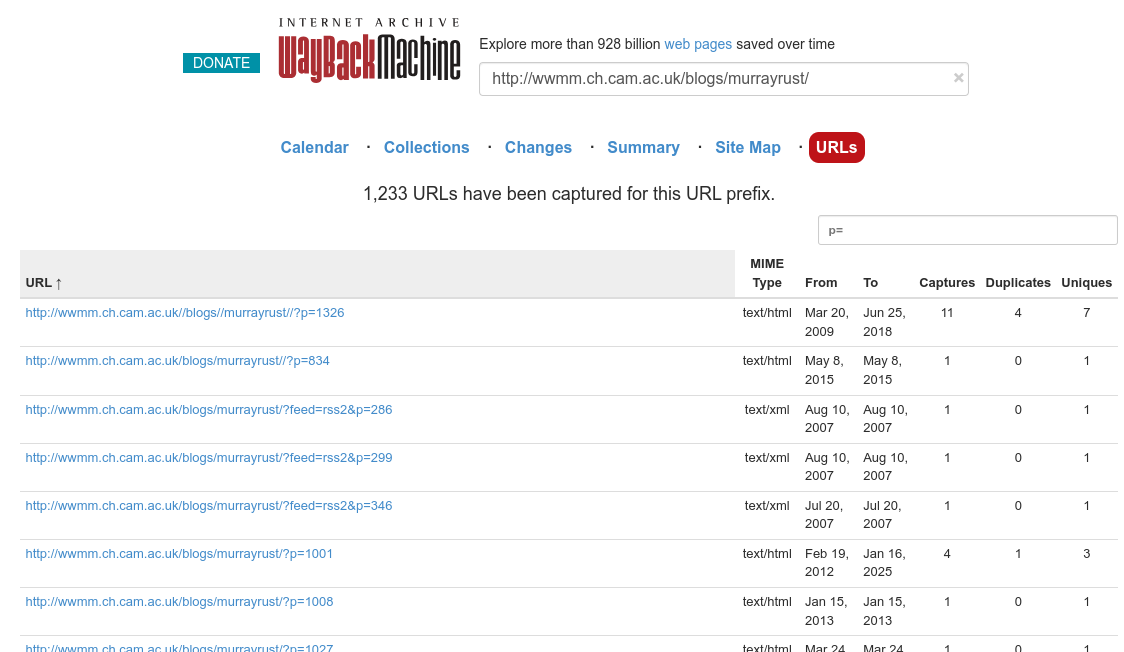
<p>This gives <a href="https://web.archive.org/web/*/http://wwmm.ch.cam.ac.uk/blogs/murrayrust/*">a list of 1233 posts</a>, <!-- keep link -->
which you can filter with the text box on the top right of the list, where I filtered
here for URLs with <code class="language-plaintext highlighter-rouge">p=</code>:</p>

<p><img src="/assets/images/pmr_internet_archive.png" alt="" /></p>

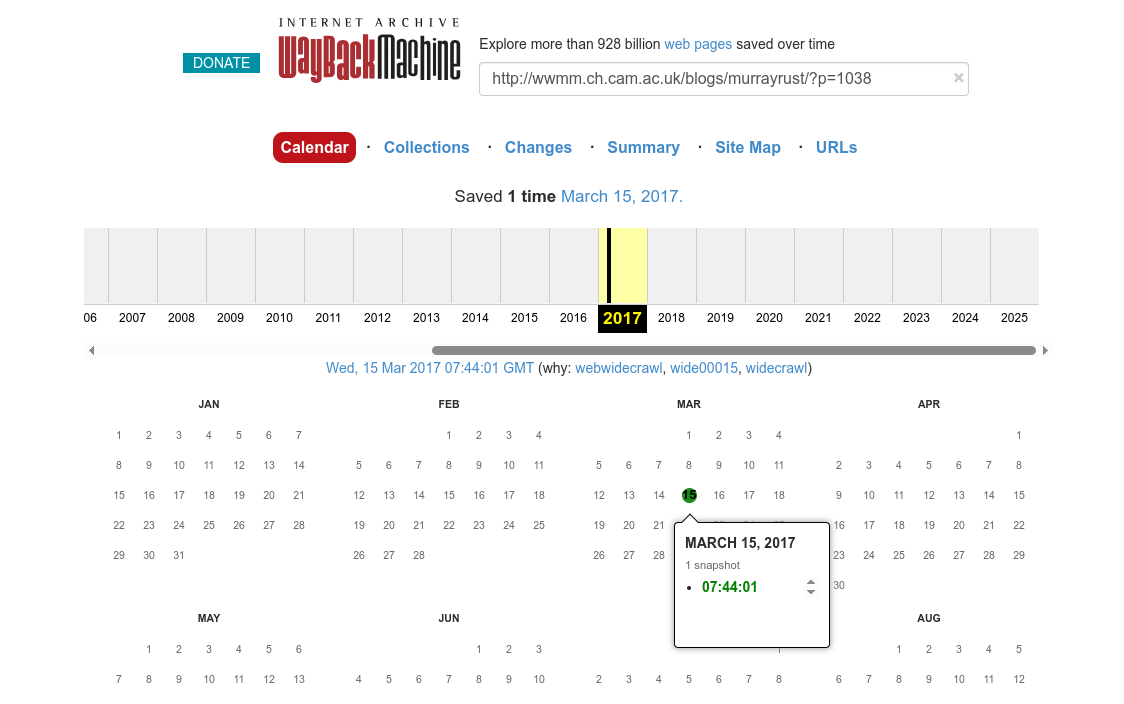
<p>However, if the blog post I am looking for is listed, it does not mean it actually has been archived. In the above
screenshot, note the <code class="language-plaintext highlighter-rouge">From</code> column, and that date needs to be from before the <code class="language-plaintext highlighter-rouge">wwmm.ch.cam.ac.uk</code> stopped being
used. For example, the following post has an Internet Archive, but after the move and the original content is
not visible, but a redirect message instead, here visible as a green date:</p>

<p><img src="/assets/images/pmr_no_luck.png" alt="" /></p>

<p>This way, I have been able to update various links already, not with a DOI and blog-to-blog citation as for
Rich’s blog, but just with an updated link so that readers of these older posts actually end up on
the post I originally linked to, such as
<a href="https://github.com/egonw/blog2/commit/d4c5e02c725ba799609e643f46389ea3b5266f6c#diff-863da47bd5bf4b33d3701c737854d2b3cd30a1802abaa225c78acac72d6d6f83L36-R38">here</a>:</p>

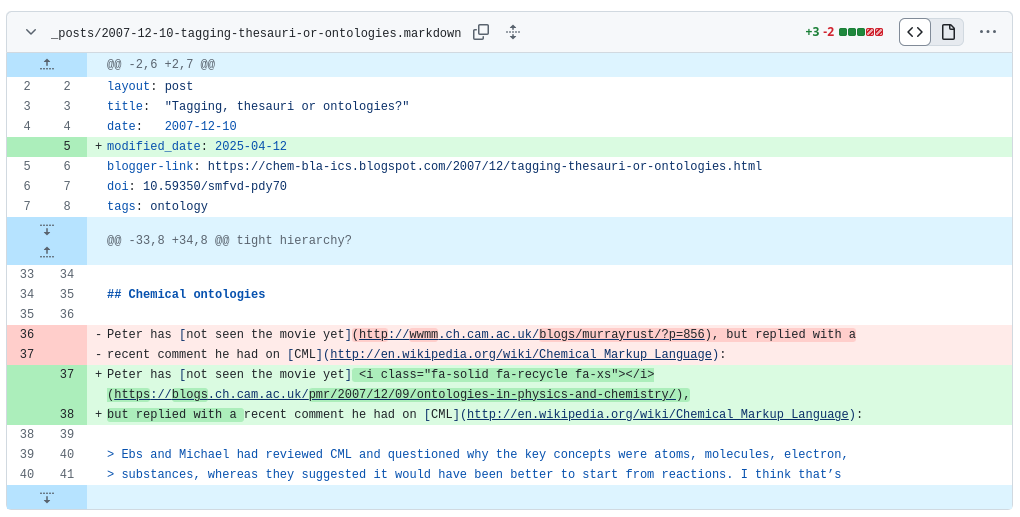
<p><img src="/assets/images/pmr_update.png" alt="" /></p>]]></content><author><name>Egon Willighagen</name></author><category term="blog" /><summary type="html"><![CDATA[One reason to move my blog from Blogger to a git-backed repository is that I can update links but that the version history shows exactly what change was made. I have been using three icons: when I can find a new URL for the website, I use ; when I cannot find a new URL, but the old URL is in the Internet Archive, I use a ; finally, if I cannot find anything to replace the broken link, I use . For example, the blog of Rich Apodaca is now archived, and I have been updating the many links to his (still running) blog to use DOI links. That has the added benefit of making blog-to-blog citations more FAIR.]]></summary><media:thumbnail xmlns:media="http://search.yahoo.com/mrss/" url="https://chem-bla-ics.linkedchemistry.info/assets/images/pmr_internet_archive.png" /><media:content medium="image" url="https://chem-bla-ics.linkedchemistry.info/assets/images/pmr_internet_archive.png" xmlns:media="http://search.yahoo.com/mrss/" /></entry><entry><title type="html">CiTO for blog citations</title><link href="https://chem-bla-ics.linkedchemistry.info/2025/02/08/cito-for-blog-citations.html" rel="alternate" type="text/html" title="CiTO for blog citations" /><published>2025-02-08T00:00:00+00:00</published><updated>2025-02-08T00:00:00+00:00</updated><id>https://chem-bla-ics.linkedchemistry.info/2025/02/08/cito-for-blog-citations</id><content type="html" xml:base="https://chem-bla-ics.linkedchemistry.info/2025/02/08/cito-for-blog-citations.html"><![CDATA[<p>This is mostly a test, but if it turns out the way I hope it will, likely after a few iterations, it adds
support in my blog for CiTO intent annotations to the DOIs I cite. I
<a href="https://chem-bla-ics.linkedchemistry.info/2024/12/30/fair-blog-to-blog-citations.html">pondered about the earlier</a>.
In the <a href="https://www.jsonfeed.org/version/1.1/">JSON Feed</a> it should, at least for now, show up like this:</p>

<div class="language-json highlighter-rouge"><div class="highlight"><pre class="highlight"><code><span class="nl">"_references"</span><span class="p">:</span><span class="w"> </span><span class="p">[</span><span class="w">
  </span><span class="p">{</span><span class="w">
    </span><span class="nl">"url"</span><span class="p">:</span><span class="w"> </span><span class="s2">"https://doi.org/10.59350/er1mn-m5q69"</span><span class="p">,</span><span class="w">
    </span><span class="nl">"doi"</span><span class="p">:</span><span class="w"> </span><span class="s2">"10.59350/er1mn-m5q69"</span><span class="p">,</span><span class="w">
    </span><span class="nl">"cito"</span><span class="p">:</span><span class="w"> </span><span class="p">[</span><span class="w"> </span><span class="s2">"extends"</span><span class="w"> </span><span class="p">]</span><span class="w">
  </span><span class="p">}</span><span class="w">
</span><span class="p">]</span><span class="w">
</span></code></pre></div></div>]]></content><author><name>Egon Willighagen</name></author><category term="cito" /><category term="blog" /><category term="cito:extends:10.59350/er1mn-m5q69" /><category term="json" /><summary type="html"><![CDATA[This is mostly a test, but if it turns out the way I hope it will, likely after a few iterations, it adds support in my blog for CiTO intent annotations to the DOIs I cite. I pondered about the earlier. In the JSON Feed it should, at least for now, show up like this:]]></summary></entry><entry><title type="html">Blog updates</title><link href="https://chem-bla-ics.linkedchemistry.info/2025/01/19/blog-updates.html" rel="alternate" type="text/html" title="Blog updates" /><published>2025-01-19T00:00:00+00:00</published><updated>2025-01-19T00:00:00+00:00</updated><id>https://chem-bla-ics.linkedchemistry.info/2025/01/19/blog-updates</id><content type="html" xml:base="https://chem-bla-ics.linkedchemistry.info/2025/01/19/blog-updates.html"><![CDATA[<p><a href="https://doi.org/10.59350/nfqxs-qs982">One-and-a-half years ago</a> I started migration my blog from blogger.com to a Markdown and Git-based blog.
It has been a fascinating journey that I do not regret. I love being back in control and not reliant on features of some
<em>content management system</em>. I learned so much along the way, including <a href="https://jekyllrb.com/">Jekyll</a> and <a href="https://jekyllrb.com/docs/liquid/">Liquid</a>
to start with, but also <a href="https://doi.org/10.59350/nfqxs-qs982">Fontawesome</a> (for better or worse)m and <a href="https://doi.org/10.59350/8x2f1-h6d21">Goatcounter</a>
for GDPR-compatible and privacy-first impact tracking.</p>

<p>But I also greatly enjoy the interaction with the <a href="https://rogue-scholar.org/">Rogue Scholar</a> team (particularly <a href="https://blog.front-matter.io/">Martin Fenner</a>).
First, it has great to be listed on (something like) a blog planet, and to read the collection of blog posts, of course! BTW, also thanks to
<a href="https://larsgw.blogspot.com/">Lars Willighagen</a> who joined Rogue Scholar earlier than I did. This interaction allowed me
to take part in various innovations, like archiving and getting DOIs for blog posts, archiving entire blogs (see doi:<a href="https://doi.org/10.53731/3c6pm-xbp04">10.53731/3c6pm-xbp04</a> and
doi:<a href="https://doi.org/10.59350/vjvdy-6p110">10.59350/vjvdy-6p110</a>), <a href="https://doi.org/10.59350/er1mn-m5q69">cite blog posts with DOIs</a>,
references in blogs (e.g. see doi:<a href="https://doi.org/10.53731/m9d5v-xmr74">10.53731/m9d5v-xmr74</a>),
<a href="https://www.jsonfeed.org/">JSON Feed</a> (see doi:<a href="https://doi.org/10.53731/d6vdvbt-tffmezj">10.53731/d6vdvbt-tffmezj</a>;
<a href="https://chem-bla-ics.linkedchemistry.info/feed.json">last 10</a> or <a href="https://chem-bla-ics.linkedchemistry.info/archive.json">full archive</a>),
<a href="https://doi.org/10.59350/1cg8w-qth68">ORCID support</a>,
and if things goes well, <a href="https://doi.org/10.53731/m9d5v-xmr74">preregistration of blogpost DOIs with commonmeta</a>.</p>

<p>The JSON Feed is interesting. For example, it includes more specific support for references, something that any scholarly
blogger should look at:</p>

<div class="language-json highlighter-rouge"><div class="highlight"><pre class="highlight"><code><span class="p">{</span><span class="w">
  </span><span class="err">...</span><span class="w">
  </span><span class="nl">"_references"</span><span class="p">:</span><span class="w"> </span><span class="p">[</span><span class="w">
    </span><span class="p">{</span><span class="w"> </span><span class="nl">"url"</span><span class="p">:</span><span class="w"> </span><span class="s2">"https://doi.org/10.7717/peerj-cs.214"</span><span class="w"> </span><span class="p">},</span><span class="w">
    </span><span class="p">{</span><span class="w"> </span><span class="nl">"url"</span><span class="p">:</span><span class="w"> </span><span class="s2">"https://doi.org/10.5281/ZENODO.14562484"</span><span class="w"> </span><span class="p">},</span><span class="w">
    </span><span class="p">{</span><span class="w"> </span><span class="nl">"url"</span><span class="p">:</span><span class="w"> </span><span class="s2">"https://doi.org/10.5281/ZENODO.14562504"</span><span class="w"> </span><span class="p">}</span><span class="w">
  </span><span class="p">],</span><span class="w">
  </span><span class="err">...</span><span class="w">
</span><span class="p">}</span><span class="w">
</span></code></pre></div></div>

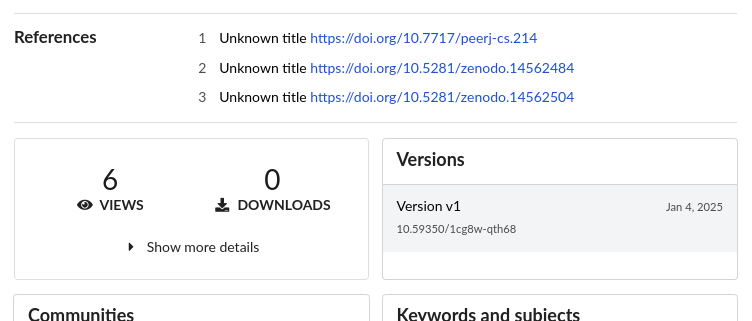
<p>And the citations get propagated and show up like this in the Rogue Scholar archives:</p>

<p><img src="/assets/images/rs_archives.png" alt="" /></p>

<p>I think we also see the ongoing innovation in action. Previously, this is the first time I see the “Unknown title”,
but from the JSON it is obviously missing too. One thing to remember here, is that currently my blog does
not have this metadata, and when you read my blog, it is <a href="https://citation.js.org/">citation.js</a>
(doi:<a href="https://doi.org/10.7717/peerj-cs.214">10.7717/peerj-cs.214</a>) that looks up the metadata using the DOI and adds
that to the blog post in your browser. Doing this when the HTML is being generated is something
I still need to learn how to do that.</p>]]></content><author><name>Egon Willighagen</name></author><category term="blog" /><category term="justdoi:10.53731/m9d5v-xmr74" /><category term="justdoi:10.53731/d6vdvbt-tffmezj" /><category term="justdoi:10.53731/3c6pm-xbp04" /><category term="justdoi:10.7717/peerj-cs.214" /><summary type="html"><![CDATA[One-and-a-half years ago I started migration my blog from blogger.com to a Markdown and Git-based blog. It has been a fascinating journey that I do not regret. I love being back in control and not reliant on features of some content management system. I learned so much along the way, including Jekyll and Liquid to start with, but also Fontawesome (for better or worse)m and Goatcounter for GDPR-compatible and privacy-first impact tracking.]]></summary><media:thumbnail xmlns:media="http://search.yahoo.com/mrss/" url="https://chem-bla-ics.linkedchemistry.info/assets/images/rs_archives.png" /><media:content medium="image" url="https://chem-bla-ics.linkedchemistry.info/assets/images/rs_archives.png" xmlns:media="http://search.yahoo.com/mrss/" /></entry><entry><title type="html">FAIR blog-to-blog citations</title><link href="https://chem-bla-ics.linkedchemistry.info/2024/12/30/fair-blog-to-blog-citations.html" rel="alternate" type="text/html" title="FAIR blog-to-blog citations" /><published>2024-12-30T00:00:00+00:00</published><updated>2024-12-30T00:00:00+00:00</updated><id>https://chem-bla-ics.linkedchemistry.info/2024/12/30/fair-blog-to-blog-citations</id><content type="html" xml:base="https://chem-bla-ics.linkedchemistry.info/2024/12/30/fair-blog-to-blog-citations.html"><![CDATA[<p><a href="https://chem-bla-ics.linkedchemistry.info/2021/08/28/scholarly-journals-should-use-archived.html">Linkrot is real</a> and
<a href="https://doi.org/10.59348/1z1p2-nn569">digital preservation problematic</a>. One reason why I have
<a href="https://chem-bla-ics.linkedchemistry.info/2023/07/27/archiving-and-updating-my-blog.html">started migrating my blog</a>
to a more robust platform. That first step gave me version control. This summer my blog was
<a href="https://chem-bla-ics.linkedchemistry.info/2024/07/21/rogue-scholar-and-more.html">accepted to Rogue Scholar</a>.
That gave me DOIs. And an idea.</p>

<p>Things are coming together, and while commercial publishers (SpringerNature, Elsevier, MDPI, Frontiers, etc)
are focused on profit (“shareholder value”) instead of the community they serve, Open Science is providing
working, real-world, inexpensive, superior FAIR solutions for scientific dissemination. Maybe European
universities are not convinced yet (see <a href="https://doi.org/10.59350/1nmwy-nhk20">Björn’s post</a>), but it is
happening.</p>

<p>Two things that are happening are <a href="https://openalex.org/">OpenAlex</a> and <a href="https://opencitations.net/">OpenCitations</a>.
<a href="https://chem-bla-ics.linkedchemistry.info/tag/cito">CiTO adoption</a> not so much yet, but I am not giving up
yet. Simply because Open Science doesn’t go away and everything can be picked up tomorrow. Each holiday
I am picking up the Citation Typing Ontology and this holiday the
<a href="https://chem-bla-ics.linkedchemistry.info/2024/04/02/open-science-retreat-2.html">use of nanopublications for CiTO intent annotation</a>
of April this year.</p>

<p>Yesterday, I played with the nanopublication templates used by NanoDash, got to the triples of it, and
ended up using the web interface to create <a href="https://w3id.org/np/RA43F9EoOuzF0xoNUnCMNyFsfIqlsuWDdPHCnN0wCdCAw">a derived template</a>
from <a href="https://w3id.org/np/RAX_4tWTyjFpO6nz63s14ucuejd64t2mK3IBlkwZ7jjLo">Tobias’ template from April</a>.
What makes this nanopublication template special is that it uses <a href="https://github.com/SPAROntologies/cito">the CiTO ontology</a>.</p>

<p>The difference is that the original template used <code class="language-plaintext highlighter-rouge">ScholarlyWork</code> as type for the citing resource,
while the derivative uses <code class="language-plaintext highlighter-rouge">CreativeWork</code> from the schema.org namespace, allowing things like this:</p>

<ul>
  <li>article to software release: <a href="https://w3id.org/np/RAzmTPPM7v5Ilgvo-3aFRRZgdD3ImaUB434NtGlfI0G90">example nanopub</a></li>
  <li>article to blog: <a href="https://w3id.org/np/RAaRH1WhRgirso3JiTUJJ0XcBaRyHI6G4OZPdWBoIf17U">example nanopub</a></li>
  <li>blog to article: <a href="https://w3id.org/np/RAXL9q3jakrpaDh8oyVaNS1Y7JowmZm4tx4WcdIFMmg8g">example nanopub</a></li>
  <li>blog to blog: <a href="https://w3id.org/np/RAJOwolZUwUxuvPEhMFiQYHywJdWMWTlt_gnXoUbUBaYY">example nanopub</a></li>
</ul>

<p>The last three are possible because of the Rogue Scholar DOIs. Let’s continue with the fourth example,
the blog to blog citation. While an URL is a unique, global identifier, the digital preservation depends
on a lot of things. On the other hand, a DOI with the associated metadata is easier to preserve. For example,
because it can be spread more easily than the digital object itself.</p>

<p>So, when <a href="https://blog.front-matter.io/author/martin/">Martin Fenner</a> and
<a href="https://chem-bla-ics.linkedchemistry.info/2024/12/08/rich-l-apodaca.html">I</a>
<a href="https://chem-bla-ics.linkedchemistry.info/2024/12/27/archiving_blogs.html">started</a>
<a href="https://doi.org/10.53731/3c6pm-xbp04">archiving</a>
the <a href="https://depth-first.com/">Depth-First blog of Rich Apodaca</a> to digitally preserve his blog, <!-- keep link -->
it also automatically gave the blog posts DOIs. This makes the blog more FAIR, just like it does
for my blog. And being more FAIR, we can use the DOIs for other things too, like blog to blog
citations with CiTO intent annotation, as nanopublications.
(Technically, any Springer Nature journal can do this, but they found reasons to not do it.)</p>

<p>So, let’s take <a href="https://chem-bla-ics.linkedchemistry.info/2024/12/08/rich-l-apodaca.html">this blog post</a>.
I have today updated this to not use <code class="language-plaintext highlighter-rouge">depth-first.com</code> URLs but, following Martin’s example, use the DOIs <!-- keep link -->
for those posts instead.</p>

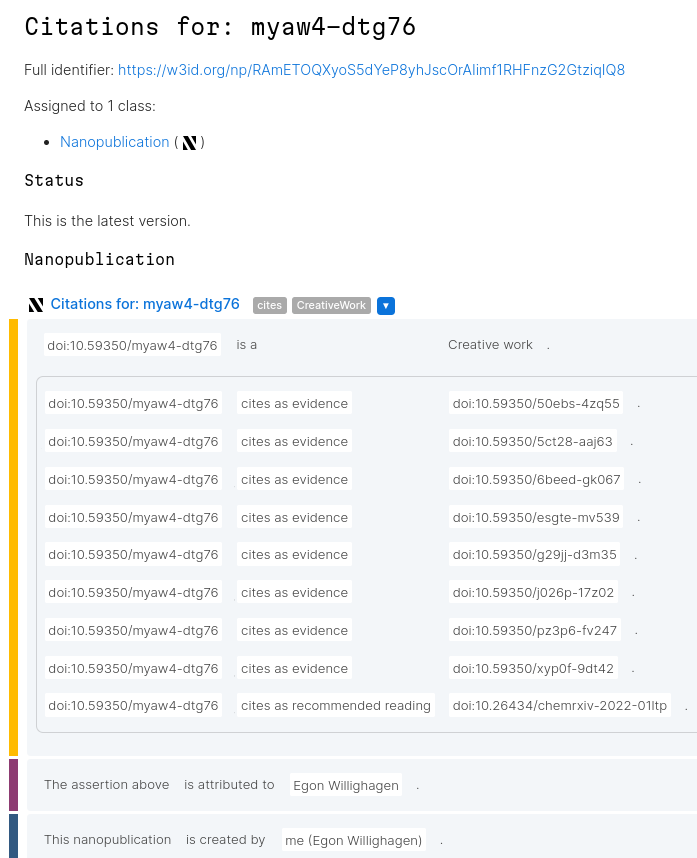
<p>And when I make a nanopublication out of this, I can add the citation intent, and then it looks like
<a href="https://w3id.org/np/RAmETOQXyoS5dYeP8yhJscOrAIimf1RHFnzG2GtziqIQ8">this</a>:</p>

<p><img src="/assets/images/nanopub1.png" alt="" /></p>

<p>For some reason, the DOIs do not show up as references as they do for this post for the DOIs of the
posts of Martin Paul Eve, Björn Brembs, and Martin Fenner. It does for
<a href="https://chem-bla-ics.linkedchemistry.info/2009/11/19/chempedia-rdf-1-sparql-end-point.html">this post citing Depth-First</a>.</p>

<p>So, from now on, I will use DOIs when citing other blog posts, and I hope many other blogs will
start using Rogue Scholar or some other service to generate DOIs for single blog posts.
I also have to figure out if I want to use DOIs to link to posts in my own blog.
And hopefully, OpenCitations will soon accept citations provided by nanopublications.
With or without CiTO intent annotations, whatever comes first. Oh, and I cannot wait to see
the citations who up in <a href="https://www.altmetric.com/">Altmetric.com</a> :)</p>

<p>Let’s see where this is going.</p>]]></content><author><name>Egon Willighagen</name></author><category term="cito" /><category term="blog" /><category term="publishing" /><category term="justdoi:10.59348/1z1p2-nn569" /><category term="justdoi:10.59350/1nmwy-nhk20" /><category term="justdoi:10.53731/3c6pm-xbp04" /><summary type="html"><![CDATA[Linkrot is real and digital preservation problematic. One reason why I have started migrating my blog to a more robust platform. That first step gave me version control. This summer my blog was accepted to Rogue Scholar. That gave me DOIs. And an idea.]]></summary><media:thumbnail xmlns:media="http://search.yahoo.com/mrss/" url="https://chem-bla-ics.linkedchemistry.info/assets/images/nanopub1.png" /><media:content medium="image" url="https://chem-bla-ics.linkedchemistry.info/assets/images/nanopub1.png" xmlns:media="http://search.yahoo.com/mrss/" /></entry><entry><title type="html">Archiving blogs</title><link href="https://chem-bla-ics.linkedchemistry.info/2024/12/27/archiving_blogs.html" rel="alternate" type="text/html" title="Archiving blogs" /><published>2024-12-27T00:00:00+00:00</published><updated>2024-12-27T00:00:00+00:00</updated><id>https://chem-bla-ics.linkedchemistry.info/2024/12/27/archiving_blogs</id><content type="html" xml:base="https://chem-bla-ics.linkedchemistry.info/2024/12/27/archiving_blogs.html"><![CDATA[<p>Blogs come and go. Sometimes they move from one location to another. However, blogs have not been systematically
archived, perhaps for work by efforts by OpenLaboraty. Bora Zivkovic gave in 2012
<a href="https://web.archive.org/web/20120713032329/http://blogs.scientificamerican.com/a-blog-around-the-clock/2012/07/10/science-blogs-definition-and-a-history/">a good overview <i class="fa-solid fa-box-archive fa-xs"></i></a>,
to which Paul Raeburn <a href="https://ksj.mit.edu/tracker-archive/what-was-first-science-blog/">replied</a>: <em>“If you weren’t
blogging in the mid-2000s, when all the science bloggers knew and blogrolled each other, you’ve already missed the golden
age.”</em>. I think blogging is as strong as ever, but a lot of blogs have become more like columns in bigger media.
Archiving of blog had not been done systematically, tho some posts made it into print, for example in
<a href="https://web.archive.org/web/20120114030926/http://blogs.scientificamerican.com/network-central/2011/07/18/open-laboratory-2011-submissions-so-far/">the Open Laboratory <i class="fa-solid fa-box-archive fa-xs"></i></a>
series. Some copies made it into libraries, e.g. <a href="https://search.worldcat.org/en/title/225554926">2006</a>,
<a href="https://search.worldcat.org/en/title/727023103">2010</a>, and <a href="https://search.worldcat.org/en/title/797975793">2012</a>.</p>

<p>The two posts from the first paragraph from the <em>blogs.scientificamerican.com</em> provide a good example of the problem:
bitrot. The Internet Archive has always been useful for archiving webpages and has been useful for archiving blogs too.
But I do not believe it has been used systematically either, but at least it helped recover the above two pages.</p>

<p>So, when I discussed <a href="https://depth-first.com/">the blog of Rich Apodaca</a> <a href="https://chem-bla-ics.linkedchemistry.info/2024/12/08/rich-l-apodaca.html">earlier this month</a>,
the question came up if we could archive his blog. Beside his <a href="https://depth-first.com/">personal coverage</a> of
his cancer, his blog also covers a good bit of open science cheminformatics of the zeros and 10s.</p>

<h2 id="rogue-scholar">Rogue Scholar</h2>

<p>This is where <a href="https://rogue-scholar.org/">Rogue Scholar</a> comes in. <a href="https://blog.front-matter.io/">Martin Fenner</a>
took up my question and started archiving Rich’ blog, resulting in <a href="https://rogue-scholar.org/communities/rapodaca/records?q=&amp;l=list&amp;p=1&amp;s=10&amp;sort=newest">this ‘community’</a>
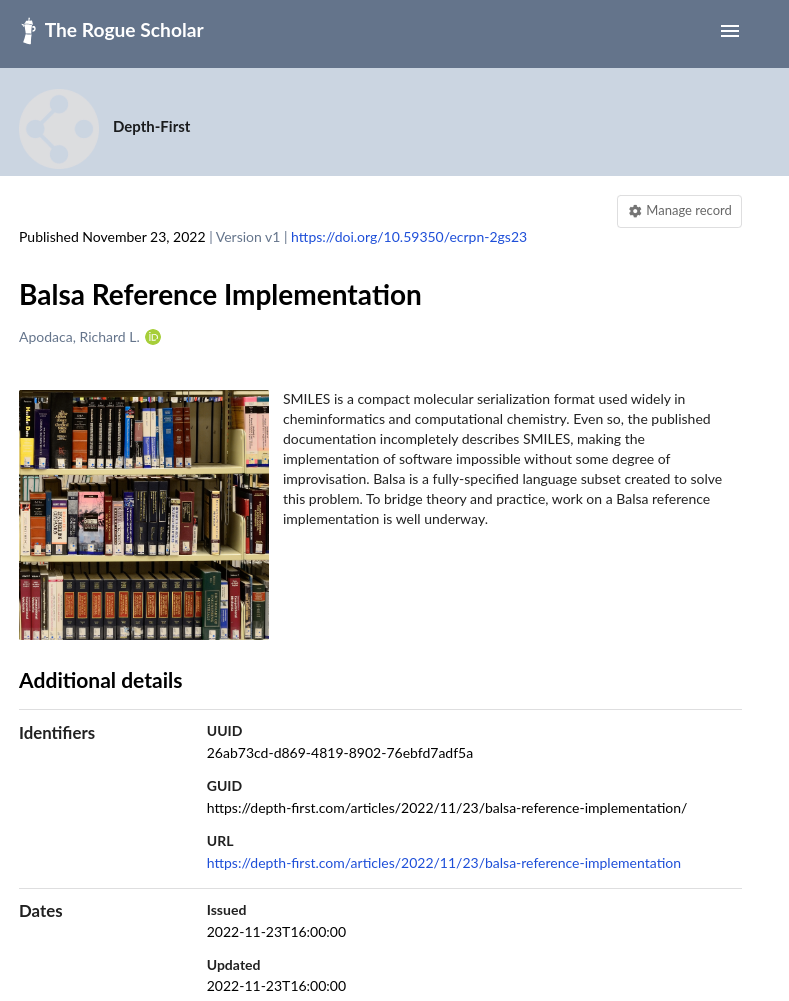
collecting the blog posts. This is what an archive page for a single blog post looks like:</p>

<p><img src="/assets/images/depth-first-on-rogue-scholar.png" alt="" /></p>

<p>What this archive now has is DOIs for each blog post, archived metadata that will also propagate via DataCite, etc.
It does not have PDFs or other copies of the full blog posts yet. There are more than 900 blog posts to create
PDFs for. Anyone <a href="https://mastodon.social/@egonw/113725573843479243">has an idea?</a></p>

<p>I will post later this year about formally/semantically linking blogs citing other blogs using DOIs for blog
posts, for example from Rogue Scholar. Any probably throw in <a href="http://localhost:4000/2024/04/02/open-science-retreat-2.html">some use of the Citation Typing Ontology</a>.</p>

<p>Anyway, I can recommend everyon to get their blog lists on Rogue Scholar, for the DOIs and for the automatic
archiving.</p>]]></content><author><name>Egon Willighagen</name></author><category term="blog" /><category term="openlab" /><summary type="html"><![CDATA[Blogs come and go. Sometimes they move from one location to another. However, blogs have not been systematically archived, perhaps for work by efforts by OpenLaboraty. Bora Zivkovic gave in 2012 a good overview , to which Paul Raeburn replied: “If you weren’t blogging in the mid-2000s, when all the science bloggers knew and blogrolled each other, you’ve already missed the golden age.”. I think blogging is as strong as ever, but a lot of blogs have become more like columns in bigger media. Archiving of blog had not been done systematically, tho some posts made it into print, for example in the Open Laboratory series. Some copies made it into libraries, e.g. 2006, 2010, and 2012.]]></summary><media:thumbnail xmlns:media="http://search.yahoo.com/mrss/" url="https://chem-bla-ics.linkedchemistry.info/assets/images/depth-first-on-rogue-scholar.png" /><media:content medium="image" url="https://chem-bla-ics.linkedchemistry.info/assets/images/depth-first-on-rogue-scholar.png" xmlns:media="http://search.yahoo.com/mrss/" /></entry></feed>