<?xml version="1.0" encoding="utf-8"?><feed xmlns="http://www.w3.org/2005/Atom" ><generator uri="https://jekyllrb.com/" version="4.3.4">Jekyll</generator><link href="https://chem-bla-ics.linkedchemistry.info/feed/by_tag/bioclipse.xml" rel="self" type="application/atom+xml" /><link href="https://chem-bla-ics.linkedchemistry.info/" rel="alternate" type="text/html" /><updated>2026-11-01T15:22:34+00:00</updated><id>https://chem-bla-ics.linkedchemistry.info/feed/by_tag/bioclipse.xml</id><title type="html">chem-bla-ics</title><subtitle>Chemblaics (pronounced chem-bla-ics) is the science that uses open science and computers to solve problems in chemistry, biochemistry and related fields.</subtitle><author><name>Egon Willighagen</name></author><entry><title type="html">Adding citations between existing articles in Wikidata</title><link href="https://chem-bla-ics.linkedchemistry.info/2024/09/07/wikidata-citations.html" rel="alternate" type="text/html" title="Adding citations between existing articles in Wikidata" /><published>2024-09-07T00:00:00+00:00</published><updated>2024-09-07T00:00:00+00:00</updated><id>https://chem-bla-ics.linkedchemistry.info/2024/09/07/wikidata-citations</id><content type="html" xml:base="https://chem-bla-ics.linkedchemistry.info/2024/09/07/wikidata-citations.html"><![CDATA[<p>Scholarly articles provide context to the factualness of statements in <a href="https://wikidata.org/">Wikidata</a>,
similar to the <a href="https://en.wikipedia.org/wiki/Citation_needed">[citation needed]</a> in <a href="https://en.wikipedia.org/wiki/">Wikipedia</a>.
And just like the cited references in each scholarly article itself. The citation network is general seen
as an essential part of (doing) science, even without <a href="https://chem-bla-ics.linkedchemistry.info/tag/cito">citation intention annotation</a>.
Nowadays, citations are mostly open, but this took very serious lobbying by the <a href="https://i4oc.org/">Initiative for Open Citations</a> and
<a href="https://chem-bla-ics.linkedchemistry.info/2018/11/17/join-me-in-encouraging-acs-to-join.html">not every publisher reacted immediately</a>.
But now that they are open, projects like <a href="https://opencitations.net/">OpenCitations</a> are making this citation
network FAIR.</p>

<p>Therefore, when an article is cited as reference in Wikidata, I think that the articles (and other research output)
cited in that article is part of the reference. After all, it is really hard to understand any article without the details
in the cited articles. So, getting these citations between article into Wikidata deepens the knowledge captured
by Wikidata. Of course, Wikidata is also one of the few places where we can capture the citation intentions at all.</p>

<p>Adding these citations manually is cumbersome but <a href="https://chem-bla-ics.linkedchemistry.info/2023/08/08/history-provenance-detail.html">sometimes needed</a>
as these citations are not open or not FAIR yet. Fortunately, in many cases we can automate the process, for
which I wrote a <a href="https://chem-bla-ics.linkedchemistry.info/tag/bioclipse">Bacting</a>-cased
<a href="https://github.com/egonw/ons-wikidata/blob/main/OpenCitations/quickstatements.groovy">script</a>.
Until recently, the script takes as input a single DOI or a list of DOIs as input, and for each DOI
looks up in OpenCitations if it cites other article DOIs and is cited by other DOIs. For the
cited and citing DOIs it checks if those are in Wikidata and (only) if they are in Wikidata,
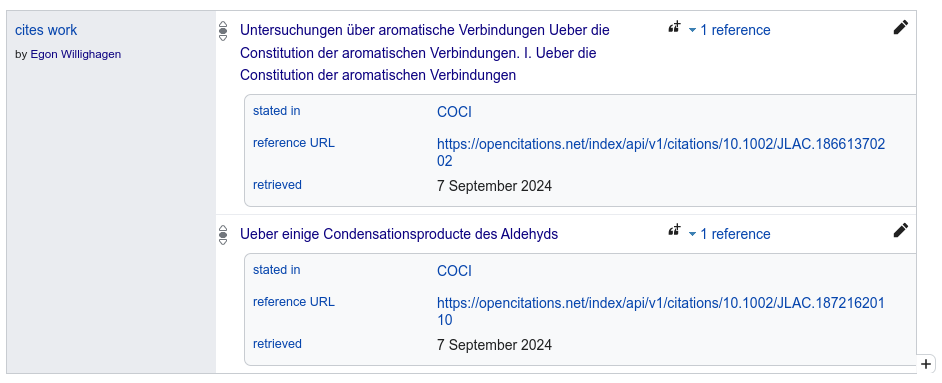
then it create QuickStatements. The result can look like <a href="https://www.wikidata.org/wiki/Q91911528#P2860">this</a>:</p>

<p><img src="/assets/images/opencitationsImport.png" alt="" /></p>

<p>The script also needs a OpenCitation token, which you can <a href="https://opencitations.net/querying">get here</a>.
This is how I run the code from the command line (with the token in the <code class="language-plaintext highlighter-rouge">TOKEN</code> environment variable),
for a single DOI:</p>

<div class="language-shell highlighter-rouge"><div class="highlight"><pre class="highlight"><code>groovy quickstatements.groovy <span class="nt">-t</span> <span class="k">${</span><span class="nv">TOKEN</span><span class="k">}</span> <span class="nt">-d</span> 10.1002/JLAC.18721620110 | <span class="nb">tee </span>output.qs
</code></pre></div></div>

<p>A list of DOIs is provided as a text file, with one DOI on one line. I then use the <code class="language-plaintext highlighter-rouge">-l</code> parameter
(oh, here DOIs of works by <a href="https://en.wikipedia.org/wiki/Shyamala_Gopalan">Shyamala Gopalan</a>, mother of
<a href="https://en.wikipedia.org/wiki/Kamala_Harris">Kamala Harris</a>):</p>

<div class="language-shell highlighter-rouge"><div class="highlight"><pre class="highlight"><code>groovy quickstatements.groovy <span class="nt">-t</span> <span class="k">${</span><span class="nv">TOKEN</span><span class="k">}</span> <span class="nt">-l</span> harris_dois.txt | <span class="nb">tee </span>output.qs
</code></pre></div></div>

<p>But last weekend I created a new feature. To enrich the profiles of authors, for example Nobel Prize
winners, mothers of, or <a href="https://scholia.toolforge.org/author/Q76784">famous</a> <a href="https://scholia.toolforge.org/author/Q80956">chemists</a>,
previously I would create a list of DOIs, now I have the script do that:</p>

<p>So, today I could add the citation network for any arbitraty author, e.g. <a href="https://en.wikipedia.org/wiki/Carolyn_Bertozzi">Carolyn Bertozzi</a>,
I just pass the Wikidata QID:</p>

<div class="language-shell highlighter-rouge"><div class="highlight"><pre class="highlight"><code>groovy quickstatements.groovy <span class="nt">-t</span> <span class="k">${</span><span class="nv">TOKEN</span><span class="k">}</span> <span class="nt">-a</span> Q7442 | <span class="nb">tee </span>output.qs
</code></pre></div></div>

<p>I can imagine that in the future the script will have more such options, to do the same
for many authors at some affiliation, or all DOIs for a certain journal.</p>]]></content><author><name>Egon Willighagen</name></author><category term="wikidata" /><category term="bioclipse" /><category term="opencitations" /><category term="justdoi:10.1002/JLAC.18721620110" /><summary type="html"><![CDATA[Scholarly articles provide context to the factualness of statements in Wikidata, similar to the [citation needed] in Wikipedia. And just like the cited references in each scholarly article itself. The citation network is general seen as an essential part of (doing) science, even without citation intention annotation. Nowadays, citations are mostly open, but this took very serious lobbying by the Initiative for Open Citations and not every publisher reacted immediately. But now that they are open, projects like OpenCitations are making this citation network FAIR.]]></summary><media:thumbnail xmlns:media="http://search.yahoo.com/mrss/" url="https://chem-bla-ics.linkedchemistry.info/assets/images/opencitationsImport.png" /><media:content medium="image" url="https://chem-bla-ics.linkedchemistry.info/assets/images/opencitationsImport.png" xmlns:media="http://search.yahoo.com/mrss/" /></entry><entry><title type="html">new: “CAS Common Chemistry in 2021: Expanding Access to Trusted Chemical Information for the Scientific Community”</title><link href="https://chem-bla-ics.linkedchemistry.info/2022/05/22/new-cas-common-chemistry-in-2021.html" rel="alternate" type="text/html" title="new: “CAS Common Chemistry in 2021: Expanding Access to Trusted Chemical Information for the Scientific Community”" /><published>2022-05-22T00:00:00+00:00</published><updated>2022-05-22T00:00:00+00:00</updated><id>https://chem-bla-ics.linkedchemistry.info/2022/05/22/new-cas-common-chemistry-in-2021</id><content type="html" xml:base="https://chem-bla-ics.linkedchemistry.info/2022/05/22/new-cas-common-chemistry-in-2021.html"><![CDATA[<p>Open Science is happening. The merits are no longer theoretical or idealistic but tangible. Research is faster than ever, more vetted than ever (think PubPeer),
more cited than ever. Fairly, not just because of Open Science, but open access causes readership causes impact causes citations. When new people and
organizations start adopting Open Science this warms my hearth.</p>

<p>So, when I was asked to work with <a href="https://www.cas.org/">Chemical Abstracts Service</a> (CAS) on a new, bigger than ever version of
<a href="https://commonchemistry.cas.org/">Common Chemistry</a> (which started as a project between CAS and Wikipedia), I welcomed the project. I don’t quite
remember the first meetings, but roughly my task became to work with the new content and match this against Wikidata and Wikipedia. It aligned well
with <a href="https://bridgedb.github.io/">BridgeDb</a>, <a href="https://scholia.toolforge.org/">Scholia</a>, and our metabolomics research, so I even could find
sufficient research time for it. This work is now published in the <a href="https://pubs.acs.org/journal/jcisd8">JCIM</a>:
<em>CAS Common Chemistry in 2021: Expanding Access to Trusted Chemical Information for the Scientific Community</em>
(doi:<a href="https://doi.org/10.1021/acs.jcim.2c00268">10.1021/acs.jcim.2c00268</a>).</p>

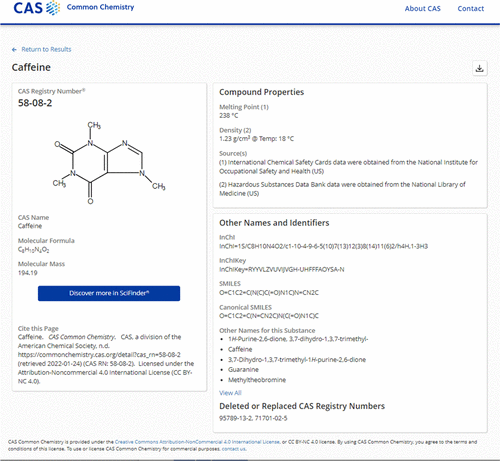
<p><img src="/assets/images/images_medium_ci2c00268_0003.png" alt="" /> <br />
<em>Figure 2 from the article. Detailed record for caffeine in CAS Common Chemistry (image: CC-BY).</em></p>

<p>About Wikidata, the paper writes (CC-BY):</p>

<blockquote>
  <p>The latest release of CAS Common Chemistry has also supported updates and corrections to CAS RNs in Wikidata and Wikipedia. (22)
InChIKeys were calculated from CAS SMILES using Bacting 0.0.31 (23) with the Chemistry Development Kit 2.7.1 (24) and were
matched with content in Wikidata. The CAS RNs were then compared. References to CAS Common Chemistry were added for CAS RNs
that matched. Mismatches have been shared with the Wikidata and Wikipedia communities so that they can manually review and
correct the misleading entries using CAS Common Chemistry as a reference. Because Wikidata also curates identifiers from
other data sources, validated CAS RNs in Wikidata may also be used to cross-reference with other resources. Scripts are
provided in the Supporting Information.</p>
</blockquote>

<p>The alignment is a continuous process, as new chemical compounds get added to Wikidata on a weekly basis. The comparison of
Common Chemistry with Wikidata and Wikipedia resulted in a wealth of curation data, e.g. inconsistent CAS numbers linked to
InChIKeys, where Common Chemistry had a different match than Wikidata or Wikipedia.</p>

<p>CAS registry numbers were not added to Wikidata in this process, only confirmed or reported as different. The latter
allowed manual curation by the community, which it did. Reports <a href="https://www.wikidata.org/wiki/Wikidata_talk:WikiProject_Chemistry/CAS_Validation_Results">look like this</a>.
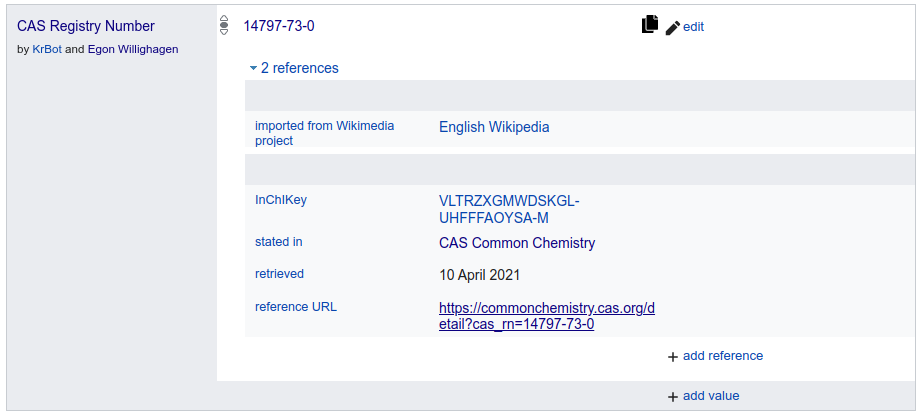
When a InChIKey-CAS RN combination in Wikidata was confirmed, it was recorded as a reference, like this:</p>

<p><img src="/assets/images/Screenshot_20220522_084233.png" alt="" /> <br />
<em>Screenshot of Wikidata with two references, one reflecting a confirmation
by the English Wikipedia (potentially the result of the original Common Chemistry
project) and the second as outcome of the now published project.</em></p>

<p>Thanks to everyone on this project and <a href="https://orcid.org/0000-0001-9316-9400">Andrea Jacobs</a>
particularly for leading this open science project.</p>]]></content><author><name>Egon Willighagen</name></author><category term="curation" /><category term="chemistry" /><category term="cas" /><category term="doi:10.1021/ACS.JCIM.2C00268" /><category term="bioclipse" /><category term="cdk" /><category term="bridgedb" /><summary type="html"><![CDATA[Open Science is happening. The merits are no longer theoretical or idealistic but tangible. Research is faster than ever, more vetted than ever (think PubPeer), more cited than ever. Fairly, not just because of Open Science, but open access causes readership causes impact causes citations. When new people and organizations start adopting Open Science this warms my hearth.]]></summary><media:thumbnail xmlns:media="http://search.yahoo.com/mrss/" url="https://chem-bla-ics.linkedchemistry.info/assets/images/images_medium_ci2c00268_0003.png" /><media:content medium="image" url="https://chem-bla-ics.linkedchemistry.info/assets/images/images_medium_ci2c00268_0003.png" xmlns:media="http://search.yahoo.com/mrss/" /></entry><entry><title type="html">Bioclipse git experiences #2: Create patches for individual plugins/features</title><link href="https://chem-bla-ics.linkedchemistry.info/2020/07/03/bioclipse-git-experiences-2-create.html" rel="alternate" type="text/html" title="Bioclipse git experiences #2: Create patches for individual plugins/features" /><published>2020-07-03T00:00:00+00:00</published><updated>2020-07-03T00:00:00+00:00</updated><id>https://chem-bla-ics.linkedchemistry.info/2020/07/03/bioclipse-git-experiences-2-create</id><content type="html" xml:base="https://chem-bla-ics.linkedchemistry.info/2020/07/03/bioclipse-git-experiences-2-create.html"><![CDATA[<p>This is a series of two posts repeating some content I <a href="https://web.archive.org/web/20180821111520/http://wiki.bioclipse.net/index.php?title=Git_Development">wrote up back in the Bioclipse days</a>
(see also <a href="https://scholia.toolforge.org/topic/Q1769726">this Scholia page</a>). They both deal with something
we were facing: restructuring of version control repositories, while actually keeping the history. For
example, you may want to copy or move code from one repository to another. A second use case can be a file
that must be removed (there are valid reasons for that). Because these posts are based on Bioclipse work,
there will be some specific terminology, but the approach I regularly apply in other situations.</p>

<p>This second post talks about how to migrate code from one repository to another.</p>

<h2 id="create-patches-for-individual-pluginsfeatures">Create patches for individual plugins/features</h2>

<p>While the above works pretty well, a good alternative in situations where you only need to get a
repository-with-history for a few plugins, is to use patch sets.</p>

<p>First, initialize a new git repository, e.g. bioclipse.rdf:</p>

<div class="language-shell highlighter-rouge"><div class="highlight"><pre class="highlight"><code><span class="nb">mkdir </span>bioclipse.rdf
<span class="nb">cd </span>bioclipse.rdf
git init
nano README
git commit <span class="nt">-m</span> <span class="s2">"Added README with some basic info about the new repository"</span> README
</code></pre></div></div>

<p>Then, for each plugin discover you need what the commit was where the plugins was first commited, using the git-svn repository created earlier:</p>

<div class="language-shell highlighter-rouge"><div class="highlight"><pre class="highlight"><code><span class="nb">cd </span>your.gitsvn.checkout
git log <span class="nt">--pretty</span><span class="o">=</span>oneline externals/com.hp.hpl.jena/ | <span class="nb">tail</span> <span class="nt">-1</span>
</code></pre></div></div>

<p>Then create patches for the last tree before that last patch by appending <code class="language-plaintext highlighter-rouge">^1</code> to the commit hash. For example, the first patch of the Jena libraries was 06d0eb0542377f958d06892860ea3363e3316389, so I type:</p>

<div class="language-shell highlighter-rouge"><div class="highlight"><pre class="highlight"><code><span class="nb">rm </span>00<span class="k">*</span>.patch
git format-patch 06d0eb0542377f958d06892860ea3363e3316389^1 <span class="nt">--</span> externals/com.hp.hpl.jena
</code></pre></div></div>

<p>(tune the filter when removing old patches if there are more than 99!)</p>

<p>The previous two steps can be combined into a Perl script:</p>

<div class="language-perl highlighter-rouge"><div class="highlight"><pre class="highlight"><code><span class="c1">#!/usr/bin/perl</span>
<span class="k">use</span> <span class="nv">diagnostics</span><span class="p">;</span>
<span class="k">use</span> <span class="nv">strict</span><span class="p">;</span>

<span class="k">my</span> <span class="nv">$plugin</span> <span class="o">=</span> <span class="nv">$ARGV</span><span class="p">[</span><span class="mi">0</span><span class="p">];</span>

<span class="k">if</span> <span class="p">(</span><span class="o">!</span><span class="nv">$plugin</span><span class="p">)</span> <span class="p">{</span>
  <span class="k">print</span> <span class="p">"</span><span class="s2">Syntax: gfp &lt;plugin|feature&gt;</span><span class="se">\n</span><span class="p">";</span>
  <span class="nb">exit</span><span class="p">(</span><span class="mi">0</span><span class="p">);</span>
<span class="p">}</span>

<span class="nb">die</span> <span class="p">"</span><span class="s2">Cannot find plugin or feature </span><span class="si">$plugin</span><span class="s2"> !</span><span class="p">"</span> <span class="k">if</span> <span class="p">(</span><span class="o">!</span><span class="p">(</span><span class="o">-</span><span class="nv">e</span> <span class="nv">$plugin</span><span class="p">));</span>

<span class="p">`</span><span class="sb">rm -f *.patch</span><span class="p">`;</span>
<span class="k">my</span> <span class="nv">$hash</span> <span class="o">=</span> <span class="p">`</span><span class="sb">git log --follow --pretty=oneline </span><span class="si">$plugin</span><span class="sb"> | tail -1 | cut -d' ' -f1</span><span class="p">`;</span>
<span class="nv">$hash</span> <span class="o">=~</span> <span class="sr">s/\n|\r//g</span><span class="p">;</span>

<span class="k">print</span> <span class="p">"</span><span class="s2">Plugin: </span><span class="si">$plugin</span><span class="s2"> </span><span class="se">\n</span><span class="p">";</span>
<span class="k">print</span> <span class="p">"</span><span class="s2">Hash: </span><span class="si">$hash</span><span class="s2"> </span><span class="se">\n</span><span class="p">";</span>
<span class="p">`</span><span class="sb">git format-patch </span><span class="si">$hash</span><span class="sb">^1 -- </span><span class="si">$plugin</span><span class="p">`;</span>
</code></pre></div></div>

<p>Move these patches into your new repository:</p>

<div class="language-shell highlighter-rouge"><div class="highlight"><pre class="highlight"><code><span class="nb">mv </span>00<span class="k">*</span>.patch ../bioclipse.rdf
</code></pre></div></div>

<p>(tune the filter when moving the patches if there are more than 99! Also customize the target folder name to match your situation)</p>

<p>Apply the new patches in your new git repository:</p>

<div class="language-shell highlighter-rouge"><div class="highlight"><pre class="highlight"><code><span class="nb">cd</span> ../bioclipse.rdf
git am 00<span class="k">*</span>.patch
</code></pre></div></div>

<p>(You’re on your own if that fails… and you may have to default to the other alternative then)</p>

<p>Repeat those two steps for all plugins you want in your new repository</p>]]></content><author><name>Egon Willighagen</name></author><category term="bioclipse" /><category term="git" /><summary type="html"><![CDATA[This is a series of two posts repeating some content I wrote up back in the Bioclipse days (see also this Scholia page). They both deal with something we were facing: restructuring of version control repositories, while actually keeping the history. For example, you may want to copy or move code from one repository to another. A second use case can be a file that must be removed (there are valid reasons for that). Because these posts are based on Bioclipse work, there will be some specific terminology, but the approach I regularly apply in other situations.]]></summary></entry><entry><title type="html">Bioclipse git experiences #1: Strip away unwanted plugins</title><link href="https://chem-bla-ics.linkedchemistry.info/2020/07/02/bioclipse-git-experiences-1-strip-away.html" rel="alternate" type="text/html" title="Bioclipse git experiences #1: Strip away unwanted plugins" /><published>2020-07-02T00:00:00+00:00</published><updated>2020-07-02T00:00:00+00:00</updated><id>https://chem-bla-ics.linkedchemistry.info/2020/07/02/bioclipse-git-experiences-1-strip-away</id><content type="html" xml:base="https://chem-bla-ics.linkedchemistry.info/2020/07/02/bioclipse-git-experiences-1-strip-away.html"><![CDATA[<p>This is a series of two posts repeating some content I <a href="https://web.archive.org/web/20180821111520/http://wiki.bioclipse.net/index.php?title=Git_Development">wrote up back in the Bioclipse days</a>
(see also <a href="https://scholia.toolforge.org/topic/Q1769726">this Scholia page</a>). They both deal with something
we were facing: restructuring of version control repositories, while actually keeping the history. For
example, you may want to copy or move code from one repository to another. A second use case can be a file
that must be removed (there are valid reasons for that). Because these posts are based on Bioclipse work,
there will be some specific terminology, but the approach I regularly apply in other situations.</p>

<p>For this first post, think of a <em>plugin</em> as a subfolder, tho it even applies to files.</p>

<h2 id="strip-away-unwanted-plugins">Strip away unwanted plugins</h2>

<p>In this case, you remove everything you do not want in your new git repository. Do:</p>

<div class="language-shell highlighter-rouge"><div class="highlight"><pre class="highlight"><code>git clone <span class="nt">--bare</span> <span class="nt">--no-hardlinks</span> old.local.clone/ new.local.clone/
</code></pre></div></div>

<p>Then use:</p>

<div class="language-shell highlighter-rouge"><div class="highlight"><pre class="highlight"><code>git filter-branch <span class="nt">--index-filter</span> <span class="s1">'git rm -r -q --cached --ignore-unmatch plugins/net.bioclipse.actionHistory plugins/net.bioclipse.analysis'</span> HEAD
</code></pre></div></div>

<p>It often happens that you need to run the above command several times, in cases when there are many subdirectories to be removed.
When you removed all the bits you need removed, you can clean up the repository and reduce the size considerably with:</p>

<div class="language-shell highlighter-rouge"><div class="highlight"><pre class="highlight"><code> git repack <span class="nt">-ad</span><span class="p">;</span> git prune
</code></pre></div></div>]]></content><author><name>Egon Willighagen</name></author><category term="bioclipse" /><category term="git" /><summary type="html"><![CDATA[This is a series of two posts repeating some content I wrote up back in the Bioclipse days (see also this Scholia page). They both deal with something we were facing: restructuring of version control repositories, while actually keeping the history. For example, you may want to copy or move code from one repository to another. A second use case can be a file that must be removed (there are valid reasons for that). Because these posts are based on Bioclipse work, there will be some specific terminology, but the approach I regularly apply in other situations.]]></summary></entry><entry><title type="html">Adding disclosures to Wikidata with Bioclipse</title><link href="https://chem-bla-ics.linkedchemistry.info/2016/03/20/adding-disclosures-to-wikidata-with.html" rel="alternate" type="text/html" title="Adding disclosures to Wikidata with Bioclipse" /><published>2016-03-20T00:00:00+00:00</published><updated>2016-03-20T00:00:00+00:00</updated><id>https://chem-bla-ics.linkedchemistry.info/2016/03/20/adding-disclosures-to-wikidata-with</id><content type="html" xml:base="https://chem-bla-ics.linkedchemistry.info/2016/03/20/adding-disclosures-to-wikidata-with.html"><![CDATA[<p>Last week the huge, bi-annual ACS meeting took place (<a href="https://twitter.com/search?q=%23ACSSanDiego">#ACSSanDiego</a>),
during which commonly new drug (leads) are disclosed. This time too, like this one tweeted by
<a href="https://twitter.com/beth_halford">Bethany Halford</a>:</p>

<iframe id="twitter-widget-3" scrolling="no" frameborder="0" allowtransparency="true" allowfullscreen="true" class="" title="X Post" src="https://platform.twitter.com/embed/Tweet.html?dnt=false&amp;embedId=twitter-widget-3&amp;features=eyJ0ZndfdGltZWxpbmVfbGlzdCI6eyJidWNrZXQiOltdLCJ2ZXJzaW9uIjpudWxsfSwidGZ3X2ZvbGxvd2VyX2NvdW50X3N1bnNldCI6eyJidWNrZXQiOnRydWUsInZlcnNpb24iOm51bGx9LCJ0ZndfdHdlZXRfZWRpdF9iYWNrZW5kIjp7ImJ1Y2tldCI6Im9uIiwidmVyc2lvbiI6bnVsbH0sInRmd19yZWZzcmNfc2Vzc2lvbiI6eyJidWNrZXQiOiJvbiIsInZlcnNpb24iOm51bGx9LCJ0ZndfZm9zbnJfc29mdF9pbnRlcnZlbnRpb25zX2VuYWJsZWQiOnsiYnVja2V0Ijoib24iLCJ2ZXJzaW9uIjpudWxsfSwidGZ3X21peGVkX21lZGlhXzE1ODk3Ijp7ImJ1Y2tldCI6InRyZWF0bWVudCIsInZlcnNpb24iOm51bGx9LCJ0ZndfZXhwZXJpbWVudHNfY29va2llX2V4cGlyYXRpb24iOnsiYnVja2V0IjoxMjA5NjAwLCJ2ZXJzaW9uIjpudWxsfSwidGZ3X3Nob3dfYmlyZHdhdGNoX3Bpdm90c19lbmFibGVkIjp7ImJ1Y2tldCI6Im9uIiwidmVyc2lvbiI6bnVsbH0sInRmd19kdXBsaWNhdGVfc2NyaWJlc190b19zZXR0aW5ncyI6eyJidWNrZXQiOiJvbiIsInZlcnNpb24iOm51bGx9LCJ0ZndfdXNlX3Byb2ZpbGVfaW1hZ2Vfc2hhcGVfZW5hYmxlZCI6eyJidWNrZXQiOiJvbiIsInZlcnNpb24iOm51bGx9LCJ0ZndfdmlkZW9faGxzX2R5bmFtaWNfbWFuaWZlc3RzXzE1MDgyIjp7ImJ1Y2tldCI6InRydWVfYml0cmF0ZSIsInZlcnNpb24iOm51bGx9LCJ0ZndfbGVnYWN5X3RpbWVsaW5lX3N1bnNldCI6eyJidWNrZXQiOnRydWUsInZlcnNpb24iOm51bGx9LCJ0ZndfdHdlZXRfZWRpdF9mcm9udGVuZCI6eyJidWNrZXQiOiJvbiIsInZlcnNpb24iOm51bGx9fQ%3D%3D&amp;frame=false&amp;hideCard=false&amp;hideThread=false&amp;id=710543705812426752&amp;lang=en&amp;origin=https%3A%2F%2Fchem-bla-ics.blogspot.com%2F2016%2F03%2Fadding-disclosures-to-wikidata-with.html&amp;sessionId=ba8a9ed10d55387ac0f656bfaf73f3a579e1e77a&amp;theme=light&amp;widgetsVersion=2615f7e52b7e0%3A1702314776716&amp;width=550px" style="position: static; visibility: visible; width: 550px; height: 1311px; display: block; flex-grow: 1;" data-tweet-id="710543705812426752"></iframe>
<p><br /></p>

<p>Because getting this information out in the open is important, I think it’s a good idea to add them to
<a href="http://wikidata.org/">Wikidata</a> (see doi:<a href="http://dx.doi.org/10.3897/rio.1.e7573">10.3897/rio.1.e7573</a>).
So, with <a href="http://www.bioclipse.net/">Bioclipse</a> (doi:<a href="http://dx.doi.org/10.1186/1471-2105-8-59">10.1186/1471-2105-8-59</a>)
I redrew the structure:</p>

<p><img src="/assets/images/strucutre.png" alt="" /></p>

<p>I previously blogged about how to <a href="https://chem-bla-ics.linkedchemistry.info/2016/01/27/adding-chemical-compound-to-wikidata.html">add chemicals to Wikidata <i class="fa-solid fa-recycle fa-xs"></i></a>,
but I realized that I wanted to also use Bioclipse to automate this process a bit. So, I wrote this script to generated the SMILES, InChI,
InChIKey, double check the compound is not already in Wikidata (using the <a href="https://query.wikidata.org/">Wikidata SPARQL endpoint</a>),
an look up the <a href="https://pubchem.ncbi.nlm.nih.gov/">PubChem</a> compound identifier (example SMILES).</p>

<div class="language-groovy highlighter-rouge"><div class="highlight"><pre class="highlight"><code><span class="n">smiles</span> <span class="o">=</span> <span class="s2">"CCCC"</span>

<span class="n">mol</span> <span class="o">=</span> <span class="n">cdk</span><span class="o">.</span><span class="na">fromSMILES</span><span class="o">(</span><span class="n">smiles</span><span class="o">)</span>
<span class="n">ui</span><span class="o">.</span><span class="na">open</span><span class="o">(</span><span class="n">mol</span><span class="o">)</span>

<span class="n">inchiObj</span> <span class="o">=</span> <span class="n">inchi</span><span class="o">.</span><span class="na">generate</span><span class="o">(</span><span class="n">mol</span><span class="o">)</span>
<span class="n">inchiShort</span> <span class="o">=</span> <span class="n">inchiObj</span><span class="o">.</span><span class="na">value</span><span class="o">.</span><span class="na">substring</span><span class="o">(</span><span class="mi">6</span><span class="o">)</span>
<span class="n">key</span> <span class="o">=</span> <span class="n">inchiObj</span><span class="o">.</span><span class="na">key</span> <span class="c1">// key = "GDGXJFJBRMKYDL-FYWRMAATSA-N"</span>

<span class="n">sparql</span> <span class="o">=</span> <span class="s2">"""
PREFIX wdt: &lt;http://www.wikidata.org/prop/direct/&gt;
SELECT ?compound WHERE {
  ?compound wdt:P235 "$key" .
}
"""</span>

<span class="k">if</span> <span class="o">(</span><span class="n">bioclipse</span><span class="o">.</span><span class="na">isOnline</span><span class="o">())</span> <span class="o">{</span>
  <span class="n">results</span> <span class="o">=</span> <span class="n">rdf</span><span class="o">.</span><span class="na">sparqlRemote</span><span class="o">(</span>
    <span class="s2">"https://query.wikidata.org/sparql"</span><span class="o">,</span> <span class="n">sparql</span>
  <span class="o">)</span>
  <span class="n">missing</span> <span class="o">=</span> <span class="n">results</span><span class="o">.</span><span class="na">rowCount</span> <span class="o">==</span> <span class="mi">0</span>
<span class="o">}</span> <span class="k">else</span> <span class="o">{</span>
  <span class="n">missing</span> <span class="o">=</span> <span class="kc">true</span>
<span class="o">}</span>

<span class="n">formula</span> <span class="o">=</span> <span class="n">cdk</span><span class="o">.</span><span class="na">molecularFormula</span><span class="o">(</span><span class="n">mol</span><span class="o">)</span>

<span class="c1">// Create the Wikidata QuickStatement,</span>
<span class="c1">// see https://tools.wmflabs.org/wikidata-todo/quick_statements.php</span>

<span class="n">item</span> <span class="o">=</span> <span class="s2">"LAST"</span> <span class="c1">// set to Qxxxx if you need to append info,</span>
              <span class="c1">// e.g. item = "Q22579236"</span>

<span class="n">pubchemLine</span> <span class="o">=</span> <span class="s2">""</span>
<span class="k">if</span> <span class="o">(</span><span class="n">bioclipse</span><span class="o">.</span><span class="na">isOnline</span><span class="o">())</span> <span class="o">{</span>
  <span class="n">pcResults</span> <span class="o">=</span> <span class="n">pubchem</span><span class="o">.</span><span class="na">search</span><span class="o">(</span><span class="n">key</span><span class="o">)</span>
  <span class="k">if</span> <span class="o">(</span><span class="n">pcResults</span><span class="o">.</span><span class="na">size</span> <span class="o">==</span> <span class="mi">1</span><span class="o">)</span> <span class="o">{</span>
    <span class="n">cid</span> <span class="o">=</span> <span class="n">pcResults</span><span class="o">[</span><span class="mi">0</span><span class="o">]</span>
    <span class="n">pubchemLine</span> <span class="o">=</span> <span class="s2">"$item\tP662\t\"$cid\""</span>
  <span class="o">}</span>
<span class="o">}</span>

<span class="k">if</span> <span class="o">(!</span><span class="n">missing</span><span class="o">)</span> <span class="o">{</span>
  <span class="n">println</span> <span class="s2">"===================="</span>
  <span class="n">println</span> <span class="s2">"Already in Wikidata as "</span> <span class="o">+</span> <span class="n">results</span><span class="o">.</span><span class="na">get</span><span class="o">(</span><span class="mi">1</span><span class="o">,</span><span class="s2">"compound"</span><span class="o">)</span>
  <span class="n">println</span> <span class="s2">"===================="</span>
<span class="o">}</span> <span class="k">else</span> <span class="o">{</span>
  <span class="n">statement</span> <span class="o">=</span> <span class="s2">"""
    CREATE
    
    $item\tDen\t\"chemical compound\"
    $item\tP233\t\"$smiles\"
    $item\tP274\t\"$formula\"
    $item\tP234\t\"$inchiShort\"
    $item\tP235\t\"$key\"
    $pubchemLine
  """</span>

  <span class="n">println</span> <span class="s2">"===================="</span>
  <span class="n">println</span> <span class="n">statement</span>
  <span class="n">println</span> <span class="s2">"===================="</span>
<span class="o">}</span>
</code></pre></div></div>

<p>The output of this script is a <a href="https://tools.wmflabs.org/wikidata-todo/quick_statements.php">QuickStatement</a> for
<a href="http://twitter.org/MagnusManske">Magnus Manske</a>’s tool (IMPORTANT: it’s not meant to automate editing Wikidata! I only automate
creating the input, which I carefully check (e.g. checking all stereochemistry is defined)! Note, how Bioclipse opens up the
structure in a viewer with ui.open()), which is a list of commands to create and edit entries in Wikidata. You need to enable
it first, but if you have an account, this is not too hard. Of course, the advantage is that it is a lot quicker. I have similar
script to create QuickStatements starting with only a <a href="https://www.ebi.ac.uk/chembl/">ChEMBL</a> identifier.</p>

<p>The QuickStatement for GDC-0853 looks like:</p>

<div class="language-plaintext highlighter-rouge"><div class="highlight"><pre class="highlight"><code>    CREATE
    
    LAST Den "chemical compound"
    LAST P233 "O=C1C(=CC(=CN1C)c2ccnc(c2CO)N4C(=O)c3cc5c(n3CC4)CC(C)(C)C5)Nc6ncc(cc6)N7CCN(C[C@@H]7C)C8COC8"
    LAST P274 "C37H44N8O4"
    LAST P234 "1S/C37H44N8O4/c1-23-18-42(27-21-49-22-27)9-10-43(23)26-5-6-33(39-17-26)40-30-13-25(19-41(4)35(30)47)28-7-8-38-34(29(28)20-46)45-12-11-44-31(36(45)48)14-24-15-37(2,3)16-32(24)44/h5-8,13-14,17,19,23,27,46H,9-12,15-16,18,20-22H2,1-4H3,(H,39,40)/t23-/m0/s1"
    LAST P235 "WNEODWDFDXWOLU-QHCPKHFHSA-N"
    LAST P662 "86567195"
</code></pre></div></div>

<p>The first line creates a new Wikidata item, while the next ones add information about this compound. GDC-0853 is now also
<a href="https://www.wikidata.org/wiki/Q23304817">Q23304817</a>. The label I added manually afterwards. Note how the Bioclipse script found
the PubChem identifier, using the InChIKey. I also use this approach to add compounds to Wikidata that we have in
<a href="http://wikipathways.org/">WikiPathways</a>.</p>]]></content><author><name>Egon Willighagen</name></author><category term="acs" /><category term="bioclipse" /><category term="chembl" /><category term="inchi" /><category term="pubchem" /><category term="wikidata" /><category term="acssandiego" /><category term="doi:10.1186/1471-2105-8-59" /><category term="doi:10.3897/RIO.1.E7573" /><summary type="html"><![CDATA[Last week the huge, bi-annual ACS meeting took place (#ACSSanDiego), during which commonly new drug (leads) are disclosed. This time too, like this one tweeted by Bethany Halford:]]></summary></entry><entry><title type="html">Adding chemical compounds to Wikidata</title><link href="https://chem-bla-ics.linkedchemistry.info/2016/01/27/adding-chemical-compound-to-wikidata.html" rel="alternate" type="text/html" title="Adding chemical compounds to Wikidata" /><published>2016-01-27T00:00:00+00:00</published><updated>2016-01-27T00:00:00+00:00</updated><id>https://chem-bla-ics.linkedchemistry.info/2016/01/27/adding-chemical-compound-to-wikidata</id><content type="html" xml:base="https://chem-bla-ics.linkedchemistry.info/2016/01/27/adding-chemical-compound-to-wikidata.html"><![CDATA[<p>Adding chemical compounds to <a href="https://www.wikidata.org/">Wikidata</a> is not difficult. You can store the chemical formula
(<a href="https://www.wikidata.org/wiki/Property:P274">P274</a>), (canonical) <a href="http://chem-bla-ics.blogspot.nl/2015/12/the-quality-of-smiles-strings-in.html">SMILES</a>
(<a href="https://www.wikidata.org/wiki/Property:P233">P233</a>), InChIKey (<a href="https://www.wikidata.org/wiki/Property:P235">P235</a>) (and InChI
(<a href="https://www.wikidata.org/wiki/Property:P233">P234</a>), of course), as well various database identifiers (see what I wrote about that
<a href="https://chem-bla-ics.linkedchemistry.info/2015/12/22/new-edition-getting-cas-registry.html">here <i class="fa-solid fa-recycle fa-xs"></i></a>]). It also allows storing of the provenance, and has predicates
for that too.</p>

<p>So, to enter a new structure for a compound, you should enter the compound information to Wikidata. Of course, make sure to create the needed accounts,
particularly one for Wikidata (<a href="https://www.wikidata.org/w/index.php?title=Special:UserLogin&amp;returnto=Wikidata%3AMain+Page&amp;type=signup">create account</a>)
(not sure if the next steps needs a more general Wikimedia account too).</p>

<p><strong>Entering the research paper</strong>: <br />
<a href="https://twitter.com/MagnusManske">Magnus Manske</a> <a href="https://twitter.com/MagnusManske/status/691664308523130880">pointed</a> me to
<a href="http://tools.wmflabs.org/sourcemd/">this helper tool</a>. If you have the DOI of the paper, it is easy to add a new paper. This is what the tool shows
for doi:<a href="http://dx.doi.org/10.1128/AAC.01148-08">10.1128/AAC.01148-08</a> (but no longer when you try!):</p>

<p><img src="/assets/images/smd.png" alt="" /></p>

<p>You need permission to run this script and the tool will alert you about that, and give the instructions how to get permission. After
I clicked the Open in QuickStatements I get this output, showing me an entry in Wikidata was created for this paper:</p>

<p><img src="/assets/images/smd1.png" alt="" /></p>

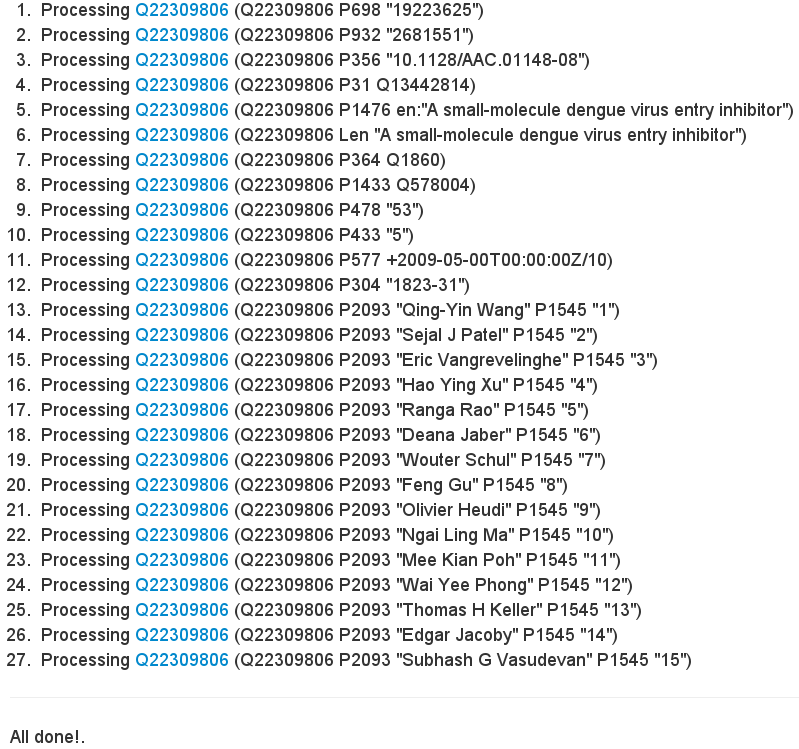
<p>Later, I can use the new Q-code (<a href="https://www.wikidata.org/wiki/Q22309806">Q22309806</a>) to use as source for statements about the compound (formula, etc).</p>

<p><strong>Draw your compound and get an InChIKey</strong>: <br />
The next step is to draw a compound and get an InChIKey. This can be done with many tools, including
<a href="http://bioclipse.net/">Bioclipse</a>. Rajarshi opted for alternatives:</p>

<ul>
<a href="https://twitter.com/collabchem">@collabchem</a> <a href="https://twitter.com/egonwillighagen">@egonwillighagen</a> OSRA or <a href="https://t.co/ZIQdgrYsmr">https://t.co/ZIQdgrYsmr</a>? <br />
— Rajarshi Guha (@rguha) <a href="https://twitter.com/rguha/status/692377715735949313">January 27, 2016</a>
</ul>

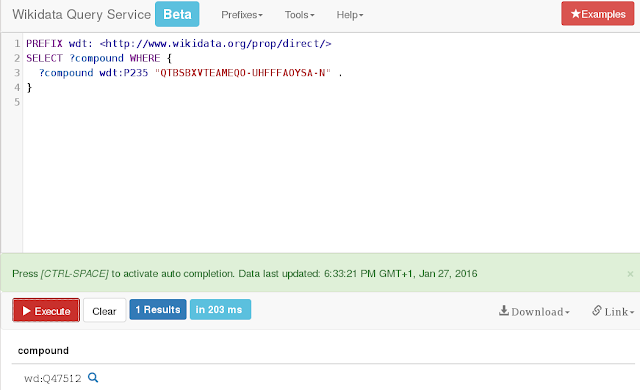
<p>Then check if the compound is not already in Wikidata. You can use this SPARQL query for that using the InChIKey of the compound (it’s for acetic acid, so it will be found):</p>

<p><img src="/assets/images/smd3.png" alt="" /></p>

<p>For convenience, here the copy/pastable SPARQL:</p>

<div class="language-sparql highlighter-rouge"><div class="highlight"><pre class="highlight"><code><span class="k">PREFIX</span><span class="w"> </span><span class="nn">wdt</span><span class="o">:</span><span class="w">
</span><span class="k">SELECT</span><span class="w"> </span><span class="nv">?compound</span><span class="w"> </span><span class="k">WHERE</span><span class="w"> </span><span class="p">{</span><span class="w">
  </span><span class="nv">?compound</span><span class="w"> </span><span class="nn">wdt</span><span class="o">:</span><span class="ss">P235</span><span class="w"> </span><span class="s2">"QTBSBXVTEAMEQO-UHFFFAOYSA-N"</span><span class="w"> </span><span class="p">.</span><span class="w">
</span><span class="p">}</span><span class="w">
</span></code></pre></div></div>

<p><strong>Entering the compound</strong>: <br />
So, the compound is not already in Wikidata, so time to add it. The minimal information you should provide is the following:</p>

<ul>
  <li>mark the new entry as ‘instance of’ (P) ‘chemical compound (Q)</li>
  <li>the chemical formula and SMILES (use as reference the paper)
    <ul>
      <li>add the reference to the paper you entered above</li>
    </ul>
  </li>
  <li>add the InChIKey and/or InChI</li>
</ul>

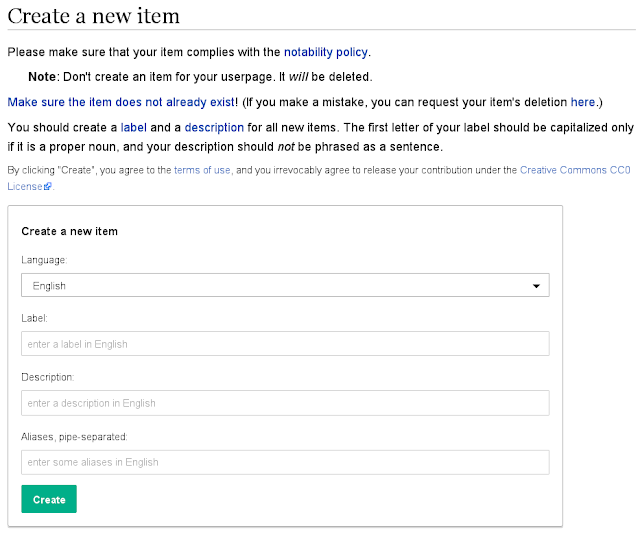
<p>The first step is to create a new Wikidata entry. The Create new item menu in the left side panel can be used, showing a page like this:</p>

<p><img src="/assets/images/smd2.png" alt="" /></p>

<p>As a label you can use the name used in the paper for the compound, even if a code, and as description ‘chemical compound’ will do for now; it can be changed later.</p>

<p>Feel free to add as much information about the compound as you can find. There are some chemically rich entries in Wikidata, such as that for acetic acid
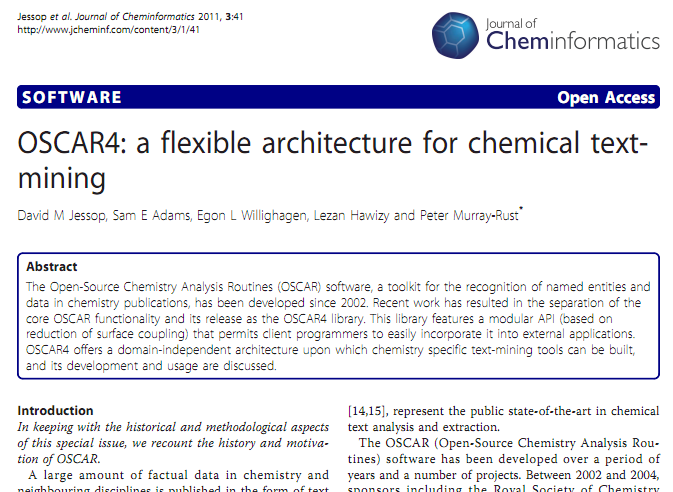
(<a href="https://www.wikidata.org/wiki/Q47512">Q47512</a>).</p>]]></content><author><name>Egon Willighagen</name></author><category term="wikidata" /><category term="chemistry" /><category term="bioclipse" /><category term="justdoi:10.1128/AAC.01148-08" /><summary type="html"><![CDATA[Adding chemical compounds to Wikidata is not difficult. You can store the chemical formula (P274), (canonical) SMILES (P233), InChIKey (P235) (and InChI (P234), of course), as well various database identifiers (see what I wrote about that here ]). It also allows storing of the provenance, and has predicates for that too.]]></summary></entry><entry><title type="html">Oscar4 paper: text mining in Bioclipse (and everywhere else, of course)</title><link href="https://chem-bla-ics.linkedchemistry.info/2011/11/01/oscar4-paper-text-mining-in-bioclipse.html" rel="alternate" type="text/html" title="Oscar4 paper: text mining in Bioclipse (and everywhere else, of course)" /><published>2011-11-01T00:00:00+00:00</published><updated>2011-11-01T00:00:00+00:00</updated><id>https://chem-bla-ics.linkedchemistry.info/2011/11/01/oscar4-paper-text-mining-in-bioclipse</id><content type="html" xml:base="https://chem-bla-ics.linkedchemistry.info/2011/11/01/oscar4-paper-text-mining-in-bioclipse.html"><![CDATA[<p>The <a href="http://www.jcheminf.com/content/3/1/41">Oscar4 paper</a> (CC-BY, just like the screenshots of the paper below) was out already some days now, but the formatting has finished:</p>

<p><img src="/assets/images/oscar4Paper.png" alt="" /></p>

<p>I spotted a rogue <code class="language-plaintext highlighter-rouge">http://</code> in the code example b) in <a href="http://www.jcheminf.com/content/3/1/41#IDAE2JBD">Appendix B</a>:</p>

<p><img src="/assets/images/oscar4Paper2.png" alt="" /></p>

<p>I’ll see what I can do about that, but the API might evolve a bit anyway.</p>

<p>That leaves me to mention that <a href="https://chem-bla-ics.linkedchemistry.info/2011/09/27/almost-year-ago-i-started-position-with.html">Bioclipse has an Oscar extension <i class="fa-solid fa-recycle fa-xs"></i></a>
(<a href="http://www.bioclipse.net/">Bioclipse</a> has a lot of functionality nowadays, in fact),
and that I <a href="https://chem-bla-ics.linkedchemistry.info/2010/12/30/text-mining-chemistry-from-dutch-or.html">blogged several times on Oscar4 <i class="fa-solid fa-recycle fa-xs"></i></a>
when I was working with the other authors on the refactoring last year.</p>]]></content><author><name>Egon Willighagen</name></author><category term="oscar" /><category term="bioclipse" /><category term="myexperiment" /><category term="doi:10.1186/1758-2946-3-41" /><summary type="html"><![CDATA[The Oscar4 paper (CC-BY, just like the screenshots of the paper below) was out already some days now, but the formatting has finished:]]></summary><media:thumbnail xmlns:media="http://search.yahoo.com/mrss/" url="https://chem-bla-ics.linkedchemistry.info/assets/images/oscar4Paper.png" /><media:content medium="image" url="https://chem-bla-ics.linkedchemistry.info/assets/images/oscar4Paper.png" xmlns:media="http://search.yahoo.com/mrss/" /></entry><entry><title type="html">Bioclipse-Oscar4 - Text mining in Bioclipse</title><link href="https://chem-bla-ics.linkedchemistry.info/2011/09/27/almost-year-ago-i-started-position-with.html" rel="alternate" type="text/html" title="Bioclipse-Oscar4 - Text mining in Bioclipse" /><published>2011-09-27T00:00:00+00:00</published><updated>2011-09-27T00:00:00+00:00</updated><id>https://chem-bla-ics.linkedchemistry.info/2011/09/27/almost-year-ago-i-started-position-with</id><content type="html" xml:base="https://chem-bla-ics.linkedchemistry.info/2011/09/27/almost-year-ago-i-started-position-with.html"><![CDATA[<p>Almost a year ago I <a href="https://chem-bla-ics.linkedchemistry.info/2010/10/15/working-on-oscar-for-three-months.html">started a position <i class="fa-solid fa-recycle fa-xs"></i></a>
with <a href="http://blogs.ch.cam.ac.uk/pmr/">Peter Murray-Rust</a> to work on Oscar for three months (see this overview of results;
a paper by the full Oscar team (Sam, David, Dan, Lezan) is pending, and I’m really happy to have been able to contribute
bits to the project). Since then, I have had little time :( That’s how it goes, with post-hopping, unfortunately.
One thing I did do after that, was write a <a href="https://github.com/bioclipse/bioclipse.oscar">Bioclipse plugin</a>.</p>

<p>I was asked recently via <a href="http://www.linkedin.com/in/egonw">LinkedIn</a> if I was planning a Bioclipse-Oscar plugin, and
I realized that I forgot to blog about it. So, here goes. The <code class="language-plaintext highlighter-rouge">oscar</code> manager I implemented follows the
<a href="https://chem-bla-ics.linkedchemistry.info/2010/10/28/oscar4-java-api-chemical-name.html">Oscar API <i class="fa-solid fa-recycle fa-xs"></i></a>, and these
methods are available: <code class="language-plaintext highlighter-rouge">extractText()</code>, <code class="language-plaintext highlighter-rouge">findNamedEntities()</code>,  <code class="language-plaintext highlighter-rouge">findResolvedNamedEntities()</code>.</p>

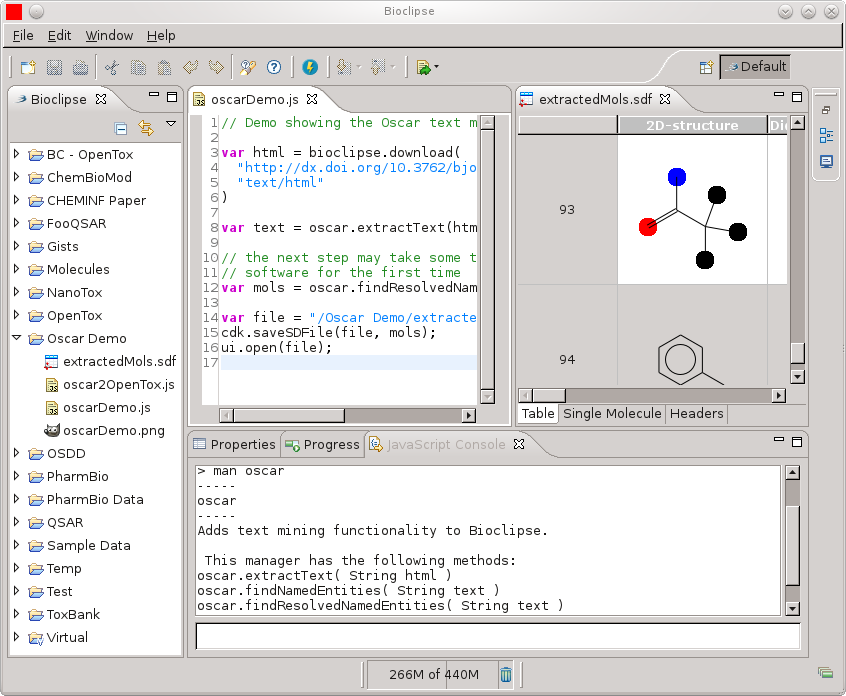
<p>When I wrote the plugin, I also uploaded an <a href="http://www.myexperiment.org/workflows/2117.html">example workflow to MyExperiment</a>.
The code is:</p>

<div class="language-javascript highlighter-rouge"><div class="highlight"><pre class="highlight"><code><span class="c1">// Demo showing the Oscar text mining functionality</span>
<span class="c1">// in Bioclipse</span>
<span class="kd">var</span> <span class="nx">html</span> <span class="o">=</span> <span class="nx">bioclipse</span><span class="p">.</span><span class="nf">download</span><span class="p">(</span>
  <span class="dl">"</span><span class="s2">http://dx.doi.org/10.3762/bjoc.6.133</span><span class="dl">"</span><span class="p">,</span>
  <span class="dl">"</span><span class="s2">text/html</span><span class="dl">"</span>
<span class="p">)</span>
<span class="kd">var</span> <span class="nx">text</span> <span class="o">=</span> <span class="nx">oscar</span><span class="p">.</span><span class="nf">extractText</span><span class="p">(</span><span class="nx">html</span><span class="p">);</span>
<span class="c1">// the next step may take some time, while</span>
<span class="c1">// initializing the Oscar software for the</span>
<span class="c1">// first time</span>
<span class="kd">var</span> <span class="nx">mols</span> <span class="o">=</span> <span class="nx">oscar</span><span class="p">.</span><span class="nf">findResolvedNamedEntities</span><span class="p">(</span><span class="nx">text</span><span class="p">);</span>
<span class="kd">var</span> <span class="nx">file</span> <span class="o">=</span> <span class="dl">"</span><span class="s2">/Oscar Demo/extractedMols.sdf</span><span class="dl">"</span><span class="p">;</span>
<span class="nx">cdk</span><span class="p">.</span><span class="nf">saveSDFile</span><span class="p">(</span><span class="nx">file</span><span class="p">,</span> <span class="nx">mols</span><span class="p">);</span>
<span class="nx">ui</span><span class="p">.</span><span class="nf">open</span><span class="p">(</span><span class="nx">file</span><span class="p">);</span>
</code></pre></div></div>

<p>The code will extract chemical entities, and open a molecules table in <a href="http://www.bioclipse.net/">Bioclipse</a>:</p>

<p><img src="/assets/images/oscarDemo2.png" alt="" /></p>]]></content><author><name>Egon Willighagen</name></author><category term="oscar" /><category term="bioclipse" /><category term="beilstein" /><summary type="html"><![CDATA[Almost a year ago I started a position with Peter Murray-Rust to work on Oscar for three months (see this overview of results; a paper by the full Oscar team (Sam, David, Dan, Lezan) is pending, and I’m really happy to have been able to contribute bits to the project). Since then, I have had little time :( That’s how it goes, with post-hopping, unfortunately. One thing I did do after that, was write a Bioclipse plugin.]]></summary><media:thumbnail xmlns:media="http://search.yahoo.com/mrss/" url="https://chem-bla-ics.linkedchemistry.info/assets/images/oscarDemo2.png" /><media:content medium="image" url="https://chem-bla-ics.linkedchemistry.info/assets/images/oscarDemo2.png" xmlns:media="http://search.yahoo.com/mrss/" /></entry><entry><title type="html">Bioclipse-CDK-ChEMBL-SPARQL-Chemometrics mashup paper published</title><link href="https://chem-bla-ics.linkedchemistry.info/2011/03/07/bioclipse-cdk-chembl-sparql.html" rel="alternate" type="text/html" title="Bioclipse-CDK-ChEMBL-SPARQL-Chemometrics mashup paper published" /><published>2011-03-07T00:00:00+00:00</published><updated>2011-03-07T00:00:00+00:00</updated><id>https://chem-bla-ics.linkedchemistry.info/2011/03/07/bioclipse-cdk-chembl-sparql</id><content type="html" xml:base="https://chem-bla-ics.linkedchemistry.info/2011/03/07/bioclipse-cdk-chembl-sparql.html"><![CDATA[<p>Our (peer-reviewed) <a href="http://www.bioclipse.net/">Bioclipse</a>-<a href="http://cdk.sf.net/">CDK</a>-SPARQL-Chemometrics
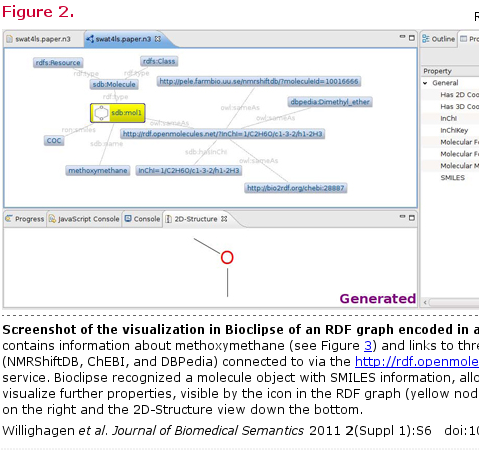
mashup paper was just published online (doi:<span class="Apple-style-span" style="font-family: Verdana, Geneva, Arial, Helvetica, sans-serif; font-size: 11px; line-height: 14px;"><a href="http://dx.doi.org/10.1186/2041-1480-2-S1-S6">10.1186/2041-1480-2-S1-S6</a></span>)
as part of the <a href="http://www.swat4ls.org/2009/">SWAT4LS 2009</a> <a href="http://www.jbiomedsem.com/supplements/2/S1">supplement</a>,
where we use the CC-SA-BY-licensed <a href="https://www.ebi.ac.uk/chembldb/">ChEMBL database</a>
as example data source, based on a <a href="https://chem-bla-ics.linkedchemistry.info/2009/11/21/swat4ls-linking-open-drug-data-to.html">presentation I gave <i class="fa-solid fa-recycle fa-xs"></i></a>
in Amsterdam back then.</p>

<p><img src="/assets/images/jbiomedPaper.png" alt="" /></p>

<p>This is a Figure from our paper, but the other papers are very interesting too,
and are worth checking out!</p>]]></content><author><name>Egon Willighagen</name></author><category term="bioclipse" /><category term="cdk" /><category term="chembl" /><category term="rdf" /><category term="semweb" /><category term="sparql" /><category term="doi:10.1186/2041-1480-2-S1-S6" /><summary type="html"><![CDATA[Our (peer-reviewed) Bioclipse-CDK-SPARQL-Chemometrics mashup paper was just published online (doi:10.1186/2041-1480-2-S1-S6) as part of the SWAT4LS 2009 supplement, where we use the CC-SA-BY-licensed ChEMBL database as example data source, based on a presentation I gave in Amsterdam back then.]]></summary><media:thumbnail xmlns:media="http://search.yahoo.com/mrss/" url="https://chem-bla-ics.linkedchemistry.info/assets/images/jbiomedPaper.png" /><media:content medium="image" url="https://chem-bla-ics.linkedchemistry.info/assets/images/jbiomedPaper.png" xmlns:media="http://search.yahoo.com/mrss/" /></entry><entry><title type="html">OPSIN used for a Bioclipse wizard</title><link href="https://chem-bla-ics.linkedchemistry.info/2011/02/17/opsin-used-for-bioclipse-wizard.html" rel="alternate" type="text/html" title="OPSIN used for a Bioclipse wizard" /><published>2011-02-17T00:10:00+00:00</published><updated>2011-02-17T00:10:00+00:00</updated><id>https://chem-bla-ics.linkedchemistry.info/2011/02/17/opsin-used-for-bioclipse-wizard</id><content type="html" xml:base="https://chem-bla-ics.linkedchemistry.info/2011/02/17/opsin-used-for-bioclipse-wizard.html"><![CDATA[<p> </p>

<p><img src="/assets/images/bioclipseOPSIN.png" alt="" /></p>

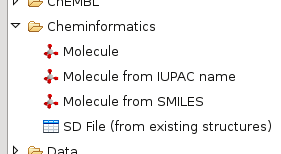
<p>Somewhere in January I added a new <em>New Wizard</em> to <a href="http://www.bioclipse.net/">Bioclipse</a>
for <a href="https://www.ebi.ac.uk/opsin/">OPSIN <i class="fa-solid fa-recycle fa-xs"></i></a>, but forgot to blog about that earlier,
which will be available in Bioclipse 2.6 later this year (or just the <a href="http://chem-bla-ics.blogspot.com/2011/02/things-are-looking-blue-for-bioclipse.html">hudson
build service</a>).</p>]]></content><author><name>Egon Willighagen</name></author><category term="bioclipse" /><category term="iupac" /><category term="opsin" /><summary type="html"><![CDATA[ ]]></summary><media:thumbnail xmlns:media="http://search.yahoo.com/mrss/" url="https://chem-bla-ics.linkedchemistry.info/assets/images/bioclipseOPSIN.png" /><media:content medium="image" url="https://chem-bla-ics.linkedchemistry.info/assets/images/bioclipseOPSIN.png" xmlns:media="http://search.yahoo.com/mrss/" /></entry></feed>